
宝信软件

Search documents
中国工业软件行业发展研究报告
艾瑞咨询· 2026-02-12 00:08
Core Insights - The industrial software industry is at a critical juncture, driven by the need for innovation and the urgency of development, particularly in the context of China's economic transformation and the push for self-sufficiency in core technologies [1][4][17] - The market for industrial software in China is projected to approach 300 billion yuan by 2024, indicating robust growth despite challenges such as a hollowing out of core technologies and imbalanced industrial structures [1][17] - The evolution of industrial software is characterized by a shift from tools to systems, platforms, and eventually to a genetic level, focusing on data value and efficiency [2][48] Industry Dynamics - The industrial software market is large, with significant opportunities for companies to target different customer segments: head clients with strong demand for domestic alternatives, mid-tier clients forming communities, and long-tail clients expanding revenue potential [2][50] - The development of industrial software is influenced by policy support, technological advancements, and market demand, with a notable shift towards integrating AI and data-driven solutions [9][12][14] Product Evolution - Current industrial software primarily involves purchasing products, but the future will see a transition towards selling "intelligence," exemplified by the emergence of industrial intelligent agents [3][52] - The focus on data accumulation and utilization will drive the transformation of industrial software into platforms that offer integrated solutions and services [48][52] Challenges and Opportunities - The industry faces significant challenges, particularly in the R&D design sector, where a lack of foundational technologies and real-world testing scenarios hampers progress [17][23][26] - Companies must navigate a complex landscape of technical, ecological, and commercial challenges, with a systemic approach required to overcome these hurdles [26][39] Market Characteristics - The industrial software market is characterized by a high degree of specialization, with significant barriers to entry and a focus on high-value data services [20][30] - The market is currently experiencing a shift towards platformization and the integration of AI, which is expected to enhance operational efficiency and drive innovation [48][52] Future Directions - The next phase of industrial software development will emphasize platformization and the internalization of industrial knowledge into code, leading to the creation of digital engineers capable of autonomous task execution [48][52] - Companies are encouraged to leverage policy advantages and technological breakthroughs to enhance their competitive positioning in the market [50][52]


【热点赛道速递】AIDC估值逻辑为啥变了?
和讯· 2026-02-11 10:51
Core Viewpoint - The data center industry is undergoing a profound restructuring driven by advancements in artificial intelligence technology and the ongoing national computing power strategy, shifting from a "real estate logic" centered on cabinet rental to a "computing power logic" focused on computing power delivery [1][4][5]. Group 1: Industry Reconstruction - The underlying logic of the industry is fundamentally changing, with data centers evolving from traditional Internet Data Centers (IDCs) to AI Data Centers (AIDCs), which are fundamentally different entities [1][18]. - AIDCs focus on high-density GPU computing clusters rather than cabinet quantity and rack rate, necessitating systemic upgrades in power supply, cooling technology, and network architecture [1][3]. - The demand for computing power is becoming the core engine driving industry growth, with China's intelligent computing power expected to reach approximately 10,373 EFLOPS by 2025, growing at a rate significantly higher than traditional cloud computing [1][22][26]. Group 2: Key Factors - Electricity is defined as the "first principle" of data centers, with grid access capacity becoming the decisive factor for new projects due to long expansion cycles and complex approvals [2][33]. - Liquid cooling technology has transitioned from an optional choice to a necessity, with its penetration rate in new AIDC projects expected to increase significantly, while older air-cooled data centers face accelerated asset depreciation [2][37]. - The demand for low-latency networks driven by AI inference is reshaping the value of data center locations, with high-grade data centers in major cities like Beijing, Shanghai, and Shenzhen maintaining premium pricing [2][43]. Group 3: Industry Chain Analysis - The AI wave is driving a collaborative evolution across the upstream hardware, midstream operations, and downstream applications, with high technical barriers and significant demand elasticity in the upstream segment [3][48]. - The future winners in the industry will be "computing power service providers" that efficiently convert underlying computing power into customer business value, shifting profit functions from "cabinet quantity × rental rate" to "deliverable computing power × energy efficiency × service added value" [3][74]. - Key considerations for evaluating data center projects and companies include real electricity access capability, liquid cooling deployment conditions, service focus on training or inference scenarios, and whether the business model is cabinet rental or computing power sales [3][81]. Group 4: Market Scale and Growth - The transition from IDC to AIDC is reshaping the growth curve of computing power demand, with AI computing power expected to grow at an annual rate of 50% [16][20]. - By 2028, China's intelligent computing power is projected to achieve approximately 168% growth from 2025 levels, indicating new development opportunities for data centers [22][26]. - The demand structure is shifting from primarily training to real-time inference scenarios, which is reshaping the spatial distribution and profitability models of data centers [1][26].

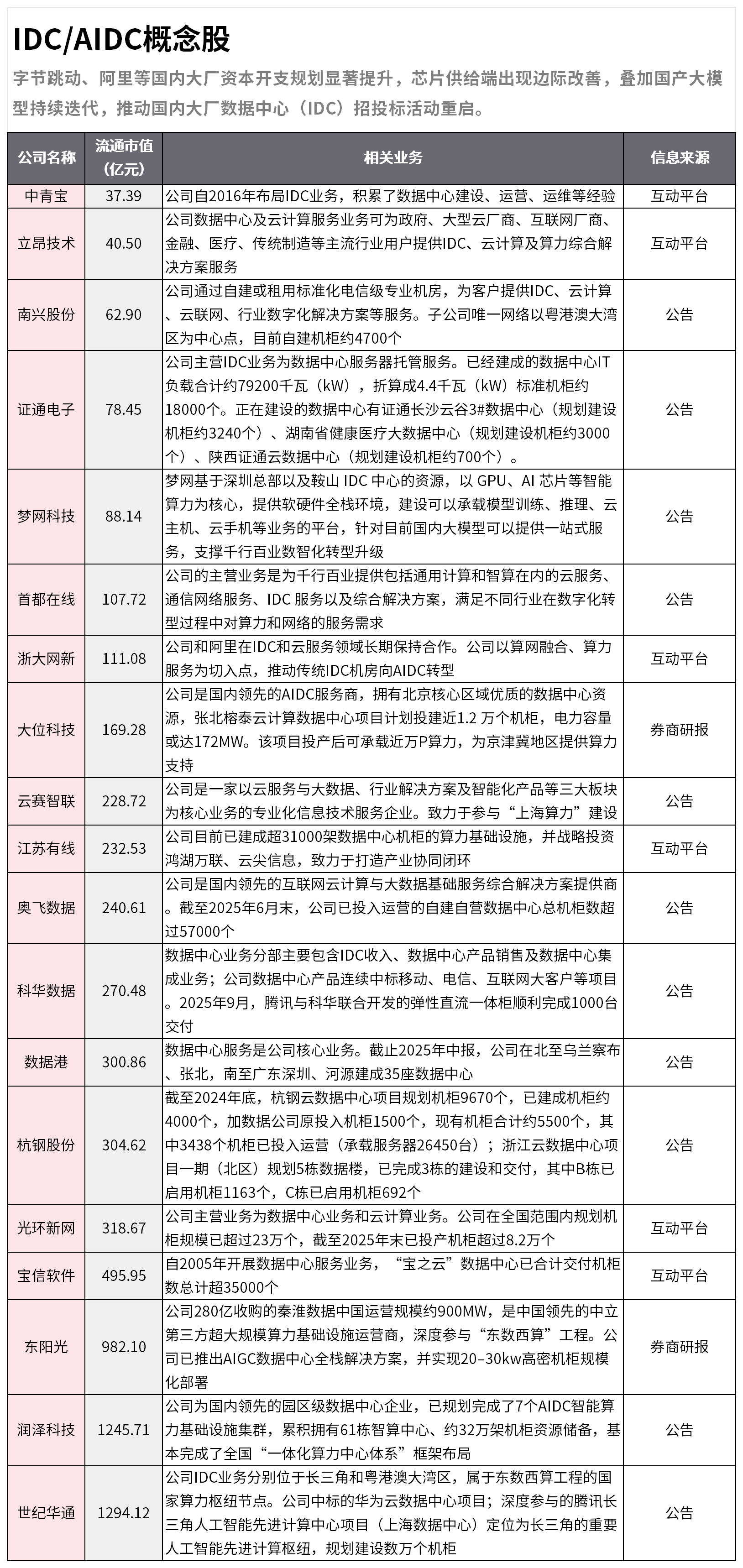
一图了解IDC/AIDC概念股
Xuan Gu Bao· 2026-02-11 02:49
Group 1 - Major domestic companies like ByteDance and Alibaba have significantly increased their capital expenditure plans, leading to a restart of bidding activities for data centers (IDC) in China [1] - The supply side of chips continues to iterate, further driving the demand for data center services [1] Group 2 - Zhongqingbao has a market capitalization of 3.739 billion yuan and has been involved in IDC business since 2016, providing services to government and large cloud providers [2] - Lianang Technology has a market capitalization of 4.050 billion yuan, offering IDC and cloud solutions to mainstream industries such as finance and healthcare [2] - Nanxing Co., with a market capitalization of 6.290 billion yuan, provides standardized telecom-grade professional computer rooms and has approximately 4,700 self-built cabinets [2] - Zhengtong Electronics, with a market capitalization of 7.845 billion yuan, focuses on IDC services and has a total load of about 79,200 kW, with ongoing construction of several data centers [2] - Mengwang Technology, with a market capitalization of 8.814 billion yuan, provides a full-stack environment based on GPU computing power, supporting digital transformation across various industries [2] - Capital Online, with a market capitalization of 10.772 billion yuan, offers comprehensive solutions including IDC services to meet diverse computing and network service needs [2] - Zhejiang University Network New, with a market capitalization of 11.108 billion yuan, collaborates with Alibaba in IDC and cloud services, promoting the transformation of traditional IDC into AIDC [2] Group 3 - Dazhi Technology has a market capitalization of 16.928 billion yuan and plans to support nearly 100 P of computing power with its new project [3] - Yunsai Zhili, with a market capitalization of 22.872 billion yuan, focuses on cloud services and big data solutions [3] - Jiangsu Cable has built over 31,000 data center cabinets, aiming to create an industrial collaboration closed loop [3] - Aofei Data, with a market capitalization of 24.061 billion yuan, has over 57,000 self-built data center cabinets operational as of June 2025 [3] - Kehua Data, with a market capitalization of 27.048 billion yuan, has won multiple bids for data center products and services [3] - Data Port, with a market capitalization of 30.086 billion yuan, has established 35 data centers across various regions [3] - Hangang Co., with a market capitalization of 30.462 billion yuan, has a data center project planning for 96,701 cabinets [3] - Guanghuan Xinnet, with a market capitalization of 31.867 billion yuan, has over 230,000 cabinets and has launched various data center services [3] - Baoxin Software, with a market capitalization of 49.595 billion yuan, has over 35,000 data center cabinets in operation [3] - Dongyangguang, with a market capitalization of 98.210 billion yuan, has acquired a large-scale data center operation and launched AIGC solutions [3] - Runze Technology, with a market capitalization of 124.571 billion yuan, is a leading park-level data center enterprise with extensive infrastructure [3] Group 4 - Shiji Huatuo, with a market capitalization of 129.412 billion yuan, has IDC operations in key economic regions and has won bids for major data center projects [4]
宝信软件:现金分红是回报投资者的重要方式
Zheng Quan Ri Bao Wang· 2026-02-10 14:13
Group 1 - The core viewpoint of the article is that Baoxin Software (600845) emphasizes the importance of cash dividends as a way to return value to investors and will continue to uphold this practice [1]

宝信软件:公司上下强化危机意识,形成聚焦向外开拓市场的激情
Zheng Quan Ri Bao Wang· 2026-02-10 13:46
Core Viewpoint - Baoxin Software (600845) is enhancing its crisis awareness and focusing on expanding its market presence while improving internal rankings to secure quality new contracts [1] Group 1: Market Strategy - The company is actively working to strengthen its marketing network within the steel industry and is also diversifying its client base by targeting non-steel industries [1] - Management is leading efforts to engage with the market and visit sites to better understand customer needs and opportunities [1] Group 2: Competitive Positioning - Baoxin Software is closely monitoring peer companies of similar scale to identify gaps and areas for improvement [1] - The company aims to capture high-quality clients and break into key customer segments [1]
宝信软件:公司不存在执行中的董事、高管减持计划
Zheng Quan Ri Bao· 2026-02-10 13:12
Group 1 - The company stated that measures for market value management can be found in the "Guidelines for the Supervision of Listed Companies No. 10 - Market Value Management" issued by the China Securities Regulatory Commission [2] - As of now, the company has no ongoing plans for share reduction by directors or senior executives [2]
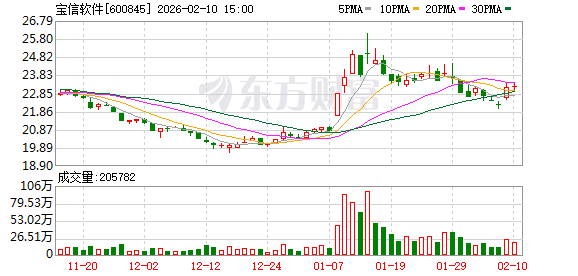
宝信软件:2025年度存货及应收账款等信息详见预约2026年3月31日披露的《2025年度报告》
Zheng Quan Ri Bao· 2026-02-10 13:11
Core Viewpoint - Baoxin Software announced on its interactive platform that details regarding inventory and accounts receivable for the fiscal year 2025 will be disclosed in the annual report scheduled for March 31, 2026 [2] Group 1 - Baoxin Software will provide information on inventory and accounts receivable in the 2025 annual report [2]
宝信软件:公司预约于2026年3月31日披露《2025年度报告》
Mei Ri Jing Ji Xin Wen· 2026-02-10 08:39
Group 1 - The company Baoxin Software (600845.SH) announced on February 10 that detailed information regarding its operational performance for the fiscal year 2025 will be disclosed in the "2025 Annual Report," scheduled for release on March 31, 2026 [2]
未知机构:申万宏源通信多模态需求春节应用推广看好算力底座IDC成长202602-20260210
未知机构· 2026-02-10 01:50
【申万宏源通信】多模态需求+春节应用推广,看好算力底座/IDC成长(20260210早) #字节多模态Seedance2.0加码算力需求。 Seedance2.0在分镜运镜、音画同步、多镜头叙事能力等方面进步显著;一旦多模态渗透率提升,对tokens和算力底 座需求量将指数级增长。 年底年初字节、阿里等招投标进展,初步推动IDC估值修复。 但中长期真正打开 【申万宏源通信】多模态需求+春节应用推广,看好算力底座/IDC成长(20260210早) #字节多模态Seedance2.0加码算力需求。 Seedance2.0在分镜运镜、音画同步、多镜头叙事能力等方面进步显著;一旦多模态渗透率提升,对tokens和算力底 座需求量将指数级增长。 腾讯链: 年底年初字节、阿里等招投标进展,初步推动IDC估值修复。 但中长期真正打开智算中心需求的,是云厂应用/agent/多模态的商业化进展。 伴随CSP春节期间持续营销投流打开泛化AI入口,IDC作为算力底座真实需求将显著提升,预计行业持续高景气。 #从选股的角度,字节、阿里、腾讯等后续有望轮动表现。 看好绑定云厂的核心IDC。 字节链(优先推荐): #东阳光(字节核心、远 ...

计算机行业“一周解码”:脑机“上天”,量子“过百”
Bank of China Securities· 2026-02-09 07:03
Investment Rating - The industry investment rating is "Outperform the Market," indicating that the industry index is expected to perform better than the benchmark index over the next 6-12 months [33]. Core Insights - Significant breakthroughs in brain-computer interface and quantum communication technologies are expected to accelerate the development of related industrial chains, with a focus on companies such as Jiayuan Technology, iFlytek, Wanda Information, Anheng Information, and Guodun Quantum [4][2]. - The first brain-controlled acupuncture rehabilitation equipment has been successfully implemented, marking a substantial advancement in the medical application of brain-computer interfaces [2][13]. - Shanghai has identified brain-computer interfaces and semiconductors as key future industries, providing strong policy support for their development [15][16]. - The University of Science and Technology of China has achieved major breakthroughs in quantum networking, paving the way for practical quantum communication [17][19]. - Waymo has completed a significant financing round of $16 billion, indicating a new phase of development in the autonomous driving industry [20][21]. Summary by Sections Brain-Computer Interface - The first brain-controlled acupuncture rehabilitation platform, "Shengong-Hua Tuo," has been launched, integrating advanced brain-computer interface technology with traditional acupuncture for personalized treatment [13][14]. - This technology has been validated through space experiments, enhancing its reliability and potential for widespread clinical application [14]. Quantum Communication - The University of Science and Technology of China has made two critical advancements in quantum networking, addressing long-standing challenges in the field and significantly extending the distance for quantum key distribution [17][19]. - These breakthroughs position China as a leader in quantum communication, with implications for national security and information protection [19]. Autonomous Driving - Waymo's recent financing of $16 billion has raised its post-money valuation to $126 billion, reflecting strong growth in its business operations [20]. - The company plans to expand its services to over 20 cities globally, indicating a shift from technology validation to large-scale commercial operations in the autonomous driving sector [21].