Epic Games

Search documents
Enthusiast Gaming Hosts Largest Ever Edition of Pocket Gamer Connects London
TMX Newsfile· 2026-01-26 12:00
Core Insights - Enthusiast Gaming Holdings Inc. hosted its largest Pocket Gamer Connects event in London, attracting over 3,000 attendees from 60 countries, marking a significant milestone for the company and the gaming industry [1][2][6] - The event showcased the growing relevance of Pocket Gamer Connects within the global games industry, with participation from notable brands and partners such as Supercell, Epic Games, and CD Projekt Red [3][4] Company Overview - Enthusiast Gaming focuses on building tools, platforms, and experiences for gamers, generating revenue through programmatic advertising, subscriptions, and events [5] - The company operates a portfolio of digital properties, including Pocket Gamer, U.GG, and Icy-Veins, and aims to expand its owned IP while deepening audience engagement [5] Event Highlights - Pocket Gamer Connects London 2026 featured 310 speakers across 27+ content tracks, covering various gaming formats and industry trends [6] - The event included initiatives like the Aurora: Celebrating Women in Games, promoting diversity and mentorship within the industry [6] - Upcoming flagship events include Pocket Gamer Connects Summit in San Francisco on March 9, Dubai GameExpo Summit on May 21-22, and Pocket Gamer Connects Barcelona on June 15-16 [3]


马斯克向OpenAI微软索赔千亿美元,奥特曼回怼/韩国「自研AI」被抓包用中国模型代码/机器人将再登春晚|Hunt Good 周报
Sou Hu Cai Jing· 2026-01-18 07:04
Group 1 - South Korea's initiative to develop a fully domestic AI model has faced controversy as three out of five finalists were found to have used foreign open-source code, including from China [1][3] - Upstage admitted to using elements from a Chinese open-source model, while other competitors like Naver and SK Telecom also acknowledged similarities with foreign technologies but claimed their core engines were independently developed [3][4] - The competition rules did not explicitly prohibit the use of foreign open-source code, raising questions about the integrity of the initiative [3] Group 2 - OpenAI has reportedly chosen to forgo a partnership with Apple to focus on developing its own AI hardware, which has implications for Apple's recent collaboration with Google [4][7] - The deal between Apple and Google could be worth tens of billions, with estimates suggesting it may add up to $5 billion in value for Google [4] - OpenAI's hardware ambitions may have influenced Apple's decision to partner with Google, as the latter has narrowed the gap with OpenAI in model capabilities [7] Group 3 - Elon Musk is suing OpenAI and Microsoft for damages ranging from $79 billion to $134 billion, claiming that OpenAI has deviated from its non-profit mission [8][10] - Musk's claims are based on an analysis suggesting he is entitled to a significant share of OpenAI's current valuation due to his initial investment of $38 million [8][10] - OpenAI has dismissed Musk's lawsuit as a form of harassment rather than a legitimate economic claim [11] Group 4 - Meta has announced significant layoffs, cutting approximately 1,500 jobs from its Reality Labs division and closing three VR game studios, indicating a shift in focus from the metaverse to AI wearable devices [16][18] - The Reality Labs division has incurred over $70 billion in losses since early 2021, prompting a budget reduction and a pivot towards mobile devices and AI glasses [18] - Meta's collaboration with EssilorLuxottica on Ray-Ban AI smart glasses has exceeded expectations, with plans to double production capacity by the end of the year [18] Group 5 - AI-native startups have seen their annualized revenue double in just seven months, reaching over $30 billion, although OpenAI and Anthropic dominate the market, capturing nearly 85% of the revenue [19][22] - Despite the revenue growth, many AI startups are burning over $20 billion annually, raising concerns about their long-term viability [19][23] - Some successful applications, like Suno and Cognition, have surpassed $1 billion in annualized revenue, but they face increasing competition from model providers like OpenAI and Anthropic [22][23] Group 6 - Neuralink's first human subject reported that the brain chip can be updated wirelessly, marking a significant advancement in brain-computer interface technology [25][26] - The device can evolve through cloud updates, enhancing performance without the need for surgical intervention, and may allow for dual-chip implantation in the future [26] - Approximately 20 patients have undergone the brain-machine surgery, with a significant number waiting for the procedure [26] Group 7 - Zhizhu's GLM-Image model has topped the Hugging Face Trending chart, marking a breakthrough for domestically developed AI models trained entirely on Chinese chips [27] - The model showcases the feasibility of training state-of-the-art models using domestic computing power and has demonstrated superior performance in specific tasks [27] - GLM-Image is now available for public use on various platforms, highlighting advancements in China's AI capabilities [27][28]






Not walkthroughs, nor cheat codes: Ghost Player AI hints at a future where PlayStation games play themselves
The Economic Times· 2026-01-09 14:22
Core Concept - Sony is developing a system called "Ghost Player," which allows an AI agent to take over gameplay when a player is stuck, potentially changing the role of human players in gaming [1][8]. AI Modes - The patent outlines two operational modes: "Guide Mode," where the AI shows the player how to proceed, and "Complete Mode," where the AI takes full control and plays the game on behalf of the player [2][8]. Shift in Gaming Experience - This proposal shifts the traditional gaming experience by allowing AI to eliminate the struggle associated with gameplay, which has historically involved learning through repeated failures [3][8]. Existing Features and Criticism - The concept builds on existing accessibility features in modern games, such as difficulty adjustments and in-game tips, but critics argue that the AI's role would transition from advising to acting [4][8]. Industry Trends - Sony is not the only company exploring AI in gaming; Microsoft has introduced Copilot for Gaming, which provides coaching but does not control gameplay directly. This indicates a broader industry trend towards integrating AI into gaming experiences [5][8]. Divisive Opinions - The use of AI in gaming has sparked controversy, with many players opposing its application in creative tasks. Despite this, industry leaders, including Epic Games CEO Tim Sweeney, express optimism about AI's future role in game production [6][8]. Future Concerns - The introduction of AI that plays games instead of players raises concerns about player agency and engagement, with predictions that AI could become increasingly intrusive in gaming experiences by 2026 [7][8]. Current Status - As of now, Sony's Ghost Player remains a patent and not a confirmed product, but its development suggests serious consideration of AI agents that could fundamentally alter gameplay dynamics [7][8].


GOG被甩卖,玩家其实并不介意“租游戏”
3 6 Ke· 2026-01-06 12:19
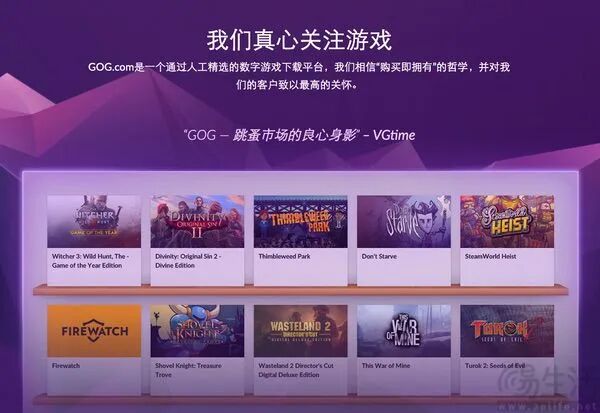
Core Viewpoint - The article discusses the ongoing debate about whether digital games are merely rentals rather than purchases, with Steam's recent clarification fueling player outrage and highlighting the contrasting approach of GOG, which emphasizes true ownership of games [1][3]. Group 1: Steam's Position - Steam has explicitly stated that digital games are considered rentals, not purchases, leading to significant backlash from the gaming community across various platforms [1][3]. - Despite this revelation, Steam's user engagement remains high, with record numbers of concurrent users, indicating that many players accept the reality of purchasing usage rights rather than ownership [4][6]. Group 2: GOG's Unique Approach - GOG differentiates itself by allowing players to have true ownership of games, offering DRM-free titles that can be downloaded, backed up, and reinstalled without restrictions [3][7]. - CD Projekt, the parent company of GOG, recently sold the platform to its co-founder for 177 million RMB, indicating a strategic shift despite GOG's unique selling proposition [3][4]. Group 3: Market Dynamics - GOG's revenue was approximately 47 million euros last year, with a net profit of only 268,000 euros, raising questions about its long-term viability compared to Steam's estimated revenue of over 16 billion USD [3][4]. - The gaming community's emotional connection to games often overshadows concerns about ownership, as most players do not mind whether they are renting or buying, unless a game is announced for shutdown [6][9]. Group 4: Community and Experience - The experience provided by distribution platforms is crucial, with Steam being viewed as a community hub, while Epic Games is seen merely as a storefront [9][11]. - GOG's lack of community engagement and reliance on its DRM-free model may not be sufficient to attract players away from more community-oriented platforms like Steam [11].
AI“世界模型”来了
财联社· 2025-12-26 03:15
Core Viewpoint - The emergence of AI models capable of generating interactive 3D environments is set to disrupt the global video game industry, potentially reshaping a market valued at tens of billions of dollars [3][4]. Group 1: AI Impact on Gaming - Leading AI teams, including Google DeepMind and World Labs, believe that "world models" will significantly transform the gaming industry [4]. - World Labs, co-founded by AI pioneer Fei-Fei Li, launched its first commercial product, Marble, which allows users to create coherent, high-fidelity 3D worlds from a single image, video, or text prompt [5]. - The technology is expected to disrupt existing game engines like Unity and Unreal, with experts predicting a fundamental change in software and game development in the coming years [8]. Group 2: Industry Growth and AI Integration - According to Newzoo, the global gaming industry is projected to generate nearly $190 billion in revenue this year, with generative AI tools already being utilized for creating visual assets in games [9]. - AI has reportedly increased the development speed of games, with Game Gears' CEO stating that their game development pace has quadrupled due to AI [9]. - The integration of AI in gaming is exemplified by Epic Games' collaboration with Disney to introduce an AI-driven character in Fortnite, showcasing the potential for interactive non-player characters [10]. Group 3: Future of Game Development - Experts predict that players will soon be able to create entirely new game worlds, reducing reliance on expensive software and specialized skills [13]. - The ability to create highly personalized games is becoming simpler, which could lead to a significant transformation in the gaming industry [14]. - While some critics express concerns about AI leading to job displacement and low-quality content, optimists believe AI can lower costs, enhance creativity, and alleviate developer burnout in a high-cost industry where top games often exceed $1 billion in development costs [15].

AI“世界模型”来袭:全球游戏产业或迎颠覆时刻
Zhong Jin Zai Xian· 2025-12-26 00:42
Core Viewpoint - The global video game industry is undergoing a transformative change due to the emergence of AI models capable of generating interactive 3D environments, with significant implications for the industry valued at tens of billions of dollars [1][2]. Group 1: AI Impact on Game Development - Leading AI teams, including Google DeepMind and World Labs, believe that "world models" will reshape the gaming industry [1]. - World Labs launched its first commercial product, Marble, which allows users to create coherent, high-fidelity 3D worlds from a single image, video, or text prompt [1]. - AI tools have already been used to enhance game development speed, with Game Gears' CEO reporting a fourfold increase in development speed for their game [2]. Group 2: Future of Gaming Experiences - AI is expected to empower creators and developers to produce content faster and in innovative ways, leading to new gaming experiences that do not currently exist [1][2]. - Players may soon be able to create entirely new game worlds, reducing reliance on expensive software and specialized skills [2]. - The introduction of AI-driven characters, such as the interactive Darth Vader in Fortnite, exemplifies the potential for AI to enhance player interaction [2]. Group 3: Industry Perspectives - Some industry experts express optimism that AI can lower costs, enhance creativity, and prevent developer burnout, especially in a sector where AAA games can take years and cost over $1 billion to develop [3]. - Critics, however, warn that increased AI usage may lead to the replacement of developers and artists, resulting in an influx of low-quality AI-generated content [2][3]. - Former Ubisoft producer emphasizes that world models could help developers regain the joy of creation and explore new ideas, especially under tight deadlines [4].
苹果摇钱树再被砍,多米诺骨牌要倒下了?
创业邦· 2025-12-24 10:10
Core Viewpoint - Apple is facing significant challenges to its App Store monopoly as Japan implements the "Mobile Software Competition Law," allowing third-party app stores and payment methods, marking a critical shift in its business model [5][10][11]. Group 1: Impact of Regulatory Changes - Japan's new law requires Apple to permit developers to use third-party app stores and payment methods, which is a major loss of control for the company [10]. - The law will take effect on December 18, 2024, and Apple has already begun supporting third-party app stores in Japan [10]. - The adjustments to Apple's commission structure in Japan represent a substantial concession, with fees reduced to 5% for third-party app stores compared to the previous standard of 30% [11]. Group 2: Financial Performance and Service Revenue - In the current fiscal year, Apple reported total revenue of $313.8 billion, with service revenue reaching $79.6 billion, accounting for over 25% of total revenue [9]. - Service business gross margins are significantly higher at 75%, compared to 40% for iPhone hardware, making it a crucial profit driver for Apple [9]. - The App Store generated total sales of $1.29 trillion last year, with an estimated commission revenue of around $30 billion [9]. Group 3: Global Regulatory Landscape - The European Union's Digital Markets Act (DMA) has already forced Apple to lower its commission rates and open its platform to third-party app stores [12][15]. - Apple faces potential fines of up to 10% of global annual revenue for non-compliance with the DMA, which could amount to billions of euros [15]. - Other countries, including the UK, South Korea, Turkey, Brazil, and Colombia, are also initiating antitrust investigations against Apple, indicating a global trend towards regulatory scrutiny [32]. Group 4: Ongoing Legal Challenges - Apple is involved in ongoing litigation with Epic Games, which has challenged the company's payment practices and commission rates [27][29]. - A recent ruling allowed Apple to charge a "reasonable" commission based on actual costs, rather than the previously high rates, indicating a shift in the legal landscape [28]. - The U.S. Department of Justice is also pursuing antitrust litigation against Apple, which could further impact its business model and market practices [30][31].

苹果摇钱树再被砍,多米诺骨牌要倒下了?
Xin Lang Cai Jing· 2025-12-22 01:42
Core Viewpoint - Apple is compelled to open its ecosystem in Japan by allowing third-party app stores and external payment channels, marking a significant shift in its control over app distribution and payment systems, similar to the pressures faced in the EU [1][5]. Group 1: Impact of New Regulations - The new Mobile Software Competition Law in Japan requires Apple to permit developers to use third-party app stores and payment methods, which is a major loss of control for Apple since the launch of its App Store in 2008 [5]. - This regulatory change is expected to significantly affect Apple's service revenue, which has already surpassed 25% of total revenue, with projections indicating it could exceed $100 billion this year [4][5]. - The service business, with a gross margin of 75%, is crucial for Apple's profitability, and the potential loss of control over app distribution could threaten this revenue stream [4]. Group 2: Comparison with EU Regulations - Japan's regulatory approach is influenced by the EU's Digital Markets Act (DMA), which has already forced Apple to reduce its commission rates and allow third-party payment options [6][8]. - Under the DMA, Apple has been required to lower its commission from 30% to as low as 10% for small businesses, indicating a trend towards reduced fees globally [8][9]. - The Japanese regulations are seen as a more detailed and potentially less burdensome framework compared to the EU's, with a minimum commission of 5% for third-party app stores [9]. Group 3: Legal and Competitive Challenges - Apple faces ongoing legal challenges in the U.S., including a significant lawsuit from Epic Games, which has resulted in court rulings that could further undermine Apple's commission structure [15][18]. - The U.S. Department of Justice is also pursuing antitrust litigation against Apple, which could lead to similar regulatory pressures as seen in Japan and the EU [19]. - The cumulative effect of these legal and regulatory challenges could lead to a global standard that diminishes Apple's control over its ecosystem, potentially impacting its market position and revenue [20].

苹果摇钱树再被砍,多米诺骨牌要倒下了?|硅谷观察
Xin Lang Cai Jing· 2025-12-21 23:40
Group 1 - Apple Japan announced it will open third-party app stores and external payment channels in response to Japan's new Mobile Software Competition Law, marking a significant shift in its app distribution and payment control [2][21] - This change dismantles Apple's previously strong ecosystem, which has been a key competitive advantage since the launch of the iOS ecosystem in 2008, allowing Apple to maintain a stable user base and significant market share [22][24] - Apple's service revenue has reached $79.6 billion, accounting for over 25% of total revenue, with expectations that it will exceed $100 billion this year, highlighting the importance of this segment to Apple's profitability [24] Group 2 - The new law in Japan, effective December 18, 2024, requires Apple to allow developers to use third-party app stores and payment methods, which is a significant loss of control for the company [25] - The commission structure for Apple in Japan has been adjusted, with third-party payments now incurring fees between 10% to 21%, while purchases through third-party app stores will incur a 5% core technology fee, a substantial reduction from the previous 30% standard [25][30] - The European Union's Digital Markets Act (DMA) has set a precedent for such regulatory changes, requiring similar adjustments from Apple, including allowing sideloading and third-party payment options [27][29] Group 3 - Apple has faced significant fines from the EU, including a €5 billion penalty for violating the DMA, which restricts its ability to limit developers from informing users about alternative payment options [31][34] - The ongoing legal battles with Epic Games and the U.S. Department of Justice highlight the increasing scrutiny Apple faces regarding its App Store practices and the so-called "Apple tax" [39][40] - The global trend of regulatory scrutiny against Apple is expanding, with countries like the UK, South Korea, and others initiating investigations or legal actions against the company's app store practices [40]

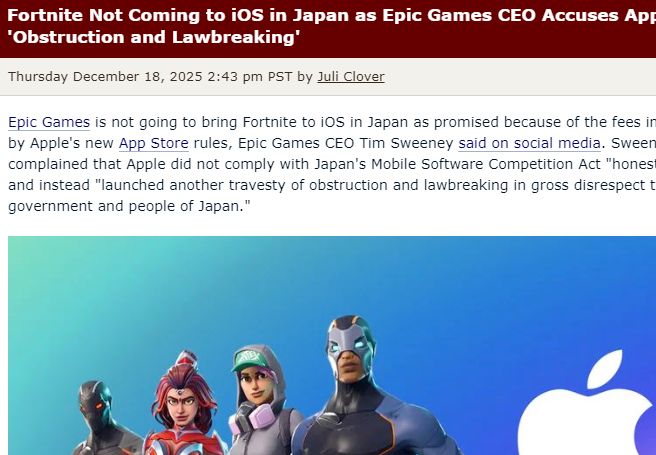
《堡垒之夜》放弃日本iOS,Epic硬刚苹果指控违法
Huan Qiu Wang Zi Xun· 2025-12-19 03:08
Group 1 - Epic Games CEO Tim Sweeney announced that the company will not be able to launch Fortnite on the iOS platform in Japan by the end of 2025 due to high fees imposed by Apple's new App Store rules [1][4] - The new rules require Epic to pay a 5% revenue share if distributing games through alternative app stores, or a 5% fee on in-app purchases or a 15% fee for digital purchases via web links if using the Apple App Store [4] - Sweeney criticized Apple for abusing its market position, hindering normal transactions between developers and users, and failing to create genuine competition, which ultimately harms consumer interests [4] Group 2 - The situation arose following the passage of Japan's Mobile Software Competition Law in 2024, which initially led Sweeney to optimistically announce Fortnite's entry into the Japanese iOS market [4] - Apple responded by stating that it had fully cooperated with Japanese regulatory authorities during the formulation of the new rules, asserting compliance with local regulations [4]