FoloToy

Search documents
2025年AI玩具行业概览:多元场景渗透,儿童启蒙、成人悦己、老年陪护下的AI玩具市场新生态
Tou Bao Yan Jiu Yuan· 2025-09-03 12:31
Investment Rating - The report indicates a high investment interest in the AI toy industry, with a significant increase in financing events since 2024, marking it as a new capital pursuit area for investors [3][5]. Core Insights - The AI toy market is expected to grow rapidly, driven by technological advancements, policy support, and increased consumer demand. The market is projected to reach a scale of 79.78 billion yuan by 2030, with a compound annual growth rate (CAGR) of 48.3% from 2024 to 2030 [5][20]. - The market penetration rate for AI toys in China is anticipated to rise steadily from 5% in 2023 to over 30% by 2030, influenced by technological development and changing consumer needs [13][19]. Summary by Sections Market Overview - The AI toy market is diversifying its application scenarios, expanding from children's entertainment to adult companionship and elderly care, addressing various age groups and specific needs [6]. - The market is segmented into basic, mid-range, and high-end products, with high-end toys holding a larger market share in terms of sales value, while basic toys dominate in sales volume [16]. Market Size and Growth - The Chinese AI toy market is experiencing rapid growth, with a projected market size of 75.1 billion yuan in 2024, increasing to 797.8 billion yuan by 2030 [20]. - The growth is attributed to technological advancements, policy support, and significant capital investment, with 96 investment institutions entering the sector [5][20]. Competitive Landscape - The global AI toy market features four main types of participants: technology giants, traditional toy companies, IP resource crossovers, and emerging competitors. In China, technology giants and emerging players dominate the market [22][26]. - Major players include OpenAI, Mattel, Disney, and emerging companies like FoloToy, each employing different strategies to capture market share [28][29]. Future Trends - The AI toy industry is expected to integrate more with new technologies such as AIGC and the metaverse, leading to the emergence of new business models like Toy as a Service (TaaS) [5][20]. - The report highlights the potential for deep integration within the industry, with traditional toy manufacturers acquiring technology capabilities to enhance their product offerings [5][20].
AI潮玩,谁不想成为LABUBU
创业邦· 2025-08-18 03:32
Core Viewpoint - The AI toy market is experiencing significant growth, driven by a surge of new companies entering the space, focusing on emotional value and user engagement rather than just technological capabilities [6][8][21] Group 1: Market Dynamics - The AI toy sector has seen over 30 emerging companies, with products designed to cater to both children and adults, reflecting a diverse range of user needs [6][8] - The market is characterized by a low entry barrier for consumers, allowing for a variety of products that fulfill different emotional and psychological needs [8][20] - The success of AI toys will depend on achieving significant sales volumes, with a benchmark of 100,000 units being crucial for establishing a product as a market leader [8][19] Group 2: Key Players and Products - Notable companies include Mengyou Intelligent, which launched the Ropet AI toy, and Luobo Intelligent, which introduced the Fuzozo, both targeting female consumers [6][12] - Ropet has achieved significant crowdfunding success in Japan, raising 26 million yen on its first day, while Fuzozo has gained traction in China through effective marketing strategies [12][13] - The products differ in their interaction capabilities, with Fuzozo utilizing a multimodal model for language interaction, while Ropet focuses on non-verbal responses to enhance user experience [13][14] Group 3: Consumer Insights - The primary purchasing motivation for consumers is the aesthetic appeal of the toys, particularly among female users, indicating a strong link between product design and consumer engagement [14][20] - The emotional value created by AI toys is paramount, with companies exploring various approaches to meet the emotional and psychological needs of users [20][21] - The market is still evolving, with opportunities for new entrants to address unmet needs, particularly in areas like mental health and emotional support [20][21] Group 4: Future Trends - The AI toy industry is expected to continue diversifying, with products aimed at both emotional companionship and practical applications in mental health [20][21] - Companies are leveraging advanced AI technologies to enhance user interaction and product functionality, which will be critical for long-term success [19][20] - The competition is intensifying as larger companies like Pop Mart enter the market, potentially reshaping the landscape of AI toys [8][21]


游戏场景现实落地吸引新用户 茶饮IP联名后续热度难维持
Nan Fang Du Shi Bao· 2025-08-11 23:16
Core Insights - The event "New Cultural Creation Ignites New Consumption" held in Shanghai focused on the intersection of digital culture and consumer behavior, emphasizing the importance of IP cross-industry empowerment and innovation in the digital cultural industry [8][10][12]. Group 1: Industry Trends - Digital cultural IP is reshaping the consumption logic of young people, with local governments promoting ecological collaboration in the cultural industry [8][10]. - The integration of technologies like AIGC and business models such as "Guzi Economy" and "Co-branding Economy" is expected to break down industry barriers and drive high-quality economic development [8][10]. - The concept of "emotional embedding" and "social interaction empowerment" is crucial for brands to maintain consumer enthusiasm, as young consumers prioritize emotional connections with products [9][10]. Group 2: Brand Collaboration Strategies - Brands are increasingly focusing on "tone alignment" when selecting collaboration partners, ensuring that the IP's characteristics resonate with their own brand identity [10][11]. - Softstar Technology emphasizes the importance of cultural depth and innovation in collaborations, showcasing successful partnerships with various brands to enhance consumer engagement [10][11]. - Century Huatong has successfully collaborated with hotels and traditional brands, demonstrating that diverse partnerships can rejuvenate brand images and attract younger audiences [11][12]. Group 3: Challenges and Considerations - The tea beverage brand Lemon Right has observed a slowdown in collaboration frequency, highlighting the need for brands to focus on building their own identity while selectively engaging in IP collaborations [13][14]. - Concerns about the effectiveness of collaborations in delivering added value are prevalent, with brands emphasizing the importance of product quality before pursuing co-branding opportunities [14][15]. - The integration of AI in IP collaborations is gaining traction, but many companies remain cautious due to concerns about AI-generated content potentially harming brand reputation [15][16]. Group 4: Intellectual Property Protection - Intellectual property protection is essential for maintaining the value and scarcity of IP, with significant investments required to cultivate successful IPs [16][17]. - The rise of counterfeit products poses challenges for IP holders, necessitating proactive measures to protect brand reputation and market integrity [16][17]. - The industry is actively exploring various legal pathways for protecting intellectual property rights, indicating a collective effort to address infringement issues [16][17].



AI录音机也能卖爆?巨头血亏,“小而美”AI硬件却在闷声发财
3 6 Ke· 2025-08-04 05:58
Core Insights - The AI hardware sector is witnessing the emergence of significant players with "blockbuster" potential, such as Meta's AI smart glasses and Plaud.AI's AI voice recorder, both achieving sales in the millions [1] - A clear trend is observed where companies focus on niche markets and specific scenarios rather than mass-market products, which has become a standard formula in AI hardware [1] - The Chinese AI hardware market is projected to reach 1.1 trillion yuan in 2025, with a year-on-year growth of 13.4% and a compound annual growth rate of 18% over the next five years [1] Group 1: Emerging Products and Companies - The AI toy sector is thriving with innovative products like BubblePal, an interactive toy that has sold over 250,000 units since its launch, generating sales exceeding 100 million yuan [4] - FoloToy, another player in the AI toy market, aims to sell 300,000 units this year, significantly increasing its sales target compared to the previous year [4] - In the AI meeting recording space, Plaud.AI's voice recorder has surpassed 1 million units sold, while TicNote has achieved over 10,000 units sold, ranking 11th in its category on JD.com [7][9] Group 2: Market Dynamics and Trends - The AI hardware market is characterized by a focus on solving specific user problems, with successful products integrating AI capabilities to enhance user experience rather than serving as standalone solutions [15][18] - The competition in the AI glasses segment is intensifying with major players like Alibaba and Xiaomi entering the market, indicating a shift from niche to mass-market potential [14] - The future of AI hardware is expected to evolve along two main lines: continuous exploration of vertical scenarios and the application of AI in more physical interaction contexts [23] Group 3: Challenges and Opportunities - Despite the promising outlook for AI hardware, there is currently no standout product that has defined the category akin to the iPhone for smartphones, indicating that many products are still in the exploratory phase [21] - The market is described as being in an early "Warring States" period, where identifying a killer application could lead to significant competitive advantages [23][24] - The potential for disruption often comes from smaller, niche companies rather than established giants, highlighting opportunities for startups in the AI hardware space [24]
论坛| 时间即货币! 杜雨博士苏州AI大会演讲剖析AI新赛点
未可知人工智能研究院· 2025-07-29 05:23
Core Viewpoint - The article discusses the growth and potential of the AI industry in Suzhou, highlighting investment opportunities and the importance of AI in scientific research and manufacturing processes [1][7]. Group 1: AI Investment Landscape - In the Chinese primary market, AI investment volume has increased by 19.3% year-on-year, making it a standout sector amidst a challenging environment [3]. - China's global market share in AI has risen from 5% in 2018 to 20% in 2024, driven by advancements in large models [3]. Group 2: Suzhou's Industrial Foundations - Suzhou's industrial strengths are anchored in two key sectors: biomedicine and high-end equipment manufacturing, which account for 52.7% and 49.4% of the city's industrial output, respectively [4]. Group 3: Emerging Opportunities - Three major trends in AI are identified: 1. Embodied intelligence and humanoid robots, with a projected global market size of 193.8 billion USD by 2035 [5]. 2. Broadly defined embodied intelligence hardware, including AI toys, AI glasses, and in-car smart terminals, with successful case studies emerging [5]. 3. AI for Science, where five research fields are undergoing a paradigm shift driven by data and algorithms [5]. Group 4: Competitive Advantage - The essence of the AI competition is framed as a race against time, emphasizing that those who can halve the cycles of research, manufacturing, and services will gain a significant advantage [7].

BubblePal不到一年卖出1个亿,AI玩具的风吹到哪了?
3 6 Ke· 2025-06-27 00:49
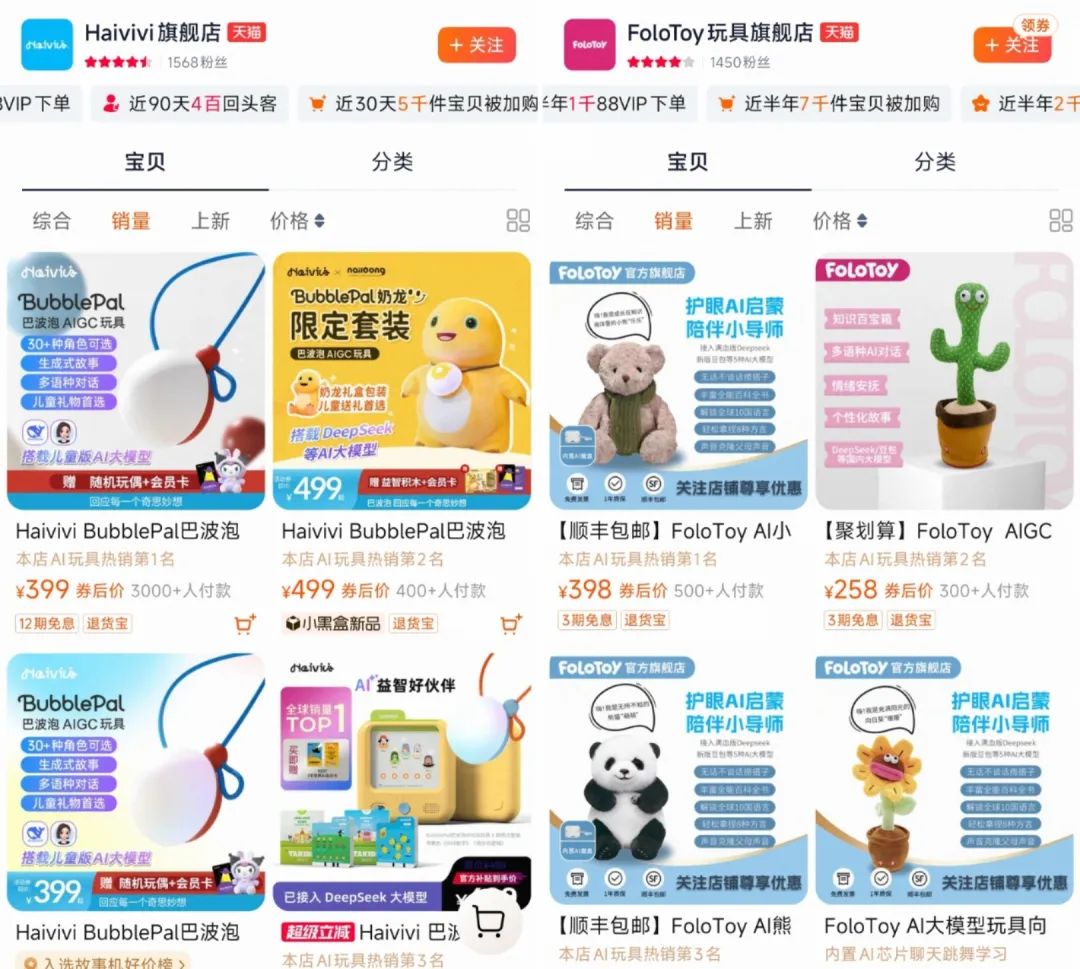
Core Insights - The AI toy market is experiencing significant growth, with companies like Haivivi and FoloToy reporting impressive sales figures, indicating a shift from skepticism to acceptance of AI toys as a legitimate market segment [1][4][5] - The industry is witnessing a surge in investment, with at least 27 financing events recorded in 2024, including several multi-million dollar rounds, highlighting the increasing interest from investors [3][4] - AI toys are characterized by their ability to provide personalized interactions through advanced technologies such as multi-modal interaction and emotional analysis, setting them apart from traditional toys [5][6] Company Highlights - Haivivi's BubblePal has sold over 250,000 units since its launch, generating sales exceeding 100 million yuan [1] - FoloToy aims to sell 300,000 units this year, significantly increasing its sales target compared to the previous year [1] - Companies like Lobo Intelligent and Bepei Technology have also secured significant funding, indicating a robust investment landscape in the AI toy sector [2][3] Market Dynamics - The AI toy market is categorized into various segments, including smart pendants, interactive dolls, and robotic toys, each offering unique features and price points [5][10] - The price range for AI toys varies widely, with simpler models priced under 500 yuan and advanced robotic toys reaching several thousand yuan [10][11] - The market is primarily driven by children's products, but there is growing potential in emotional companionship toys targeting adults and seniors [11][14] Investment Trends - The AI toy sector has seen a mix of traditional toy manufacturers and tech startups entering the market, with established companies leveraging their IP to create AI-enhanced products [6][16] - Notable investments include Haivivi's partnerships with various venture capital firms and the strategic collaborations between traditional toy companies and tech firms [4][6][16] - The trend of integrating popular IPs into AI toys is gaining traction, with companies like FoloToy and Haivivi exploring collaborations with well-known brands to enhance market appeal [15][16] Future Outlook - The development of AI toys is expected to accelerate as technology costs decrease, allowing for more innovative products that can engage users on a deeper emotional level [14][21] - The potential for creating new IPs within the AI toy space is significant, with companies exploring unique designs and narratives to attract consumers [18][21] - As the market matures, the emergence of iconic brands similar to LABUBU is anticipated, driven by the intersection of technology and creative product design [21]




万创行研——AI玩具,下一代“亲密形态”的智能终端
3 6 Ke· 2025-05-28 02:31
Group 1 - The core concept of AI toys is evolving from traditional children's toys to intelligent interactive systems that cater to all age groups, providing companionship and emotional support [2][5] - AI toys are defined as products that integrate artificial intelligence to create interactive, personalized experiences, moving beyond simple entertainment [3][4] - The technology stack supporting AI toys includes voice recognition, natural language processing, computer vision, emotional computing, and continuous learning capabilities [20][21][24] Group 2 - AI toys are expanding their application scenarios from children's education to emotional companionship for adults and elderly care, reflecting a trend towards diverse user needs [7][11][14] - For children, AI toys focus on language development, behavior intervention, and emotional support, with a shift towards interactive and dynamic learning experiences [9][10] - For adults, AI toys serve as digital companions to alleviate loneliness and stress, with features that promote emotional interaction and relaxation [12][13] Group 3 - The competitive landscape for AI toys is characterized by a mix of tech giants and innovative startups, with a focus on cross-industry integration and ecosystem development [32][33] - In the global market, major tech companies are exploring AI toy capabilities through ecosystem partnerships, while startups emphasize emotional interaction and educational value [34][35] - The Chinese market is rapidly developing AI toys, driven by strong hardware manufacturing capabilities and a large consumer base, with a focus on content-driven innovation [37][38] Group 4 - Recent investment trends indicate a growing interest in AI toys as a potential application of AI technology, with over 40 financing events and a total of over $1 billion in funding in 2024 [47][48] - Investors are increasingly looking for projects that combine AI capabilities, user retention, and emotional value, reflecting a shift in evaluation criteria compared to traditional consumer electronics [52][68] - The future of AI toys is seen as a key entry point for AI technology into everyday life, with potential for significant market growth as technology and user understanding evolve [64][72]

在AI儿童硬件产品赛道,人人都想抢学习机的饭碗
Tai Mei Ti A P P· 2025-04-03 10:35
Core Insights - AI technology is increasingly penetrating the hardware sector, particularly in the realm of AI companionship products aimed at children, elderly, and women, with a strong focus on children's products [1][2] - The primary competition in AI children's companionship products revolves around the integration of education, as these products often serve dual purposes of companionship and educational support [1][2][3] Group 1: Market Dynamics - The AI companionship market for children is characterized by a diverse range of products, including AI toys, smartwatches, and educational devices, with notable brands like FoloToy achieving significant sales growth [2][3] - FoloToy aims to enhance emotional companionship through advanced technology, such as voice simulation, while still embedding educational themes in its products [2][3][6] - The market is expected to face consolidation, with predictions of a "brand death wave" as competition intensifies and only a few brands may survive [7][10][11] Group 2: Target Audience - The target audience for AI companionship products is distinct, comprising both the children who use the products and the parents who make purchasing decisions, necessitating a balance between the two groups' needs [6][9] - Children's developmental stages align well with the capabilities of current AI products, making them more receptive to these technologies, while parents are increasingly open to introducing AI to their children [9][10] Group 3: Competitive Barriers - The core competitive barrier in the AI children's companionship market is technology, particularly in areas such as multi-modal emotional expression and intelligent interaction capabilities [10][11] - The ability to adapt to advanced models and enhance user experience through ongoing data support is crucial for product differentiation and success in the market [10][11] Group 4: Future Trends - The industry is at a crossroads, with the potential for a shift from companionship-focused products to those emphasizing educational value, driven by market demands and consumer expectations [11][12] - The outcome of this transition will determine whether the market will prioritize "companionship" or "education" as the primary value proposition for AI children's products [12]