天玛智控

Search documents
中原证券晨会聚焦-20250604
Zhongyuan Securities· 2025-06-04 01:03
Key Points - The report highlights the ongoing recovery in the domestic market, with a focus on the automotive and financial sectors leading the growth in A-shares [5][8][9] - The manufacturing sector is experiencing a decline, as indicated by the PMI dropping to 48.3 in May, marking the first fall below the critical point since October 2024 [5][8] - The electric equipment sector underperformed compared to the broader market, with a 1.79% increase in May, lagging behind the CSI 300 index which rose by 2.34% [13][15] - The photovoltaic industry saw significant growth in installed capacity, with April's new installations reaching 45.22 GW, a year-on-year increase of 214.68% [17][18] - The mechanical industry reported improved performance in Q1 2025, with revenue growth of 8.91% and net profit growth of 17.21% compared to the previous year [20][21] - The semiconductor sector continues to show growth, with global sales increasing by 18.8% year-on-year in March 2025 [26][27] - The new materials sector is expected to benefit from increasing demand driven by domestic manufacturing and technological advancements, maintaining a "stronger than market" investment rating [28] - The brokerage sector is experiencing a recovery, with Q1 2025 showing a 24.60% increase in revenue and an 83.48% increase in net profit compared to the previous year [29][31]

【干货】矿用机器人产业链全景梳理及区域热力地图
Qian Zhan Wang· 2025-06-03 03:53
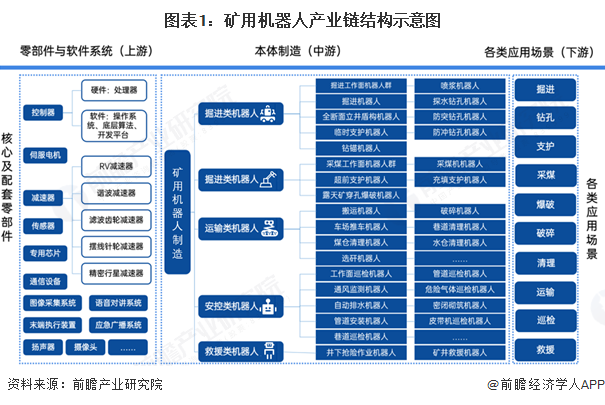
Core Insights - The article discusses the mining robot industry chain, highlighting its similarities to the general robotics industry chain, which includes upstream components, midstream manufacturing, and downstream applications [1][3]. Industry Overview - The mining robot industry relies heavily on international suppliers for core components, with major players like the "Four Families" of robotics controlling key parts, while companies like NVIDIA and Horizon dominate the AI chip market [3]. - Key manufacturers in the midstream include companies such as CITIC Heavy Industries, Zhengzhou Coal Mining Machinery, and China Railway Construction Heavy Industry [3]. Regional Analysis - The mining robot industry is well-developed in regions such as Guangdong, Shaanxi, Shandong, Jiangsu, and Shanxi, with Guangdong and Jiangsu having strong upstream component and equipment manufacturing capabilities [4]. - Other regions with a complete industry chain include Beijing, Hunan, Liaoning, Shanghai, Anhui, and Fujian [4]. Cost Structure - The core components of mining robots, including controllers, servo systems, and reducers, account for 70% of the total cost, with reducers being the most expensive at 35% [8]. - Controllers represent about 15% of the total cost, while servo systems account for 20% [8]. Value Chain Analysis - The growth potential for suppliers of the robot body is limited compared to upstream and downstream players, with the highest profit margins found in reducers (40%), followed by servo systems and integrated systems (35%) [11]. - The profit margin for controllers is 25%, while the robot body has the lowest margin at 15% [11].


2025年中国矿用机器人行业发展现状 上游原材料和零部件需求量稳步增长【组图】
Qian Zhan Wang· 2025-05-29 08:40
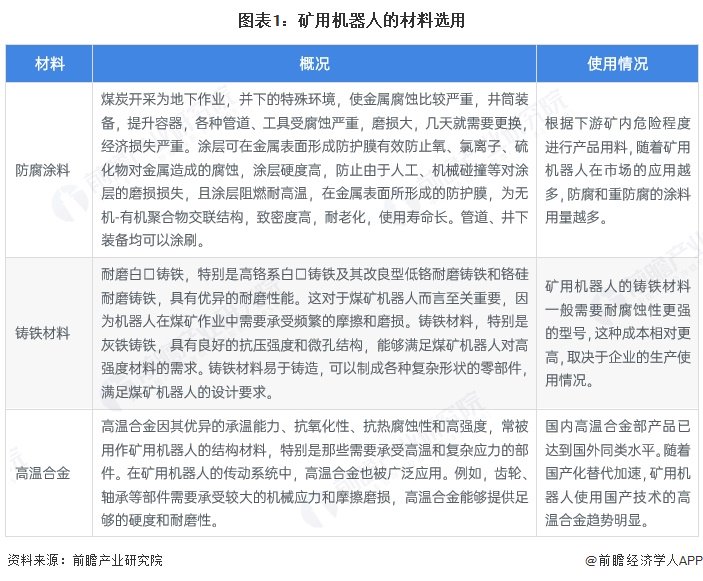
Core Insights - The article discusses the materials used in mining robots, emphasizing the importance of corrosion-resistant coatings and cast iron components for durability in harsh mining environments [1][3][4]. Material Overview - Corrosion-resistant coatings are essential in mining due to the severe corrosion caused by acidic gases and saline mist, which can damage metal parts and electronic components of robots [3]. - The coatings form a dense protective layer that reduces direct contact with corrosive substances, thereby extending the lifespan of mining robots [3]. - Cast iron, particularly wear-resistant varieties, is favored for structural components of mining robots due to its high strength and durability against wear [4]. - High-temperature alloys are also utilized in mining robots for parts that endure high temperatures and complex stresses, with domestic production reaching levels comparable to international standards [2][4]. Production Data - In 2023, China's production of corrosion-resistant coatings reached 7.15 million tons, accounting for approximately 20% of the total paint market, with a projected increase to 7.52 million tons in 2024 [3]. - The production of cast iron components in China was 51.95 million tons in 2023, reflecting a year-on-year increase of 250,000 tons, with a compound annual growth rate of 13.7% from 2016 to 2023 [4].
天玛智控: 天玛智控关于首次公开发行部分战略配售限售股上市流通的公告
Zheng Quan Zhi Xing· 2025-05-27 10:24
? 本次股票上市流通日期为2025 年 6 月 5 日。 一、本次上市流通的限售股类型 根据中国证券监督管理委员会于 2023 年 3 月 21 日出具的《关于同意北京天 玛智控科技股份有限公司首次公开发行股票注册的批复》(证监许可〔2023〕614 号),公司首次向社会公众公开发行人民币普通股 73,000,000 股,并于 2023 年 6 月 5 日在上海证券交易所科创板上市,公司首次公开发行后股本总额为 证券代码:688570 证券简称:天玛智控 公告编号:2025-016 北京天玛智控科技股份有限公司 关于首次公开发行部分战略配售限售股上市流通的公告 本公司董事会及全体董事保证本公告内容不存在任何虚假记载、误导性陈述 或者重大遗漏,并对其内容的真实性、准确性和完整性依法承担法律责任。 重要内容提示: ? 本次股票上市类型为首发战略配售股份(限售期 24 个月);股票认购方 式为网下,上市股数为2,190,000股。本公司确认,上市流通数量等于该限售期的 全部战略配售股份数量。 本次股票上市流通总数为2,190,000股。 本次上市流通的限售股为公司首次公开发行部分战略配售限售股,限售股股 东数量 1 ...
天玛智控(688570) - 天玛智控关于首次公开发行部分战略配售限售股上市流通的公告
2025-05-27 09:47
证券代码:688570 证券简称:天玛智控 公告编号:2025-016 北京天玛智控科技股份有限公司 关于首次公开发行部分战略配售限售股上市流通的公告 本公司董事会及全体董事保证本公告内容不存在任何虚假记载、误导性陈述 或者重大遗漏,并对其内容的真实性、准确性和完整性依法承担法律责任。 重要内容提示: 本次股票上市类型为首发战略配售股份(限售期 24 个月);股票认购方 式为网下,上市股数为2,190,000股。本公司确认,上市流通数量等于该限售期的 全部战略配售股份数量。 本次股票上市流通总数为2,190,000股。 本次股票上市流通日期为2025 年 6 月 5 日。 一、本次上市流通的限售股类型 根据中国证券监督管理委员会于 2023 年 3 月 21 日出具的《关于同意北京天 玛智控科技股份有限公司首次公开发行股票注册的批复》(证监许可〔2023〕614 号),公司首次向社会公众公开发行人民币普通股 73,000,000 股,并于 2023 年 6 月 5 日在上海证券交易所科创板上市,公司首次公开发行后股本总额为 433,000,000 股,其中有限售条件流通股合计 378,690,809 股,占公 ...
天玛智控(688570) - 中信建投证券股份有限公司关于北京天玛智控科技股份有限公司首次公开发行部分战略配售限售股上市流通的核查意见
2025-05-27 09:46
中信建投证券股份有限公司 关于北京天玛智控科技股份有限公司 首次公开发行部分战略配售限售股上市流通的核查意见 中信建投证券股份有限公司(以下简称"保荐人")作为北京天玛智控科技 股份有限公司(以下简称"公司"或"天玛智控")首次公开发行股票并在科创 板上市的保荐人,根据《证券发行上市保荐业务管理办法》《上海证券交易所科 创板股票上市规则》等有关法律法规和规范性文件的要求,对天玛智控首次公开 发行部分限售股上市流通的事项进行了核查,具体情况如下: 一、本次上市流通股的限售股类型 根据中国证券监督管理委员会于 2023 年 3 月 21 日出具的《关于同意北京天 玛智控科技股份有限公司首次公开发行股票注册的批复》(证监许可〔2023〕614 号),公司首次向社会公众公开发行人民币普通股 73,000,000 股,并于 2023 年 6 月 5 日在上海证券交易所科创板上市,公司首次公开发行后股本总额为 433,000,000 股,其中有限售条件流通股合计 378,690,809 股,占公司总股本的 87.46%,无限售条件流通股合计 54,309,191 股,占公司总股本的 12.54%。 本次上市流通的限售股为 ...
量减价稳,重视煤炭板块配置
Xinda Securities· 2025-05-25 07:40
Investment Rating - The investment rating for the coal mining industry is "Positive" [2] Core Viewpoints - The current phase is seen as the beginning of a new upward cycle for the coal economy, with a resonance between fundamentals and policies, making it an opportune time to invest in the coal sector [11][12] - The coal price is expected to stabilize at a new level, supported by a slowdown in coal production growth, particularly in high-cost regions like Xinjiang, and a decrease in coal imports [11][12] - The coal sector is characterized by high profitability, cash flow, return on equity (ROE) between 10-20%, and dividend yields exceeding 5%, indicating strong core asset attributes [11][12] Summary by Sections 1. Coal Price Trends - As of May 24, the market price for Qinhuangdao port thermal coal (Q5500) is 613 RMB/ton, down 5 RMB/ton week-on-week [3][30] - The price for coking coal at Jing Tang port is 1320 RMB/ton, down 30 RMB/ton week-on-week [3][32] - International thermal coal prices show a mixed trend, with Newcastle thermal coal at 68.0 USD/ton, down 1.0 USD/ton week-on-week [3][30] 2. Supply and Demand Dynamics - The utilization rate of thermal coal mines increased to 97.1%, while coking coal mine utilization decreased to 86.3% [11][12] - Daily coal consumption in coastal provinces rose by 7.10 thousand tons/day (+3.93%) and in inland provinces by 6.00 thousand tons/day (+1.93%) [11][12] - The April coal production in China was 390 million tons, reflecting a 5 million ton decrease from March, indicating a contraction in supply [11][12] 3. Investment Strategy - The report emphasizes the importance of investing in high-quality coal companies with stable operations and strong performance, such as China Shenhua, Shaanxi Coal, and others [12][13] - The coal sector is expected to maintain high performance and cash flow, with a favorable outlook for the next 3-5 years due to ongoing supply constraints [12][13] 4. Market Performance - The coal sector saw a 0.98% increase this week, outperforming the broader market, which saw a 0.18% decline [15][18] - The thermal coal segment rose by 1.62%, while the coking coal segment experienced a slight decline [15][18]



【行业深度】洞察2025:中国矿用机器人行业竞争格局及竞争力评价(附市场集中度、企业竞争力分析等)
Qian Zhan Wang· 2025-05-23 03:54
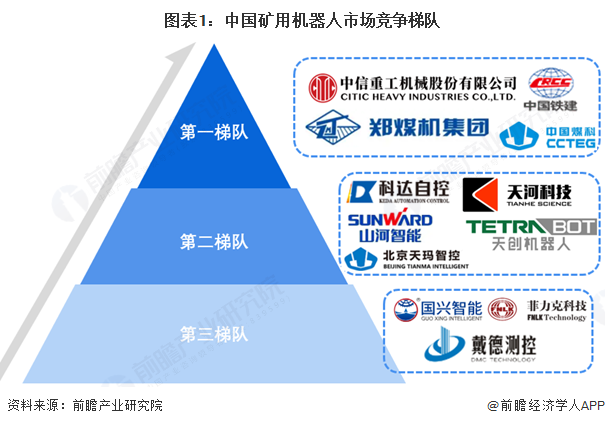
Core Insights - The Chinese mining robot market is characterized by a low concentration level, with a CR10 of approximately 20% [6] - The market is segmented into three tiers based on competitive strength, with leading companies including CITIC Heavy Industries, China Railway Heavy Industry, Zhengzhou Coal Mining Machinery, and China Coal Technology Engineering Group in the first tier [1][9] - The industry is experiencing a shift towards intelligent mining solutions, with companies like CITIC Heavy Industries and Shandong Hi-Speed Heavy Industry pursuing smart transformation [9] Market Structure - The first tier of the mining robot market includes CITIC Heavy Industries, China Railway Heavy Industry, Zhengzhou Coal Mining Machinery, and China Coal Technology Engineering Group, which possess strong market presence and product ecosystems [1] - The second tier consists of companies like Keda Control, Shanhe Intelligent, Tianma Intelligent, and Tianhe Technology, which have advantages in R&D investment and product manufacturing [1] - The third tier includes Guoxing Intelligent, Felik Technology, and Dade Measurement and Control, which focus on product manufacturing but have weaker competitive positions [1] Regional Analysis - The mining robot industry chain is well-developed in Guangdong, Shaanxi, Shandong, Jiangsu, and Shanxi provinces, with Guangdong and Jiangsu having a strong upstream component supply [3] - Shaanxi, Shandong, and Shanxi have a high demand for mining robots due to the presence of numerous mines [3] Competitive Landscape - The industry lacks a clear leader in terms of both revenue and growth, with most companies focusing on traditional mining equipment rather than intelligent mining robots [9] - Companies like Zhengzhou Coal Mining Machinery and Tianhe Technology are leading in revenue but have struggled with profit margins [9] - Notable companies with high profit margins exceeding 30% include Tianma Intelligent, Meian Technology, and Keda Control [9] Competitive Evaluation - A competitive analysis using six dimensions shows that CITIC Heavy Industries, China Coal Technology Engineering Group, China Railway Heavy Industry, and Zhengzhou Coal Mining Machinery lead in market revenue, product layout, and R&D investment [12] - Companies like Keda Control and Tianma Intelligent have lower revenue but a diverse product range, indicating potential for growth [12] Porter's Five Forces Analysis - The intensity of rivalry among existing competitors is moderate, with specialized manufacturers like Tianma Intelligent and Keda Control holding a technological edge [14] - The threat of new entrants is significant due to policy support for smart mining, although high R&D costs and technical barriers limit small enterprises [14] - Supplier bargaining power is strong, particularly for core components that are often imported [14] - Buyer bargaining power is also strong, especially among large state-owned mining enterprises [14]
第七届“5·15—5·19中小投资者保护宣传周”公益活动圆满结束 五天三地 多方聚力共谱中小投资者保护新篇
Zheng Quan Ri Bao Zhi Sheng· 2025-05-21 17:09
本报记者 毛艺融 投资者保护是资本市场健康发展的基石。历时五天,由《证券日报》社有限责任公司主办,北京基金小 镇投资者教育基地、东方财富、第一创业证券联合举办,中国上市公司协会、中证中小投资者服务中心 有限责任公司(以下简称"中证投服中心")为支持单位的第七届"5·15—5·19中小投资者保护宣传周"公 益活动,日前在北京、上海、深圳三地圆满结束。 此次公益活动以"践行'三投资',筑牢'两防范'"为主题,邀请了券商首席分析师、公益律师、上市公司 代表等通过主题分享、圆桌讨论的形式,为投资者们普及投资知识,倡导理性投资、价值投资和长期投 资理念,提升投资者的风险意识和自我保护能力。 "5·15—5·19中小投资者保护宣传周"公益活动已连续举办了七届。今年,来自北京、上海、深圳的投资 者分别在中央财经大学、东方财富投资者教育基地、第一创业投资者教育基地,聆听资本市场投资者保 护的新方法、新举措。 中国上市公司协会会长宋志平在致辞时表示,股市稳定关乎经济社会大局、关乎亿万投资者切身利益。 保护投资者是一项系统工程。一是需加强公司治理规范性,筑牢投资者保护基石;二是要提高市值管理 水平,积极主动回报投资者;三是要强化 ...
2025年全球矿用机器人行业发展现状 未来将替代人进行高危复杂工作【组图】
Qian Zhan Wang· 2025-05-19 07:18
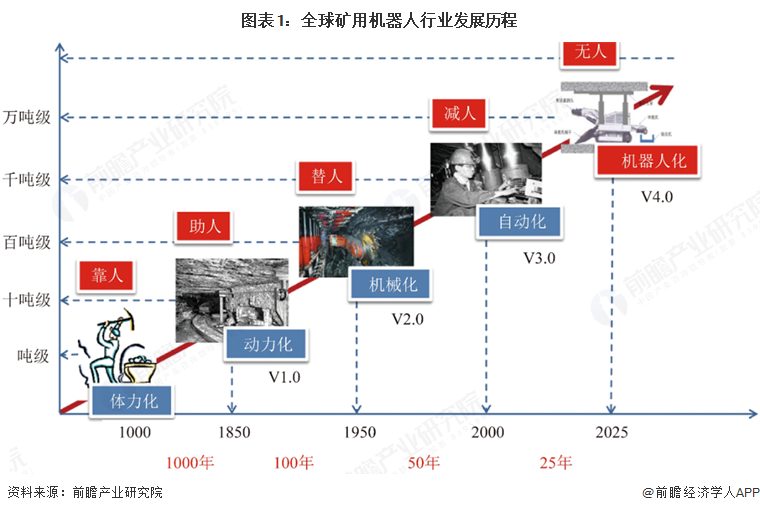
Global Mining Robot Industry Development - The global mining robot industry has evolved through several phases, starting from the mechanization 1.0 period in the 1870s to 1980s, where countries like the USA, UK, Germany, Australia, and South Africa established coal mine auxiliary transport systems [1] - The mechanization 2.0 period began in 1958 with the development of the first underground loader by Wagner in the USA, focusing on remote control and autonomous systems for mining operations [2] - The industry entered the automation 3.0 phase in the 21st century, emphasizing faster, safer, and more efficient mining operations through advanced technologies [2] - The mining robotization 4.0 phase is expected to commence in 2025, where mining robots will be widely adopted for repetitive, hazardous, and technically challenging tasks [2] Market Size and Growth - The global mining robot market reached a size of $1.363 billion in 2021, with a year-on-year growth rate exceeding 20% [6] - In 2022, the market experienced a decline, but it rebounded in 2023, with a market size of $1.28 billion, and is projected to reach $1.4 billion in 2024 [6] - The global special robot market is expected to grow to $14 billion by 2024, reflecting a year-on-year increase of 16.7% [5] Competitive Landscape - The competitive landscape of the global mining robot industry is characterized by companies like Komatsu, Sandvik, and Caterpillar leading in patent applications, while FAMUR excels in sales coverage [9] - Companies such as China Energy Investment Group and Tian Di Shanghai Mining Equipment Technology Co., Ltd. are emerging players, showing good performance in overseas markets despite being behind the leading tier in terms of product diversity and regional sales coverage [9] Future Outlook - The mining robot market is driven by increased investment in robotic mining systems, advancements in digitalization and automation, and the demand for precise and efficient operations [11] - The global energy shortage has renewed interest in traditional energy sources like coal, with mining robots being widely applied in coal mining countries, particularly in developing regions such as China and Southeast Asia [11] - The global mining robot market is projected to reach $3.7 billion by 2030, with a compound annual growth rate (CAGR) of 20% [11]