SPDR Gold Trust

Search documents
金荣中国:美联储利率决议如期落地,金价冲高回落或陷震荡
Sou Hu Cai Jing· 2025-10-30 02:03
Core Viewpoint - International gold prices experienced fluctuations and closed lower on October 29, with a closing price of $3993.00 per ounce after reaching a high of $4030.36 and a low of $3913.43 [1] Economic Indicators - The Federal Reserve's interest rate was set at 4%, aligning with market expectations, down from the previous 4.25% [3] - The FOMC statement indicated a split among members regarding future rate cuts, with some supporting a 50 basis point cut while others preferred to maintain the current rate [3][4] - Economic activity is expanding at a moderate pace, with employment growth slowing and a slight increase in the unemployment rate [3][4] Federal Reserve Insights - Fed Chair Powell emphasized that the decision for a December rate cut is not guaranteed and highlighted significant uncertainty due to a lack of government data [4][5] - The probability of a 25 basis point cut in December is estimated at 67.8%, while the likelihood of maintaining the current rate is 32.2% [5] Gold Market Dynamics - The largest gold ETF, SPDR Gold Trust, saw a decrease in holdings by 2.87 tons, bringing the total to 1036.05 tons [5] - Gold prices are currently in a downtrend since peaking at $4381, with short-term indicators suggesting a bearish outlook [9] Trading Strategy - Suggested trading strategies include cautious high short and low long positions, with specific entry and exit points outlined for both aggressive and conservative traders [10]


截至10月29日 全球最大黄金ETF--SPDR Gold Trust持仓较上日减少2.87吨
Xin Hua Cai Jing· 2025-10-29 23:19
截至10月29日,全球最大黄金ETF--SPDR Gold Trust持仓较上日减少2.87吨,当前持仓量为1036.05吨。 (文章来源:新华财经) ...
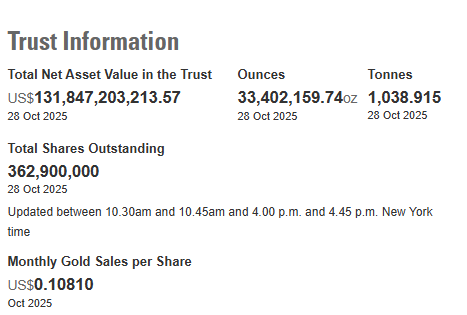
截至10月28日 全球最大的黄金ETF——SPDR Gold Trust的黄金持仓量为1038.92吨
Xin Hua Cai Jing· 2025-10-28 23:09
Group 1 - The largest gold ETF globally, SPDR Gold Trust, has a gold holding of 1,038.92 tons as of October 28, remaining unchanged from the previous trading day [1]
分析黄金百年历史的5次暴跌:从-65%到-22%的通性是什么?
Sou Hu Cai Jing· 2025-10-28 17:02
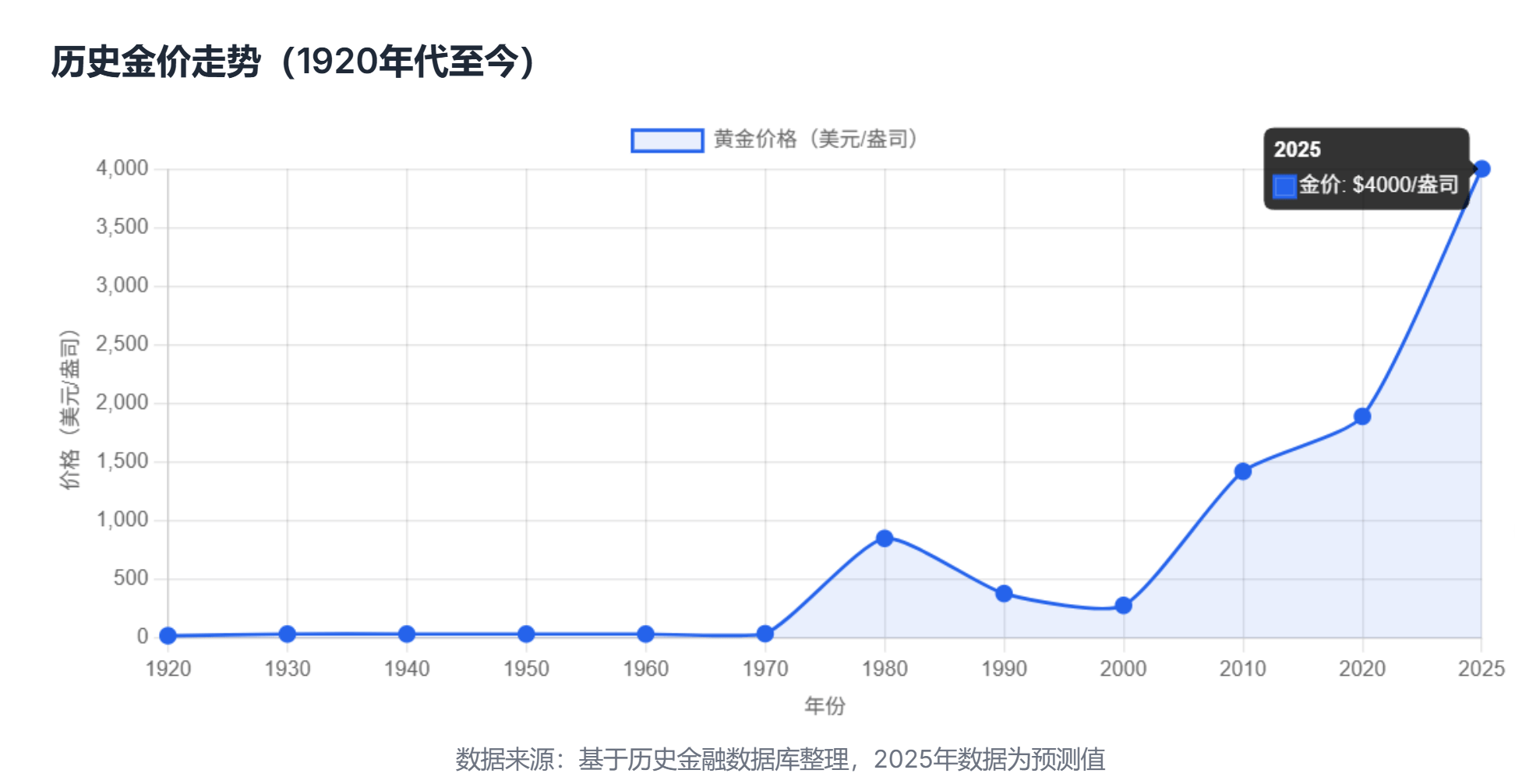
Core Insights - Gold prices experienced a significant drop of over 6% after reaching a historical high of $4,380 in October 2025, causing market panic. This volatility is not an isolated incident, as similar drops have occurred five times in the past century, with declines ranging from 22% to 65% [1][3]. Group 1: Historical Context of Gold Price Drops - Historical analysis reveals that two main factors consistently influence gold price fluctuations: the Federal Reserve's monetary policy and the U.S. dollar credit cycle. When both factors align, gold's status as a "safe haven" diminishes [3][15]. - In January 1980, gold peaked at $850 per ounce but plummeted to below $300 by 1982, marking a 65% decline. This drop was triggered by extreme monetary policies implemented by then-Fed Chairman Paul Volcker to combat hyperinflation, which raised the federal funds rate to a historic high of 20% [3][5]. - Between 1996 and 1999, gold prices fell from $415 to $252, a 40% decrease, driven by a booming tech sector that attracted funds away from gold to riskier assets, alongside a strengthening dollar [5][7]. Group 2: Market Dynamics and Institutional Behavior - In 1999, the Bank of England's decision to sell approximately 400 tons of gold reserves led to a shift in the supply-demand structure and eroded market confidence in gold's value. This central bank selling, combined with a risk asset rally, created a prolonged downward pressure on gold prices [7][9]. - During the 2008 financial crisis, gold failed to act as a safe haven as institutions sold off all liquid assets, including gold, to maintain cash flow amid liquidity shortages. This behavior was reflected in the significant reduction of holdings in the SPDR Gold Trust, the largest gold ETF [9][11]. Group 3: Recent Trends and Future Implications - In 2011, gold reached a high of $1,920 but entered a bear market, dropping to $1,046 by 2015, a 46% decline. This was primarily due to the Fed's shift in monetary policy and a recovering U.S. economy that redirected funds to the stock market [11][13]. - In 2022, the Fed initiated an aggressive rate hike cycle, raising rates by a total of 425 basis points over the year, which led to a 22% decline in gold prices as the dollar index surged to a 20-year high [13][15]. - The analysis of five major price drops reveals two common factors: the Federal Reserve's monetary policy shift and the strengthening of the dollar, both of which exert significant downward pressure on gold prices. Additional factors, such as central bank selling and liquidity crises, can amplify these declines but require alignment with the primary factors to trigger a sustained downturn [15].
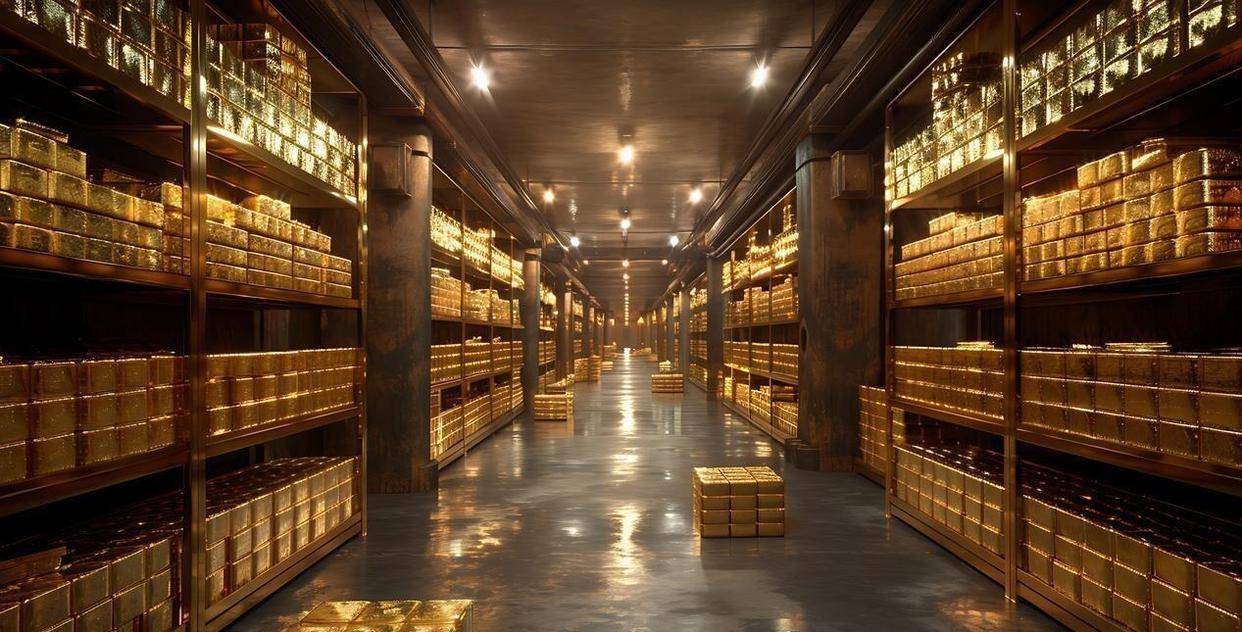
截至10月27日,全球最大黄金ETF--SPDR Gold Trust持仓较上日减少8.01吨,当前持仓量为1038.92吨
Xin Hua Cai Jing· 2025-10-28 00:46
Core Insights - As of October 27, the world's largest gold ETF, SPDR Gold Trust, saw a decrease in holdings by 8.01 tons, bringing the current holdings to 1,038.92 tons [1] Group 1 - The SPDR Gold Trust is the largest gold ETF globally [1] - The current holdings of SPDR Gold Trust stand at 1,038.92 tons [1] - The reduction in holdings is 8.01 tons compared to the previous day [1]
【黄金etf持仓量】10月24日黄金ETF较上一交易日减少5.44吨
Jin Tou Wang· 2025-10-27 07:22
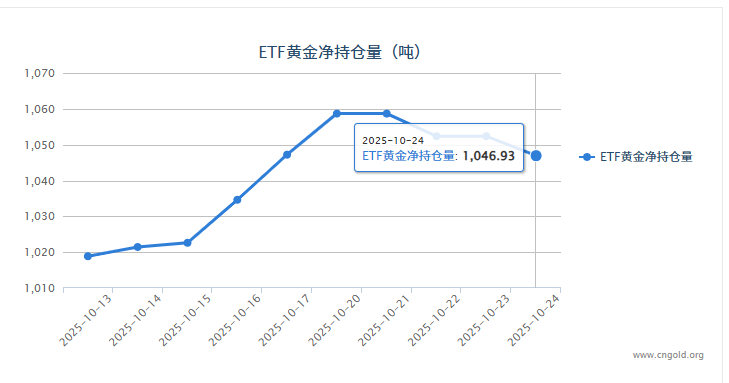
全球最大黄金ETF--SPDR Gold Trust持仓报告显示,10月23日黄金etf持有量为1046.93吨,与上一交易日 减少5.44吨。周四(10月23日)截止收盘,现货黄金报4110.69美元/盎司,跌幅0.38%,日内最高上探至 4144.21美元/盎司,最低触4043.69美元/盎司。 巴西总统卢拉:(就特朗普是否在会谈中做出承诺表示)不,总统无权做出承诺,特朗普向我保证我们 将达成协议,速度将超乎想象,我们必须追求我们想要的东西。 【市场要闻速递】 摘要全球最大黄金ETF--SPDRGoldTrust持仓报告显示,10月23日黄金etf持有量为1046.93吨,与上一交 易日减少5.44吨。周四(10月23日)截止收盘,现货黄金报4110.69美元/盎司,跌幅0.38%,日内最高上探 至4144.21美元/盎司,最低触4043.69美元/盎司。 中美经贸团队在马来西亚首都吉隆坡结束为期两天的磋商。路透社称,这是自今年5月以来中美经贸团 队的第五次面对面磋商。会谈结束后,贝森特在接受美媒采访时表示,经过吉隆坡为期两天的会谈,双 方达成了"非常实质性的框架协议",美方"不再考虑"对中国加征100% ...
贵金属小幅回调 "去美元化"支撑长线牛市
Jin Tou Wang· 2025-10-27 07:22
上周五的美国9月消费者物价指数(CPI)同比上涨3%,略低于经济学家预期的3.1%。但数据公布后只是 减缓了价格的跌幅,昨天的周评文章也有写,现阶段黄金价格的下调是健康的,至少较高位回吐10%水 平才是合理的(现在只有5%),因此本周我们继续观察金价的震荡下跌(不指望单边)。 市场方面,本周将有美联储决议,投资者将等待美联储主席鲍威尔的前瞻指引,普遍预计美联储将在12 月的会议上进一步降息。黄金作为一种不孳息资产,通常在低利率环境中表现较好。 另外,美国官员表示,中美两国高级经济官员周日已敲定一项贸易协议的框架,供两国元首在本周晚些 时候决定是否签署。该协议将暂停美方加征关税及中方稀土出口管制措施。 摘要周一(10月27日)欧盘时段,贵金属延续小幅回调状态,俄乌冲突缓和以及中美经贸谈判给市场风 险担忧缓和空间。在美国通胀数据走软后,金价反弹,但在关键阻力位下方依然脆弱。银价正在从近期 高点回调,目前强劲的支撑位支撑着看涨结构。美元指数继续盘整,盘整后可能恢复下跌压力 周一(10月27日)欧盘时段,贵金属延续小幅回调状态,俄乌冲突缓和以及中美经贸谈判给市场风险担 忧缓和空间。在美国通胀数据走软后,金价反弹,但在 ...
金价规律全面深度分析,史上8次金价大跌,藏着多少人血亏的真相
Sou Hu Cai Jing· 2025-10-26 14:34
Core Insights - The article discusses the historical volatility of gold prices, highlighting significant drops and the underlying factors that contribute to these declines, emphasizing that gold, often seen as a safe haven, can experience sharp downturns during crises [1][4][28]. Historical Context and Analysis - Gold has experienced dramatic price fluctuations throughout its history, with notable declines during economic crises, reflecting changes in the global financial system and providing valuable lessons for investors [4][5]. - The analysis will utilize historical event analysis to construct a comprehensive timeline of significant gold price drops, examining the market environment, triggering factors, and impacts on various economic sectors [5]. Early 20th Century Price Drops - During the gold standard period (1920-1932), gold prices remained stable, but the 1929 stock market crash led to a severe economic downturn, challenging the gold standard [9][10]. - The Great Depression (1929-1933) saw a re-evaluation of gold prices, with significant increases due to bank failures and gold hoarding, culminating in the U.S. abandoning the gold standard [10]. Post-Bretton Woods Price Fluctuations - The collapse of the Bretton Woods system in 1971 marked the beginning of gold's free-floating era, leading to significant price volatility [12]. - The first major drop post-Bretton Woods occurred between 1975-1976, where gold prices fell by 47% due to government intervention and profit-taking [13][14]. 1980s Price Collapse - The peak of gold prices in January 1980 at $850 per ounce was followed by a dramatic decline of 65% by mid-1982, driven by aggressive monetary policy changes and a strong dollar [16][17][18]. - The long-term bear market from 1980 to 2000 saw gold prices fluctuate between $250 and $500 per ounce, influenced by high interest rates and a strong dollar [20][23]. 21st Century Price Drops - The 2008 financial crisis led to an unexpected drop in gold prices, despite its traditional role as a safe haven, with prices falling over 30% during the crisis [28][32]. - The COVID-19 pandemic in March 2020 triggered a brief but severe drop in gold prices, similar to 2008, due to liquidity crises and forced selling [40][43]. Recent Adjustments - In October 2025, gold prices reached a record high of $4059 per ounce before experiencing a significant drop, highlighting the volatility and rapid changes in market sentiment [50][51]. - The recent adjustment was characterized by rapid declines, high trading volumes, and significant losses for leveraged investors, indicating a shift in market dynamics [52][53]. Common Characteristics of Price Drops - Key triggers for gold price declines include shifts in monetary policy, strong dollar performance, liquidity crises, and speculative bubbles [61][62]. - Historical data shows that significant price drops can occur rapidly, with single-day declines exceeding 12%, and longer-term bear markets lasting several years [64][65].
截至10月23日 全球最大的黄金ETF SPDR Gold Trust持仓量为1052.37吨
Xin Hua Cai Jing· 2025-10-23 23:32
(文章来源:新华财经) 截至10月23日,全球最大的黄金ETF SPDR Gold Trust持仓量为1052.37吨,较前一个交易日维持不变。 ...
New Russia Sanctions Trigger A Buy Signal On Oil And Give Gold Second Wind; Government May Back Quantum Computing - American Airlines Group (NASDAQ:AAL)
Benzinga· 2025-10-23 16:46
Core Insights - New sanctions on Russian oil are imposed on major companies Lukoil and Rosneft, restricting their ability to conduct business internationally, particularly affecting sales to India and China [7] - The sanctions are expected to reduce oil supply, potentially increasing prices, but there is a risk of Russian oil being sold at a discount in the black market [7] - The U.S. dollar's status as the reserve currency enables the enforcement of these sanctions, impacting global transactions involving Russian oil [7] Oil Market Analysis - The VUD indicator shows a strong net demand for oil, with the market sentiment indicating that oil is currently undervalued compared to other assets like stocks and gold [7] - Investors should be cautious as rising oil prices could lead to increased inflation, complicating the Federal Reserve's ability to cut interest rates [7] - Airlines and cruise lines may face negative impacts from rising oil prices, affecting their operational costs [7] Quantum Computing Sector - Government interest in quantum computing stocks has led to initial spikes in stock prices, but gains have diminished due to the small scale of potential government investments and lack of high-level discussions [7] - Companies like IONQ, Rigetti, and D-Wave are highlighted as key players in this sector [7] Sentiment and Market Trends - The sentiment among the "momo crowd" has shifted from extremely positive to negative, impacting stock performance [5] - Money flows in major stocks like Amazon, Alphabet, and Microsoft are positive, while flows in NVIDIA and Tesla are negative [6][8] - The overall market sentiment remains in the positive zone, influenced by the momo crowd's activities [7]