
奥特维

Search documents
“制造强国”实干系列周报(26、02、01期)-20260202
Shenwan Hongyuan Securities· 2026-02-02 07:11
Group 1: Commercial Aerospace - The commercial aerospace industry is experiencing upward trends due to accelerated progress in domestic and international computing constellations[5] - Key focus areas include satellite payloads, satellite platforms, space photovoltaics, application terminals, operational services, and rocket support[3] - The China Aerospace Science and Technology Corporation has significant external assets, indicating strong expectations for mergers and acquisitions[3] Group 2: Photovoltaic Industry - Rising silver prices are increasing cost pressures in the photovoltaic industry, making "de-silvering" a critical demand for battery mass production[3] - The adoption of N-type batteries has become mainstream, with silver paste costs in components rising to 21.4% by January 2026[30] - The laser technology is pivotal in supporting the de-silvering transition, enhancing efficiency and reducing material costs[31] Group 3: AI Glasses Market - Global sales of AI glasses are rapidly increasing, with Meta contributing significantly to growth, projecting 6 million units sold in 2025[3] - By 2026, global AI glasses sales are expected to reach 16 million units, with non-display AI audio and photography glasses being major contributors[40] - In Q4 2025, domestic and overseas sales of AI glasses were 24.5 million and 425 million units, respectively[40]
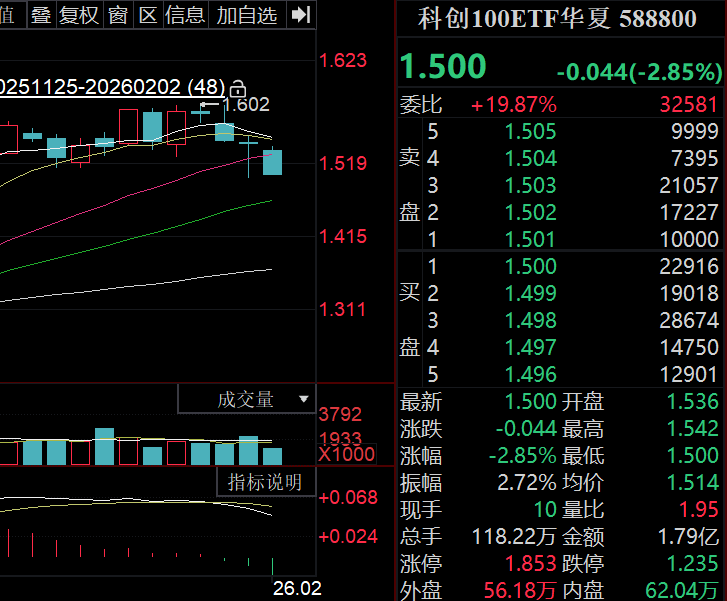
科创100ETF华夏(588800.SH)下跌2.85%,科创企业贷款支持力度不减
Mei Ri Jing Ji Xin Wen· 2026-02-02 03:22
2月2日上午,A股三大指数集体下跌,其中沪指下跌1.02%。截止10:58,科创100ETF华夏 (588800.SH)下跌2.85%。其他宽基指数中,上证50跌0.55%,科创50跌2.24%,创业板50跌1.02%,北 证50跌0.81%。 | 值 | | | 科创100ETF华夏 588800 | | | --- | --- | --- | --- | --- | | 0251125-20260202 (48) 合 | 1.623 | 1.500 | | -0.044(-2.85%) | | .602 | | 委北 | +19.87% | 32581 | | | | 5 | 1.505 | gggg | | | 1.519 | 卖4 | 1.504 | 7395 | | | | 3 | 1.503 | 21057 | | | | 盘2 | 1.502 | 17227 | | | 1.415 | 1 | 1.501 | 10000 | | | | 1 | 1.500 | 22916 | | | 1.311 | 买2 | 1.499 | 19018 | | | | 3 | 1.498 | 28674 | | ...

科创100ETF华夏(588800)盘中成交1.74亿,AI加速赋能医疗产业
Xin Lang Cai Jing· 2026-02-02 03:13
Group 1 - The core viewpoint is that AI is accelerating the transformation of the healthcare industry, with significant growth potential in companies like Huaxi Biological, which expects a net profit increase of 54.93%-83.63% by 2025 [1] - Huaxi Biological's stock led the gains in the Sci-Tech Innovation Board, rising by 7.70%, indicating strong market interest and confidence in its future performance [1] - The Sci-Tech 100 ETF has shown significant liquidity and growth, with a recent trading volume of 1.74 billion yuan and a 1.32 billion yuan increase in scale over the past two weeks [1] Group 2 - According to Everbright Securities, AI has become a core productivity driver in the new infrastructure of healthcare, with AI drug development and AI medical imaging being the most mature sectors [2] - The future competition in the AI healthcare space will focus on exclusive high-quality private data and the ability to create closed-loop business scenarios [2] - The Sci-Tech 100 ETF closely tracks the Sci-Tech 100 Index, which focuses on high-growth sectors including semiconductors, pharmaceuticals, and new energy [2]

未知机构:商业航天领航员东吴计算机王紫敬SpaceX申请100万颗算力星座抢占频-20260202
未知机构· 2026-02-02 02:05
【商业航天领航员|东吴计算机王紫敬】SpaceX申请100万颗算力星座,抢占"频轨"即抢占未来6G话语权 这不仅是算力的布局,更是对近地轨道资源的极限挤压。 核心逻辑升级: 1透过"算力"看本质,实为"太空圈地 【商业航天领航员|东吴计算机王紫敬】SpaceX申请100万颗算力星座,抢占"频轨"即抢占未来6G话语权 新闻事件: 1月31日,SpaceX向FCC提交申请,拟部署最多100万颗卫星用于大规模AI推理及数据中心,轨道高度500-2000公 里。 这不仅是算力的布局,更是对近地轨道资源的极限挤压。 核心逻辑升级: 新闻事件: 1月31日,SpaceX向FCC提交申请,拟部署最多100万颗卫星用于大规模AI推理及数据中心,轨道高度500-2000公 里。 这已不是商业选择,而是国家战略必争。 1透过"算力"看本质,实为"太空圈地": 虽然SpaceX名义上申请的是"AI算力卫星",但其部署高度(500- 2000km)正是近地轨道(LEO)的黄金地带。 在ITU"先申报先得"的规则下,申请100万颗实则是利用海量卫星物理锁死轨道资源和频谱资源。 未来3-5年将是发射量的指数级爆发期,这将对火箭运力(发动 ...
低轨星座竞赛与太空算力革命,引爆太空光伏需求新周期
GOLDEN SUN SECURITIES· 2026-02-01 10:08
Investment Rating - The report provides a positive investment rating for solar equipment suppliers, particularly highlighting companies like Maiwei Co., Ltd. and others with potential capabilities in the solar photovoltaic sector [7][33]. Core Insights - The demand for space photovoltaic systems is expected to surge due to the explosive growth in satellite deployment and AI computing power in space, with China planning to submit applications for 203,000 satellites by the end of 2025, while the U.S. has already launched over 10,000 satellites [1][10]. - New technological pathways such as P-type HJT and perovskite tandem cells are emerging, offering lower costs and improved performance compared to traditional gallium arsenide batteries, which are currently too expensive for large-scale deployment [2][27]. - The global manufacturing landscape is shifting, presenting historic opportunities for Chinese equipment and battery manufacturers to expand internationally, especially as the U.S. lacks capabilities in HJT and perovskite production lines [3][29]. Summary by Sections Section 1: Satellite Deployment and Space AI - The global low Earth orbit satellite deployment is entering a critical phase, with intense competition between China and the U.S. for orbital resources and frequency bands [10]. - The AI computing explosion is creating a new paradigm for space-based data centers, which can operate continuously under sunlight and utilize the cold of space for cooling, leading to exponential growth in demand for space photovoltaic systems [1][10]. Section 2: Technological Advancements - P-type HJT batteries and silicon/perovskite tandem cells are identified as the main directions for future space photovoltaic technology, with significant advantages in efficiency and cost [2][16]. - The report highlights the limitations of traditional gallium arsenide batteries, which are costly and reliant on scarce materials, making them unsuitable for large-scale satellite constellations [2][26]. Section 3: Global Market Dynamics - The report emphasizes that the demand for solar photovoltaic systems in space is set to enter a new cycle, benefiting domestic equipment and battery manufacturers as they transition from ground support to core space applications [29][30]. - Companies like Junda Co., Ltd., Trina Solar, and others are noted for their advancements in space-grade batteries and solar technologies, positioning them well for future growth in the space photovoltaic market [30][33].





光伏设备行业跟踪报告:SpaceX 申请百万卫星布局轨道 AI 数据中心,太空光伏与设备环节有望率先受益
国泰海通· 2026-02-01 03:04
Investment Rating - The report assigns an "Overweight" rating for the photovoltaic equipment industry, indicating a projected performance that exceeds the Shanghai and Shenzhen 300 Index by more than 15% over the next 12 months [4][12]. Core Insights - The report highlights that as SpaceX advances its satellite launches and related in-orbit applications, the trend of exploring orbital AI data centers is becoming evident. Photovoltaics are expected to gain more application opportunities in the construction of these data centers, benefiting related photovoltaic equipment manufacturers [2][4]. - The demand for photovoltaic solutions is anticipated to grow due to the increasing computational power requirements for data centers, shifting the logic of ground photovoltaic installations from power-driven to computation-driven [4]. - Key companies in the photovoltaic equipment sector are actively exploring opportunities in space photovoltaics, with notable advancements in technology and production capabilities [4]. Summary by Sections Investment Recommendations - The report recommends specific companies across different segments of the photovoltaic equipment industry: - **Cell Segment**: Recommended companies include Maiwei Co., Jiejia Weichuang, Laplace, and Dier Laser [4]. - **Module Segment**: Recommended company is Aotewei, with ST Jingji as a related company [4]. - **Wafer Segment**: Related companies include Gaoce Co., Jingsheng Mechanical & Electrical, Liancheng CNC, and Shuangliang Energy [4]. Company Profit Forecasts - The report provides earnings per share (EPS) forecasts for key companies in the industry: - **Maiwei Co.**: EPS forecast of 0.7 CNY for 2024, increasing to 1.3 CNY by 2026, with a PE ratio decreasing from 96.8 to 74.2 [5]. - **Aotewei**: EPS forecast of 4.0 CNY for 2024, remaining stable at 2.0 CNY for 2025 and 2026, with a PE ratio decreasing from 48.6 to 42.2 [5]. - **Jiejia Weichuang**: EPS forecast of 0.5 CNY for 2024, increasing to 0.9 CNY by 2026, with a PE ratio increasing from 16.9 to 33.9 [5]. - **Laplace**: EPS forecast of 0.7 CNY for 2024, increasing to 1.3 CNY by 2026, with a PE ratio decreasing from 33.6 to 25.5 [5]. - **Dier Laser**: EPS forecast of 1.9 CNY for 2024, increasing to 2.4 CNY by 2026, with a PE ratio decreasing from 36.8 to 27.0 [5].

“太空光伏”概念走热,业内:目前仍处于0到1阶段
Di Yi Cai Jing Zi Xun· 2026-01-30 13:27
Core Insights - The "space photovoltaic" concept has gained significant attention in the secondary market, largely influenced by Tesla CEO Elon Musk's endorsements [2] - The Wind Space Photovoltaic Index has risen by 19.83% over the past month, outperforming the Shanghai and Shenzhen 300 Index, which increased by 1.18% [2] - Several photovoltaic companies have experienced substantial stock price increases, with JunDa Co., Ltd. rising by 84.62% and Mingyang Smart Energy increasing by 60.22% in the last 20 days [2] Market Performance - The stock prices of companies like Dongfang Risen and Laplace have shown abnormal fluctuations, with price deviations exceeding 30% over consecutive trading days [3] - The space photovoltaic sector is characterized by its potential to harness solar energy in outer space, providing power to satellites and space stations [3] Industry Challenges - Despite the market enthusiasm, the commercialization of space photovoltaics faces significant uncertainties related to technology maturity and economic viability [4] - Industry insiders indicate that the application scenarios for space photovoltaics are still in the exploratory phase, with many companies not yet supplying products to commercial satellite firms [4] Technological Considerations - Current leading materials for space photovoltaics include gallium arsenide, which is costly at approximately 1000 RMB per watt, and perovskite, which faces stability issues in extreme space conditions [5] - The cost of electricity generated from space photovoltaics is estimated to be 2-3 USD per kilowatt-hour, significantly higher than the ground-based photovoltaic cost of 0.03-0.05 USD per kilowatt-hour [5] Future Outlook - Several A-share listed companies express optimism about the future of space photovoltaics, with potential market size reaching trillions as technology advances [5] - Companies like Trina Solar and HaiMuxing are actively collaborating with leading aerospace institutions to develop practical applications for space solar energy [5] - The commercialization of space photovoltaics is projected to gradually occur over the next 10 to 15 years as launch costs decrease and battery technologies improve [6]



“太空光伏”概念走热 部分企业触发交易异常 业内:目前仍处于0到1阶段
Di Yi Cai Jing· 2026-01-30 12:05
Core Viewpoint - The "space photovoltaic" concept has become a major focus in the secondary market, significantly influenced by Tesla CEO Elon Musk's endorsements, with the relevant index rising 19.83% in the past month, outperforming the CSI 300 index by 18.65% [1] Market Performance - The space photovoltaic concept index has shown strong performance, with notable stock increases: JunDa Co., Ltd. up 84.62%, Mingyang Smart Energy up 60.22%, Jiejia Weichuang up 44.04%, Dier Laser up 41.54%, and Tuori New Energy up 35.94% over the past 20 days [1] - Several photovoltaic companies have experienced significant stock price surges, triggering trading anomalies, such as Dongfang Risheng and Laplace, both exceeding a cumulative price deviation of 30% within a short period [2] Industry Insights - Space photovoltaic energy refers to utilizing solar photovoltaic technology in outer space to generate and supply energy, with the potential to transmit power wirelessly to Earth or supply satellites and space stations [2] - The rationale for space photovoltaics includes abundant sunlight in space and the feasibility of deploying photovoltaic components on satellites, with near-Earth satellites experiencing over 60% sunlight exposure [2] Challenges in Industrialization - Despite the rising stock prices, the industry faces significant uncertainties regarding the industrialization of space photovoltaics, including technological maturity and economic viability for large-scale commercialization [3] - Current applications of space photovoltaics are still exploratory, with many companies in the secondary market not yet supplying products to commercial space satellite companies [3] - Analysts indicate that space photovoltaics are in the early stages of development, requiring validation of technology and economic benefits for large-scale applications [3] Technological Considerations - Gallium arsenide is the mainstream material for space photovoltaics, but its high cost (approximately 1000 RMB per watt) poses challenges for large-scale deployment [4] - Perovskite technology shows promise but has stability concerns in extreme space conditions, necessitating further validation [4] - Multiple technological routes are being explored, with a focus on solving power and cost issues as critical for the commercialization of space energy solutions [4] Cost Analysis - Current estimates suggest that the cost of electricity from space photovoltaics is around $2-3 per kilowatt-hour, compared to $0.03-0.05 per kilowatt-hour for ground-based photovoltaics, indicating a potential cost disparity of up to 100 times [5] - Companies like Trina Solar and HaiMuxing express optimism about the future of space photovoltaics, citing collaborations with leading aerospace institutions and advancements in reusable rocket technology [5] Commercialization Timeline - Predictions indicate that space photovoltaics may gradually commercialize over the next 10 to 15 years, contingent on decreasing launch costs and breakthroughs in battery technology [6]
奥特维:公司对合并报表范围内子公司提供的担保总额约为18.63亿元
Mei Ri Jing Ji Xin Wen· 2026-01-30 11:52
每经头条(nbdtoutiao)——中国无人驾驶"军团","武装"阿布扎比 (记者 王晓波) 每经AI快讯,奥特维1月30日晚间发布公告称,公司为全资子公司无锡奥特维供应链管理有限公司(以 下简称"供应链公司")与宁波银行股份有限公司无锡分行(简称"宁波银行无锡分行")签署担保合同人 民币5000.00万元,期限为2026年1月13日至2027年1月31日;公司为全资子公司供应链公司与中国银行 股份有限公司无锡分行(简称"中国银行无锡分行")开立保函人民币11.41万元,期限为2025年12月31 日至2027年12月22日。公司为供应链公司的银行授信提供连带责任保证担保。 截至本公告披露日,公司对合并报表范围内子公司提供的担保总额约为18.63亿元,占公司最近一期经 审计净资产及总资产的比例分别为45.15%、13.28%。 ...
奥特维(688516) - 无锡奥特维科技股份有限公司关于为子公司提供担保的公告2026-014
2026-01-30 11:45
证券代码:688516 证券简称:奥特维 公告编号:2026-014 转债代码:118042 转债简称:奥维转债 无锡奥特维科技股份有限公司 关于为子公司提供担保的公告 本公司董事会及全体董事保证本公告内容不存在任何虚假记载、 误导性陈述或者重大遗漏,并对其内容的真实性、准确性和完整性承 担法律责任。 重要内容提示: 担保对象及基本情况 | 对外担保逾期的累计金额(万元) | 0.00 | | --- | --- | | 截至本公告日上市公司为合并子 公司提供担保总额(万元) | 186,335.49 | | 为合并子公司提供担保总额占上 市公司最近一期经审计净资产的 | 45.15% | | 比例(%) | | | 特别风险提示(如有请勾选) | □对外担保总额超过最近一期经审计净资产 | | | 100% | | | □担保金额超过上市公司最近一期经审计净 | | | 资产 50% | | | □对合并报表外单位担保金额达到或超过最 | | | 近一期经审计净资产 30%的情况下 | | | ☑对资产负债率超过 70%的单位提供担保 | | 其他风险提示(如有) | 无 | 一、担保情况概述 (一) 担保 ...