强脑科技

Search documents
脑机接口产业更新及重点标的推荐
2026-01-07 03:05
Q&A 脑机接口产业目前的市场行情如何?有哪些关键因素推动了这一领域的发展? 最近脑机接口市场行情非常火爆,主要是由于国内出台了利好政策,以及马斯 克在社交媒体上表示 Neuralink 将在 2026 年大规模生产脑机接口设备。这些 因素共同引爆了整个板块的情绪。脑机接口产业的发展关键在于快速商业化落 地,尤其是在非侵入式领域,企业需要具备强大的销售渠道能力、品牌力以及 与原有医疗业务的协同效应,以促进商业化落地速度和后续发展。 脑机接口产业更新及重点标的推荐 20260106 摘要 脑机接口产业正快速发展,商业化落地是关键,尤其在非侵入式领域, 企业需具备强大的销售渠道、品牌力及与原有医疗业务的协同效应,以 加速商业化进程。预计到 2025 年全球市场规模将达 30 亿美元,医疗 端应用将在 2030 年超过 400 亿美元。 脑机接口技术路径包括侵入式、半侵入式和非侵入式。侵入式信号质量 高但风险大,适用于重症患者;非侵入式安全性高,商业化快但竞争激 烈;半侵入式介于两者之间。美国企业多布局半侵入式,中国企业则以 非侵入式为主。 Neuralink 在侵入式脑机接口领域领先,已完成约 20 例人体植入, ...
脑机接口专家会议
2026-01-07 03:05
Summary of Neural Interface Technology Conference Industry Overview - The conference focused on the neural interface technology industry, particularly advancements made by Neuralink and domestic companies in China [1][3][4][5][10]. Key Points and Arguments Neuralink's Advancements - Neuralink has significantly reduced the cost of implantable devices, with fixture costs dropping by 95%, from approximately $5,000-$6,000 to a few hundred dollars [1][3][4]. - The electrode production cost remains high, at over $10,000 per electrode, but the implantation speed has improved from 20 seconds to 1.5 seconds per electrode, facilitating clinical applications [1][3][4]. - The company has entered clinical trials, utilizing BlackRock electrodes and developing its own implantation devices that combine electron microscopy and OCR systems for precise electrode placement [1][8][9]. Challenges in Neural Interface Technology - The industry faces challenges such as complex electrode production processes, low yield rates, and patent barriers, particularly regarding non-invasive puncture techniques patented by Musk [1][5][6]. - Domestic companies need breakthroughs in materials, processes, and patent strategies to compete effectively [1][5]. Comparison of Invasive and Semi-Invasive Techniques - Neuralink's fully invasive technology targets complex diseases, while domestic companies like BoruiKang focus on semi-invasive methods primarily for rehabilitation, which are less risky and costly [1][7][10]. - The main difference lies in the application: fully invasive techniques aim to treat severe conditions through deep neural stimulation, whereas semi-invasive methods are used for rehabilitation by repairing damaged nerves [1][7]. Domestic Industry Landscape - Domestic companies such as JieTi, Tiger Technology, and WeiLing have made progress in flexible electrodes but still lag behind international leaders like Neuralink in terms of channel count (128 channels vs. Neuralink's 1,024 channels) and other technical specifications [1][10]. - The downstream applications of the domestic neural interface industry account for 70% of the market share, focusing on rehabilitation devices and commercial products, while upstream investments in electrode and chip development are capital-intensive [1][10]. Clinical Applications and Future Directions - BoruiKang's semi-quantitative methods have been widely adopted in over 20 hospitals in China, with more than 200 clinical trials conducted in 2024 [12]. - The potential for interventionist neural interfaces is highlighted, with successful trials indicating a promising future if challenges like vascular blockage can be addressed [2][16]. Competitive Landscape - Companies like Medtronic have received FDA approval for their brain stimulators, showing significant efficacy in treating conditions like epilepsy, while competitors like Pinchi Medical face challenges due to patent restrictions [14][25]. - The market for deep brain stimulation (DBS) devices is still developing, with no fully mature embedded products available yet [25]. Additional Important Insights - The domestic neural interface industry is characterized by a high investment threshold in the upstream sector, with a typical investment ratio of 3:1 or 4:1 favoring downstream applications [10]. - The technology's application in treating neurological diseases is expanding, with potential uses in conditions like Alzheimer's and depression through adaptive neural regulation [19]. This summary encapsulates the key discussions and insights from the neural interface technology conference, highlighting both advancements and challenges within the industry.
脑机接口,突传重磅!
Zheng Quan Shi Bao· 2026-01-07 03:00
Core Insights - The brain-computer interface (BCI) sector is experiencing significant growth, highlighted by the recent completion of approximately 2 billion yuan financing by Qiangnao Technology, marking it as the second-largest financing in the field globally, after Neuralink [1][2] Industry Overview - The BCI sector has become the hottest investment track in the A-share market since the beginning of 2026, with multiple stocks such as Innovation Medical, Aipeng Medical, and Xiangyu Medical achieving consecutive trading limits [1] - The industry is currently driven by both policy support and technological breakthroughs, with expectations for Neuralink's large-scale production and automated surgical solutions marking a transition from clinical validation to commercial viability [3] Company Highlights - Qiangnao Technology, founded in February 2015, focuses on non-invasive BCI technology and has received FDA and CE certifications, making it one of the largest investors in BCI R&D globally [2] - The company has launched several products, including smart bionic limbs and brain-machine intelligent sleep devices, and has been recognized by TIME magazine as one of the best inventions of the year [2] Recent Developments - On January 6, multiple BCI stocks, including Sanbo Brain Science and Maillande, issued announcements regarding abnormal trading fluctuations, warning investors of potential risks [4][5][6] - Sanbo Brain Science, while experiencing significant stock price increases, clarified that it does not engage in BCI product development, and its revenue from neuro-regulation technology is minimal [4] - Maillande and Xiangyu Medical also reported that their BCI products are still in the R&D phase and have not yet achieved significant sales impact [5][6]



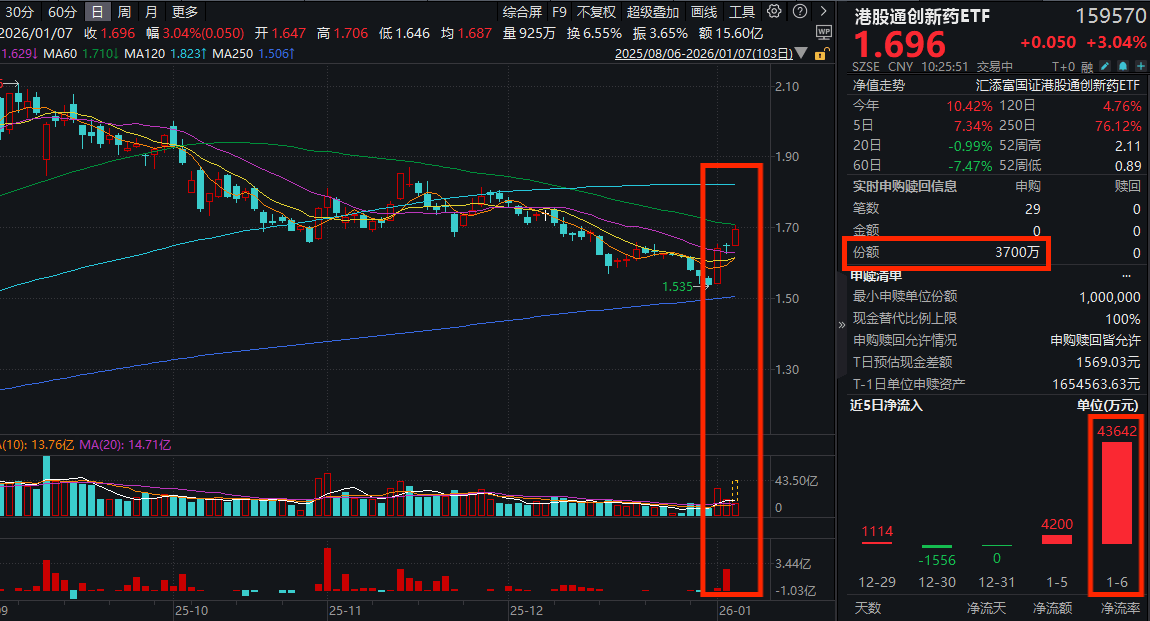
创新药行情卷土重来!港股通创新药ETF(159570)大涨3%,昨日净流入超4.3亿元!美联储降息大消息!
Xin Lang Cai Jing· 2026-01-07 02:45
Group 1: Market Performance - Hong Kong's innovative drug ETF (159570) surged by 3%, with a trading volume exceeding 1.5 billion yuan, following a net inflow of over 62 million yuan today after a previous inflow of 430 million yuan [1][3] - As of January 6, the latest scale of the Hong Kong innovative drug ETF reached over 23.3 billion yuan, leading its peers in the same category [1] Group 2: Economic Signals - Federal Reserve Governor Milan indicated that upcoming economic data may support further interest rate cuts, with expectations of a reduction exceeding 100 basis points this year [3] - Wall Street analysts suggest that if the U.S. unemployment rate rises to 4.7% by December 2025, the Fed may cut rates by 25 basis points this month [3] Group 3: Company Developments - Brain-computer interface "unicorn" Strong Brain Technology completed a financing round of 2 billion yuan, second only to Musk's Neuralink [3] - AI pharmaceutical company Insilico Medicine announced a long-term collaboration with Siveya for anti-tumor drug development, with a total deal value of 888 million USD [3] Group 4: New Drug Approvals - On January 6, BeiGene announced that its self-developed BCL2 inhibitor, Baiyueda® (sotucumab), received conditional approval from the National Medical Products Administration [3] - Shiyao's SYS6017 has initiated Phase II clinical trials for the prevention of shingles [3] Group 5: Investment Insights - Zhongtai Securities predicts that the pharmaceutical sector's opportunities in 2025 will focus on innovation and industry upgrades, with investment strategies continuing into 2026 [5] - The report emphasizes the importance of "innovative drugs and industry chains, demand recovery, and AI" as key investment dimensions [5] Group 6: J.P. Morgan Healthcare Conference - The 44th J.P. Morgan Healthcare Conference is set to take place from January 12 to 15, 2026, in San Francisco, attracting over 8,000 global participants [6] - The conference will feature over 500 listed companies and thousands of startups, focusing on "capital + strategy" discussions [6] Group 7: Industry Trends - Three major trends are highlighted for 2026: the continued rise of gene and cell therapies, deep integration of AI in pharmaceuticals, and the emergence of new market forces [7] - The report notes that over 20 gene editing companies will showcase breakthroughs in CAR-T and base editing at the conference [7] Group 8: MNC Engagement - Multinational corporations (MNCs) are willing to pay higher prices for innovative drugs from China, with the average total package for drugs purchased from China being 2.76 billion USD, compared to 1.29 billion USD for those from overseas [8] - The willingness of MNCs to pay a premium for Chinese innovations is driven by the need to fill significant pipeline gaps due to impending patent expirations [8] Group 9: Investment Focus - Investment strategies should focus on companies with strong clinical development capabilities and those in popular therapeutic areas such as ADCs, GLP-1, and dual antibodies [11] - Companies that can produce high-quality late-stage clinical assets are likely to attract MNC interest [11] Group 10: Key Therapeutic Areas - The report identifies key therapeutic areas for investment, including ADCs, GLP-1, dual antibodies, and neuroscience, emphasizing the need for innovative platforms and clinical data superiority [12]




A股开年主线浮现,脑机接口风口正劲 热潮背后多只个股提示风险
Xin Hua Cai Jing· 2026-01-07 02:30
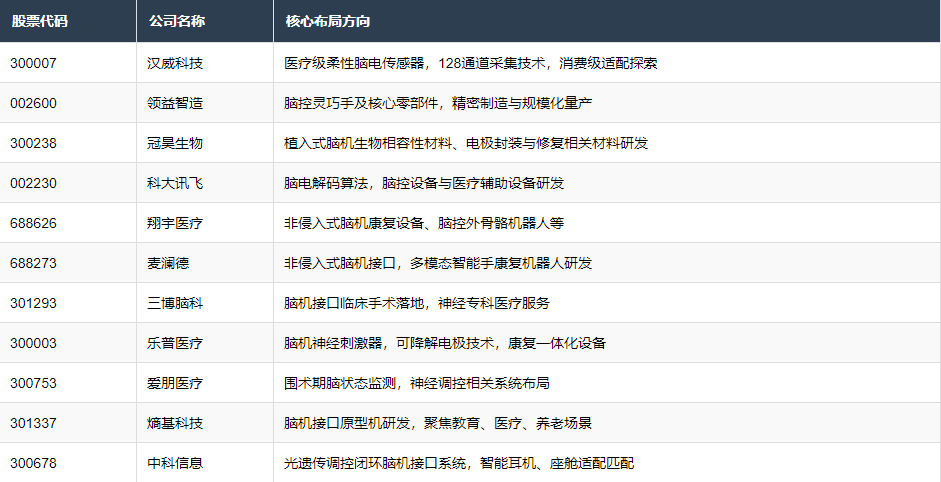
新华财经北京1月7日电(丁晶、董道勇)新年伊始,脑机接口概念股集体"沸腾",近20只个股连续两个交易日涨停。板块"开门红"缘 于市场对脑机接口巨大潜在需求、产业化进展提速及国家战略支持的叠加效应。 值得注意的是,新华财经数据显示,2026年1月5日该板块主力净流入29亿元,而6日主力资金开始净流出,规模近20亿元,但创新医 疗、爱朋医疗仍受主力资金追捧,继续保持净流入。分析认为,脑机接口行业正迎来"技术与商业化共振"的时刻,2026年脑机接口商 业化进程有望加速,并从医疗刚需向AI应用、机器人等多领域渗透。 长期来看,技术与合规双壁垒及业务联动长期看好头部企业形成技术与合规双壁垒,技术上具备核心专利、领先的研发能力,合规上 符合医疗行业严格的监管要求,如通过国家药监局的行业标准认证等。此外,关注传统业务与脑机接口业务具备联动性的企业,这类 企业可借助原有资源加速脑机接口业务的发展,同时脑机接口业务也能为传统业务带来新的增长极。 对于脑机接口加速"接入"现实,需要关注哪些细分领域? 国信证券陈曦炳团队指出, 这是一个从0到1的增量市场。短期内,市场情绪受Neuralink量产预期和国内政策利好驱动,具备高爆发 ...
小米发布处罚声明;芯片巨头齐聚CES丨科技风向标
2 1 Shi Ji Jing Ji Bao Dao· 2026-01-07 02:28
Group 1: Technology Developments - Amazon launched a new AI chatbot website, Alexa.com, available to all Alexa+ early experience users, allowing online use similar to other AI chatbots like ChatGPT and Google's Gemini [2] - ZhiYuan introduced the SOP (Scalable Online Post-training) system aimed at achieving scalable deployment and intelligent operation of general-purpose robots in real-world environments [4] - iFlytek reported that its Starfire model training efficiency has been optimized to 85%-95% compared to NVIDIA's A100, following significant investments in domestic computing power solutions [5] Group 2: Corporate Actions and Partnerships - RoboTech's subsidiary ficonTEC signed a significant contract worth approximately €770,000 (about 63.08 million RMB) with a Swiss client for an automated optical switch packaging line, which will positively impact the company's operations [6] - Blue Glass Technology confirmed its strategic investment in Strong Brain Technology, exclusively undertaking the mass production of core hardware modules [8] - Aihua Long signed a strategic cooperation framework agreement with Shenzhen Brain Machine Star Chain Technology, focusing on market expansion and sales of brain-machine interface products [10] Group 3: Product Launches and Innovations - Hisense unveiled its new RGB Mini LED display technology at CES 2026, featuring a four-color chip architecture to enhance color performance [9] - AMD introduced the MI455X GPU and a 72-card server named "Helios," anticipating a significant increase in active AI users from 1 billion to 5 billion by 2030 [12] - Intel launched its third-generation Core Ultra series processors, marking a new era for AI PCs with edge AI computing power reaching 180 TOPS [13][14] Group 4: Financing and Market Movements - MiniMax's IPO was oversubscribed by over 1,200 times, raising more than 253.3 billion HKD, indicating strong market interest [17] - Strong Brain Technology completed approximately 2 billion RMB in financing, becoming the second-largest financing in the brain-machine interface sector after Neuralink [18] - ZhiZhan Technology successfully raised nearly 300 million RMB in its C round of financing, focusing on silicon carbide power modules and advanced electric drive systems [18] Group 5: Mergers and Acquisitions - Guanshang Technology announced plans to acquire 100% of Liao Jing Electronics, a key player in the defense technology sector, aiming for complementary and synergistic effects [19]


1.7盘前速览 | 两市成交破2.8万亿,卫星持续冲高,关注有色矿业与半导体
Jin Rong Jie· 2026-01-07 02:01
Macro - The People's Bank of China plans to implement a moderately loose monetary policy by 2026, establishing a mechanism to provide liquidity to non-bank institutions under specific scenarios to support capital markets [1] Satellite Internet - The first commercial rocket company in China, Kegong Rocket, is set to change ownership with an overall valuation of approximately 11.2 billion yuan [2] Semiconductor - NVIDIA's BlueField-4 is expected to reconstruct the AI storage hierarchy, potentially opening up new demand for NAND [3] - NVIDIA's CEO Jensen Huang announced at CES that the era of "physical AI" has arrived [7] Pricing Strategies - Seagate plans to increase product prices by 10% each quarter [4] Non-ferrous Metals - China has announced a ban on all dual-use items for military purposes to Japan, affecting critical metal materials such as rare earths, tungsten, molybdenum, indium, lithium, and titanium alloys [5] Artificial Intelligence - Market discussions regarding NVIDIA's next-generation Rubin platform specifications indicate no issues with downgrading [6] Robotics - Tesla's official recruitment platform has posted job openings related to "covering materials and soft products" for the Optimus robot [8] New Energy - A meeting for the power and energy storage battery industry is scheduled for January 7 [9] - Feedback from the industry indicates extremely low inventory levels of lithium carbonate and strong demand, with two listed companies in lithium iron phosphate confirming price increases [10] - Australia has significantly increased subsidies for home battery systems [11] - The organic silicon industry plans to intensify production cuts [12] Brain-Computer Interface - The brain-computer interface "unicorn" Qiangna Technology has completed a financing round of 2 billion yuan [13] Intelligent Driving - NVIDIA has released an open-source model family for autonomous driving, aimed at addressing long-tail issues and accelerating the implementation of intelligent driving [14] Market Dynamics - Guosheng Technology and Jiamei Packaging are under suspension for verification; Fenglong Co. has issued a warning about stock fluctuations; several commercial aerospace and brain-computer interface companies have released announcements regarding stock movements [15] - In December 2025, the number of new A-share accounts opened on the Shanghai Stock Exchange increased by approximately 9% month-on-month and surged by 30.55% year-on-year [15] Strategy Observation - On Tuesday, trading volume reached 2.81 trillion yuan, with a significant increase in market sentiment; however, rapid gains and the activation of financial sectors may raise concerns about the "healthy bull" rhythm [16] - The regulatory authorities have released signals of concern through suspensions and announcements, which may provide divergence opportunities for the market, but substantial cooling requires sustained measures [16] - Sectors such as non-ferrous metals, non-bank financials, and chemicals led the gains, indicating active institutional investment [16] - The thematic sectors, particularly those related to Musk's industries (intelligent driving and robotics), performed actively; while the semiconductor sector (e.g., storage) has solid logic, it has not yet become a focal point, with potential for future attention [16] - Currently, large funds tend to operate around mainline capacity varieties [16]


霸王茶姬回应“徒手打奶茶”;李在镕在北京买了100个Labubu;马斯克旗下xAI公司完成200亿美元融资;微信辟谣好友太多会被封...
Sou Hu Cai Jing· 2026-01-07 01:30
Group 1: Market Regulation and Standards - The State Administration for Market Regulation is accelerating the update and upgrade of a batch of national standards for green consumption to create a favorable market environment and enhance public satisfaction [4] Group 2: Taxation on Cosmetic Surgery - Starting from January 1, 2026, cosmetic surgery will be subject to value-added tax, while medical services provided by medical institutions will remain exempt from this tax [5] Group 3: Corporate Responses and Actions - Bawang Tea responded to a viral video of a staff member preparing tea with bare hands, stating it was a staged act for social media and not for sale, leading to the indefinite closure of the store and disciplinary actions against involved staff [6][7][8] - Xiaomi announced disciplinary actions against employees involved in a KOL engagement incident, including termination and performance penalties for senior management [12] Group 4: Financial and Investment News - MiniMax's IPO was oversubscribed by 1209 times, with a total subscription amount of over 253.3 billion HKD, set to officially list on January 9 [25] - Qiang Brain Technology, a brain-computer interface company, completed a financing round of approximately 2 billion RMB, marking it as the second-largest financing in the sector after Neuralink [25] - Liko.ai announced the completion of its first round of financing, aimed at developing visual language models and AI-native hardware [26] Group 5: Technology Developments - AMD's CEO stated that AI computing power needs to increase by 100 times in the coming years to meet the growing demand, with active AI users rising from 1 million to 1 billion since the launch of ChatGPT [22] - ByteDance's AI glasses are planned for a production run of about 100,000 units, primarily targeting dedicated users rather than a public sale [27]
A股密集公告!最火赛道再迎重磅利好!
天天基金网· 2026-01-07 01:09
Core Viewpoint - The brain-computer interface (BCI) sector is experiencing significant growth and investment, highlighted by the recent 2 billion yuan financing of Qiangnao Technology, marking it as the second-largest financing in the field after Neuralink [3][4]. Group 1: Investment and Market Dynamics - Qiangnao Technology, part of the "Hangzhou Six Little Dragons," has completed approximately 2 billion yuan in financing, positioning itself as a major player in the BCI market [3][4]. - The BCI sector has become the hottest investment track in A-shares since the beginning of 2026, with multiple stocks like Innovation Medical, Aipeng Medical, and Xiangyu Medical achieving consecutive trading limit increases [3]. - The market is witnessing a surge in interest, with several BCI-related stocks announcing abnormal trading fluctuations, prompting warnings about investment risks [7]. Group 2: Company Developments - Qiangnao Technology, founded in 2015, focuses on non-invasive BCI technology and has received FDA and CE certifications, making it one of the largest investors in BCI R&D globally [4][5]. - The company has launched several products, including smart bionic limbs and brain-machine sleep aids, and has been recognized by Time magazine as one of the best inventions of the year [4]. - Qiangnao's investor lineup includes prominent institutions such as IDG and various strategic partners, indicating strong market confidence [4]. Group 3: Industry Trends and Future Outlook - The BCI industry is in a high-growth phase driven by policy support and technological breakthroughs, with expectations for large-scale production and automated surgical solutions from companies like Neuralink [6]. - The transition from clinical validation to commercial scalability is underway, suggesting that BCI technology is moving towards becoming widely accessible products rather than just experimental tools [6]. - Companies like Xiangyu Medical and Weisi Medical are focusing on non-invasive BCI technologies, although they currently have limited revenue contributions from these products [8][9].
星河动力将发射“谷神星一号海射型”商业运载火箭 强脑科技完成约20亿融资
Xin Lang Cai Jing· 2026-01-07 00:46
Group 1: Data Standards and Regulations - The National Bureau of Statistics announced that by 2026, China will introduce over 30 national standards in the data field, focusing on emerging areas such as intelligent agents and embodied intelligence [2] - The development of standards for public data, high-quality datasets, and data infrastructure will be accelerated, along with key standards for urban digital transformation and a national integrated computing network [2] - In 2025, China developed 48 national standards and technical documents in the data field, with over one-third undergoing simultaneous validation trials during the drafting process [2] Group 2: Technology Developments - Huang Renxun stated at CES that server racks equipped with the new Rubin chip can be cooled without water cooling systems, requiring airflow similar to that of racks with Blackwell chips [3] - Following Huang's comments, data center cooling concept stocks experienced significant declines, with companies like Johnson Controls and Trane Technologies dropping by 10% and Modine by 20% [3] Group 3: Financing and Investment - XAI announced it raised $20 billion in its E round of financing, surpassing its $15 billion target, with strategic investors including Nvidia and Cisco [4] - Qiang Brain Technology, a brain-computer interface "unicorn," completed approximately 2 billion yuan in financing, making it the second-largest financing in the brain-computer interface field after Neuralink [5] Group 4: Market Trends - Two listed companies in lithium iron phosphate confirmed price increases of 1,500 to 2,000 yuan per ton for major clients [6] - Companies like Xiangyu Medical and Weisi Medical are focusing on non-invasive brain-computer interface technologies, but have not achieved large-scale sales as of the end of 2025 [7][8] - Micron's products in the brain-computer interface field are still in the research and market cultivation phase, with no significant impact on company performance yet [9] Group 5: Corporate Actions - Chip Origin announced the completion of the acquisition of Zhudian Semiconductor, with a new registered capital of 9.5 billion yuan, making it the largest shareholder [11] - Shengke Communication's second-largest shareholder plans to reduce its stake by up to 3% through trading methods [12] - Yandong Micro's fourth-largest shareholder reduced its stake from 6.08% to 6.00% as part of a previously disclosed plan [13]