
招商银行

Search documents
我国系统重要性银行名单发布,共计21家
Xin Lang Cai Jing· 2026-02-14 07:12
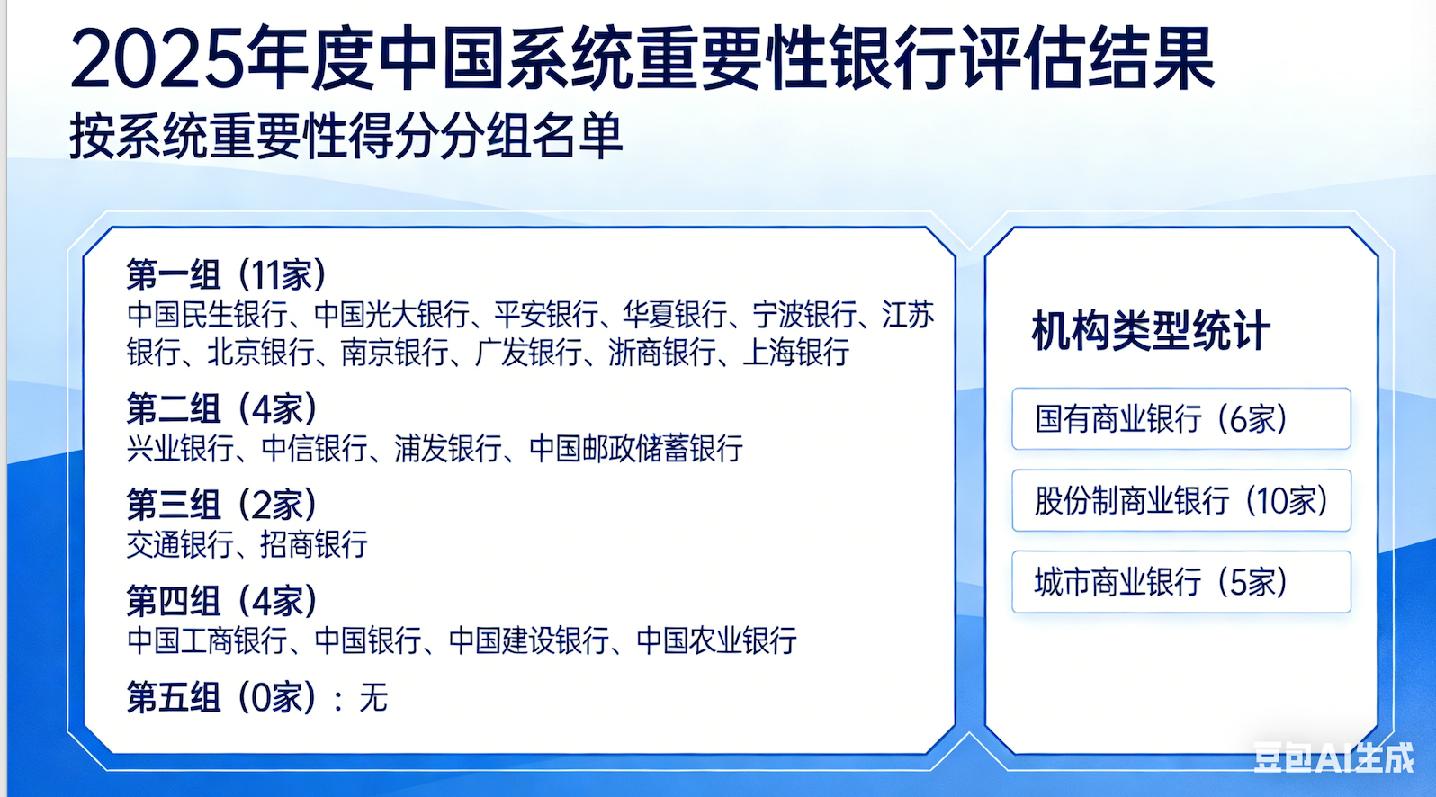
第五组,暂无银行进入。 记者2月13日从中国人民银行了解到,近期中国人民银行、国家金融监督管理总局开展了2025年度我国 系统重要性银行评估,认定21家国内系统重要性银行,其中国有商业银行6家、股份制商业银行10家、 城市商业银行5家。 中国人民银行表示,下一步将持续夯实系统重要性银行附加监管,促进系统重要性银行安全稳健经营和 健康发展,更好服务实体经济高质量发展。 按系统重要性得分从低到高分为五组: 第三组2家,包括:交通银行、招商银行; 第四组4家,包括:中国工商银行、中国银行、中国建设银行、中国农业银行; 第一组11家,包括:中国民生银行、中国光大银行、平安银行、华夏银行、宁波银行、江苏银行、北京 银行、南京银行、广发银行、浙商银行、上海银行; 第二组4家,包括:兴业银行、中信银行、浦发银行、中国邮政储蓄银行; 来源:央视新闻 ...
系统重要性银行分层洗牌:谁在晋级,谁在降组?
Jing Ji Guan Cha Wang· 2026-02-14 06:32
Core Insights - The People's Bank of China and the National Financial Regulatory Administration released the list of systemically important banks (D-SIBs) for 2025, expanding the number of institutions from 20 to 21, with Zheshang Bank being the new addition [1][3] - The list reflects a significant internal reshuffling, with Industrial Bank being downgraded from the third group to the second group, indicating a re-evaluation of systemic risk profiles by regulators [3][8] Group Summaries - **First Group (10 Banks)**: Includes China Everbright Bank, China Minsheng Bank, Ping An Bank, Huaxia Bank, Ningbo Bank, Jiangsu Bank, Guangfa Bank, Shanghai Bank, Nanjing Bank, and Beijing Bank [5] - **Second Group (4 Banks)**: Comprises CITIC Bank, Shanghai Pudong Development Bank, China Postal Savings Bank, and now includes Industrial Bank [5][8] - **Third Group (3 Banks)**: Contains Bank of Communications, China Merchants Bank, and Industrial Bank [5][6] - **Fourth Group (4 Banks)**: Dominated by the four major state-owned banks: Industrial and Commercial Bank of China, Bank of China, China Construction Bank, and Agricultural Bank of China [5][6] - **Fifth Group (0 Banks)**: No banks are currently classified in this group, which has the highest additional capital requirements [10] Zheshang Bank's Inclusion - Zheshang Bank's inclusion in the first group is attributed to its performance across four dimensions: scale, interconnectedness, substitutability, and complexity, achieving a weighted score that meets the threshold [6][11] - As of Q3 2025, Zheshang Bank's asset size reached 3.39 trillion yuan, with a core Tier 1 capital adequacy ratio rising by 0.02 percentage points to 8.40% [6][11] Industrial Bank's Downgrade - Industrial Bank's downgrade to the second group signifies a reduction in regulatory costs, as the additional capital requirement drops from 0.75% to 0.5%, potentially freeing up hundreds of billions in capital [8][10] - The downgrade reflects a shift in the competitive landscape, where Industrial Bank's relative advantages in market operations may have diminished due to the performance of peer banks [8][11] Regulatory Dynamics - The release of the new list comes after a gap of nearly 18 months, indicating a shift in regulatory oversight and a more cautious approach to data evaluation by the authorities [9][10] - The regulatory framework emphasizes both macro-prudential and micro-prudential management, requiring banks to meet various additional capital and leverage ratio requirements based on their group classification [10][11]



系统重要性银行扩围至21家:浙商银行突围,兴业银行跌落第三组
Jing Ji Guan Cha Wang· 2026-02-14 06:32
Core Viewpoint - The People's Bank of China and the National Financial Regulatory Administration have updated the list of Domestic Systemically Important Banks (D-SIBs), increasing the total from 20 to 21, with Zhejiang Commercial Bank being newly included [2][3]. Group Summaries Group 1 - The first group now includes 10 banks, such as China Everbright Bank, Minsheng Bank, and Ping An Bank, reflecting a strong position in the financial system [6]. - Zhejiang Commercial Bank's inclusion in this group indicates its significant role and improved risk profile within the banking sector [4][8]. Group 2 - The second group consists of four banks, including Citic Bank, Shanghai Pudong Development Bank, and Postal Savings Bank, with the addition of Industrial Bank [3][6]. - The adjustment of Industrial Bank to this group signifies a shift in its risk assessment and regulatory requirements [4]. Group 3 - The third group includes three banks: Bank of Communications, China Merchants Bank, and Industrial Bank, which maintain advantages in cross-regional operations and market coverage [3][6]. - The downgrade of Industrial Bank from the third to the second group reflects a relative loss of competitive edge in the financial market [6]. Group 4 - The fourth group remains unchanged with the four major state-owned banks: ICBC, ABC, BOC, and CCB, which continue to be the backbone of the national financial system [3][6]. - These banks are subject to the highest regulatory scrutiny due to their systemic importance [3]. Regulatory Insights - The update of the D-SIB list demonstrates a dynamic adjustment in the assessment of systemic risk, emphasizing the importance of both macro and micro-prudential regulations [3][7]. - The additional capital requirements for each group range from 0.25% to 1.5%, with the first group facing the lowest and the fifth group (currently empty) facing the highest [7][8]. - The regulatory framework aims to ensure that banks not only meet micro-level indicators but also adhere to macro-level capital and leverage requirements [7].
我国系统重要性银行上新
Zhong Guo Xin Wen Wang· 2026-02-14 05:45
中新网北京2月14日电2月13日,我国系统重要性银行名单公布。 21家国内系统重要性银行入选其中,包括6家国有商业银行、10家股份制商业银行和5家城市商业银行。 按系统重要性得分从低到高分为五组:第一组11家,包括中国民生银行、中国光大银行、平安银行、华 夏银行、宁波银行、江苏银行、北京银行、南京银行、广发银行、浙商银行、上海银行;第二组4家, 包括兴业银行、中信银行、浦发银行、中国邮政储蓄银行;第三组2家,包括交通银行、招商银行;第 四组4家,包括中国工商银行、中国银行、中国建设银行、中国农业银行;第五组暂无银行进入。 什么是系统重要性银行?入选意味着什么? 按照《系统重要性银行评估办法》,系统重要性是指金融机构因规模较大、结构和业务复杂度较高、与 其他金融机构关联性较强,在金融体系中提供难以替代的关键服务,一旦发生重大风险事件而无法持续 经营,可能对金融体系和实体经济产生不利影响的程度。 二是兴业银行被调整至第二组。 自2021年系统重要性银行名单披露以来,兴业银行一直属于第三组。 对于此次位次调整,董希淼认为,系统重要性银行评估基于规模、关联度、可替代性、复杂性等维度, 组别下调通常反映其在这些维度的综 ...
2026年1月金融数据点评:存款搬家加速,M1、M2增速大幅回升
GF SECURITIES· 2026-02-14 05:23
Investment Rating - The industry rating is "Buy" [6] Core Insights - The overall social financing growth slightly declined to 8.2% in January, while M1 and M2 growth rates significantly rebounded, with M1 growing by 4.9% and M2 by 9.0% [6][16] - Government net financing increased significantly by 2,831 billion yuan year-on-year, contributing to the overall social financing growth [6][17] - The report indicates a shift in deposit structure due to accelerated deposit migration, impacting M1 negatively while having limited effect on M2 [6][16] Summary by Sections Overall Situation - Social financing growth decreased slightly to 8.2%, while M1 and M2 growth rates increased significantly [15][16] - M1 and M2 growth rates rose by 1.1 percentage points and 0.5 percentage points respectively compared to the previous month [6][16] Government Sector - Fiscal strength showed a year-on-year decline, impacting overall financing dynamics [39] Household Sector - Demand remained stable year-on-year, with short-term loan demand increasing [39] Corporate Sector - Short-term loan demand increased year-on-year, while bill financing saw a significant reduction [39] Non-Bank Sector - The acceleration of deposit migration was noted, with non-bank deposits increasing by 1.45 trillion yuan year-on-year [6][39]



金价疯涨并不是牛市,而是警报!全球银行狂囤金,旧秩序正在碎裂
Sou Hu Cai Jing· 2026-02-14 05:14
地缘政治风险从短期扰动变成了长期定价因素。 美伊冲突、中东局势、俄乌战争,这些事件不再引发金价的短线 波动后迅速回落,而是持续推高金价的定价中枢。 2026年1月,美国与伊朗、格陵兰岛及部分欧洲地区地缘政治 紧张升级,持续激发投资者对黄金的兴趣。 反过来,只要一有和谈消息,比如美委突然说要坐下来谈,金价当天 就可能下跌5.68%。 这说明当前价格很虚,靠的是"万一出事"的预期,而不是"已经出事"的事实。 金价冲上4985美元,不是牛市,而是全球美元信用体系松动的警报。 2026年2月13日,国际金价在剧烈震荡中触 及4985美元,随后又回落至4950美元附近徘徊。 这种价格走势与历史上任何一次黄金牛市都截然不同。 一个月前 的1月29日,金价曾飙升至每盎司5598.75美元的历史巅峰,但随后三天内直线下挫,最低探至4402.06美元,跌幅 超过21%。 市场像坐上了过山车,而驱动它的,不再是简单的供需关系。 价格的剧烈波动成了常态。 2026年1月,伦敦金现价格单月上涨了13.01%,首次站上5000美元大关。 但这种飙升 伴随着极端的日内震荡。 1月30日,伦敦金现遭遇了40年来最大单日跌幅,下跌超过9.2 ...

离岸人民币破6.89!三股力量推升A股,四大板块暗藏玄机
Sou Hu Cai Jing· 2026-02-14 05:12
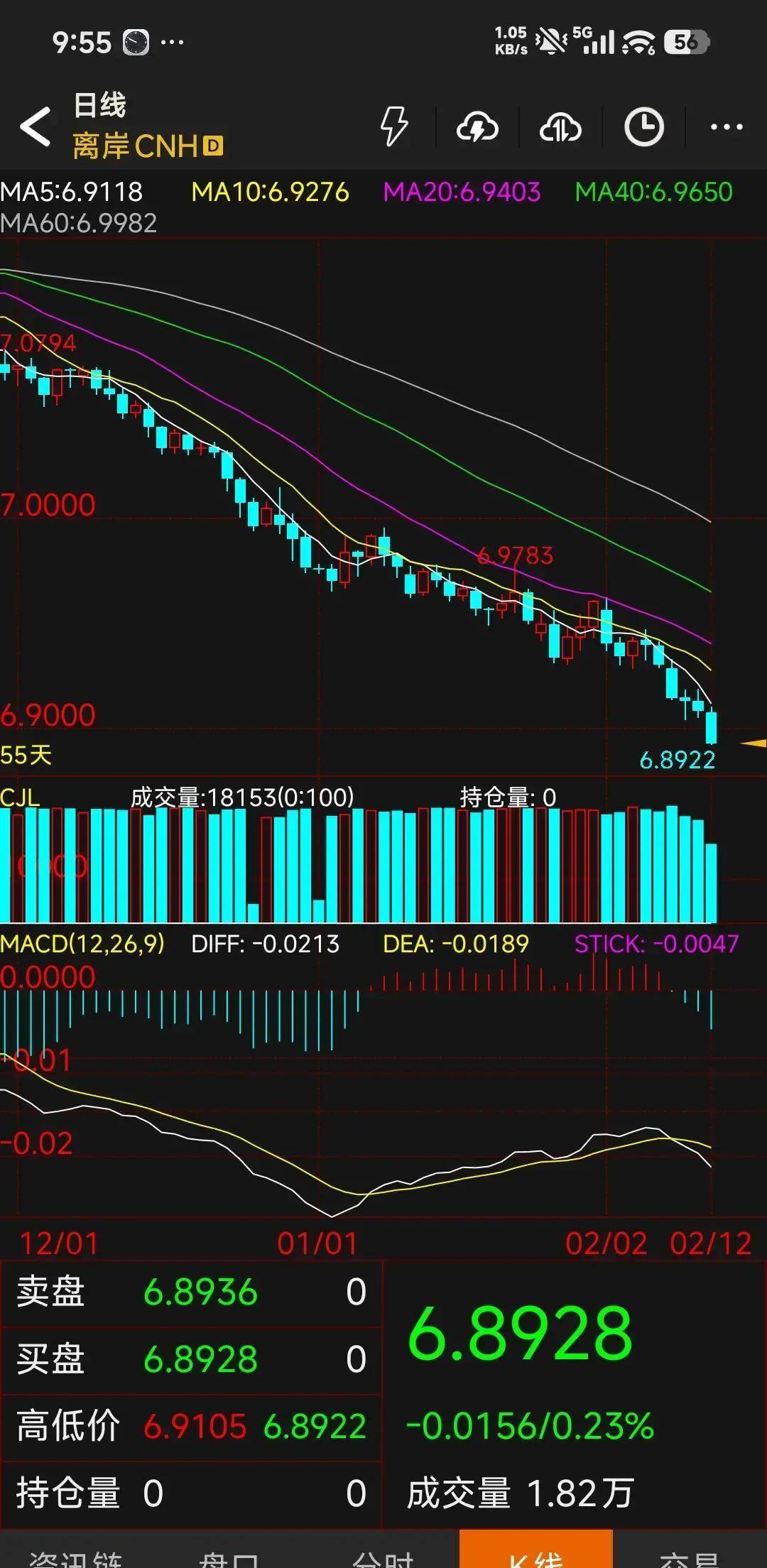
Core Viewpoint - The offshore RMB has strengthened significantly, breaking the 6.89 mark, driven by reduced expectations for Fed rate hikes, continuous foreign capital inflow, and steady improvement in the Chinese economy, making RMB a focal point in the market [1] Group 1: Aviation Industry - The aviation sector is highly sensitive to exchange rates, with costs for aircraft, fuel, and parts typically settled in USD; RMB appreciation reduces financial burdens for companies [4] - China National Airlines, China Southern Airlines, and China Eastern Airlines benefit from this appreciation, with China National Airlines' USD debt constituting 60% of its liabilities, leading to significant profit increases with every 1% rise in RMB [4] - China Southern Airlines, due to its large fleet, sees even more pronounced profit increases, while China Eastern Airlines also experiences improved profitability from reduced fuel costs and exchange gains [4] Group 2: Paper Industry - The paper industry is directly impacted by RMB appreciation, as pulp prices are closely tied to USD, with over 60% of pulp imported; a stronger RMB effectively lowers raw material costs [4] - Companies like Sun Paper, which has a high self-sufficiency rate, can see immediate profit increases with slight RMB appreciation, while others heavily reliant on imports, such as Hengda New Materials, benefit significantly from reduced cost pressures [4] Group 3: Outbound Tourism - The outbound tourism sector reacts quickly to exchange rate changes; a stronger RMB makes international travel, including flights and accommodations, more affordable, increasing consumer interest [5] - China Duty Free Group stands out as a major beneficiary, with rising demand for duty-free shopping, while China Youth Travel Service also benefits from improved product value and increased orders due to RMB appreciation [5] Group 4: Financial Sector - The financial sector is an indirect beneficiary of RMB strength, attracting foreign capital, particularly from funds focused on long-term asset allocation [5] - Major banks like Industrial and Commercial Bank of China maintain stable profits, while retail banks like China Merchants Bank see increased foreign holdings; China Ping An benefits from the appreciation of overseas investments when converted to RMB [5] Group 5: Market Sentiment and Future Outlook - The recent RMB appreciation signals a shift in investor sentiment, moving from passive observation to active evaluation of Chinese asset safety and value [6] - The sustainability of this appreciation and its ability to translate into real profits for companies remains uncertain, but if it continues, sectors like aviation, paper, tourism, and finance could enter a new valuation cycle [7] - The market's response to the RMB's strength reflects a broader confidence returning, with questions about how long this confidence can last and its potential impact on corporate earnings [7]
最新21家系统重要性银行名单公布
Jing Ji Ri Bao· 2026-02-14 04:21
Group 1 - The People's Bank of China and the National Financial Regulatory Administration have conducted an assessment for the 2025 systemically important banks, identifying 21 domestic banks as systemically important, including 6 state-owned commercial banks, 10 joint-stock commercial banks, and 5 city commercial banks [1][3] - The list aims to establish a comprehensive macro-prudential management system and strengthen the regulation of systemically important financial institutions [2] Group 2 - Systemically important banks in China are categorized into five groups based on their importance scores, with the first group consisting of 11 banks, the second group having 4 banks, the third group with 2 banks, the fourth group containing 4 banks, and no banks in the fifth group [3] - The People's Bank of China plans to enhance the combined effect of macro-prudential management and micro-prudential regulation, continuing to solidify additional supervision for systemically important banks to promote their safe and sound operation and better serve the high-quality development of the real economy [3]



招商银行2026年博士后研究人员招聘公告
招商银行研究· 2026-02-14 04:07
Core Viewpoint - The article announces the recruitment of postdoctoral researchers by China Merchants Bank, emphasizing its role as a leading platform for high-level talent development in the financial sector, particularly in fintech and banking research [3][4]. Group 1: Recruitment Announcement - China Merchants Bank is seeking to recruit the 23rd batch of postdoctoral researchers for 2026, focusing on various research areas including commercial banking, fintech, and investment models [3][4]. - The bank's postdoctoral research station was established in 2003 and has been recognized for its independent recruitment and training of postdoctoral candidates since 2009 [3]. Group 2: Research Directions - The research directions available for applicants include: - Research on pension finance in commercial banking - Research on innovation finance in commercial banking - Research on government investment and financing models - Research on intelligent banking in the AI era - Research on comprehensive development in commercial banking - Research on commodity investment [4][5]. Group 3: Candidate Expectations - Candidates should possess strong political and ethical qualities, have recently obtained a PhD or be graduating in 2026, and have a background in economics, finance, management, computer science, AI, or mathematics [5][6]. - A passion for research combined with practical insights and a commitment to continuous professional development is desired [5]. Group 4: Benefits and Support - Successful candidates will engage deeply in the Guangdong-Hong Kong-Macao Greater Bay Area's financial technology landscape, receiving mentorship from top industry and academic leaders [9]. - The program offers a unique training model that integrates cross-departmental rotations and project practice, allowing research outcomes to be applied directly within the bank [9][10]. - Postdoctoral researchers will receive a living allowance of 360,000 yuan during their two-year tenure, with additional support available for those who excel in innovation competitions [10]. Group 5: Application Process - Interested candidates must submit their applications by April 15, 2026, through the official recruitment website, including a research plan, CV, and recommendation letters [13]. - The selection process will involve public examinations and interviews to ensure a fair recruitment process [13].


国内系统重要性银行名单发布 21家银行入选
Cai Jing Wang· 2026-02-14 02:03
Core Viewpoint - The People's Bank of China has conducted an assessment of systemically important banks for 2025, identifying 21 domestic banks categorized into five groups based on their systemic importance scores [1] Group 1: Assessment Overview - The assessment is part of a broader effort to establish a comprehensive macro-prudential management system and strengthen the regulation of systemically important financial institutions [1] - The evaluation was carried out in collaboration with the National Financial Regulatory Administration [1] Group 2: Classification of Banks - A total of 21 banks were recognized as systemically important, including 6 state-owned commercial banks, 10 joint-stock commercial banks, and 5 city commercial banks [1] - The banks are divided into five groups based on their systemic importance scores: - Group 1: 11 banks including China Minsheng Bank, China Everbright Bank, Ping An Bank, Huaxia Bank, Ningbo Bank, Jiangsu Bank, Beijing Bank, Nanjing Bank, Guangfa Bank, Zheshang Bank, and Shanghai Bank [1] - Group 2: 4 banks including Industrial Bank, China CITIC Bank, Shanghai Pudong Development Bank, and China Postal Savings Bank [1] - Group 3: 2 banks including Bank of Communications and China Merchants Bank [1] - Group 4: 4 banks including Industrial and Commercial Bank of China, Bank of China, China Construction Bank, and Agricultural Bank of China [1] - Group 5: No banks were classified in this group [1]
