
瑞普生物

Search documents
每四个养宠人就有一个00后
第一财经· 2025-11-22 11:39
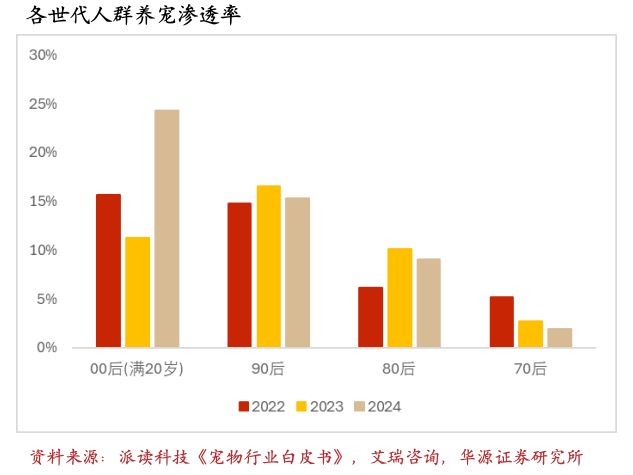
Core Viewpoint - The Chinese pet market is experiencing rapid growth, with a compound annual growth rate (CAGR) of 13.3%, making it the fastest-growing pet market globally [3]. Group 1: Market Growth and Trends - Over the past six years, the compound growth rate of the Chinese pet industry has reached 10%, significantly outpacing the growth of retail sales [3]. - The rise of the post-00s generation is a new growth engine for the pet market, with an expected increase in pet ownership among this demographic to over 20 million by 2024, representing a year-on-year growth of 164% [3][6]. - The average annual spending per pet is currently 2,419 yuan, with a shift towards a "parenting-style" approach to pet ownership among the post-00s, leading to increased demand for personalized pet products and services [3]. Group 2: Investment and Innovation - The recent pet industry innovation investment conference in Wuhan attracted numerous investment institutions, indicating strong interest in the sector [3]. - Five pet companies presented at the conference, focusing on key areas such as pet healthcare, food, smart hardware, and service chains, showcasing innovation in the industry [6]. - The Chinese pet market is projected to exceed 300 billion yuan in 2024 and is expected to surpass 400 billion yuan by 2027, driven by economic growth, rising incomes, urbanization, demographic changes, and evolving consumer attitudes [6]. Group 3: Strategic Recommendations - Local companies are encouraged to focus on niche markets, continuously develop functional and high-end products, and establish technological barriers [7]. - With over 60% of the pet market being online, companies should leverage big data, AI, and social media to enhance operational efficiency and implement precise marketing strategies [8].


每四个养宠人就有一个00后,资本瞄上“它经济”新引擎
Di Yi Cai Jing· 2025-11-22 10:41
Core Insights - The Chinese pet market is experiencing rapid growth, with a compound annual growth rate (CAGR) of 13.3%, making it the fastest-growing pet market globally [1] - The pet industry in China has seen a compound growth rate of 10% over the past six years, significantly outpacing the growth of retail sales [1] - The rise of the post-2000 generation is a new growth driver, with an expected 20 million pet owners by 2024, representing a 164% year-on-year increase [1] Market Dynamics - The pet market in China is projected to exceed 300 billion RMB in 2024 and is expected to surpass 400 billion RMB by 2027, indicating a cumulative growth of approximately 33% over three years [4] - Five key drivers are identified for the explosive growth of the pet economy: economic growth and income increase, accelerated urbanization, demographic changes, shifts in consumer attitudes, and improvements in policies and social environments [4] Consumer Trends - The average annual spending per pet is currently 2,419 RMB, with the post-2000 generation showing a preference for "parenting-style" pet care, leading to increased demand for personalized pet products, medical care, insurance, grooming, photography, and social activities [1] - The penetration rate of pet ownership among the post-2000 generation is 24%, compared to only 9% for the post-1980 generation, highlighting a significant shift in pet ownership demographics [1] Industry Innovations - Five pet companies presented at the investment conference, focusing on key areas such as pet healthcare, food, smart hardware, and service chains [4] - Innovations include advancements in medical technology for pets, development of new pet food brands, and the introduction of smart hardware to enhance pet care experiences [4] Strategic Recommendations - Companies are encouraged to deepen collaboration across various dimensions, including technological research, industry chain synergy, and international expansion [5] - There is a strong emphasis on developing high-end, functional products and leveraging technology to create competitive advantages [5] - With over 60% of the pet market being online, businesses should utilize big data and AI to enhance operational efficiency and engage in precise marketing strategies [5]
招商证券:猪价下行拖累盈利 后周期景气延续
智通财经网· 2025-11-21 08:39
Core Viewpoint - The report from China Merchants Securities indicates that in Q3 2025, the profitability of listed pig companies has significantly declined due to falling pig prices and rising raw material costs, while the cost variance within the industry remains substantial, leading to an expansion of cost advantages for high-quality pig companies. The overall demand is showing signs of recovery in the later cycle, suggesting a potential increase in pig prices in 2026 due to accelerated sow capacity reduction [1][2]. Group 1: Swine Farming - In Q3 2025, the profitability of 18 listed pig companies dropped to 5.54 billion yuan, reflecting a year-on-year decrease of 71% and a quarter-on-quarter decrease of 38% [2]. - The cost variance in the industry remains significant, with high-quality pig companies further enhancing their cost advantages [2]. - The operational cash flow of listed pig companies continues to improve, while capital expenditures remain low and debt ratios are high [2]. - The report anticipates an acceleration in sow capacity reduction, which may elevate the average pig price in 2026 [2]. - Recommended companies include Muyuan Foods and Wens Foodstuff Group, with additional attention on Shennong Group, Dekang Agriculture, Dongrui Co., and COFCO Joycome [2][5]. Group 2: Poultry Farming - The white feather chicken market is expected to see an increase in the import of grandparent stock chickens in 2024, but it will not return to pre-disruption levels until 2025 [3]. - The supply of parent stock chickens is expected to tighten in the second half of 2025, impacting the supply of commercial chickens in 2026 [3]. - The yellow feather chicken sector is experiencing a reduction in parent stock numbers to historically low levels, which may support future price increases [3]. - Recommended companies in poultry farming include San Nong Development for white feather chickens and Lihua Food for yellow feather chickens [3][5]. Group 3: Post-Cycle Demand - The demand for feed in the swine and poultry sectors is gradually recovering, leading to a notable improvement in feed demand [4]. - The demand for aquaculture feed is also expected to rise as the aquaculture sector recovers [4]. - The report forecasts continued demand growth for livestock feed in Q4 2025, while aquaculture feed demand may enter a seasonal decline [4]. - Recommended companies for feed include Haida Group, which is expected to benefit from overseas expansion [4][5]. - In the animal health sector, demand is recovering due to sustained profitability in the downstream farming sector, with major animal health companies expected to see improved profitability [4]. Recommended companies include Kexin Biological and attention on BioStock and Reap Biological [4][5].



2025年中国宠物服务行业发展背景、发展历程、市场规模、重点企业及趋势研判:宠物经济加速崛起,宠物服务规模突破千亿元[图]
Chan Ye Xin Xi Wang· 2025-11-21 01:56
Core Insights - The Chinese pet industry has experienced unprecedented growth since the 21st century, transitioning from viewing pets as mere tools for guarding to recognizing them as essential emotional companions and family members [1][9] - The pet service sector has diversified significantly, encompassing medical, grooming, boarding, and training services to meet the evolving needs of pet owners [1][9] - The market for pet services in China is projected to grow from 34.034 billion yuan in 2015 to 104.47 billion yuan in 2024, with a compound annual growth rate (CAGR) of 13% [1][10] Pet Service Industry Overview - The pet industry includes all activities related to pets, such as breeding, trading, and providing goods and services like pet food, supplies, and services [3] - Pet services are defined as non-physical consumption services for pets and their owners, covering a wide range of offerings from grooming and medical care to training and insurance [3] Market Growth and Trends - The number of urban pets in China is expected to rise from 87.46 million in 2017 to 124.11 million by 2024, with a CAGR of 5.13% [5] - The pet consumption market in China is anticipated to expand from 97.8 billion yuan in 2015 to 300.2 billion yuan in 2024, with a CAGR of 13.27% [8] - In 2024, pet food is projected to account for 52.8% of the market, while pet services will represent 34.8% [8] Industry Development History - The establishment of the China Small Animal Protection Association in 1992 marked the beginning of the pet industry in China, promoting the concept of pets as companions [5] - Over the past thirty years, the pet service industry has evolved from basic breeding and trading to a comprehensive service model covering the entire lifecycle of pets [5][6] Industry Structure and Key Players - The pet service industry features a diverse competitive landscape, with key players in medical services including New Ruipeng and Ruipai, while grooming and boarding services are dominated by regional brands like Baozaiwu and Paiduo [10] - The market remains fragmented, with opportunities for growth through service extension, technological empowerment, and brand building [10] Future Trends in Pet Services - The industry is expected to embrace intelligent technology, integrating smart wearables and online platforms for enhanced pet health management and service efficiency [12] - Services will increasingly focus on emotional value and personalized experiences, such as customized training and memorial services for pets [13] - The service model will diversify, combining online and offline experiences, with O2O platforms and community-based services enhancing user engagement [14]

动物保健板块11月20日跌0.31%,驱动力领跌,主力资金净流入8881.31万元
Zheng Xing Xing Ye Ri Bao· 2025-11-20 09:09
Core Insights - The animal health sector experienced a decline of 0.31% on November 20, with the leading stock, Driven Power, falling significantly by 9.15% [1][2] - The Shanghai Composite Index closed at 3931.05, down 0.4%, while the Shenzhen Component Index closed at 12980.82, down 0.76% [1] Stock Performance - The top performer in the animal health sector was Xianfeng Holdings, which rose by 10.00% to a closing price of 4.07, with a trading volume of 1.1525 million shares and a turnover of 462 million yuan [1] - Other notable stocks included Biological Shares, which increased by 1.98% to 12.36, and Dayu Biological, which remained unchanged at 8.40 [1] - Conversely, Driven Power led the decline with a drop of 9.15% to 9.73, followed by ST Green Health, which fell by 5.00% to 44.08 [2] Capital Flow - The animal health sector saw a net inflow of 88.8131 million yuan from institutional investors, while retail investors experienced a net outflow of 74.1985 million yuan [2][3] - The capital flow data indicates that Driven Power had a significant net outflow of 12.409 million yuan from institutional investors, reflecting a negative sentiment towards the stock [3]


动物保健板块11月19日跌0.31%,贤丰控股领跌,主力资金净流出4912.79万元
Zheng Xing Xing Ye Ri Bao· 2025-11-19 08:46
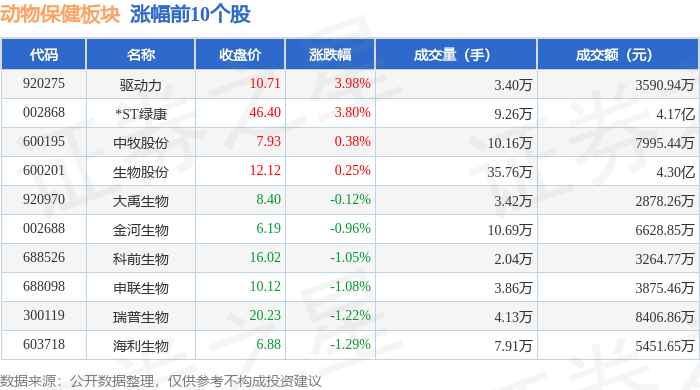
Core Viewpoint - The animal health sector experienced a slight decline of 0.31% on November 19, with Xianfeng Holdings leading the losses, while the Shanghai Composite Index rose by 0.18% to close at 3946.74 [1]. Group 1: Market Performance - The animal health sector's individual stock performance varied, with notable gainers including Qudongli (up 3.98% to 10.71) and ST Lvkang (up 3.80% to 46.40) [1]. - Conversely, several stocks faced declines, such as Jinhai Biological (down 0.96% to 6.19) and Shunlian Biological (down 1.08% to 10.12) [1][2]. Group 2: Trading Volume and Capital Flow - The total trading volume for the animal health sector was significant, with Qudongli achieving a volume of 34,000 hands and a transaction value of approximately 35.9 million yuan [1]. - The sector saw a net outflow of 49.13 million yuan from institutional investors, while retail investors contributed a net inflow of 548.09 million yuan [2]. Group 3: Individual Stock Capital Flow - Among individual stocks, Shengong Holdings experienced a net outflow of 31.56 million yuan from retail investors, while Biotech Holdings saw a net inflow of 555.72 million yuan from retail investors [3]. - The stock with the highest net inflow from retail investors was Biotech Holdings, with 555.72 million yuan, while the largest net outflow was from Yongshun Biological, totaling 408.61 million yuan [3].


农林牧渔行业2025年三季报总结:猪价下行拖累盈利,后周期景气延续
2025-11-18 01:15
Summary of the Agricultural Sector Conference Call Industry Overview - The conference call focuses on the **Agricultural Sector**, specifically the **Pig Farming** and **Poultry Farming** industries, along with **Feed and Animal Health** sub-sectors [1][2][3]. Key Points and Arguments Pig Farming Sector - In Q3 2025, the profitability of the pig farming sector declined significantly, with a **71% year-on-year** and **38% quarter-on-quarter** drop in profits, totaling **CNY 5.54 billion** for 18 listed pig farming companies [2][3][9]. - The average price of live pigs was **CNY 13.8/kg**, while the average cost for most listed companies was between **CNY 13-14/kg**, indicating a challenging margin environment [9][12]. - Major players like **Muyuan** and **Wens** reported combined profits of approximately **CNY 6 billion**, while the remaining 16 companies were in a loss position [9]. - The industry is expected to accelerate the reduction of sow capacity, which may elevate the price center for pigs in 2026 [2][12][13]. - The cash flow situation remains positive, with **CNY 18.1 billion** in operating cash flow for Q3, marking the tenth consecutive quarter of net inflow [10]. Poultry Farming Sector - The poultry farming sector is experiencing a tightening supply of parent stock, particularly for **white feathered chickens**, which is expected to support price increases in 2026 [5][14]. - The **yellow feathered chicken** sector is facing historical lows in parent stock, compounded by ongoing industry losses, setting the stage for potential price increases [5][14]. - The overall revenue for the poultry sector increased by **11% year-on-year**, but net profit fell by **45%** due to low chicken prices [14]. Feed and Animal Health Sub-Sectors - The feed and animal health sectors are showing signs of recovery, with demand improving as livestock numbers stabilize [6][7][17]. - Leading feed companies are expanding overseas, which is expected to create new growth opportunities [6][18]. - The animal health sector reported a **19% year-on-year** revenue increase, with profits rising **76%** due to a low base from the previous year [19]. Additional Important Insights - The average cost of pig farming is projected to be between **CNY 13-14/kg** for 2025, with expectations for 2026 to rise to **CNY 14-16/kg** [12][13]. - The **Haida Group** plans to IPO its overseas assets, which may dilute short-term earnings but is expected to enhance long-term growth potential [18]. - Investment recommendations focus on low-cost leading companies in pig farming like **Muyuan** and **Wens**, as well as smaller quality firms such as **Shennong** and **Dekang** [8][20]. Investment Recommendations - Emphasis on companies with strong cost control and cash flow improvement in the pig farming sector [8][20]. - In the poultry sector, recommendations include **Shennong** for white feathered chickens and **Lihua** for yellow feathered chickens [8][20]. - For feed and animal health, focus on leading companies like **Haida Group** and **Kefei**, as well as those with product advantages in the animal health sector [8][20].

动物保健板块11月17日跌0.24%,大禹生物领跌,主力资金净流出1015.37万元
Zheng Xing Xing Ye Ri Bao· 2025-11-17 08:41
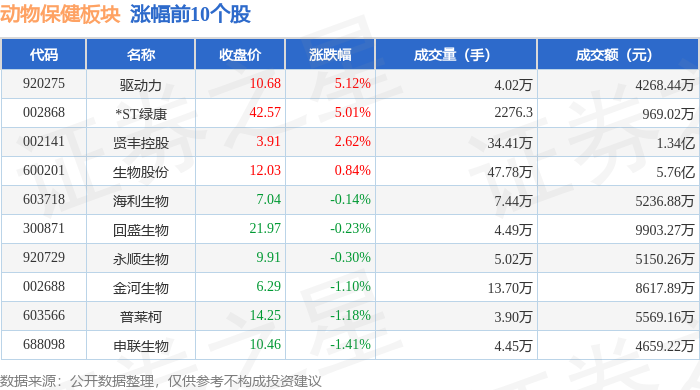
Core Insights - The animal health sector experienced a decline of 0.24% on November 17, with Dayu Biological leading the drop [1] - The Shanghai Composite Index closed at 3972.03, down 0.46%, while the Shenzhen Component Index closed at 13202.0, down 0.11% [1] Stock Performance - Notable gainers included: - Qudongli (code: 920275) with a closing price of 10.68, up 5.12% [1] - *ST Lvkang (code: 002868) with a closing price of 42.57, up 5.01% [1] - Houfeng Holdings (code: 002141) with a closing price of 3.91, up 2.62% [1] - Major decliners included: - Dayu Biological (code: 920970) with a closing price of 8.70, down 3.87% [2] - Ruipu Biological (code: 300119) with a closing price of 20.61, down 2.92% [2] - Zhongmu Co., Ltd. (code: 600195) with a closing price of 7.94, down 1.98% [2] Capital Flow - The animal health sector saw a net outflow of 10.15 million yuan from institutional investors, while retail investors experienced a net outflow of 20.76 million yuan [2] - Conversely, speculative funds recorded a net inflow of 30.91 million yuan [2] Individual Stock Capital Flow - Notable capital flows included: - Biological Shares (code: 600201) with a net inflow of 12.08 million yuan from institutional investors [3] - Xianfeng Holdings (code: 002141) with a net inflow of 9.50 million yuan from institutional investors [3] - Ruipu Biological (code: 300119) with a net inflow of 1.05 million yuan from speculative funds [3] - Decliners in capital flow included: - *ST Lvkang (code: 002868) with a net outflow of 0.79 million yuan from institutional investors [3] - Hai Li Biological (code: 603718) with a net outflow of 2.82 million yuan from institutional investors [3]


东方证券:10月生猪出栏集中增量 供应压力持续显现
智通财经网· 2025-11-17 08:24
Core Viewpoint - In October, the pig farming industry experienced a significant increase in the number of pigs slaughtered, leading to a sharp decline in pork prices due to oversupply and weakened demand [1][2]. Group 1: Industry Performance - In October, 14 listed pig companies collectively slaughtered 17.2 million pigs, representing a month-on-month increase of 23.20% and a year-on-year increase of 25.85% [1][2]. - Major companies such as Muyuan Foods, WH Group, and New Hope reported slaughter increases of 26.97%, 17.07%, and 20.87% respectively [1][2]. - The total number of market pigs slaughtered by these companies was approximately 15.4 million, with a month-on-month increase of 23.96% and a year-on-year increase of 24.58% [2]. Group 2: Price Dynamics - The increase in slaughter volume has led to a significant drop in pork prices, with most listed companies reporting a price decline of over 10% month-on-month and over 30% year-on-year [2]. - The average weight of slaughtered pigs increased to 126.27 kg, up by 1.09 kg month-on-month, indicating a trend towards heavier pigs being brought to market [2]. Group 3: Future Outlook - The current weak prices for both fattened pigs and piglets, alongside policy-driven factors, suggest that the pig farming industry may initiate a capacity reduction phase [4]. - The price of fattened pigs has fallen below 12 yuan per kg, while weaned piglet prices are around 200 yuan per head, indicating a phase of overall industry losses [4]. - Historical trends suggest that when both fattened and piglet prices are low, the industry is likely to undergo market-driven capacity reduction, which could support long-term price increases [4]. Group 4: Investment Recommendations - The pig farming sector is expected to benefit from recent policies and market dynamics that promote capacity reduction, enhancing long-term performance for companies like Muyuan Foods, WH Group, and others [5]. - The recovery in pig inventory is anticipated to boost demand for feed and veterinary products, benefiting companies in the downstream supply chain [5]. - The agricultural sector is showing positive trends with rising grain prices, presenting investment opportunities in large-scale agricultural companies [5].

美股震荡分化,A股冲高回落,后市如何应对?
2025-11-16 15:36
Summary of Key Points from Conference Call Industry Overview - **U.S. Stock Market**: Expected to experience volatility and differentiation, with a focus on technology stocks following Nvidia's earnings report, small-cap tech, healthcare, financial sectors, and low-end consumer staples [1][3] - **A-Share Market**: Currently in a phase of fluctuation, with attention on price increase diffusion, low-level rebounds, and sentiment-driven themes [1][5] Economic Indicators - **Domestic Macro Data**: Weak performance noted in October, with social financing and credit weakening, exports turning negative, and declines in fixed and real estate investments [1][5] - **Liquidity Trends**: Marginal contraction in macro liquidity, with a projected decline in the growth rate of liabilities in the real sector [1][6][7] Investment Recommendations - **Fixed Income Strategy**: Maintain flexibility in asset allocation due to changing liquidity conditions, with a recommendation for a combination of long-term bonds and value equity assets [1][7] - **Healthcare Sector**: Recent rebound in the innovative drug sector, with increasing competitiveness in Chinese drug licensing and a rationalization of valuations [1][8] - **Agriculture Sector**: Opportunities identified in agricultural modernization, disease prevention in livestock, and environmental technology in aquaculture [1][11] Geopolitical Impact - **Military Sector**: Rising geopolitical tensions, particularly related to Japan's statements on Taiwan, may boost sentiment in the military sector [1][9][10] Specific Company Insights - **Yuehai Feed**: Notable recovery in performance with a projected compound growth rate of 20% to 30% over the next three years, driven by internal adjustments and market expansion [1][16][18] Consumer Trends - **Pet Industry**: Strong performance of brands under Guobao and Zhongchong during the Double Eleven shopping festival, indicating robust market positioning [1][12][14] Conclusion - **Market Outlook**: Cautious approach recommended in light of weak domestic fundamentals, with a focus on sectors showing potential for price increases and low-level rebounds, alongside monitoring geopolitical developments [1][19]