沪农商行

Search documents
银行员工为企业微信考核伤脑筋,有人去电商买量,还有同行发帖求“互加”
Mei Ri Jing Ji Xin Wen· 2025-12-31 13:36
Core Viewpoint - Banks are increasingly focusing on the assessment of adding clients via enterprise WeChat as a key performance indicator (KPI) amid challenges in retail banking, leading to a surge in social media posts where employees seek mutual additions to meet their targets [1][22]. Group 1: KPI and Assessment Mechanisms - Many banks have set specific targets for adding enterprise WeChat contacts, with requirements such as 50 contacts per month for some employees, and penalties for not meeting these targets [5][8]. - The assessment includes financial penalties, such as a deduction of 300 yuan for failing to meet monthly targets, and some banks have implemented a ranking system with monetary rewards for top performers [8][12]. - The pressure to meet these KPIs has led to a culture of mutual assistance among bank employees, with many posting their WeChat QR codes on social media to gain more contacts [2][3]. Group 2: Challenges and Pain Points - Employees express frustration over the pressure to add contacts, often feeling compelled to work overtime to meet their targets [17]. - The current assessment system is criticized for focusing solely on frontline employees, neglecting the role of middle management in effectively utilizing enterprise WeChat [18][20]. - There is a concern that the quality of interactions is suffering, as many employees are merely adding contacts to fulfill their quotas rather than engaging meaningfully with clients [19]. Group 3: Industry Context and Performance - The retail banking sector is experiencing significant pressure, with many banks reporting declines in retail revenue and profits compared to the previous year [22][24]. - For instance, several banks, including Postal Savings Bank and Agricultural Bank, have seen retail revenue drop by over 6% year-on-year [23]. - In response to these challenges, banks are leveraging enterprise WeChat as a tool for deeper customer engagement, aiming to enhance client interaction and operational efficiency [25][26].




农商行板块12月31日涨0.94%,渝农商行领涨,主力资金净流入1263.96万元
Zheng Xing Xing Ye Ri Bao· 2025-12-31 09:06
Group 1 - The agricultural commercial bank sector increased by 0.94% on December 31, with Chongqing Rural Commercial Bank leading the gains [1] - The Shanghai Composite Index closed at 3968.84, up 0.09%, while the Shenzhen Component Index closed at 13525.02, down 0.58% [1] - The trading volume and turnover for Chongqing Rural Commercial Bank were 791,700 shares and 509 million yuan, respectively, with a price increase of 2.38% [1] Group 2 - The net inflow of main funds into the agricultural commercial bank sector was 12.64 million yuan, while retail investors experienced a net outflow of 39.35 million yuan [1] - The main net inflow for Changshu Bank was 22.32 million yuan, accounting for 13.28% of its trading volume [2] - Zhangjiagang Bank saw a main net inflow of 15.00 million yuan, representing 11.93% of its trading volume [2]






高股息为盾,静待价值修复
Xiangcai Securities· 2025-12-31 08:21
证券研究报告 2025 年 12 月 31 日 湘财证券研究所 行业研究 银行业年度策略 高股息为盾,静待价值修复 相关研究: 行业评级:增持(维持) 近十二个月行业表现 % 1 个月 3 个月 12 个月 | 相对收益 | -4.85 | 4.99 | -10.62 | | --- | --- | --- | --- | | 绝对收益 | -2.10 | 5.22 | 5.69 | 分析师:郭怡萍 证书编号:S0500523080002 Tel:(8621) 50295327 Email:guoyp@xcsc.com 中国人寿金融中心10楼 核心要点: 市场回顾 今年银行板块行情节奏呈现"前强、中弱、后稳"的走势,主要反映从避 险主导到寻求增长的市场风格转换过程,以及资产风险预期的变化。 政策导向:宽松政策过渡期,金融支持实体经济 | 1. | 《2025年中期策略-价值重估仍 | | --- | --- | | 在进行时》 | 2025.07.02 | | 2. | 《业绩底部修复,配置价值提 | | 升》 | 2025.09.05 | 2026 年,政策环境正从此前的超常规逆周期调节模式,向更具稳定性和 ...
普益标准发布商业银行综合竞争力评价报告农商行百强榜(2025年),哪些银行上榜?
Xin Lang Cai Jing· 2025-12-31 07:14
Core Viewpoint - The 2025 ranking of the top 100 rural commercial banks in China highlights the competitive landscape, focusing on various dimensions of performance including comprehensive competitiveness, operational scale, profitability, stability, technological innovation, and brand building [3][4][6]. Comprehensive Competitiveness - The top ten banks in comprehensive competitiveness are: Chongqing Rural Commercial Bank, Shanghai Rural Commercial Bank, Beijing Rural Commercial Bank, Shenzhen Rural Commercial Bank, Chengdu Rural Commercial Bank, Dongguan Rural Commercial Bank, Guangzhou Rural Commercial Bank, Jiangsu Jiangnan Rural Commercial Bank, Tianjin Rural Commercial Bank, and Qingdao Rural Commercial Bank [1][8]. Operational Scale and Capital Strength - The leading banks in operational scale and capital strength are: Shanghai Rural Commercial Bank, Chongqing Rural Commercial Bank, Beijing Rural Commercial Bank, Guangzhou Rural Commercial Bank, Dongguan Rural Commercial Bank, Shenzhen Rural Commercial Bank, Chengdu Rural Commercial Bank, Jiangsu Jiangnan Rural Commercial Bank, Tianjin Rural Commercial Bank, and Guangdong Shunde Rural Commercial Bank [1][13]. Profitability - The top banks in profitability are: Shanghai Rural Commercial Bank, Chongqing Rural Commercial Bank, Chengdu Rural Commercial Bank, Jiangsu Changshu Rural Commercial Bank, Shenzhen Rural Commercial Bank, Hangzhou United Rural Commercial Bank, Beijing Rural Commercial Bank, Jiangsu Jiangnan Rural Commercial Bank, Dongguan Rural Commercial Bank, and Zhejiang Xiaoshan Rural Commercial Bank [1][18]. Stability - The banks excelling in stability are: Shanghai Rural Commercial Bank, Chongqing Rural Commercial Bank, Shenzhen Rural Commercial Bank, Dongguan Rural Commercial Bank, Jiangsu Jiangnan Rural Commercial Bank, Tianjin Rural Commercial Bank, Guangzhou Rural Commercial Bank, Beijing Rural Commercial Bank, Shaanxi Qinong Rural Commercial Bank, and Wuhan Rural Commercial Bank [1][6]. Technological and Service Innovation Capability - The top banks in technological and service innovation capability are: Chongqing Rural Commercial Bank, Shanghai Rural Commercial Bank, Beijing Rural Commercial Bank, Chengdu Rural Commercial Bank, Guangzhou Rural Commercial Bank, Jiangsu Suzhou Rural Commercial Bank, Shenzhen Rural Commercial Bank, Qingdao Rural Commercial Bank, Tianjin Rural Commercial Bank, and Dongguan Rural Commercial Bank [2][6]. Brand Building Capability - The leading banks in brand building capability are: Chongqing Rural Commercial Bank, Shanghai Rural Commercial Bank, Jiangsu Zijin Rural Commercial Bank, Dongguan Rural Commercial Bank, Jiangsu Kunshan Rural Commercial Bank, Shenzhen Rural Commercial Bank, Jiangsu Jiangnan Rural Commercial Bank (tied for seventh), Zhejiang Shaoxing Ruifeng Rural Commercial Bank (tied for seventh), Beijing Rural Commercial Bank, and Chengdu Rural Commercial Bank [2][6].


红利低波ETF泰康(560150)红盘向上,2025收官日有望收阳, 上市公司近五年连续现金分红公司达1681家
Xin Lang Cai Jing· 2025-12-31 07:02
Group 1 - The core viewpoint of the news highlights the performance and growth of the Dividend Low Volatility ETF Taikang (560150), which has shown a recent increase in both price and trading volume, indicating strong investor interest [1][2] - As of December 30, 2025, the Dividend Low Volatility ETF Taikang has seen a significant increase in scale by 1.3871 million yuan and an increase in shares by 2 million, reflecting robust growth in the past week [1] - The report from the China Securities Association indicates that as of June 30, 2025, the total cash dividends from listed companies reached 2.4 trillion yuan, with a notable number of companies maintaining consistent dividend payouts over the years [1] Group 2 - The dividend sector is gaining attention due to its attractive dividend yield and defensive characteristics, with a focus on stable dividend capabilities and commodity price trends [2] - Historical data shows that the banking sector has a high probability of generating absolute and excess returns before the Spring Festival, with over 80% success rate in the past decade [2] - The Dividend Low Volatility Index, which the ETF closely tracks, selects 50 securities based on liquidity, consistent dividend payments, and low volatility, reflecting the overall performance of high dividend and low volatility securities [2]
独立App被关停,银行信用卡业务加快“瘦身”
Xin Lang Cai Jing· 2025-12-31 00:21
Core Viewpoint - The trend of "streamlining" and "integration" of banking apps is accelerating, with several banks consolidating their credit card services into their main banking apps to enhance user experience and resource efficiency [1] Group 1: Industry Trends - China Bank was the first to shut down its independent credit card app, followed by Postal Savings Bank, which announced the gradual cessation of updates to its "Postal Savings Credit Card App" [1] - Other banks, including Beijing Rural Commercial Bank, Bohai Bank, Shanghai Rural Commercial Bank, and Sichuan Rural Credit Union, have also initiated similar integration efforts [1] Group 2: Business Implications - Experts indicate that as the expansion benefits of credit cards diminish and profit margins come under pressure, commercial banks are likely to reduce costs and improve user experience by integrating credit card services into their main apps [1] - The credit card business is transitioning from an "independent entry" model to a "comprehensive ecosystem" service approach [1]
农商行板块12月30日跌0.07%,瑞丰银行领跌,主力资金净流出7332万元
Zheng Xing Xing Ye Ri Bao· 2025-12-30 09:08
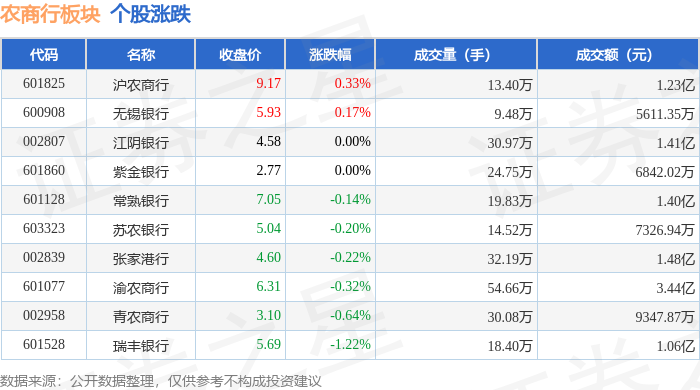
证券之星消息,12月30日农商行板块较上一交易日下跌0.07%,瑞丰银行领跌。当日上证指数报收于 3965.12,下跌0.0%。深证成指报收于13604.07,上涨0.49%。农商行板块个股涨跌见下表: | 代码 | 名称 | 收盘价 | 涨跌幅 | 成交量(手) | 成交额(元) | | --- | --- | --- | --- | --- | --- | | 601825 | 沪农商行 | 9.17 | 0.33% | 13.40万 | 1.23 乙 | | 600908 | 无锡银行 | 5.93 | 0.17% | 9.48万 | 5611.35万 | | 002807 | 江阴银行 | 4.58 | 0.00% | 30.97万 | 1.41亿 | | 601860 | 紫金银行 | 2.77 | 0.00% | 24.75万 | 6842.02万 | | 601128 | 常熟银行 | 7.05 | -0.14% | 19.83万 | 1.40亿 | | 603323 | 苏农银行 | 5.04 | -0.20% | 14.52万 | 7326.94万 | | 002839 | 张家港行 | 4 ...

湖北三峡新型建材股份有限公司 关于公司办理融资租赁业务的公告
Zhong Guo Zheng Quan Bao - Zhong Zheng Wang· 2025-12-30 08:03
本公司董事会及全体董事保证本公告内容不存在任何虚假记载、误导性陈述或者重大遗漏,并对其内容 的真实性、准确性和完整性承担法律责任。 重要内容提示: ●湖北三峡新型建材股份有限公司(以下简称"三峡新材"或"公司")拟向长江联合金融租赁有限公司 (以下简称"长江金租")办理融资租赁业务,融资金额为5,000万元,租赁标的为公司或子公司生产设 备及配套设备等。 ●本次办理融资租赁业务事项已经公司董事会2025年第五次临时会议审议通过,无须提交股东会审议。 一、本次融资租赁业务概述 为优化公司资产结构,满足生产经营不断发展的需要,公司拟向长江金租办理融资租赁业务,融资金额 为人民币5,000万元,租赁标的为公司或子公司生产设备及配套设备等,融资期限不超过36个月。三峡 新材董事会2025年第五次临时会议授权公司管理层办理本次融资租赁业务中的一切行为,包括但不限于 办理相关手续和签署合同、协议、凭证等相关法律文件。融资方式、融资金额、融资期限等具体内容以 实际签订的协议为准。 (十)公司与长江金租不存在关联关系。 二、交易对方的基本情况 (一)公司名称:长江联合金融租赁有限公司 (二)成立日期:2015年6月18日 ( ...

银行金融投资如何摆布记账?
GF SECURITIES· 2025-12-30 05:34
Investment Rating - The report provides a "Buy" rating for all listed banks analyzed, indicating a positive outlook for their stock performance [6]. Core Insights - The report focuses on the classification of financial investments, the current allocation of listed banks, and how related revenues are accounted for under new accounting standards [5]. - As of Q3 2025, the financial investments of 42 listed banks total approximately 101.5 trillion CNY, with 87% allocated to the configuration portfolio and 13% to the trading portfolio [5][23]. - The bond market is the primary investment direction for listed banks, accounting for 87.6% of their financial investments, with government bonds making up 59.5% of this total [5]. Summary by Sections 1. Classification of Financial Investments - Financial assets are classified into three categories under the new accounting standards: FVTPL (fair value through profit or loss), AC (amortized cost), and FVOCI (fair value through other comprehensive income) [12][13]. - The classification is based on the business model for managing financial assets and the cash flow characteristics of the financial assets [14]. 2. Accounting for Market Revenues - FVTPL assets reflect market fluctuations through "fair value changes" in profit or loss, while AC assets do not reflect fair value changes and primarily generate income from interest [5]. - FVOCI assets account for market fluctuations in other comprehensive income, with interest income recognized in profit or loss [5]. 3. Financial Investment Structure - The configuration portfolio is dominant, with state-owned banks showing the highest allocation to AC, while joint-stock banks and city commercial banks have a higher proportion of trading assets [23][24][25]. - The report notes a structural shift where FVOCI is becoming the main growth area, as banks seek flexibility in their investment strategies [5][23].




减速提质、降本增效,巩固高质量发展态势——A股上市农商银行三季报分析
Xin Lang Cai Jing· 2025-12-30 03:32
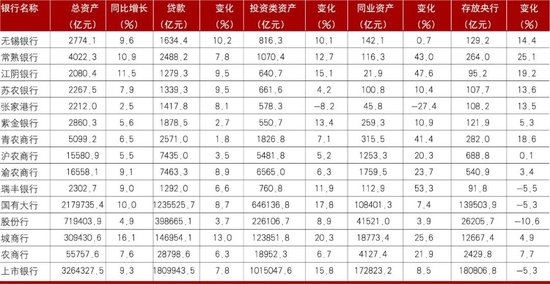
Core Viewpoint - The listed rural commercial banks are focusing on cost control and optimizing asset structure while maintaining steady growth in total assets, reflecting a shift in operational strategy towards enhancing efficiency and quality of growth rather than merely expanding scale [1][24]. Group 1: Asset Growth and Structure - As of the end of Q3 2025, the total asset size of listed rural commercial banks reached 5.58 trillion yuan, with a year-on-year growth of 7.56%, which is lower than the industry average [1][25]. - The growth rate of listed rural commercial banks is relatively stable compared to other bank types, with city commercial banks growing by 16.12% and state-owned banks by 9.95% during the same period [1][25]. - The asset structure is being adjusted, with personal loans decreasing to 51.25% of total loans, down 2.6 percentage points year-on-year, while corporate loans increased to 56.45%, up 2.9 percentage points [3][27]. Group 2: Revenue and Profitability - Revenue growth for listed rural commercial banks remained flat year-on-year, with an average increase of 3.60% in net profit, surpassing the overall growth of listed banks [8][16]. - Net interest income remains the primary source of revenue, accounting for 74.36% of total income, but its growth is hindered by a narrowing net interest margin [8][16]. - The strategy of "volume compensating for price" has become ineffective, leading to a rational shift in operational focus away from aggressive scale expansion [8][20]. Group 3: Cost Management - The average growth of total liabilities for listed rural commercial banks was 7.59%, aligning closely with asset growth, indicating a cautious approach to liability expansion [13][15]. - The banks are emphasizing cost control, particularly in managing interest expenses, operational costs, and risk costs, to enhance profitability [12][16]. - The cost-to-income ratio has shown improvement, reflecting effective cost management practices [16]. Group 4: Risk Management and Asset Quality - The overall non-performing loan (NPL) ratio for listed rural commercial banks was 1.07%, a decrease of 0.02 percentage points year-on-year, indicating improved asset quality [18][19]. - The reduction in NPLs is attributed to effective control over new bad loans and the disposal of existing non-performing assets [18][19]. - The banks are adjusting their credit strategies in response to rising credit risks and changing market conditions, focusing more on corporate lending [9][27]. Group 5: Future Strategy Outlook - The future strategy for listed rural commercial banks will focus on enhancing differentiated competitive advantages by serving the real economy and optimizing wealth management services [21][22]. - There is a need to strengthen cost management and risk control to ensure stable asset quality and reduce risk losses [22][23]. - Leveraging digital technologies for operational efficiency and risk management will be crucial for achieving high-quality development [23].