
中通客车

Search documents
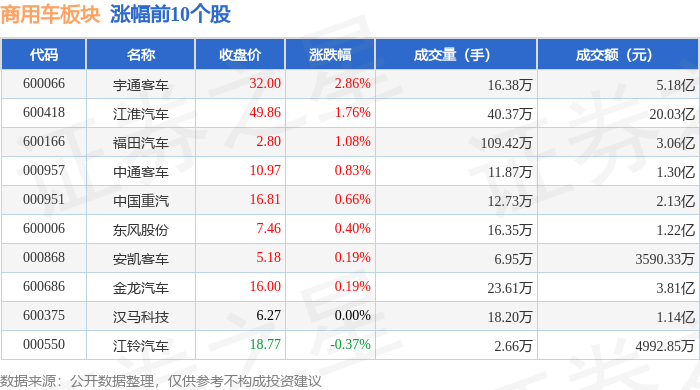
商用车板块12月1日涨1.24%,宇通客车领涨,主力资金净流出1.55亿元
Zheng Xing Xing Ye Ri Bao· 2025-12-01 09:03
Group 1 - The commercial vehicle sector increased by 1.24% on December 1, with Yutong Bus leading the gains [1] - The Shanghai Composite Index closed at 3914.01, up 0.65%, while the Shenzhen Component Index closed at 13146.72, up 1.25% [1] - Key stocks in the commercial vehicle sector showed varied performance, with Yutong Bus closing at 32.00, up 2.86%, and Jianghuai Automobile at 49.86, up 1.76% [1] Group 2 - The commercial vehicle sector experienced a net outflow of 155 million yuan from institutional investors, while retail investors saw a net inflow of 198 million yuan [3][4] - Specific stock performances included China National Heavy Duty Truck with a net outflow of 42.35 million yuan and a retail inflow of 26.78 million yuan [4] - The trading volume for Yutong Bus was 163,800 shares, with a transaction value of 518 million yuan [1]





宇通/中车居前二 金旅进三甲 中通翻4倍 10月新能源客车销量看点
第一商用车网· 2025-11-30 13:20
Core Viewpoint - The sales of new energy buses in China have shown significant growth in October 2025, with a total of 7,137 units sold, marking a month-on-month increase of 23.31% and a year-on-year increase of 23.56% [1][2]. Sales Performance - In October 2025, the top ten companies in the new energy bus market saw 9 out of 10 achieve year-on-year sales growth, with Yutong Bus leading the pack with 1,225 units sold, capturing a market share of 17.16% [2][3]. - CRRC Electric ranked second with 922 units sold, experiencing a month-on-month growth of 103.08% and a year-on-year decline of 38.00% [3][5]. - Xiamen Jinlv, ranked third, sold 658 units, with a month-on-month increase of 91.84% and a year-on-year increase of 32.39% [3][5]. - Zhongtong Bus and Foton Ouhui also showed remarkable growth, with Zhongtong selling 633 units (month-on-month growth of 97.20%, year-on-year growth of 414.63%) and Foton Ouhui selling 444 units (month-on-month growth of 114.49%, year-on-year growth of 174.07%) [5][6]. Cumulative Sales - From January to October 2025, a total of 39,179 new energy buses were sold, representing a year-on-year increase of 32.94% [1][2]. - Among the top ten companies, Zhongtong Bus was the only one to achieve a cumulative sales growth of over 100%, with an increase of 145.86% [8][15]. - Yutong Bus maintained its position as the leading cumulative seller with 5,485 units sold, while BYD and other companies also surpassed 2,000 units in cumulative sales [15][17]. Market Segmentation - The three major segments of the new energy bus market (public transport buses, seated buses, and other buses including school buses) all experienced positive year-on-year growth in October 2025 [10][12]. - The public transport bus segment saw cumulative sales growth of 38.48%, while the other bus segment achieved a remarkable year-on-year increase of 74.93% [10][12]. Notable Performances - Nanjing Jinlong Chuangwei exhibited outstanding performance with a month-on-month increase of 288.71% and a year-on-year increase of 487.80% [6][15]. - Dongfeng Special Automobile's Super Dragon model reported a staggering month-on-month growth of 1,514.29% [6][15]. - In the seated bus market, Yutong Bus led with 514 units sold, achieving a year-on-year growth of 103.97% [16][17].
宇通1.2万辆霸榜 金龙系猛涨 欧辉/比亚迪发力 前10月客车出口破6万辆 | 头条
第一商用车网· 2025-11-30 10:43
Core Viewpoint - In October 2025, China's bus exports unexpectedly declined, ending a 21-month streak of year-on-year growth, with a total export of 5,105 vehicles, marking a month-on-month decrease of 29.37% and a year-on-year decrease of 22.37% [1][3][10]. Group 1: Export Performance - From January to October 2025, a total of 60,703 buses were exported, an increase of 11,933 vehicles or 24.47% year-on-year [1][12]. - In October 2025, the export volume of large, medium, and light buses all saw year-on-year declines, with large buses at 2,657 units (down 3.94%), medium buses at 1,203 units (down 20.33%), and light buses at 1,245 units (down 45.87%) [5][7][10]. - The export volume of large buses in October was only higher than January and February, indicating a significant drop compared to September's over 7,200 units [3][5]. Group 2: Market Dynamics - The decline in October's bus exports is attributed to three main factors: a high base from the previous year, a noticeable cooling in the bus market, particularly for large buses, and underperformance in light bus exports [10][11][33]. - The market share leaders from January to October 2025 were Yutong with 11,742 units (19.34%), followed by Xiamen King Long and BYD, both showing significant year-on-year growth [12][28]. Group 3: Company Rankings - In the bus export rankings for January to October 2025, Yutong, Xiamen King Long, and Xiamen Jinlv led the market, with notable increases in export volumes for companies like Foton Ouhui and Ankai, which saw growth rates of 76.55% and 182.06% respectively [12][15]. - The top ten companies in bus exports for October 2025 included Yutong (1,000 units), Xiamen King Long (729 units), and Xiamen Jinlv (713 units), with mixed year-on-year performance among these companies [15][28]. Group 4: Segment Analysis - The seat bus segment showed a cumulative export of 34,676 units from January to October 2025, with a year-on-year growth of 26.94%, while the bus segment as a whole saw a cumulative export of 23,562 units, reflecting a 34.49% increase [18][27]. - In the large bus segment, Yutong led with 4,936 units exported, while BYD and Foton Ouhui also performed strongly, indicating a competitive landscape in the large bus market [30][32].
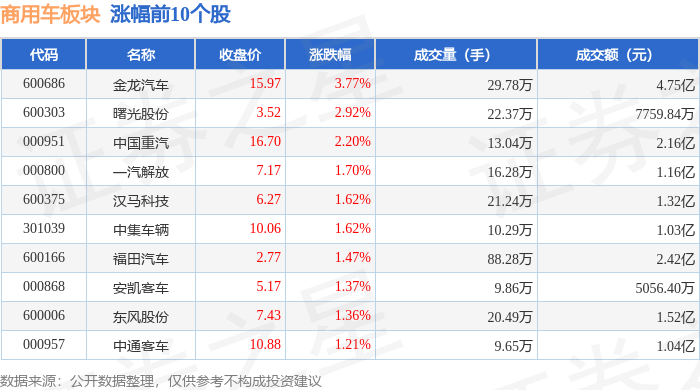
商用车板块11月28日涨1.16%,金龙汽车领涨,主力资金净流入9232.68万元
Zheng Xing Xing Ye Ri Bao· 2025-11-28 09:08
Core Insights - The commercial vehicle sector experienced a 1.16% increase on November 28, with Jinlong Automobile leading the gains [1] - The Shanghai Composite Index closed at 3888.6, up 0.34%, while the Shenzhen Component Index closed at 12984.08, up 0.85% [1] Commercial Vehicle Sector Performance - Jinlong Automobile (600686) closed at 15.97, up 3.77% with a trading volume of 297,800 shares and a transaction value of 475 million yuan [1] - Other notable performers included: - Shuguang Co. (600303) at 3.52, up 2.92% [1] - China National Heavy Duty Truck Group (000951) at 16.70, up 2.20% [1] - FAW Jiefang (000800) at 7.17, up 1.70% [1] - The total net inflow of main funds in the commercial vehicle sector was 92.33 million yuan, while retail investors saw a net outflow of 77.01 million yuan [1] Fund Flow Analysis - Jinlong Automobile had a main fund net inflow of 55.50 million yuan, accounting for 11.69% of its trading volume, while retail investors had a net outflow of 49.44 million yuan [2] - Zhongtong Bus (000957) saw a main fund net inflow of 14.56 million yuan, with retail investors experiencing a net outflow of 11.73 million yuan [2] - Hanma Technology (600375) had a main fund net inflow of 9.38 million yuan, with retail investors showing a net outflow of 30,550 yuan [2]

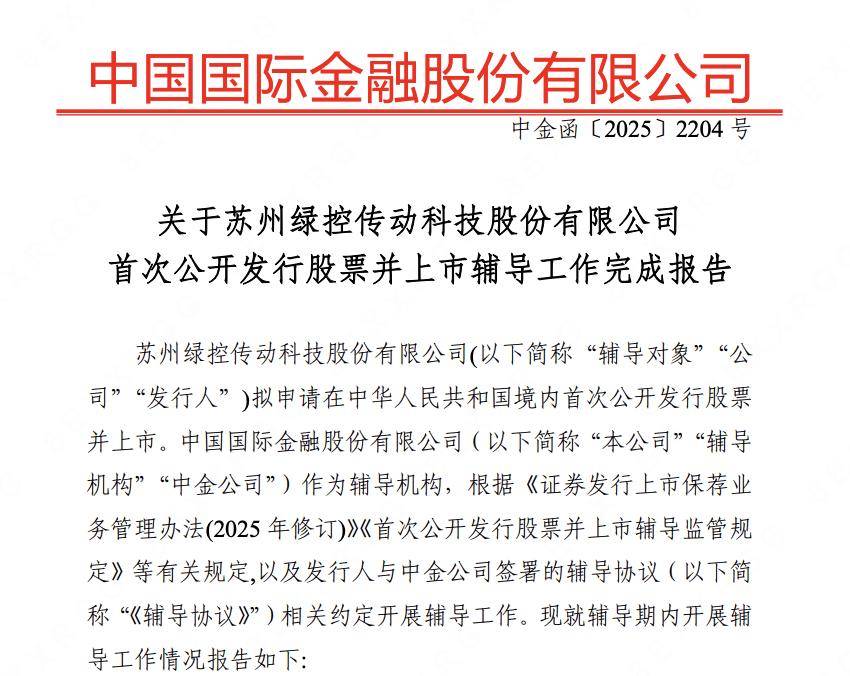
绿控传动二度冲刺A股IPO:董事长李磊控股48%,拥有清华博士学历
Sou Hu Cai Jing· 2025-11-28 01:28
Group 1 - The core viewpoint of the news is that Suzhou Green Control Transmission Technology Co., Ltd. (referred to as Green Control Transmission) has completed its listing counseling work and plans to go public on the A-share market, with China International Capital Corporation (CICC) as the counseling institution [2] - Green Control Transmission was established in 2011 and focuses on power transmission systems for new energy commercial vehicles, possessing five core technologies including electric drive system architecture design and high-efficiency drive motor technology [2] - The company has eight series of powertrain products covering pure electric, fuel cell, and hybrid technology routes, widely used in buses, trucks, special vehicles, and non-road mobile machinery [2] Group 2 - The controlling shareholder of Green Control Transmission is Li Lei, who directly holds 21.46 million shares, accounting for 35.98% of the total share capital before issuance, and indirectly controls an additional 7.43 million shares, totaling 48.43% [3] - Li Lei, born in April 1985, has a background in automotive engineering and has held various positions, including chairman and general manager of Green Control Transmission since December 2011 [3] Group 3 - Green Control Transmission's IPO application for the Sci-Tech Innovation Board was accepted in December 2022 but was withdrawn in March 2023, leading to the termination of the listing application [4]
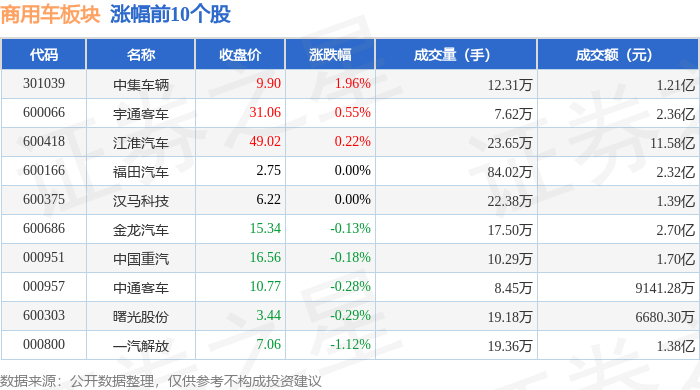
商用车板块11月26日涨0.01%,中集车辆领涨,主力资金净流出7749.2万元
Zheng Xing Xing Ye Ri Bao· 2025-11-26 09:05
Core Viewpoint - The commercial vehicle sector experienced a slight increase of 0.01% on November 26, with CIMC Vehicles leading the gains, while the overall market showed mixed results with the Shanghai Composite Index down by 0.15% and the Shenzhen Component Index up by 1.02% [1] Group 1: Market Performance - The closing price for CIMC Vehicles was 9.90, reflecting a rise of 1.96% with a trading volume of 123,100 shares and a transaction value of 121 million yuan [1] - Yutong Bus closed at 31.06, up by 0.55%, with a trading volume of 76,200 shares and a transaction value of 236 million yuan [1] - JAC Motors closed at 49.02, increasing by 0.22%, with a trading volume of 236,500 shares and a transaction value of 1.158 billion yuan [1] - Foton Motor remained unchanged at 2.75, with a trading volume of 840,200 shares and a transaction value of 232 million yuan [1] - Hanma Technology closed at 6.22, unchanged, with a trading volume of 223,800 shares and a transaction value of 139 million yuan [1] - Golden Dragon Bus decreased slightly by 0.13% to 15.34, with a trading volume of 175,000 shares and a transaction value of 270 million yuan [1] Group 2: Fund Flow Analysis - The commercial vehicle sector saw a net outflow of 77.49 million yuan from institutional investors, while retail investors experienced a net outflow of 12.79 million yuan [2] - Conversely, speculative funds recorded a net inflow of 90.28 million yuan [2] - The detailed fund flow for specific stocks indicates that China National Heavy Duty Truck had a net inflow of 6.327 million yuan from institutional investors, while Foton Motor saw a net inflow of 5.674 million yuan [3] - Ankai Bus experienced a significant net outflow of 8.657 million yuan from institutional investors, indicating a negative sentiment towards the stock [3]


客车11月月报:10月内需同比修复,期待年底翘尾行情-20251124
Soochow Securities· 2025-11-24 09:05
Investment Rating - The industry investment rating is "Buy" for the recommended companies Yutong and King Long [3][4]. Core Insights - The bus industry is expected to benefit from China's automotive manufacturing becoming a global leader in technology output, with overseas market contributions potentially recreating a market equivalent to China within 3-5 years [2]. - The domestic market has seen a recovery in demand, with expectations for a year-end surge in sales driven by tourism recovery and bus replacement needs [2]. - The absence of price wars in the domestic market is anticipated to support profitability, alongside a favorable oligopoly market structure and decreasing lithium carbonate costs [6]. Summary by Sections Industry Overview - In October 2025, the overall production of the bus industry in China was 50,000 units, with year-on-year growth of 13.2% and month-on-month decline of 8.8% [9][10]. - The wholesale volume for the same month was also 50,000 units, reflecting a year-on-year increase of 14.96% and a month-on-month increase of 3% [9][10]. - The terminal sales for buses reached 47,000 units, with a year-on-year increase of 8.73% but a month-on-month decline of 17.84% [14]. Company Performance - Yutong is recognized as a "model student" with high growth and dividend attributes, with projected net profits of 4.63 billion, 5.52 billion, and 6.68 billion yuan for 2025-2027, representing year-on-year growth of 12%, 19%, and 21% respectively [4]. - King Long is noted for its rapid progress, with projected net profits of 440 million, 640 million, and 830 million yuan for 2025-2027, showing significant year-on-year growth of 182%, 45%, and 28% respectively [4]. Market Dynamics - The domestic bus market is characterized by a stable market share for leading companies, with Yutong and King Long maintaining significant positions [31]. - In October, Yutong's domestic bus sales were 404 units with a market share of 11.5%, while King Long sold 1,111 units with a market share of 31.6% [31]. - The export market for buses saw a total of 3,845 units in October, with a year-on-year increase of 10% but a month-on-month decline of 31% [40].
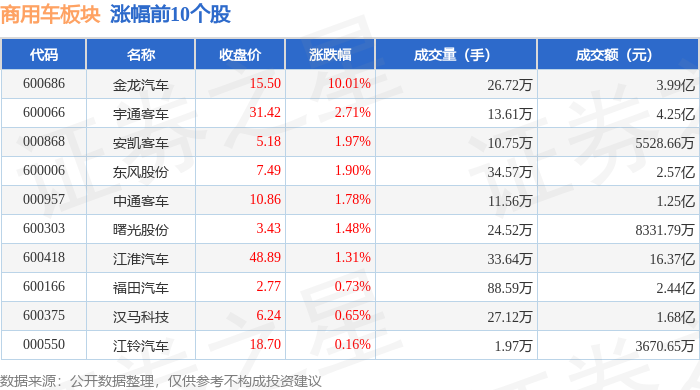
商用车板块11月24日涨1.56%,金龙汽车领涨,主力资金净流入1.05亿元
Zheng Xing Xing Ye Ri Bao· 2025-11-24 09:02
Market Overview - The commercial vehicle sector increased by 1.56% on November 24, with Jinlong Automobile leading the gains [1] - The Shanghai Composite Index closed at 3836.77, up 0.05%, while the Shenzhen Component Index closed at 12585.08, up 0.37% [1] Stock Performance - Jinlong Automobile (600686) closed at 15.50, up 10.01% with a trading volume of 267,200 shares and a turnover of 266.6 million [1] - Yutong Bus (600066) closed at 31.42, up 2.71% with a trading volume of 136,100 shares and a turnover of 4.25 billion [1] - Ankai Bus (000868) closed at 5.18, up 1.97% with a trading volume of 107,500 shares and a turnover of 55.29 million [1] - Dongfeng Motor (600006) closed at 7.49, up 1.90% with a trading volume of 345,700 shares and a turnover of 257 million [1] - Other notable performances include: - JAC Motors (600418) at 48.89, up 1.31% [1] - Foton Motor (600166) at 2.77, up 0.73% [1] Capital Flow - The commercial vehicle sector saw a net inflow of 105 million from institutional investors, while retail investors experienced a net outflow of 80.64 million [2] - The main capital flow details include: - JAC Motors had a net inflow of 181.01 million, accounting for 4.95% of the total [3] - Jinlong Automobile had a net inflow of 39.13 million, accounting for 9.81% [3] - Foton Motor experienced a net outflow of 14.29 million, with a net inflow from retail investors of 9.27 million [3]
车百会理事长张永伟:全球汽车供应链加速重构,中国角色愈发突出!
第一商用车网· 2025-11-22 13:29
Group 1 - The global automotive supply chain is undergoing profound changes, with China playing an increasingly prominent role in both vehicle manufacturing and component supply [2][3] - China's share in global battery installations is nearing 70%, maintaining a leading position for several years, and the country has transitioned from importing to exporting intelligent automotive components and solutions [3] - The concept of "含中率" (the proportion of Chinese components in global vehicles) is introduced as a critical indicator of China's growing influence in the automotive supply chain [3] Group 2 - The future competition in the automotive supply chain will focus on three key areas: power batteries, chips, and software, which are characterized by their extreme importance and uncertainty [4][5] - Despite being a strong player in the battery sector, China faces challenges from countries building localized battery supply chains, and the supply security of critical resources like lithium, cobalt, and nickel is a concern [5] - The chip industry in China is rapidly developing, but the domestic production ratio of control chips remains low, posing a significant technological bottleneck for the automotive industry [6] Group 3 - China's automotive supply chain is now facing new opportunities and challenges in global development, with a shift from primarily input-based to a more internationalized approach [7][8] - The "双工厂" (dual factory) model is emerging as an innovative strategy for companies to maintain core processes domestically while establishing automated production facilities abroad [8] - Multinational companies are shifting their strategies from "in China, for China" to "in China, for the world," facilitating the global distribution of Chinese components [8] Group 4 - The automotive supply chain is extending into new fields such as robotics, low-altitude economy, and unmanned vessels, providing new growth avenues for automotive companies [9][10] - This cross-industry extension allows automotive companies to leverage existing supply chains to support emerging intelligent industries, enhancing their competitive edge [10] Group 5 - Automotive companies need to rethink their supply chain strategies, moving from a focus on lean production and zero inventory to building secure and stable supply chain systems [11][12] - Many companies have yet to prioritize supply chain security strategically, indicating a need for increased investment in capital, human resources, and regional distribution [12] Group 6 - Component manufacturers are encouraged to adopt proactive strategies such as "fast response and near supply" and continuous technological iteration to adapt to the rapidly changing automotive landscape [13][14] - The automotive industry is experiencing shorter development cycles, necessitating quick response capabilities from component suppliers [13] Group 7 - A new structural contradiction exists in the relationship between vehicle manufacturers and component suppliers, where manufacturers struggle to find reliable new components while tech companies face barriers to entry [15][16] - Establishing a supply-demand platform to facilitate collaboration between vehicle manufacturers and technology providers is recommended to enhance matching efficiency [16] Group 8 - The development of the automotive supply chain should align with the "14th Five-Year Plan" goals of high-end, intelligent, green, and integrated development [16] - Emphasizing integration across various sectors, including cross-industry development and the fusion of hardware and software, is crucial for maintaining a competitive edge in the global market [16]
中通客车申请燃料电池客车氢舱体泄漏检测方法及装置专利,能够发现仿真未预料到的局部氢气聚集团
Jin Rong Jie· 2025-11-22 11:37
Group 1 - The core viewpoint of the article is that Zhongtong Bus Holding Co., Ltd. has applied for a patent for a hydrogen leak detection method and device for fuel cell buses, indicating a focus on safety and innovation in hydrogen technology [1] Group 2 - The patent, published as CN 120992114 A, was applied for on August 2025, showcasing the company's commitment to advancing hydrogen fuel cell technology [1] - The invention includes a hydrogen gas bottle, multi-branch variable distance sensor bracket, hydrogen concentration sensors, and a central controller to detect hydrogen leaks [1] - The method constructs a diffusion cloud map based on the initial positions, movement speeds, and operational times of the hydrogen concentration sensors, allowing for real-time identification of leak locations [1] - This technology addresses inherent limitations of simulation and empirical methods in terms of real-time response, environmental complexity, and sudden incidents, making it particularly suitable for safety scenarios requiring rapid response [1]