
奥飞娱乐

Search documents
40只中证A500基金再度全线收跌,总规模跌破2000亿元
2 1 Shi Ji Jing Ji Bao Dao· 2025-11-21 11:25
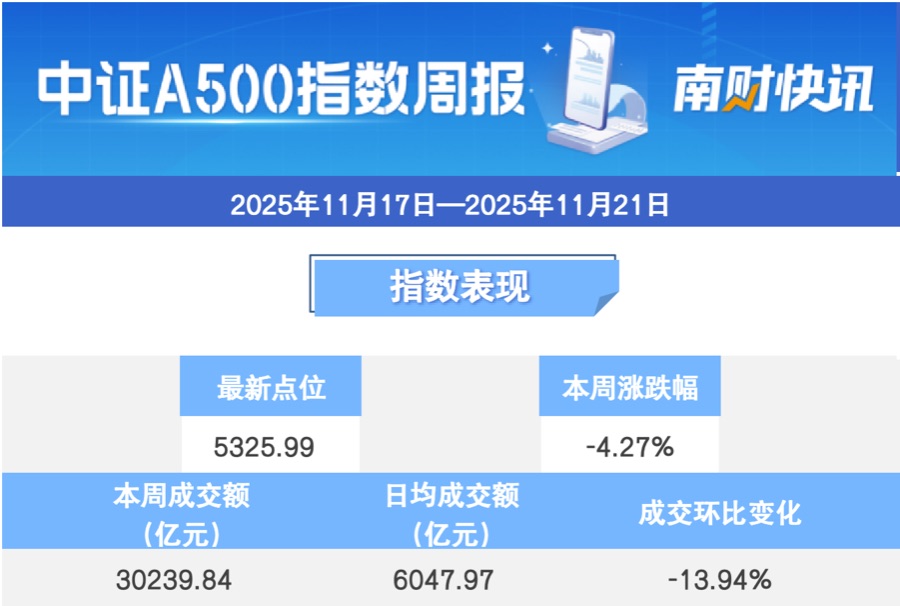
Index Performance - The CSI A500 Index decreased by 4.27% this week, closing at 5325.99 points as of November 21 [3][8] - The average daily trading volume for the week was 6047.97 billion yuan, reflecting a decrease of 13.94% compared to the previous week [3][8] Component Stock Performance - The top ten gainers in the CSI A500 Index this week included: 1. Aerospace Development (000547.SZ) with a gain of 31.77% 2. BlueFocus Communication Group (300058.SZ) with a gain of 20.18% 3. Tongcheng New Materials (603650.SH) with a gain of 14.75% [5] - The top ten losers included: 1. Defang Nano (300769.SZ) with a loss of 19.27% 2. Xinzhou Bang (300037.SZ) with a loss of 17.98% 3. GoodWe (688390.SH) with a loss of 17.59% [5] Fund Performance - All 40 CSI A500 funds experienced declines, with losses exceeding 3% this week [8] - The smallest decline was seen in the E Fund CSI A500 Enhanced ETF, which fell by 3.23%, while the largest decline was in the Huaan Fund's CSI A500 Enhanced ETF, which dropped by 4.67% [8] - The total scale of the funds has fallen below 200 billion yuan, now standing at 1920.64 billion yuan, with the top three funds being: 1. Huatai-PB CSI A500 ETF at 256.97 billion yuan 2. E Fund CSI A500 ETF at 226.45 billion yuan 3. Guotai Fund's CSI A500 ETF at 212.14 billion yuan [8] Market Analysis - Huaxin Securities reports that the A-share market is currently in a tug-of-war around the 4000-point mark, influenced by external factors such as the rising US dollar index and internal factors including profit-taking in technology stocks and disappointing earnings reports [9] - The report indicates that while there are signals of short-term adjustments in the market, there are no clear signs of a peak, suggesting that the bull market is still in its mid-stage, awaiting further capital inflows from residents, public funds, and foreign investments [9]

资金“越跌越买”,游戏ETF(159869)近5个交易日“吸金”9.26亿元
Mei Ri Jing Ji Xin Wen· 2025-11-20 14:59
Group 1 - The gaming sector is experiencing a downturn, with the gaming ETF (159869) dropping over 1% during midday trading on November 20. Notable declines were seen in stocks such as Fuchun Co., Mingchen Health, Xinghui Entertainment, Youzu Network, and Yaoji Technology, while Aofei Entertainment saw an increase [1] - Despite the recent volatility, there is a trend of increased buying as prices drop, with a net inflow of 926 million yuan into the gaming ETF over the past five trading days, bringing the total product scale to 11.461 billion yuan [1] - The nomination of "Ningchao" by Kuro Games for "Best Mobile Game" at the TGA 2025 has led to a reward distribution of "Star Voice*1000" to players, highlighting the recognition of domestic games in areas such as open-world design and narrative depth [1] Group 2 - According to a report by CICC, a favorable policy environment is fostering a new content cycle, accelerating the development of the cultural industry. The 15th Five-Year Plan emphasizes the importance of cultural prosperity as a hallmark of modernization in China [2] - The gaming industry has demonstrated potential for growth during this policy-friendly period, with a normalization in the issuance of game licenses leading to a recovery in supply-side dynamics and an increase in content richness [2] - The gaming sector is catalyzed by advancements in AI, content, and commercialization models, with the gaming ETF (159869) tracking the performance of A-share listed companies in the animation and gaming industry, presenting investment opportunities [2]
影视院线板块11月20日跌1.67%,幸福蓝海领跌,主力资金净流出4.05亿元
Zheng Xing Xing Ye Ri Bao· 2025-11-20 09:16
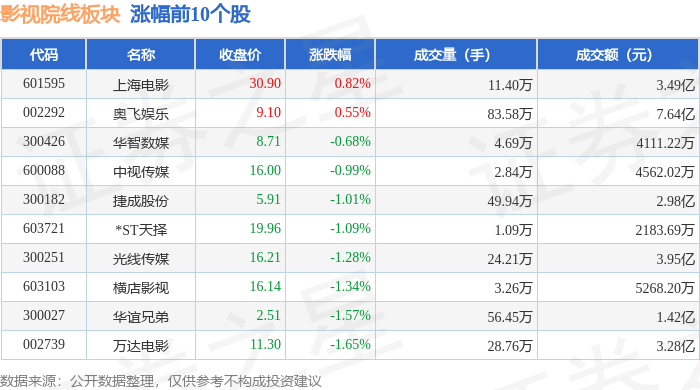
Market Overview - The film and theater sector declined by 1.67% on November 20, with Happiness Blue Sea leading the drop [1] - The Shanghai Composite Index closed at 3931.05, down 0.4%, while the Shenzhen Component Index closed at 12980.82, down 0.76% [1] Stock Performance - Shanghai Film (601595) closed at 30.90, up 0.82% with a trading volume of 114,000 shares and a turnover of 349 million [1] - AoFei Entertainment (002292) closed at 9.10, up 0.55% with a trading volume of 835,800 shares and a turnover of 764 million [1] - Happiness Blue Sea (300528) led the decline, closing at 21.15, down 5.58% with a trading volume of 241,300 shares and a turnover of 519 million [2] - China Film (600977) closed at 16.41, down 2.78% with a trading volume of 480,500 shares and a turnover of 797 million [2] Capital Flow - The film and theater sector experienced a net outflow of 405 million from institutional investors, while retail investors saw a net inflow of 468 million [2] - The data indicates that retail investors are more active in the sector despite the overall decline [2] Individual Stock Capital Flow - AoFei Entertainment had a net inflow of 48.85 million from institutional investors, while retail investors had a net outflow of 88.64 million [3] - Happiness Blue Sea saw a significant net outflow of 14.14 million from institutional investors, indicating weaker institutional interest [3] - Shanghai Film experienced a net outflow of 7.86 million from institutional investors, suggesting a cautious stance among larger investors [3]


当前游戏行业景气度持续攀升,龙头公司业绩表现强劲,聚焦游戏ETF(159869)布局窗口
Mei Ri Jing Ji Xin Wen· 2025-11-20 07:16
11月20日,游戏板块早盘高开后震荡下挫,游戏ETF(159869)现跌超0.5%。持仓股中,富春股 份、名臣健康、星辉娱乐、游族网络、姚记科技等跌幅居前,仅奥飞娱乐、北纬科技、三七互娱等逆势 上涨。截至11月19日,该ETF规模已达114.61亿元,为投资者布局A股游戏龙头提供了便捷工具。 当前游戏行业景气度持续攀升,龙头公司业绩表现强劲:完美世界三季度营收与利润大幅增长且前 三季度扭亏为盈;世纪华通单季收入突破百亿,移动游戏业务实现高速增长;腾讯游戏业务增速亮眼, 国际市场表现尤为突出。行业驱动力充沛:四季度新游密集上线,腾讯、网易、字节等大厂重磅产品集 中亮相;政策环境友好,文化出海受鼓励;AI技术催化产品创新,助力估值修复。 招商证券认为,当前游戏龙头公司(如世纪华通、三七互娱等)估值处于低位(明年预估市盈率不 足15倍),安全边际高;同时,预计明年一季度业绩将保持高增长,成为短期催化剂,加之AI技术有 望在游戏领域实现应用突破,机构坚定看好该板块的投资价值。 (责任编辑:董萍萍 ) 【免责声明】本文仅代表作者本人观点,与和讯网无关。和讯网站对文中陈述、观点判断保持中立,不对所包含内容 的准确性、可靠 ...
工业和信息化部:引导玩具企业应用AI技术创造更多新需求
Shang Hai Zheng Quan Bao· 2025-11-20 03:45
Core Insights - The Ministry of Industry and Information Technology (MIIT) plans to release an implementation plan to promote the adaptability of supply and demand in consumer goods, specifically encouraging toy companies to leverage AI technology to create new demands [1][6] Group 1: AI Toys as a Growth Engine - AI toys are becoming a new engine for high-quality development in the toy industry, characterized by stronger product integration, redefined functional roles, and comprehensive user demographics [2] - The AI toy market in China is projected to reach approximately 24.6 billion yuan in 2024, with an expected increase to 29 billion yuan in 2025 [2] Group 2: Industry Chain Activation - The explosive growth of the AI toy market is activating the vitality of the entire industry chain, leading to a diverse competitive landscape where toy companies and tech firms are accelerating their positioning [3] - Companies like Shifeng Culture and Aofei Entertainment are actively pursuing AI transformation strategies, collaborating with tech firms and establishing dedicated AI toy divisions [3] Group 3: Advantages of Domestic AI Toys - Domestic AI toy manufacturers possess significant advantages in manufacturing costs, R&D cycles, iteration speed, and supply chain integrity, which could lead to the creation of globally influential products [4] Group 4: Comprehensive Support System - A complete support system is essential for the sustainable development of the industry, encompassing policy guidance, innovation incentives, and safety regulations [5] - The MIIT will work with relevant departments to enhance safety standards and data privacy for AI toys, addressing consumer concerns [6] Group 5: Market Dynamics and Future Outlook - Changes in population structure are putting long-term growth pressure on traditional toys, making AI transformation a key path for industry breakthroughs [7] - With a complete industrial chain and continuous innovation capabilities, China's AI toy industry is expected to enhance its influence in the global smart consumer market [7]
促进消费品供需适配性实施方案将出台 引导玩具企业应用AI技术创造更多新需求
Zhong Guo Jin Rong Xin Xi Wang· 2025-11-19 23:19
Core Insights - The application of artificial intelligence (AI) and large models in the toy industry is significantly enhancing product interactivity and creating a new competitive landscape [1][2] - AI toys are becoming a new engine for high-quality development in the toy industry, characterized by stronger product integration, redefined functional roles, and comprehensive user coverage [1][2][3] Industry Characteristics - **Stronger Product Integration**: AI toys are integrating various technologies, allowing them to interact with users through understanding language and visual inputs, while also incorporating cultural elements to enhance product value [1][2] - **Redefined Functional Roles**: AI toys are evolving from mere entertainment to becoming "smart companions" that provide educational, emotional, and creative support [1][2] - **Comprehensive User Coverage**: AI toys are breaking age barriers, catering to a diverse consumer base across all age groups, thus meeting varied consumption needs [2] Market Growth and Dynamics - The AI toy market in China is projected to grow from approximately 24.6 billion yuan in 2024 to 29 billion yuan in 2025, indicating strong market demand and growth potential [2] - The rapid growth of the AI toy market is activating the entire industry chain, with companies accelerating their AI transformation strategies and forming a diverse competitive landscape [3] Company Strategies - Companies are actively pursuing AI transformation, with notable collaborations and innovations, such as partnerships between toy companies and tech firms to develop AI-powered products [3] - Specific examples include partnerships for voice-interactive products, establishment of dedicated AI toy divisions, and the integration of AR technology into new product lines [3] Policy and Support Framework - The Ministry of Industry and Information Technology is set to implement policies to guide toy companies in leveraging AI technology to create new consumer demands [5][6] - A comprehensive support system is being established, focusing on policy direction, innovation encouragement, and safety regulation to ensure the sustainable development of the AI toy industry [5][6] Future Outlook - The combination of favorable policies, corporate innovation, and market dynamics is expected to facilitate the transition of the AI toy industry from growth in scale to improvement in quality, enhancing China's influence in the global smart consumer market [6]
财经聚焦丨安全标准修订 对玩具产业影响几何?
Xin Hua She· 2025-11-19 23:18
Core Viewpoint - The newly revised mandatory national standards for toy safety will be implemented starting November 1, 2026, addressing emerging safety risks in the rapidly growing toy industry [1][5]. Industry Development - The toy industry in China is experiencing rapid growth, with projections indicating that the domestic retail sales of toys will exceed 100 billion yuan by 2025 [3]. - The "14th Five-Year Plan" has accelerated the transformation and upgrading of the toy industry, focusing on increasing variety, improving quality, and creating brands [3]. Safety Risks - New materials and technologies in the toy industry have introduced safety hazards, including toxic substances in popular toys like "crystal mud" and "magnetic beads," which pose risks of choking and poisoning [4]. - Experts have noted that some trending toys lack clear material specifications and quality control, leading to potential health risks for children [4]. Standard Enhancements - The revised standards include comprehensive upgrades to safety requirements and testing methods, enhancing the enforceability and applicability of national standards [5]. - New limits on ten categories of harmful substances, including formaldehyde and volatile organic compounds, have been added to prevent health hazards [5]. - The standards now include specific technical requirements for new product categories, such as flame-retardant properties for headwear toys and safety measures for food-shaped toys [5][6]. Implementation and Compliance - Companies are proactively adapting to the new standards, with some already initiating the transition process to ensure compliance [8]. - The transition period for the new standards includes a 12-month production phase and an additional 12-month sales phase to facilitate the orderly exit of existing inventory [8]. Regulatory Actions - A joint three-year action plan has been launched by six government departments to enhance the safety of children's products, with extensive inspections conducted on toy manufacturers [9]. - The goal is to effectively address safety hazards and significantly improve the quality of children's products by 2027 [9].
促进消费品供需适配性实施方案将出台 工业和信息化部相关负责人表示:引导玩具企业应用AI技术创造更多新需求
Shang Hai Zheng Quan Bao· 2025-11-19 18:24
Core Insights - The application of artificial intelligence (AI) and large models in the toy industry is significantly enhancing product interactivity and creating a new competitive landscape [1][4] - The AI toy market in China is projected to grow from approximately 24.6 billion yuan in 2024 to 29 billion yuan in 2025, indicating strong market potential [2] Industry Development - AI toys are becoming a new engine for high-quality development in the toy industry, characterized by stronger product integration, redefined functional roles, and comprehensive user demographics [1] - The integration of AI technology allows toys to interact intelligently, combining educational, emotional, and creative functions, thus evolving from mere entertainment to "smart companions" [1][4] Market Dynamics - The explosive growth of the AI toy market is activating the entire industry chain, with toy companies and tech firms accelerating their competitive positioning [4] - Companies like Shifeng Culture and Aofei Entertainment are actively pursuing AI transformation strategies, collaborating with tech firms to develop AI interactive products [4] Competitive Landscape - Domestic AI toy manufacturers possess significant advantages in manufacturing costs, R&D cycles, and supply chain integrity, positioning them to create globally influential products [5] - The cross-industry penetration of smart manufacturing companies is enriching the industry ecosystem, showcasing China's global competitiveness in AI education robots [4] Policy and Support - The Ministry of Industry and Information Technology is set to implement policies to guide toy companies in leveraging AI technology to create new consumer demands [6] - A comprehensive support system is being established to ensure the sustainable development of the AI toy industry, focusing on direction guidance, innovation promotion, and safety regulation [6] Future Outlook - The AI toy industry in China is expected to transition from scale growth to quality enhancement, driven by a combination of policy support, corporate efforts, and market dynamics [7] - With a complete industrial chain and continuous innovation capabilities, the Chinese AI toy industry is poised to strengthen its influence in the global smart consumer market [7]
财经聚焦丨安全标准修订,对玩具产业影响几何?
Xin Hua Wang· 2025-11-19 16:09
Core Viewpoint - The newly revised mandatory national standards for toy safety will be implemented starting November 1, 2026, reflecting the rapid development of the toy industry in China and addressing emerging safety risks [2][3]. Industry Development - The toy industry in China is experiencing rapid growth, with projections indicating that the domestic retail sales of toys will exceed 100 billion yuan by 2025 [3]. - The "14th Five-Year Plan" has driven the transformation and upgrading of the toy industry, focusing on increasing variety, improving quality, and creating brands [5]. Safety Concerns - Recent years have seen significant safety concerns regarding toys, including hazardous materials in popular products like "crystal mud" and "magnetic beads," which pose risks such as choking and poisoning [6]. - Experts have noted that many trendy toys lack clear material specifications and quality control, leading to potential health hazards for children [6]. Standard Enhancements - The revised standards include comprehensive upgrades to safety requirements and testing methods, enhancing the enforceability and applicability of the national standards [7]. - New requirements have been added for harmful substances, mechanical safety, and fire safety, addressing issues such as the presence of formaldehyde and the safety of toys designed in food shapes [7][8]. Implementation and Compliance - Companies are proactively preparing for the transition to the new standards, with some already completing over 90% of their product line compliance [9]. - The transition period for the new standards includes a 12-month production phase and an additional 12-month sales phase to ensure a smooth adjustment for manufacturers [9]. Regulatory Actions - A joint initiative by six government departments has been launched to enhance the safety of children's products, with extensive inspections conducted on toy manufacturers and retailers [10][11]. - The goal is to effectively address safety hazards in children's products by 2027, with a focus on improving overall safety levels [11].

安全标准修订,对玩具产业影响几何?
Xin Hua Cai Jing· 2025-11-19 10:08
Core Insights - The newly revised mandatory national standards for toy safety will be implemented on November 1, 2026, aiming to enhance safety measures in the toy industry [1] Industry Development - The toy industry in China is experiencing rapid growth, with projections indicating that the domestic retail sales of toys will exceed 100 billion yuan by 2025 [2] - The "14th Five-Year Plan" has focused on transforming and upgrading the toy industry, emphasizing the strategy of increasing variety, improving quality, and creating brands [2] Safety Concerns - The application of new materials and technologies has exposed new safety risks in toys, including toxic substances in popular items like "crystal mud" and "magnetic beads" [3] - Experts have highlighted that some toys have design flaws that pose mechanical and physical safety hazards, such as small parts that can be swallowed [3] Standard Enhancements - The revised standards include comprehensive upgrades to safety requirements and testing methods, enhancing the enforceability and applicability of national standards [4] - New limits on ten categories of harmful substances, including formaldehyde and volatile organic compounds, have been added to protect children's health [4] - Technical requirements for new product categories, such as flame-retardant properties for masks and toys, have been introduced to improve fire safety [4][5] Implementation and Compliance - Many toy companies are proactively adapting to the new standards, with some already completing over 90% of their product line compliance [6] - The transition period for the new standards includes a 12-month production phase and an additional 12-month sales phase to ensure a smooth transition [6] Regulatory Actions - The State Administration for Market Regulation has initiated a three-year action plan to safeguard the safety of children's products, inspecting over 18,000 batches of toys and addressing issues in nearly 2,000 companies [6][7] - Future efforts will focus on strengthening quality supervision and enhancing safety levels for children's products by 2027 [7]