
京东健康

Search documents
京东若爆雷,或将成为历史上最大的雷,其规模甚至可能超过恒大
商业洞察· 2026-01-19 09:46
Core Viewpoint - JD.com has achieved a record revenue of 1.15 trillion yuan, surpassing Alibaba by nearly 180 billion yuan and Huawei by approximately 300 billion yuan, establishing itself as China's largest private enterprise and the only private company with over a trillion yuan in revenue [1][3][5]. Group 1: Revenue and Workforce - JD.com reported a total revenue of 1.1588 trillion yuan, significantly exceeding Alibaba's 984.7 billion yuan and Huawei's 860 billion yuan, marking it as the largest private enterprise in China [3][5]. - The company employs 670,000 staff members, contributing to its substantial revenue generation [1]. Group 2: Employee Welfare and Business Strategy - JD.com has invested heavily in employee welfare, with over 116.1 billion yuan spent on labor costs last year, and offers a housing loan program for employees, providing up to 1 million yuan [1][9]. - The company has implemented a strategy of full social insurance coverage for all delivery personnel, enhancing employee satisfaction and loyalty [7][9]. Group 3: JD Health and Growth Potential - JD Health has shown remarkable growth, with total revenue projected to increase by 8.6% to 58.2 billion yuan in 2024, becoming a significant profit driver for the group [10]. - The introduction of innovative health products, such as "Xiaoniu Acid," has led to substantial revenue growth, with JD Health's net profit reaching 2.44 billion yuan, accounting for nearly a quarter of the group's total profit [17]. Group 4: Market Position and Competitive Advantage - JD.com has established a robust logistics network with 3,600 smart warehouses and a storage area equivalent to 4,500 football fields, enabling rapid order fulfillment [7]. - The company has successfully penetrated the high-net-worth consumer market, with 77% of households earning over 500,000 yuan annually making purchases on JD.com [12]. Group 5: Contribution to National Economy - Private enterprises in China, including JD.com, have collectively generated 41 trillion yuan in revenue, significantly contributing to the national economy and employment [21]. - The government is supporting private enterprises through tax reductions and encouraging technological advancements, allowing companies like JD.com to thrive [23].



OpenAI及谷歌等巨头齐攻AI医疗,健康 160(2656.HK) 与京东健康(6618.HK)等国内龙头如何打造中国方案
Zhong Jin Zai Xian· 2026-01-19 09:16
Core Insights - The global tech giants are intensifying their efforts in the AI healthcare sector, with Chinese companies adopting pragmatic approaches that are becoming essential [1] - The AI healthcare market in China is experiencing rapid growth, driven by an aging population and a structural imbalance in quality medical resources [7] Group 1: Major Players and Their Strategies - OpenAI's ChatGPT Health focuses on consumer engagement, allowing users to upload medical records for personalized health advice, processing over 230 million health interactions weekly [2] - Google has launched the MedGemma 1.5 model, which operates offline and supports 3D scanning and medical text analysis, with a speech-to-text error rate of only 5.2% [2] - Anthropic targets the enterprise market with Claude for Healthcare, emphasizing privacy and compliance, and has partnered with institutions like Boston Children's Hospital [2] Group 2: Chinese Companies' Developments - Health 160 has connected over 44,800 healthcare institutions and developed an AI health management system that covers the entire patient journey, achieving a content click-through rate increase of 90% [3][4] - JD Health aims to evolve AI from a tool to a core engine for personalized health management, launching the "Zhi Yi" AI for evidence-based medicine [5][6] - JD Health's AI initiatives include a comprehensive health service matrix and specialized systems for cancer treatment, showcasing the potential of AI in personalized medicine [6] Group 3: Market Trends and Challenges - The AI medical device market in China is projected to grow from 292 million yuan in 2020 to 24.2 billion yuan by 2025, highlighting the sector's rapid expansion [7] - The competitive focus in AI healthcare is shifting from utility to stable, compliant, and sustainable implementation, with ecological layouts being crucial for achieving these goals [7] - Challenges include data privacy, ethical standards, and the need for improved data quality and interoperability among healthcare systems [8] Group 4: Future Directions - The future of AI healthcare in China will see a complementary relationship between major players' comprehensive strategies and targeted niche developments [9] - As technology matures, AI models are expected to further empower the healthcare industry, shifting the focus from treatment to proactive health management [9]


A股超100股涨停,中航系集体飘红,黄金逼近4700美元,白银年内涨超30%
21世纪经济报道· 2026-01-19 07:49
Market Overview - Major stock indices in the Asia-Pacific region showed mixed results, with the Shanghai Composite Index surpassing 4100 points, while Hong Kong's main indices were in the red [1] - The South Korean Composite Index broke through 4900 points for the first time, with Hyundai and Kia Motors both rising over 12% [1] - A-shares experienced a contraction in trading volume, with the Shanghai Composite Index up 0.29% and the Shenzhen Component Index up 0.09%, while the ChiNext Index fell by 0.7% [1][2] Trading Volume and Stock Performance - The total trading volume in the Shanghai and Shenzhen markets was 2.73 trillion yuan, a decrease of 324.3 billion yuan from the previous trading day [1] - Over 3500 stocks in the market rose, with 103 stocks hitting the daily limit [1] Sector Performance - The electric grid equipment sector showed strong performance throughout the day, with stocks like China West Electric, Dalian Electric Porcelain, and Guangdian Electric all hitting the daily limit [3] - The AVIC index opened high and saw all constituent stocks in the green, with AVIC Aircraft, AVIC Power, AVIC Control, and AVIC Technology all hitting the daily limit, while Hongdu Aviation rose nearly 9% [4][5] Hong Kong Market - The three major indices in Hong Kong collectively declined, with the Hang Seng Index and Hang Seng Technology Index both dropping over 1%, and the Hang Seng China Enterprises Index down over 0.8% [6] - Most tech stocks in Hong Kong fell, with Bilibili down over 7%, Alibaba and Alibaba Health down over 3%, and other companies like Kuaishou and JD Health down over 2% [6] Commodity Performance - Gold and silver prices reached new highs, with spot gold nearing $4700 and silver up over 3.6%, marking a year-to-date increase of over 30% [7] - The cryptocurrency market continued to decline, with Bitcoin dropping nearly 3% and over 250,000 individuals facing liquidation, totaling approximately $871 million [7]



ETF盘中资讯|港股医药再调整,港股通医疗ETF(159137)、港股通创新药ETF(520880)跌2%!低吸时机到了?场内持续溢价!
Jin Rong Jie· 2026-01-19 04:04
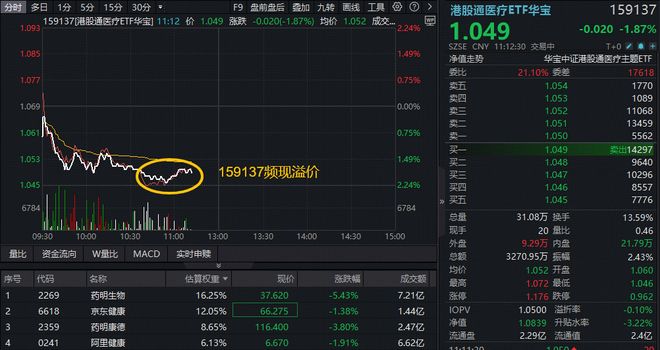
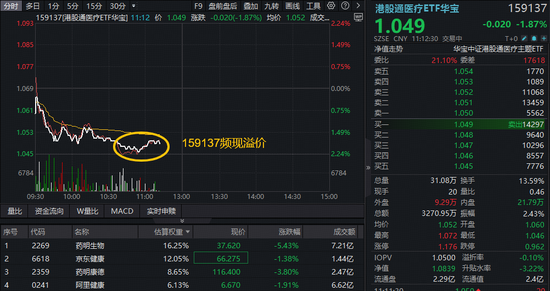
Market Overview - The Hong Kong stock market experienced a broad adjustment on January 19, with the Hang Seng Index falling nearly 1% and the pharmaceutical sector declining alongside the market [1] - The Hong Kong Stock Connect Medical ETF, Huabao (159137), saw a drop of 2%, frequently trading at a premium, while major stocks like WuXi Biologics fell over 5% [1][2] - AI healthcare leaders JD Health and Alibaba Health both dropped more than 1% [1] Pharmaceutical Sector Performance - The medical sector opened lower and continued to decline, with the Hong Kong Stock Connect Innovation Drug ETF (520880) dropping over 2% during the session [1] - Key stocks in the innovation drug sector, such as BeiGene and CanSino Biologics, also fell by more than 2%, while several others, including China Biologic Products and 3SBio, dropped over 4% [1] Trading Activity - The Hong Kong Stock Connect Innovation Drug ETF (520880) was noted for its persistent premium trading, indicating strong buying interest, with a transaction volume exceeding 200 million yuan [3] - The ETF's price was reported at 0.541, down 1.99%, with a trading volume of 4.65 billion [4] Future Outlook - The National Medical Products Administration of China announced that by 2025, 76 innovative drugs are expected to be approved, placing China at the forefront globally [4] - The total transaction volume for overseas licensing of Chinese innovative drugs is projected to exceed 130 billion USD in the same year [4] - Analysts believe that the Chinese innovative drug sector is entering a phase of simultaneous benefits from "going global, technology, and policy," leading to a revaluation of innovative drug stocks [5] Investment Opportunities - Starting in January 2026, several innovative drug companies will release their earnings forecasts for 2025, presenting potential valuation recovery opportunities for those exceeding expectations [6] - The Hong Kong Stock Connect Innovation Drug ETF (520880) and its associated funds track the Hang Seng Hong Kong Stock Connect Innovation Drug Select Index, which has distinct advantages, including a focus on pure innovative drug companies and a significant weighting of leading firms [6][7] - The top ten innovative drug leaders account for over 73% of the index, highlighting the strength of the sector [7]
港股医药再调整,港股通医疗ETF(159137)、港股通创新药ETF(520880)跌2%!低吸时机到了?场内持续溢价!
Xin Lang Cai Jing· 2026-01-19 03:25
Core Viewpoint - The Hong Kong stock market is experiencing a broad adjustment, with the Hang Seng Index down nearly 1%, particularly affecting the healthcare sector, which is seeing declines in major pharmaceutical stocks and ETFs [1][10]. Group 1: Market Performance - The Hong Kong healthcare sector opened lower and continued to decline, with the Hong Kong Stock Connect Medical ETF (Huabao, 159137) dropping by 2%, and major stocks like WuXi Biologics falling over 5% [1][10]. - The Hong Kong Stock Connect Innovative Drug ETF (520880), which exclusively tracks innovative drugs, fell by over 2%, with leading stocks such as BeiGene and CanSino Biologics also declining by more than 2% [3][10]. - The trading volume for the Hong Kong Stock Connect Innovative Drug ETF exceeded 200 million yuan, indicating strong buying interest despite the price drop [12]. Group 2: Regulatory and Market Insights - The National Medical Products Administration of China announced that 76 innovative drugs are expected to be approved by 2025, positioning China as a global leader in this area, with the total transaction value for overseas licensing of innovative drugs expected to exceed 130 billion USD [14]. - Analysts believe that the Chinese innovative drug sector is entering a phase of simultaneous benefits from "going global, technology, and policy," leading to a revaluation of innovative drug stocks [15]. Group 3: ETF Characteristics - The Hong Kong Stock Connect Innovative Drug ETF (520880) and its associated funds passively track the Hang Seng Stock Connect Innovative Drug Select Index, which has three unique advantages: it is purely focused on innovative drugs, has a high concentration of leading companies, and effectively manages risks associated with less liquid stocks [5][6][16]. - The top ten stocks in the ETF account for over 73% of its weight, highlighting the dominance of leading companies in the innovative drug sector [17].
阿里开启AI“办事时代”,催化密集,高“含BA量”港股互联网ETF(513770)大举揽金近12亿元
Xin Lang Cai Jing· 2026-01-19 02:26
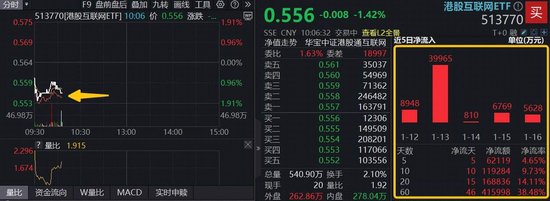
1月19日,港股市场集体调整,恒指、恒科指均跌逾1%,分析认为,美联储短期内降息预期降低,全球 地缘政治不确定性加剧,预计港股窄幅震荡。但中长期科技板块仍是投资主线,受益于产业链涨价、国 产化替代、AI应用加速推进等多重利好。 港股AI方面,互联网龙头集体回调,阿里巴巴-W跌逾3%,快手- W跌近2%,腾讯控股、小米集团-W跌 超1%,美团-W跟跌。港股AI核心资产——港股互联网ETF(513770)场内价格现跌1.42%,再现宽幅 溢价,显示买盘资金积极介入。上交所数据显示,港股互联网ETF(513770)近10日连续吸金,合计高 达11.93亿元。 1月15日,阿里巴巴宣布千问APP全面接入淘宝、支付宝、淘宝闪购、飞猪、高德等阿里生态业务,在 全球首次实现点外卖、买东西、订机票、订酒店等AI购物功能,引领AI行业从"聊天对话"迈入"办事时 代"。阿里巴巴集团副总裁吴嘉在发布会上表示,千问C端月活用户在上线不到2个月后已突破1亿。 此外,1月14日,阿里云智能集团资深副总裁、公共云事业部总裁刘伟光表示,阿里云的目标是"拿下 2026年中国AI云市场80%的新增份额"。 开源证券表示,全球头部大模型厂商在加速 ...
沪指涨0.5%,电网设备掀起涨停潮,人民币中间价创逾32个月新高,恒科指跌0.6%,科网股调整,沪锡跌超5%
Hua Er Jie Jian Wen· 2026-01-19 02:26
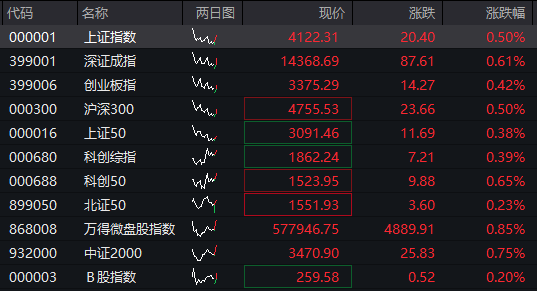
Market Overview - A-shares experienced a volatile rise in early trading on January 19, with all three major indices strengthening, particularly in the electric grid equipment and precious metals sectors [1] - The Hang Seng Index opened lower and continued to decline, with the Hang Seng Technology Index also falling, while new consumption concepts rebounded [2][3] A-shares Performance - The Shanghai Composite Index rose by 20.40 points, or 0.50%, to 4122.31 - The Shenzhen Component Index increased by 87.61 points, or 0.61%, to 14368.69 - The ChiNext Index gained 14.27 points, or 0.42%, to 3375.29 [1] Hong Kong Market Performance - The Hang Seng Index fell by 229.97 points, or 0.86%, to 26614.99 - The Hang Seng Technology Index decreased by 43.23 points, or 0.74%, to 5778.95 [2][3] Bond Market - The bond market showed mixed results, with the 30-year main contract down by 0.23% and the 10-year main contract down by 0.01% [3][4] Commodity Market - Most domestic commodity futures declined, with notable drops in tin (over 6%) and lithium carbonate (nearly 4%) - Silver and gold prices saw increases, with silver up by 2% and gold by 1% [4][5] Electric Grid Equipment Sector - The electric grid equipment sector saw a surge, with stocks like Shuangjie Electric hitting the daily limit up of 20%, and several others rising over 10% [6][7] Tourism and Hospitality Sector - The tourism and hotel sector showed positive movement, with Jiuhua Tourism hitting the daily limit up and several other hotel stocks also rising, driven by increased travel bookings for the upcoming holiday season [8] AI Application Sector - The AI application sector rebounded, with stocks like Baina Qiancheng rising over 10%, following news of OpenAI testing ad placements in its services [9][11] Precious Metals Sector - The precious metals sector was active, with Sichuan Gold rising over 9% and other gold stocks following suit, influenced by record high international gold and silver prices [10]


京东健康发布京东卓医2.0
Xin Lang Cai Jing· 2026-01-19 01:31
Core Viewpoint - JD Health has officially launched the 2.0 version of its large model product "JD Zhuoyi," which integrates AI and supply chain capabilities to provide comprehensive management solutions for hospitals [1][3]. Group 1: Product Features - The new JD Zhuoyi 2.0 combines JD Health's "AI + Supply Chain" advantages, creating a system that supports clinical nutrition, outpatient medication, and weight management [1][3]. - The "AI + Clinical Nutrition" feature focuses on nutritional assessment and intervention for inpatients and outpatients, making nutritional treatment traceable and assessable [1][3]. - A "Clinical Nutrition Large Model" developed in collaboration with Wenzhou Medical University and the National Health Commission provides foundational support for the solution, enabling automatic assistance for healthcare personnel in nutrition risk screening, assessment, diagnosis, and personalized treatment plan generation [1][3]. Group 2: AI Applications - The "AI + Pharmacy Management" feature utilizes AI tools for prescription review and smart pharmacist assistance, allowing doctors and pharmacists to focus on high-value diagnosis and academic development [2][4]. - An AI prescription flow platform has been established to manage the entire cycle of prescription review, medication collection, home medication, and follow-up prescriptions, with 24/7 online AI pharmacists available for patient inquiries [2][4]. - The "AI + Weight Management" feature automates standard tasks, allowing professional doctors to concentrate on critical decisions and risk management, balancing scalable services with cost control [2][4]. Group 3: Patient Engagement - The solution integrates hospital medical data with external lifestyle data to create a complete patient profile, using AI to recommend effective weight treatment plans [2][4]. - AI provides instant feedback and emotional support, converting medical advice into daily actionable tasks, enhancing patient compliance through encouragement and guidance after completing dietary, exercise, and weight tracking [2][4].
阿里AI Agent落地!生态闭环引爆港股互联网估值切换
Xin Lang Cai Jing· 2026-01-19 01:09
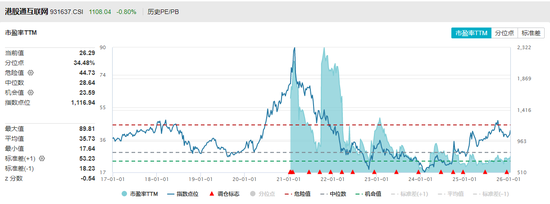
Core Viewpoint - The recent surge in A-share trading volume has led to a cooling market sentiment, transitioning into a phase of consolidation, which is viewed as a healthy adjustment. This is accompanied by a structural reallocation of liquidity from low-yield assets to equity markets, with the central bank indicating room for further monetary easing [1][16]. Group 1: Market Dynamics - The current adjustment in the A-share market is seen as a positive development, with a macro perspective indicating a shift of household savings from deposits and bonds to equity markets [1][16]. - The central bank's stance on potential interest rate cuts suggests a continued loose liquidity environment, which may drive funds towards the more attractive valuations and solid fundamentals of the Hong Kong stock market [1][16]. - A significant portion of the new capital entering the market is through ETFs, creating a positive feedback loop between capital flow and price discovery [1][16]. Group 2: Investment Opportunities in Hong Kong Stocks - The Hong Kong Internet ETF (513770) is highlighted as a noteworthy investment option, as it targets technology leaders and encompasses a robust ecosystem of businesses [1][17]. - The ETF includes major players like Alibaba and Alibaba Health, providing investors with an excellent pathway to capitalize on the current recovery in AI and internet sectors [2][17]. Group 3: Valuation and Growth Potential - The Hong Kong Internet sector shows compelling valuation metrics, with the Hong Kong Internet Index trading at a PE ratio of approximately 26 times, compared to 42 times for the Nasdaq and 43 times for the A-share ChiNext index [3][20]. - This valuation gap presents a high-risk-reward opportunity for investors seeking growth or avoiding high valuations [5][20]. Group 4: AI and Alibaba's Role - Alibaba's recent launch of the Qianwen Task Assistant 1.0 is seen as a pivotal upgrade, integrating various core services and marking a transition into the "AI Agent era" [5][26]. - The integration of AI technology into Alibaba's ecosystem is expected to enhance user experience and operational efficiency, positioning the company as a key player in the AI-driven market [5][28]. - The anticipated growth in AI applications is projected to significantly impact the digital landscape, with estimates suggesting that 60%-70% of routine tasks will be handled by AI in the next two years [5][28]. Group 5: Competitive Landscape - The competition for AI-driven market share is intensifying, with Alibaba's advancements posing challenges to Tencent and other players, prompting them to enhance their AI offerings [14][31]. - The market is expected to evolve from being driven by a single player (Alibaba) to a more diversified landscape with multiple leading companies contributing to growth [14][31]. - The Hong Kong Internet ETF provides comprehensive coverage of major players, mitigating individual stock volatility while capturing the full spectrum of industry growth [14][31].
智通港股沽空统计|1月19日
智通财经网· 2026-01-19 00:27
智通财经APP获悉,友邦保险-R(81299)、安踏体育-R(82020)、京东健康-R(86618)上一交易日沽空比率 位于前三位,分别为100.00%、100.00%、100.00%。阿里巴巴-W(09988)、泡泡玛特(09992)、小米集团- W(01810)的沽空金额位居前三,分别为19.51 亿元、14.69 亿元、14.06 亿元。中国平安-R(82318)、腾讯 控股-R(80700)、友邦保险-R(81299)的偏离值位居前三,分别为61.20%、48.74%、34.93%。 | 股票名称 | 沽空金额↓ | 沽空比率 | 偏离值 | | --- | --- | --- | --- | | 阿里巴巴-W(09988) | 19.51 亿元 | 14.77% | 0.58% | | 泡泡玛特(09992) | 14.69 亿元 | 24.66% | 0.25% | | 小米集团-W(01810) | 14.06 亿元 | 19.02% | -1.96% | | 腾讯控股(00700) | 9.55 亿元 | 7.50% | -3.65% | | 美团-W(03690) | 5.28 亿元 | ...



