新城控股

Search documents
新城控股:12月商业运营收入12.38亿元,同比增长6.44%
Xin Lang Cai Jing· 2026-01-09 09:06
新城控股公告,12月份商业运营总收入12.38亿元,同比增长6.44%;1-12月140.9亿元,同比增长 10.00%。当月合同销售金额13.54亿元,同比下降57.80%,销售面积18.43万平方米。1-12月合同销售金 额192.7亿元,同比下降52.03%,销售面积253.58万平方米。四季度偿还境内外公开市场债券37.88亿 元,截至12月31日合联营公司权益有息负债23.85亿元。 ...

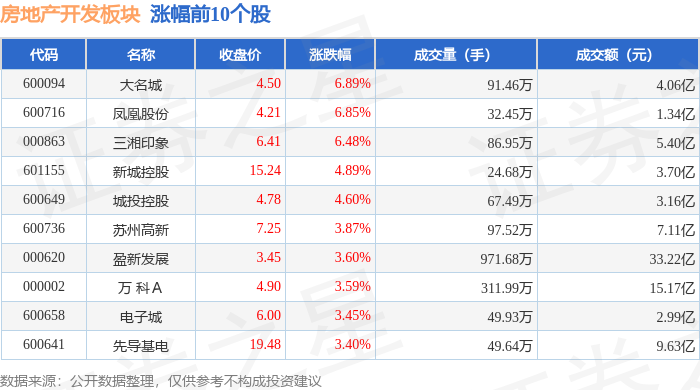
房地产开发板块1月8日涨1.56%,大名城领涨,主力资金净流出2.56亿元
Zheng Xing Xing Ye Ri Bao· 2026-01-08 08:56
Core Insights - The real estate development sector saw an increase of 1.56% on January 8, with Daming City leading the gains [1] - The Shanghai Composite Index closed at 4082.98, down 0.07%, while the Shenzhen Component Index closed at 13959.48, down 0.51% [1] Stock Performance - Daming City (600094) closed at 4.50, up 6.89% with a trading volume of 914,600 shares and a transaction value of 406 million [1] - Phoenix Holdings (600716) closed at 4.21, up 6.85% with a trading volume of 324,500 shares and a transaction value of 134 million [1] - Sanxiang Impression (000863) closed at 6.41, up 6.48% with a trading volume of 869,500 shares and a transaction value of 540 million [1] - New Town Holdings (601155) closed at 15.24, up 4.89% with a trading volume of 246,800 shares and a transaction value of 370 million [1] - City Investment Holdings (600649) closed at 4.78, up 4.60% with a trading volume of 674,900 shares and a transaction value of 316 million [1] Capital Flow - The real estate development sector experienced a net outflow of 256 million from institutional investors and 226 million from speculative funds, while retail investors saw a net inflow of 482 million [2] - Vanke A (000002) had a net inflow of 2.20 billion from institutional investors, but a net outflow of 733.35 million from speculative funds [3] - Poly Developments (600048) had a net inflow of 1.82 billion from institutional investors, with a net outflow of 389.64 million from speculative funds [3]




如何理解“房地产高质量发展”
Haitong Securities International· 2026-01-08 08:05
Investment Rating - The report recommends a positive investment outlook for the real estate sector, highlighting specific stocks in various categories such as development, commercial residential, property management, and cultural tourism [1]. Core Insights - The report emphasizes the shift in the real estate industry from a focus on quantity to a focus on quality, driven by the new requirements set forth during the "15th Five-Year Plan" period, which aims for high-quality development [1][13]. - It identifies six key tasks to achieve high-quality development, including optimizing affordable housing supply and enhancing property service quality [1][61]. Summary by Sections 1. High-Quality Development as a New Requirement - The report discusses the significant changes in the real estate market, transitioning from a supply-demand imbalance to a potential oversupply situation, necessitating a focus on high-quality development [3][6]. - It outlines the central government's shift in policy from reducing leverage and total volume to stabilizing the real estate market and promoting quality [6][7]. 2. Understanding High-Quality Development - The report defines high-quality development as essential for meeting the people's aspirations for a better life, advancing modernization, and facilitating the transformation of the real estate industry [22][24]. - It presents three major significances, four key requirements, and six essential tasks for high-quality development [21][28]. 3. Policy Expectations for the 15th Five-Year Plan - The report anticipates that future policies will focus on risk prevention, quality improvement, and transformation in the development sector [62]. - It emphasizes the need for a balanced approach between short-term market stabilization and long-term structural reforms [36][60]. 4. Six Key Tasks for High-Quality Development - The report outlines six tasks: optimizing affordable housing supply, promoting sustainable market development, reforming development and financing systems, enhancing housing quality, improving property service quality, and establishing a safety management system for the entire lifecycle of housing [61][62].



房地产板块活跃上行,房地产ETF(512200)涨超2%冲击5连涨,成分股上海九百涨停
Xin Lang Cai Jing· 2026-01-08 07:15
Group 1 - The real estate ETF (512200) experienced a rise of over 2%, currently up 1.76%, marking a potential five-day increase, with a turnover of 3.82% and a transaction volume of 185 million yuan [1] - In 2025, the second-hand housing market in first-tier cities showed strong performance, with Shanghai's transaction volume reaching approximately 254,000 units, a four-year high, and Shenzhen's transactions totaling 68,200 units, a year-on-year increase of 5.7% [1] - The real estate market in 2025 is showing signs of recovery, with ten major real estate companies achieving sales exceeding 10 billion yuan, and an average sales amount of 17.655 billion yuan [1] Group 2 - Zhongyou Securities highlighted a significant policy shift towards systematic efforts to stabilize the real estate market, indicating that the market is expected to stabilize in 2026 [2] - The real estate ETF (512200) closely tracks the CSI All Share Real Estate Index, which categorizes companies into various industry levels, providing a comprehensive analysis tool for investors [2]


A股地产板块走强 城建发展领涨超8%
Xin Lang Cai Jing· 2026-01-08 06:36
观点网讯:1月8日,A股房地产开发板块震荡走高。截至收盘,城建发展涨超8%,凤凰股份涨超6%, 盈新发展(维权)、新城控股涨超5%,苏州高新、电子城等个股跟涨。 MACD金叉信号形成,这些股涨势不错! 免责声明:本文内容与数据由观点根据公开信息整理,不构成投资建议,使用前请核实。 ...

房地产板块逆势走强,房地产ETF基金涨超2%
Mei Ri Jing Ji Xin Wen· 2026-01-08 05:54
Core Viewpoint - The A-share market shows mixed performance with the Shanghai Composite Index up by 0.10% while the Shenzhen Component Index and the ChiNext Index are down by 0.29% and 0.78% respectively [1] Group 1: Market Performance - The Real Estate ETF (515060) increased by 2.05%, with the latest price at 0.748 yuan and an intraday turnover rate of 4.74% [1] - Among the constituent stocks, Chengjian Development led with a rise of 9.78%, followed by Shilianhang up 6.14%, Yingxin Development up 5.71%, New City Holdings up 5.51%, and Suzhou Gaoxin up 5.01% [1] Group 2: Industry Outlook - On January 7, during the "Ding Zuyu Evaluates the Real Estate Market" 2026 annual conference, industry expert Ding Zuyu indicated that the Chinese real estate sector is expected to stabilize at the bottom in 2026 [1] - This forecast aligns closely with recent industry outlooks from the China Index Academy and Yihan Think Tank [1]
房地产板块震荡走高,城建发展触及涨停
Mei Ri Jing Ji Xin Wen· 2026-01-08 05:37
(文章来源:每日经济新闻) 每经AI快讯,房地产板块震荡走高,城建发展触及涨停,凤凰股份、盈新发展涨超5%,新城控股、万 科A、大名城跟涨。 ...
大摩闭门会:房地产、交运、汽车行业更新
2026-01-08 02:07
Summary of Key Points from the Conference Call Industry: Real Estate Core Insights and Arguments - The overall real estate market is expected to maintain a downward trend in 2026, but the decline may slow compared to 2024 and 2025. The reasoning is based on a cautious and reactive policy stance, similar to 2025, with no significant stimulus expected in the first half of the year [2][3] - The anticipated decline in sales volume for both new and second-hand homes is projected to be in the mid-single digits compared to 2025. New home sales are expected to decline by a high single-digit percentage, while second-hand home sales may see a decrease of 3% to 5% [3][4] - Second-hand home prices are expected to drop by a high single-digit percentage in 2026, reflecting a slight slowdown from the low double-digit decline in 2025. This is attributed to high inventory levels, despite a recent slowdown in new listings [5][6] - The land sales situation remains weak, with a 13% year-on-year decline in land sales in 300 cities as of November 2025. This is expected to translate into a decrease in new construction starts in 2026, with a projected decline of around 15% to 16% compared to 2025 [6][7] - The real estate market is characterized by high inventory levels and weak consumer sentiment, suggesting that price stabilization in major cities may not occur until the second half of 2027 [7][8] - Developers, particularly state-owned enterprises, are expected to face continued pressure on profit margins, despite some recovery in liquidity within the industry [8][9] - Investment recommendations include focusing on companies that can effectively manage their commercial properties and those that are consolidating in the residential market, such as Huaren Zhidi and Jianfa International [10][11] Industry: Transportation Core Insights and Arguments - The transportation sector is experiencing a slowdown in growth, with December 2025 showing a further decline in industry growth rates to around 1% to 2% [15][16] - Zhongtong has been gaining market share, with a growth rate exceeding the industry average by approximately 5% in December, indicating a positive trend in market share acquisition [16][17] - The company’s ability to maintain or improve its market share is viewed as more critical than short-term profit fluctuations, as historical data suggests that sacrificing market share for profit can lead to long-term valuation declines [17][18] - The overall outlook for the transportation sector remains positive, with expectations of continued demand growth supported by geopolitical factors and a shift from unregulated to regulated markets [19][20] - The airline industry is expected to see strong demand growth, with a projected increase in passenger numbers by around 10% and ticket prices expected to rise by low double digits [20][21] - Supply constraints in the airline industry are anticipated to persist, with limited capacity growth expected to keep demand pressures high [22][23] - Upcoming catalysts for the airline sector include performance forecasts from major airlines and potential positive impacts from the Spring Festival travel season [25][26] Industry: Automotive Core Insights and Arguments - SAIC Motor Corporation is undergoing significant adjustments and improvements across its various business lines, with a focus on increasing market share in the domestic market [35][36] - The company’s self-owned brands are gradually gaining traction, with expectations of maintaining growth momentum in 2026 [36][37] - Despite challenges in the joint venture segment, particularly with SAIC Volkswagen, there is potential for surprises due to new product launches in the electric vehicle segment [38][39] - The company’s financial services and parts supply businesses are expected to benefit from recovering sales volumes, providing additional profit stability [40][41] - Overall, SAIC is positioned to capture more value as its sales recover, with a current valuation of approximately 10 times its 2026 earnings forecast, indicating potential for valuation recovery [44][45] Other Important Insights - The conference highlighted the importance of monitoring market dynamics and potential catalysts across various sectors, including real estate, transportation, and automotive, as they navigate through 2026 [46][47]
大摩闭门会-房地产-交运-汽车行业更新-纪要
2026-01-08 02:07
大摩闭门会:房地产、交运、汽车行业更新 260107 摘要 房地产市场:预计 2026 年一、二手房销售量将继续以中单位数下降, 与 2025 年跌幅相当。二手房价预计继续以高单位数下跌,跌幅或略有 放缓,但挂牌量高企是主要制约因素。 房地产开发投资:受土地销售疲软影响,2026 年新开工项目预计维持 中等程度下降,开发投资同比降幅预计与 2025 年持平,维持在 15%- 16%左右。 房地产股票投资策略:建议关注能够分拆商业物业并受益于内需刺激的 商业运营商(如华润置地、新城控股),以及通过优化业务实现盈利增 长的住宅市场整合者(如建发国际、中海地产)。 中通快递:预计明年盈利增长 10%左右,包括 10%的量增长及单位利 润持平。连续三个月增速超过行业平均水平,市场份额扩张对估值有支 撑作用,盈利增长或超预期。 航运行业:地缘政治因素导致不合规运力退出,增加合规运力需求。委 内瑞拉局势变化支持这一需求,目前位置仍具备绝对收益空间。关注春 节期间运价下调风险。 航空业:需求强劲,客流量增长 10%,票价高单位数到低双位数增长。 运力投放仅增长 2%,客座率明显上升,表明行业供给侧存在局限性, 增强了对供给 ...
2025年度中国房地产企业品牌传播力
克而瑞地产研究· 2026-01-07 09:31
Core Viewpoint - In 2025, the Chinese real estate industry is entering a new phase of value competition amid deep adjustments, shifting its core competitiveness from scale and speed to product quality, operational service, and sustainable professional capabilities. Brand communication has transformed into a multi-dimensional value output focused on "hardcore product strength," "warm community strength," and "entrusted professionalism" [1]. Group 1: Brand Development - The year 2025 marks a significant transformation in the industry, with the "Good House" standard becoming a key driver for brand development and product quality, as it is integrated into government work reports and residential regulations [8]. - Many companies are releasing updated "Good House" standards, with Green City China updating its standards to include 270 core guidelines, while Jianfa Real Estate has introduced a four-dimensional framework for its "Good House" system [9]. - The launch of innovative community projects under the "Good House" framework, such as Darwin Camp and zero-carbon community projects, has garnered high attention and engagement [10]. Group 2: Community Brand - The real estate industry is evolving from "space construction" to "relationship cultivation," focusing on community warmth, neighborly relations, and growth experiences [16]. - Leading companies are creating community ecosystems that foster recognition, participation, and continuity, with community operations becoming a key aspect of post-delivery services [21]. - Initiatives like the "Children-Friendly" program by China Railway Real Estate and various health and wellness activities by companies like China Railway and Fuyue Property highlight the industry's focus on enhancing living experiences for residents [17][18]. Group 3: Construction Brand - In 2025, brand communication in real estate construction is characterized by a focus on "stronger companies, technology-driven, and value deepening," with an emphasis on comprehensive strength and differentiated value [22]. - The integration of AI technology in construction processes, such as the AI cooling station control system developed by Longfor, showcases the industry's commitment to innovation and efficiency [22]. - The establishment of industry standards, such as the "Comprehensive Capability Evaluation Standard for Construction Enterprises," enhances brand credibility and positions companies as authoritative figures in the market [23]. Group 4: Future Outlook - The brand communication landscape in the real estate sector is becoming increasingly structured, with product brands focusing on the "Good House" concept, community brands emphasizing human connections, and construction brands building on professionalism and technological capabilities [26]. - Future brand strategies will likely integrate product innovation, community engagement, and digital capabilities, allowing companies to create perceivable and trustworthy brand assets that provide a competitive edge in the evolving market [26].