孩子王

Search documents
零售股强势,永辉超市、步步高等多股涨停
Ge Long Hui· 2025-12-10 04:05
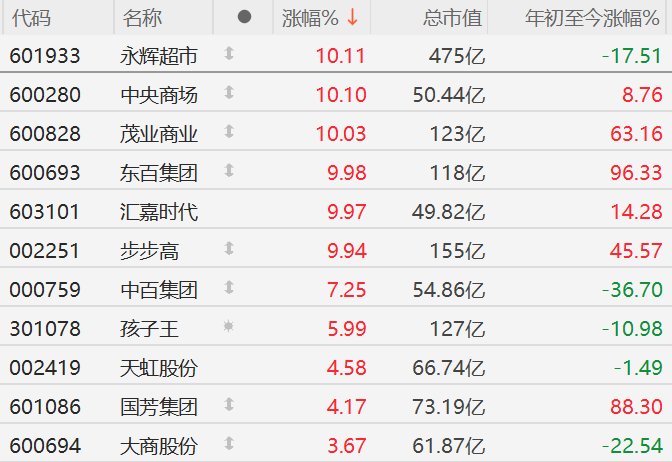
Group 1 - The A-share market saw strong performance in retail stocks, with several companies hitting the daily limit up, including Yonghui Supermarket, Central Plaza, Maoye Commercial, Dongbai Group, Huijia Times, and Bubugao [1] - The National Retail Industry Innovation Development Conference was held in Beijing on December 9-10, where the Deputy Minister of Commerce, Sheng Qiuping, emphasized the importance of the retail sector in fostering a complete domestic demand system and strengthening the domestic circulation during the 14th Five-Year Plan period [1] Group 2 - Notable stock performances included Yonghui Supermarket with a 10.11% increase, Central Plaza at 10.10%, and Maoye Commercial at 10.03%, among others [2] - Year-to-date performance showed significant variations, with Dongbai Group up 96.33% and Maoye Commercial up 63.16%, while Zhongbai Group and Haiziwang reported declines of 36.70% and 10.98%, respectively [2]


水银体温计禁产在即,线上店开始断货,客服称“购买的顾客增多”
Mei Ri Jing Ji Xin Wen· 2025-12-10 00:19
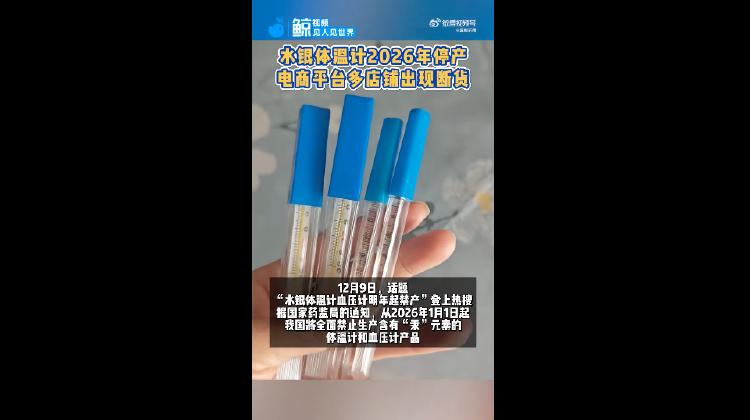
Core Viewpoint - The Chinese government will ban the production of mercury thermometers and sphygmomanometers starting January 1, 2026, marking the end of mercury-based medical devices in the market [1]. Company Impact - Companies such as Yuyue Medical (002223.SZ), Jiuan Medical (002432.SZ), and Kefu Medical (301078.SZ) are currently selling mercury thermometers and sphygmomanometers, but their impact from the ban is expected to be minimal as they primarily focus on electronic products [1]. - Yuyue Medical stated that the volume of mercury-based products in their business is very small, with a major focus on electronic devices [1]. - Jiuan Medical indicated that they are not traditional manufacturers of thermometers and that their main revenue source comes from reagent kits, particularly in the U.S. market [1]. Market Trends - There has been a noticeable increase in demand for mercury thermometers on e-commerce platforms, leading to stock shortages, while electronic and glass thermometers remain available [2]. - In physical pharmacies, staff reported that mercury thermometers are selling out quickly, with many customers still preferring them despite the availability of electronic alternatives [4]. - The price of electronic thermometers and infrared thermometers is significantly higher, often exceeding 100 yuan, compared to the low price of mercury thermometers, which can be as low as 6.1 yuan [4]. Industry Response - Some medical enterprises have already stopped using mercury thermometers in anticipation of the ban and are transitioning to compliant products [5]. - Pharmacies have not yet received official notifications regarding the prohibition of selling mercury thermometers, indicating a potential lag in industry compliance [5].


水银体温计禁产在即,线上店开始断货,客服称“购买顾客增多”
Mei Ri Jing Ji Xin Wen· 2025-12-09 22:29
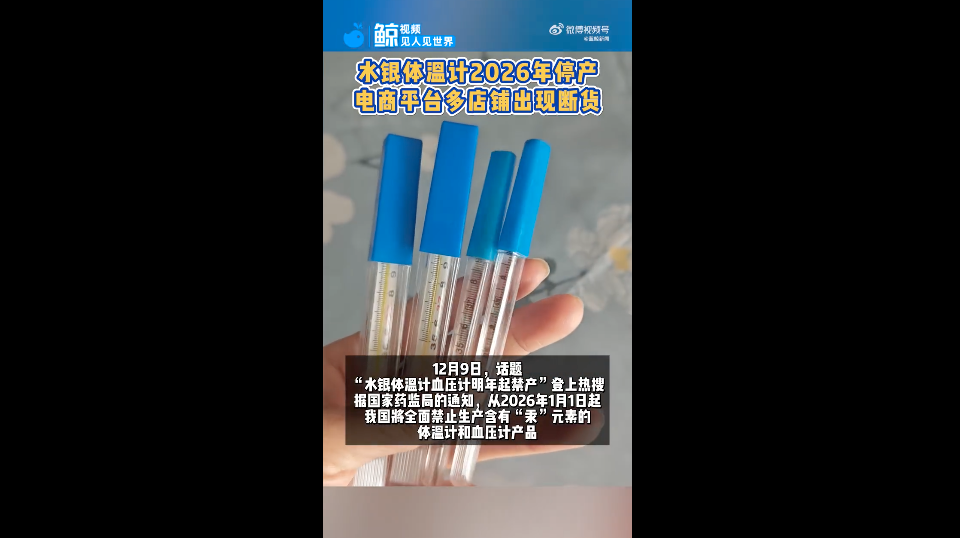
Core Viewpoint - The Chinese government will ban the production of mercury-containing thermometers and blood pressure monitors starting January 1, 2026, marking the end of mercury thermometers in the market [1]. Company Impact - Companies such as Yuyue Medical (002223.SZ) and Jiuan Medical (002432.SZ) have indicated that the impact of this ban on their business will be minimal, as they primarily focus on electronic products and have a very small volume of mercury thermometer and blood pressure monitor sales [1]. - Jiuan Medical stated that it is not a traditional thermometer manufacturer and that its main revenue source comes from reagent kits, particularly in the U.S. market [1]. Market Observations - There has been a noticeable increase in demand for mercury thermometers on e-commerce platforms, leading to stock shortages, while electronic and glass thermometers are more readily available [2]. - In physical pharmacies, staff reported that mercury thermometers are selling out quickly, with many customers still preferring them despite the availability of electronic alternatives [4][6]. Transition to Alternatives - Pharmacies are increasingly stocking electronic and infrared thermometers, which are priced significantly higher than mercury thermometers, indicating a shift in consumer preference [4][6]. - Medical companies are preparing to transition away from mercury products in compliance with government regulations, although some have not yet received formal notifications regarding the sales ban [6].
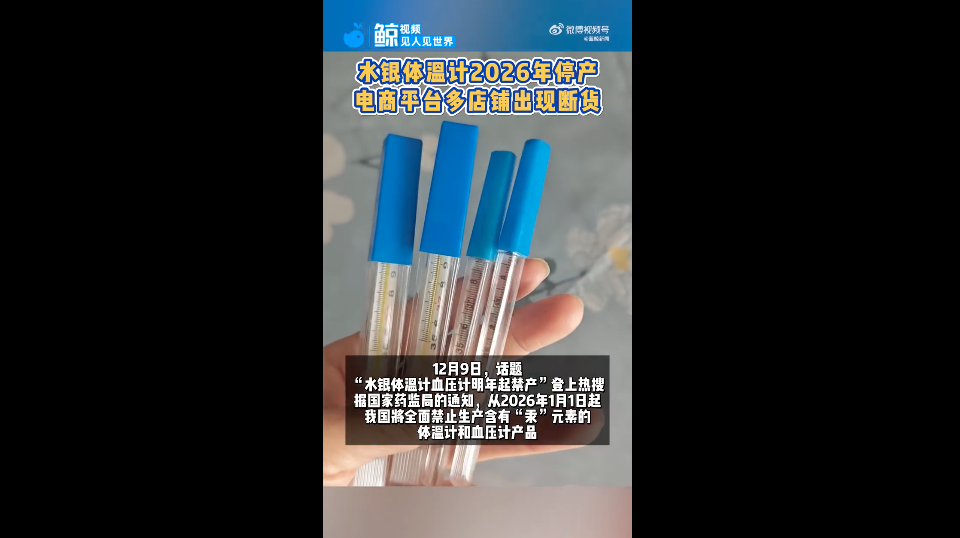
水银体温计禁产在即 线上店开始断货 客服称“购买的顾客增多”!生产企业:肯定遵守规定 要全面转型
Mei Ri Jing Ji Xin Wen· 2025-12-09 16:54
Core Viewpoint - The Chinese government will ban the production of mercury-containing thermometers and blood pressure monitors starting January 1, 2026, marking the end of mercury thermometers in the market [1]. Company Impact - Companies such as Yuyue Medical (002223.SZ) and Jiuan Medical (002432.SZ) have indicated that the impact of this ban on their business will be minimal, as they primarily focus on electronic products and have a very small volume of mercury thermometer and blood pressure monitor sales [1][5]. - Jiuan Medical stated that their main revenue source comes from reagent kits, particularly in the U.S. market, and they are not traditional manufacturers of thermometers [1]. Market Observations - There has been a noticeable increase in demand for mercury thermometers on e-commerce platforms, leading to stock shortages, while electronic and glass thermometers are more readily available [2]. - In physical pharmacies, staff reported that they have sold out of mercury thermometers due to increased demand, especially during the flu season, but they still offer electronic and infrared thermometers at significantly higher prices [4]. Industry Transition - Some medical companies have already begun transitioning away from mercury thermometers in anticipation of the ban, although they have not received formal notifications regarding the prohibition of sales [5]. - The market is expected to shift towards electronic and infrared thermometers, which are perceived as more convenient, especially for families with young children [4].

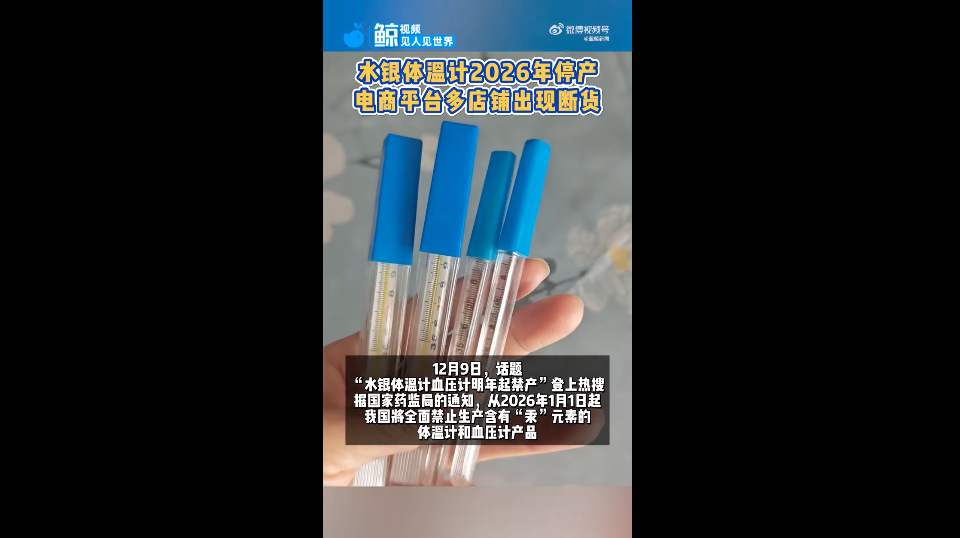
水银体温计禁产在即,线上店开始断货,客服称“购买的顾客增多”!生产企业:肯定遵守规定,要全面转型
Mei Ri Jing Ji Xin Wen· 2025-12-09 16:27
Group 1 - The Chinese government will ban the production of mercury-containing thermometers and blood pressure monitors starting January 1, 2026, marking the end of mercury thermometers in the market [1] - Companies such as Yuyue Medical, Jiuan Medical, and Kefu Medical are currently selling mercury thermometers and blood pressure monitors, but their impact on business is minimal as they primarily focus on electronic products [1][4] - Jiuan Medical stated that it is not a traditional thermometer manufacturer and that its main revenue comes from reagent kits, with minimal reliance on mercury products [1] Group 2 - There has been a noticeable increase in demand for mercury thermometers on e-commerce platforms, leading to stock shortages, while electronic and glass thermometers are more readily available [2] - In physical pharmacies, staff reported that mercury thermometers are sold out due to increased demand, particularly during the flu season, and that electronic alternatives are available at significantly higher prices [4][6] - Some pharmacies have not yet received official notifications regarding the ban on selling mercury thermometers, indicating a potential lag in compliance with the new regulations [6]
孩子王:公司将在定期报告中披露相关股东信息和人数
Zheng Quan Ri Bao Wang· 2025-12-09 09:12
证券日报网讯12月9日,孩子王(301078)在互动平台回答投资者提问时表示,为保证所有投资者平等 获悉公司信息,公司会在各定期报告中披露相关股东信息和人数。 ...
陕西首富,拿下一家上市公司
Sou Hu Cai Jing· 2025-12-09 03:18
Core Insights - The article discusses a significant transaction in the A-share market where the controlling shareholder of the company Sanrenxing transferred 8% of its shares for 450 million yuan to Yan Jianya, a newly prominent billionaire in Shaanxi [2][6] - This investment marks Yan Jianya's strategic entry into the marketing services sector, as Sanrenxing is a leading integrated marketing service provider in China [2][5] - The transaction is seen as a strategic move for both parties, with Sanrenxing aiming to optimize its governance and leverage Yan's extensive industry resources [6][10] Company Overview - Sanrenxing, established in 2003, specializes in digital marketing, event services, and campus media, serving major clients like China Mobile and JD.com [2][5] - The company's revenue has declined from 5.65 billion yuan in 2022 to an estimated 4.21 billion yuan in 2024, with net profit dropping from 740 million yuan to 120 million yuan during the same period [2][6] Investment Details - Yan Jianya's acquisition of shares reduces the controlling shareholder's stake from 53.88% to 45.88%, while Yan becomes the second-largest shareholder with over 5% ownership [6][10] - The transaction is framed as a move to introduce a significant strategic investor to enhance Sanrenxing's governance and market credibility [6][10] Strategic Collaboration - Yan Jianya and Sanrenxing have a history of collaboration, with previous investments and partnerships that have built mutual trust and resource sharing [3][7] - The partnership is expected to create synergies between Sanrenxing's marketing capabilities and Yan's ventures in biotechnology and aerospace, potentially expanding Sanrenxing's client base [7][10] Market Impact - The investment is anticipated to enhance Sanrenxing's operational capabilities and market positioning, particularly in high-end manufacturing and military sectors [6][10] - Yan Jianya's growing influence in the A-share market is highlighted by his control over three listed companies, forming a diversified capital matrix that includes biotechnology, aerospace, and marketing [5][10]

孩子王:公司目前经营一切正常
Zheng Quan Ri Bao· 2025-12-08 11:36
(文章来源:证券日报) 证券日报网讯 12月8日,孩子王在互动平台回答投资者提问时表示,公司目前经营一切正常,公司严格 按照规定履行信息披露义务,不存在应披露而未披露的重大事项,无财务造假、重大违规情形等情形。 ...

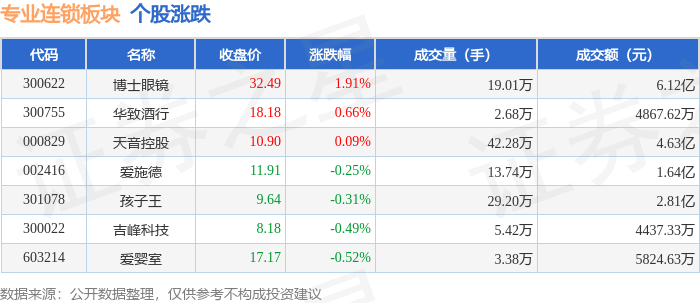
专业连锁板块12月8日涨0.09%,博士眼镜领涨,主力资金净流出3083.53万元
Zheng Xing Xing Ye Ri Bao· 2025-12-08 09:09
Core Insights - The professional chain sector experienced a slight increase of 0.09% on December 8, with Doctor Glasses leading the gains [1] - The Shanghai Composite Index closed at 3924.08, up 0.54%, while the Shenzhen Component Index closed at 13329.99, up 1.39% [1] Professional Chain Sector Performance - Doctor Glasses (300622) closed at 32.49, with a rise of 1.91% and a trading volume of 190,100 shares [1] - Huazhi Wine (300755) closed at 18.18, up 0.66%, with a trading volume of 26,800 shares and a transaction value of 48.68 million [1] - Tianyin Holdings (000829) closed at 10.90, with a minor increase of 0.09% [1] - Aishide (002416) closed at 11.91, down 0.25%, with a trading volume of 137,400 shares [1] - Kids Wang (301078) closed at 9.64, down 0.31%, with a trading volume of 292,000 shares [1] - Jifeng Technology (300022) closed at 8.18, down 0.49%, with a trading volume of 54,200 shares and a transaction value of 44.37 million [1] - Aiying Room (603214) closed at 17.17, down 0.52%, with a trading volume of 33,800 shares [1] Capital Flow Analysis - The professional chain sector saw a net outflow of 30.84 million from main funds, while retail funds experienced a net inflow of 17.86 million [1] - Kids Wang (301078) had a main fund net inflow of 12.15 million, with a retail net inflow of 17.53 million [2] - Doctor Glasses (300622) experienced a main fund net outflow of 15.11 million, but had a retail net inflow of 53.21 million [2] - Aishide (002416) had a main fund net outflow of 0.51 million, with a retail net inflow of 12.83 million [2] - Huazhi Wine (300755) saw a main fund net outflow of 2.94 million, with a retail net inflow of 0.44 million [2] - Aiying Room (603214) had a significant main fund net outflow of 9.93 million, but a retail net inflow of 0.43 million [2]

化妆品医美行业周报:11月抖音表现符合预期,双12国货积极备战-20251207
Shenwan Hongyuan Securities· 2025-12-07 15:21
Investment Rating - The report maintains a "Positive" outlook on the cosmetics and medical beauty industry, despite recent underperformance compared to the market [4][5]. Core Insights - The cosmetics and medical beauty sector has shown weaker performance, with the Shenwan Beauty Care Index declining by 2.0% from November 28 to December 5, 2025, underperforming the market [4][5]. - Douyin's performance in November met expectations, with domestic brands preparing actively for the upcoming Double 12 sales event, indicating a strong competitive landscape for domestic products [4][10]. - The report highlights the leading market share of Minoxidil products, particularly from Mandi International, which has established itself as a top brand in the hair growth sector [11][12]. Summary by Sections Industry Performance - The Shenwan Cosmetics Index fell by 2.2%, while the Shenwan Personal Care Index also dropped by 2.0%, both underperforming against the Shenwan A Index [4][5]. - The top-performing stocks in the sector included Juzhibio (+5.9%) and Hongmian Co. (+3.5%), while the worst performers were Kelao Co. (-7.6%) and Baiya Co. (-4.8%) [6]. Key Market Developments - Mandi International has dominated the Minoxidil market, achieving a revenue growth from 982 million yuan in 2022 to approximately 1.455 billion yuan in 2024, with a CAGR of 21.7% [12][13]. - The company has maintained a leading position in the market for ten consecutive years, with a market share of about 57% in the hair loss treatment sector and 71% in the Minoxidil product market as of 2024 [12][14]. E-commerce Insights - In November 2025, Douyin's domestic brand GMV showed significant growth, with brands like Han Shu and New Page experiencing double-digit increases [15][18]. - The overall retail sales of cosmetics in October 2025 grew by 9.6%, driven by the Double 11 shopping festival, indicating a robust recovery in consumer spending [18][20]. Company Announcements - Lin Qingxuan updated its IPO prospectus for the Hong Kong market, reporting a revenue of 1.052 billion yuan in the first half of 2025, a year-on-year increase of 98.3% [22][19]. - The company plans to expand its research and development team and explore international markets in Southeast Asia [22][19]. Market Trends - The Chinese consumer healthcare market is projected to grow from 9.313 billion yuan in 2018 to 16.420 billion yuan in 2024, with a CAGR of 9.9% [13]. - The report emphasizes the increasing market share of domestic brands in the skincare sector, with a notable rise in the competitive landscape against international brands [24].