
泰康基金

Search documents
又一家自购破亿!年内公募豪掷自购权益类基金,“真金白银”流向哪些产品?
Sou Hu Cai Jing· 2025-08-13 16:25
Group 1 - Southern Fund announced an investment of no less than 230 million yuan in its products, including Southern CSI A500 ETF and Southern S&P China A-share Large Cap Dividend Low Volatility ETF, with a holding period of at least one year [1] - This marks the second public fund this year to conduct a single round of self-purchase exceeding 100 million yuan [1] - In April, Jianxin Fund also announced an investment of no less than 180 million yuan in its equity public fund products [3] Group 2 - Multiple public funds have joined the self-purchase of equity products in the second half of the year, with ICBC Credit Suisse Fund and Taikang Fund also announcing their respective investments [3] - As of August 12, the net subscription amount for public fund self-purchases in equity products has exceeded 2.7 billion yuan this year [3] - Leading funds in net subscription amounts include Tianhong Fund, ICBC Credit Suisse Fund, Huatai-PB Fund, and Guotai Fund [3] Group 3 - The top 10 public fund self-purchase amounts for equity products show significant investments from Tianhong Fund, with the highest being 1.39999 billion yuan in Tianhong Hang Seng Shanghai-Shenzhen Hong Kong Innovative Drug Selection 50 ETF [4] - Other notable funds include ICBC Modern Service Industry Fund and Tianhong Cultural Emerging Industry Fund, with net subscription amounts of 999.90 million yuan and 1 billion yuan respectively [4] - The collective self-purchase by public funds reflects confidence in their products and is influenced by supportive policies [5]

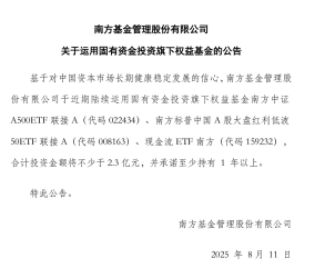
公募机构密集自购权益产品释放多重信号
Zheng Quan Ri Bao· 2025-08-12 16:12
Group 1 - Southern Fund announced an investment of at least 230 million yuan in its equity funds, demonstrating confidence in the long-term stability of China's capital market [1] - Public fund institutions have been actively engaging in self-purchase behaviors, with a significant focus on equity products [1][2] - The China Securities Regulatory Commission's action plan aims to incentivize public fund institutions to increase equity investments, enhancing the stability of capital market funding [1] Group 2 - Several fund companies, including ICBC Credit Suisse and Taikang Fund, have announced self-purchase plans, indicating a collective effort to boost market confidence [2] - Fund managers emphasize that self-purchases signal a commitment to risk-sharing with investors and a long-term positive outlook on the Chinese capital market [2] - The proactive self-purchase actions by fund companies reflect a response to the regulatory push for increased equity fund participation [3] Group 3 - The recent self-purchases by public fund institutions are seen as a positive signal for value recognition, confidence boosting, and aligning interests with investors [3] - The strong resilience of the Chinese economy, with a GDP growth of 5.3% in the first half of the year, supports the long-term positive outlook for the capital market [4] - Current valuations in the Chinese stock market are considered attractive for long-term investors, presenting a good opportunity for investment [4]
沪指逼近去年“924”行情高点 债市却持续回调 多只债基濒临清盘
Mei Ri Jing Ji Xin Wen· 2025-08-12 14:46
Market Overview - The Shanghai Composite Index closed at 3665.92 points, just shy of the 2024 "924" market peak of 3674.40 points [2][4] - The total trading volume across the three markets reached 1.91 trillion yuan, marking a new high in nearly eight trading days, with financing balances remaining above 2 trillion yuan [2][4] Bond Market Performance - The bond market continues to show weakness, with many bond funds facing redemption pressures and some warning of potential liquidation risks [2][3] - As of August 12, at least 14 public funds have reported asset net values below 50 million yuan, with bond funds being the most affected [3][4] Fund Redemption Trends - Significant redemptions have been reported in bond funds, with at least five funds announcing large-scale redemptions since the beginning of August [4] - Notable examples include the Huisheng Hefeng Pure Bond Fund and the Boyuan Zengrui Pure Bond Fund, which adjusted net value precision due to large redemptions [4] Shift in Investment Preferences - With rising market risk appetite, funds that previously focused on defensive strategies, such as high-dividend and low-volatility stocks, are experiencing slowed growth or negative growth [3][4] - Investors are increasingly redeeming pure bond products in favor of equity or "fixed income plus" products, reflecting a shift in investment strategy [4] Convertible Bond Market - The convertible bond market is showing a rising trend, supported by a slow bull market in equities and strong small-cap performance, with trading volumes and ETF sizes increasing [5] - Average returns for convertible bond funds reached 7.00% since July, significantly outperforming mixed bond funds and pure bond funds [6]
公募基金年内自购“申赎清单”:谁受宠?谁被弃?
3 6 Ke· 2025-08-12 11:19
Core Viewpoint - The recent surge in public fund self-purchases reflects a growing confidence in the Chinese capital market, with significant investments occurring as the market heats up rather than at traditional low points [1][2][3]. Fund Self-Purchase Trends - Southern Fund announced a self-purchase of at least 230 million yuan in its equity funds, demonstrating a strong commitment to the market [2]. - Other fund companies, including Huashang Fund and Dachen Fund, have also engaged in substantial self-purchases, indicating a broader trend of confidence among fund managers [4]. - The self-purchase trend is characterized by a focus on newly launched products, suggesting a promotional aspect alongside genuine market optimism [4]. Self-Purchase and Redemption Data - In the first half of the year, 126 fund managers engaged in self-purchases totaling 243.07 billion yuan, while 114 fund managers executed redemptions amounting to 133.42 billion yuan [5]. - The net self-purchase amount for public funds was 109.66 billion yuan, with non-monetary products contributing 5.25 billion yuan [6]. - Debt funds led the net self-purchase category with 2.83 billion yuan, while equity funds followed with 1.32 billion yuan [7]. Specific Fund Performance - Notable self-purchases included Tianhong Fund's equity products, which saw over 100 million yuan in self-purchases [7]. - Mixed funds also experienced significant self-purchases, with several funds exceeding 100 million yuan in net self-purchases [7]. - In contrast, certain funds faced significant redemptions, highlighting a mixed sentiment in specific segments of the market [8].
沪指3600点之际公募新动作:绩优基金密集限购VS机构自购潮涌
经济观察报· 2025-08-12 11:05
Core Viewpoint - The public fund market is currently experiencing two significant trends: a surge in limit purchases for high-performing active equity funds and a wave of self-purchases by public fund institutions to bolster market confidence [2][8]. Limit Purchases - Numerous high-performing active equity funds have announced limits on purchases, with over a hundred funds implementing such measures since the beginning of the second half of the year [2][5]. - For instance, China Europe Fund announced limits on large purchases for its medical innovation stock fund and other funds, citing the need to ensure stable operations and protect the interests of existing fund holders [4][5]. - The performance of these funds has been impressive, with some, like the China Europe Medical Innovation Stock Fund, achieving over 60% net value growth year-to-date [5][6]. Self-Purchases - Public fund institutions, including Southern Fund and Industrial Bank of China Credit Fund, have initiated significant self-purchases of their equity funds, with Southern Fund planning to invest at least 230 million yuan [7][8]. - This self-purchase trend is seen as a positive signal, indicating that institutions remain optimistic about the market's future, especially as the Shanghai Composite Index stabilizes above 3600 points [8]. - The self-purchases not only serve as a confidence endorsement but also create a deeper capital bond between the institutions and their funds, promoting a long-term investment philosophy [8].

“真金白银”力挺A股!近半月4家公募启动自购
2 1 Shi Ji Jing Ji Bao Dao· 2025-08-12 05:26
Group 1 - A large public fund company, Southern Fund, has recently announced the use of its own funds to invest in three of its equity funds, with a total investment amount of no less than 230 million yuan, committing to hold for at least one year [2] - This marks the fourth public fund company to disclose self-purchase activities in the past two weeks, following announcements from ICBC Credit Suisse Fund, Taikang Fund, and Founder Fubon Fund, all of which have also chosen equity funds as their investment targets [2] - The number of public fund managers implementing self-purchases this year has exceeded 100, with a total of 127 fund managers reported to have engaged in self-purchases since 2025, involving various types of funds including equity, mixed, and bond funds [3] Group 2 - The net subscription amounts for public equity and mixed funds this year have surpassed 1.5 billion yuan and 800 million yuan, respectively [3] - The simultaneous self-purchase actions by multiple fund companies signal a recognition of the current market valuation's rationality, although self-purchase by fund companies is seen as a positive signal, it is not an absolute guarantee nor a precise indicator of market reversal [3]
沪指3600点之际公募新动作:绩优基金密集限购VS机构自购潮涌
Jing Ji Guan Cha Wang· 2025-08-12 04:57
Core Viewpoint - The A-share market is recovering, with the Shanghai Composite Index stabilizing above 3600 points, leading to two significant trends in the public fund market: many high-performing active equity funds are imposing purchase limits, and public institutions are actively buying back their funds to boost market confidence [2][8]. Fund Purchase Limits - Over a hundred active equity funds have announced purchase suspensions or limits since the beginning of the second half of the year, particularly those with strong performance and significant growth in scale during the first half [2][4]. - For instance, China Europe Fund announced limits on large purchases for several of its funds, including a cap of 100,000 yuan for the China Europe Medical Innovation Stock Fund and 1 million yuan for the China Europe Science and Technology Theme Mixed Fund [3][4]. - The rationale behind these limits is to ensure stable fund operations and protect the interests of existing fund holders, reflecting a cautious operational strategy among fund managers [3][5]. Fund Performance and Growth - The China Europe Medical Innovation Stock Fund has seen a net value increase of over 60% year-to-date, with its scale growing to 8.114 billion yuan by the end of Q2, an increase of approximately 931 million yuan from the end of last year [4]. - Other funds, such as the China Europe Science and Technology Theme Mixed Fund and the China Europe Digital Economy Mixed Fund, have also experienced significant growth, with year-to-date net value increases exceeding 30% and 60%, respectively [4]. - The trend of limiting purchases is seen as a way to prevent strategy failure due to excessive scale and to maintain existing investors' returns [5]. Self-Purchase by Public Institutions - Several public institutions, including Southern Fund and Industrial Bank of China Credit Fund, have initiated a wave of self-purchases, indicating confidence in the long-term stability and health of the capital market [6][8]. - Southern Fund plans to invest at least 230 million yuan in its equity funds, committing to hold these investments for at least one year [6][7]. - This self-purchase activity is viewed as a positive signal, suggesting that institutions remain optimistic about the market's future, especially as the index surpasses 3600 points [8]. Strategic Shifts in the Fund Industry - The public fund industry is undergoing two strategic transformations: shifting from a "scale-oriented" approach to a "quality-driven" model, and deepening the investment philosophy towards "long-termism" [8]. - The imposition of purchase limits by high-performing funds reflects a commitment to maintaining the integrity of investment strategies and ensuring effective execution [5][8]. - Self-purchases by fund companies not only serve as a confidence endorsement but also create a capital link that binds interests, fostering a positive development ecosystem within the industry [8].
年内自购的公募基金管理人,突破100家
21世纪经济报道· 2025-08-12 02:58
Core Viewpoint - Several public fund companies have recently announced self-purchase plans, indicating confidence in the current market valuations and long-term investment potential in China's capital market [1][6][9]. Group 1: Self-Purchase Announcements - On August 11, Southern Fund announced a self-purchase of at least 230 million yuan across three equity funds, committing to hold for at least one year [1][3]. - Four public fund companies, including Southern Fund, Industrial Bank of China Credit Fund, Taikang Fund, and Founder Fubon Fund, have initiated self-purchases since July 28, with total investments exceeding 260 million yuan [2][3]. - Southern Fund's self-purchase plan includes investments in specific equity funds, highlighting its commitment to the market [3][5]. Group 2: Market Sentiment and Valuation - The self-purchase actions by multiple fund companies are seen as a positive signal, reflecting institutional recognition of current market valuations [6][9]. - As of August 6, the price-to-earnings ratios for the CSI 300 and Hang Seng indices were 13.93 and 11.83, respectively, both lower than major mature markets, indicating a valuation advantage for Chinese stocks [6][9]. - The self-purchase trend is viewed as a strategy to stabilize investor sentiment and demonstrate confidence in the market's long-term health [6][9]. Group 3: Historical Context and Trends - The self-purchase trend has been ongoing, with over 100 public fund managers having implemented self-purchases in 2023 alone [8][9]. - Notably, some fund companies have made multiple self-purchase announcements within the year, indicating a sustained commitment to their products [8][9]. - The China Securities Regulatory Commission's policy encouraging fund companies to self-purchase a portion of their profits has contributed to this trend [9]. Group 4: Investor Considerations - While self-purchase is a positive indicator, it should not be the sole criterion for investment decisions, as it does not guarantee future performance [10][11]. - Investors are advised to consider the scale of self-purchases, the duration of holding commitments, and the credibility of the purchasing entity [10][11]. - Monitoring changes in holdings and fund performance through regular reports is recommended to avoid impulsive investment decisions [10][11].
宝城期货资讯早班车-20250812
Bao Cheng Qi Huo· 2025-08-12 02:07
1. Report Industry Investment Rating No content provided regarding the industry investment rating. 2. Core Views of the Report - The AH premium has significantly declined due to factors such as the acceleration of southbound capital inflows, the increasing attractiveness of Hong Kong stocks' dividend - paying sectors, and the improvement of the Hong Kong stock market structure. It may converge in the long - term but cannot be completely eliminated [24]. - The short - term bond market lacks a clear main line, with the 10 - year Treasury bond yield ranging between 1.6 - 1.8%. The short - end is benefited by loose liquidity, while the long - end is affected by the stock market and domestic demand policies. It is recommended to seize coupon opportunities of ordinary credit bonds, secondary perpetual bonds, and certificates of deposit [24]. - The margin trading balance has exceeded 2 trillion yuan again, reflecting the increasing market activity. The current A - share market has different characteristics from 2015, and the overall performance this year is expected to be better than that in 2013 [25]. - The short - term stock market may enter a consolidation period, and the focus may shift to style switching. For convertible bonds, it is recommended to reduce positions, take profits on high - priced varieties, and adjust the portfolio structure [25]. 3. Summary by Directory 3.1 Macro Data - In Q2 2025, GDP grew by 5.2% year - on - year, slightly lower than the previous quarter [1]. - In July 2025, the manufacturing PMI was 49.3%, down from the previous month; the non - manufacturing PMI was 50.1%, also lower than the previous month [1]. - In June 2025, the year - on - year growth rates of M0, M1, and M2 were 12.0%, 4.6%, and 8.3% respectively, showing different trends compared to the previous month and the same period last year [1]. - In July 2025, exports increased by 7.2% year - on - year, and imports increased by 4.1% year - on - year [1]. 3.2 Commodity Investment Reference 3.2.1 Comprehensive - The US will suspend the implementation of a 24% tariff on Chinese goods for another 90 days starting from August 12, 2025, while retaining a 10% tariff [2]. - Ant Group and China National Rare Earth Group have refuted the rumor of jointly building a rare - earth RMB stablecoin [2]. - The probability of the Fed cutting interest rates by 25 basis points in September is 85.9%, and the probability of cumulative rate cuts of 50 basis points in October is 55.1% [3]. 3.2.2 Metals - The suspension of lithium mine production by CATL has led to a full - board limit - up of lithium carbonate futures contracts, driving up the prices of domestic lithium carbonate spot and lithium mine stocks [4]. - The national standard for the transportation safety and multimodal transport of power lithium batteries will be implemented on February 1, 2026 [4]. - As of August 8, the inventories of various metals such as tin, zinc, and aluminum showed different changes [5]. 3.2.3 Coal, Coke, Steel, and Minerals - In June, the copper production of Escondida and Collahuasi mines in Chile decreased year - on - year [7]. - Codelco is gradually resuming the operation of its largest copper mine, El Teniente [7]. 3.2.4 Energy and Chemicals - The refined oil price may experience the fourth suspension of adjustment this year due to the rise and then fall of international oil prices during the current pricing cycle [8]. - Chongqing has issued regulations on the development and construction of distributed photovoltaic power generation [9]. - India plans to launch a credit guarantee plan and has released $3.4 billion in oil rescue compensation [9]. - In June, Colombia's natural gas and oil production decreased year - on - year [9]. - UBS expects Brent crude oil prices to fall to $62 per barrel by the end of this year and rise to $65 per barrel by mid - 2026 [10]. 3.2.5 Agricultural Products - Mexico has set a minimum export price for fresh tomatoes after the US imposed tariffs [11]. - Malaysia's palm oil exports in July increased by 3.82% compared to June [12]. 3.3 Financial News Compilation 3.3.1 Open Market - On August 11, the central bank conducted 112 billion yuan of 7 - day reverse repurchase operations, with a net withdrawal of 432.8 billion yuan [13]. 3.3.2 Key News - The Ministry of Finance and the State Taxation Administration are soliciting public opinions on the implementation regulations of the VAT law [14]. - The central settlement company simplifies the investment process for overseas central bank - type institutions [14]. - The China Inter - bank Market Dealers Association strengthens the self - discipline management of underwriting quotes in the inter - bank bond market [15]. - The science and technology innovation bond market has expanded rapidly, and efforts are needed to improve the recognition of private enterprise science and technology innovation bonds [16]. - The debt risk of real estate enterprises is gradually being resolved, and the industry is moving towards a new stage [16]. 3.3.3 Bond Market Summary - Yields of major interest - rate bonds in the inter - bank market generally rose, and Treasury bond futures closed down [18]. - In the exchange bond market, some bonds of AVIC Industry - Finance Holdings Co., Ltd. and Treasury bonds rose, while some other bonds fell [18]. - The CSI Convertible Bond Index rose, and the performance of individual convertible bonds varied [19]. - Money market rates showed different trends, and the yields of financial bonds and Treasury bonds in auctions were announced [20]. - European and US bond yields showed different trends [22]. 3.3.4 Foreign Exchange Market - The on - shore RMB against the US dollar rose, while the central parity rate was depreciated [23]. - The US dollar index rose, and most non - US currencies fell [23]. 3.3.5 Research Report Highlights - The AH premium has declined significantly, and it may converge in the long - term [24]. - The short - term bond market lacks a clear main line, and the 10 - year Treasury bond yield ranges between 1.6 - 1.8% [24]. - The margin trading balance has exceeded 2 trillion yuan again, and the A - share market is more active [25]. - The short - term stock market may enter a consolidation period, and convertible bond investment strategies need adjustment [25]. 3.4 Stock Market Key News - The A - share market was operating at a high level, with the Shanghai Composite Index rising for six consecutive days. Most stocks rose, and the trading volume expanded [30]. - The Hong Kong Hang Seng Index rose slightly, and the performance of different sectors varied [30]. - Many funds have suspended large - scale subscriptions due to the A - share market recovery [30]. - Four public funds have announced self - purchase plans for equity funds [31].
“真金白银”力挺A股 公募“接力”自购权益基金
2 1 Shi Ji Jing Ji Bao Dao· 2025-08-11 23:59
Core Viewpoint - Several large public fund companies have recently announced self-purchase plans, indicating confidence in the long-term stability and health of the Chinese capital market [1][4]. Group 1: Self-Purchase Announcements - On August 11, Southern Fund announced a self-purchase plan involving an investment of at least 230 million yuan in three equity funds, committing to hold for at least one year [1][2]. - In the past two weeks, four public fund companies, including Southern Fund, ICBC Credit Suisse Fund, Taikang Fund, and Founder Fubon Fund, have disclosed self-purchase plans, with total investments exceeding 260 million yuan [2][7]. - Southern Fund's self-purchase plan is particularly notable, targeting specific equity funds such as the Southern CSI A500 ETF and the Southern S&P China A-Share Large Cap Dividend Low Volatility ETF [2][3]. Group 2: Market Sentiment and Valuation - The self-purchase actions by multiple fund companies signal their recognition of the current market valuation's reasonableness and their confidence in the medium to long-term investment value [4][8]. - According to Wind data, as of August 6, the price-to-earnings ratios of the CSI 300 Index and the Hang Seng Index are 13.93 and 11.83, respectively, both lower than major mature market indices, indicating that the Chinese stock market is in a "valuation pit" [3][4]. Group 3: Implications for Investors - Fund companies' self-purchases are seen as a way to enhance trust and stabilize investor sentiment, as they align their interests with those of investors [4][9]. - While self-purchase can be a positive signal, it should not be the sole criterion for investment decisions; investors are advised to consider other factors such as fund manager capability and investment strategy [8][9]. - The trend of self-purchases has been ongoing, with over 100 fund management companies having implemented self-purchases this year, reflecting a regulatory push to encourage such actions [6][7].