
海油工程

Search documents
石化行业央企ESG评价结果分析:应对气候变化和安全生产是石化央企的重点关注
Shenwan Hongyuan Securities· 2025-11-13 08:44
Investment Rating - The report rates the petrochemical industry as "Positive" for investment, indicating an expectation of outperforming market performance [1]. Core Insights - The report highlights that addressing climate change and safety production are key focuses for state-owned petrochemical enterprises [1]. - Most companies in the industry have performed well in ESG scores, with a 100% coverage of ESG reporting, particularly excelling in environmental and social aspects, while governance needs improvement [10][16]. - Seven companies scored above 80 points, including China National Offshore Oil Corporation (CNOOC), China Petroleum, and China Petrochemical, while two companies scored between 40-80 points [10]. Summary by Sections 1. ESG Reporting Coverage - The ESG report coverage is complete, with high scores in environmental and social aspects, but governance remains an area for improvement [10][16]. 2. Environmental Indicators - Companies show a strong commitment to environmental management, with five companies scoring over 15 points and eight scoring above 10 points. However, disclosure on oil spill risk management and circular economy indicators is lacking [16][20]. 3. Climate Change Response - The industry generally scores high in climate change response, with 100% disclosure rates for climate management and indicators. However, there is a need for better disclosure on internal supervision and financial impact assessments [26][30]. 4. Social Responsibility - Most companies score moderately high in social responsibility, focusing on rural revitalization, social contributions, innovation, safety production, and employee welfare. However, the disclosure rate for public awareness initiatives is low [43][46]. 5. Governance Structure - The governance structure is largely complete, with high scores in governance indicators. However, the disclosure of ESG information reporting and supervision mechanisms needs improvement [57][66].



涠洲11-4 CEPD平台完成浮托安装
Zhong Guo Hua Gong Bao· 2025-11-12 06:55
Core Insights - The successful installation of the Weizhou 11-4 CEPD platform marks a record for the largest and heaviest offshore oil and gas platform in the Beibu Gulf region, with a height of 49.5 meters and a weight exceeding 14,000 tons [1][2] - The platform integrates drilling and oil and gas processing functions, featuring 134 key equipment sets and a 95% localization rate for core components, significantly reducing engineering investment and annual maintenance costs by over 30% [1][2] Group 1 - The Weizhou 11-4 CEPD platform is a multifunctional drilling and production platform, designed and constructed by China National Offshore Oil Corporation (CNOOC), and utilizes floating installation technology due to its size exceeding domestic floating crane capabilities [1][2] - The project employs innovative design and construction techniques, including a slanted leg structure and transition section for the platform's foundation, enhancing load transfer and precise positioning during installation [2] - The platform will serve as a critical facility for the Weizhou 11-4 oil field, which is China's first independently developed oil field in the South China Sea according to international standards, contributing to the establishment of a third gathering center in the Weizhou oil field cluster [2]

海油工程涨2.07%,成交额1.14亿元,主力资金净流入1146.79万元
Xin Lang Cai Jing· 2025-11-12 02:28
Core Viewpoint - The stock of CNOOC Engineering has shown a positive trend with a 12.55% increase year-to-date and a recent rise of 5.70% over the last five trading days, indicating strong market interest and potential growth in the oil and gas engineering sector [1][2]. Financial Performance - For the period from January to September 2025, CNOOC Engineering reported a revenue of 17.661 billion yuan, reflecting a year-on-year decrease of 13.54%. The net profit attributable to shareholders was 1.605 billion yuan, down 8.01% compared to the previous year [2]. - CNOOC Engineering has distributed a total of 7.178 billion yuan in dividends since its A-share listing, with 1.981 billion yuan distributed over the last three years [3]. Shareholder and Market Activity - As of September 30, 2025, the number of shareholders for CNOOC Engineering was 78,900, a decrease of 15.77% from the previous period. The average number of circulating shares per shareholder increased by 18.72% to 56,047 shares [2]. - The stock's trading activity showed a net inflow of 11.4679 million yuan from main funds, with significant buying from large orders, indicating strong institutional interest [1]. Business Overview - CNOOC Engineering, established on April 20, 2000, and listed on February 5, 2002, specializes in providing engineering and technical services for the development of offshore oil and gas resources. Its revenue composition includes 75.39% from offshore engineering general contracting projects, 16.24% from non-general contracting projects, and 7.99% from non-offshore projects [1].
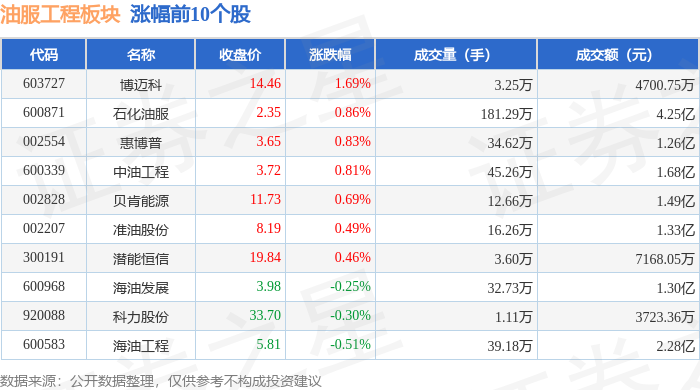
油服工程板块11月11日跌0.06%,中曼石油领跌,主力资金净流出1.45亿元
Zheng Xing Xing Ye Ri Bao· 2025-11-11 08:46
Core Viewpoint - The oil service engineering sector experienced a slight decline of 0.06% on November 11, with Zhongman Petroleum leading the drop. The Shanghai Composite Index closed at 4002.76, down 0.39%, while the Shenzhen Component Index closed at 13289.0, down 1.03% [1]. Group 1: Market Performance - The oil service engineering sector's stocks showed mixed performance, with notable gainers including: - Bomaike (603727) at 14.46, up 1.69% with a trading volume of 32,500 lots and a turnover of 47.01 million yuan [1]. - Mo Hua Oil Service (600871) at 2.35, up 0.86% with a trading volume of 1.81 million lots [1]. - Huibo Yin (002554) at 3.65, up 0.83% with a trading volume of 346,200 lots [1]. - Conversely, Zhongman Petroleum (603619) closed at 21.88, down 1.53% with a trading volume of 86,700 lots and a turnover of 191 million yuan [2]. Group 2: Capital Flow - The oil service engineering sector saw a net outflow of 145 million yuan from main funds, while retail investors contributed a net inflow of 176 million yuan [2]. - Specific stock capital flows included: - Qian Neng Heng Xin (300191) with a main fund net inflow of 8.26 million yuan, but a net outflow from retail investors of 3.34 million yuan [3]. - Zhongyou Engineering (600339) had a main fund net inflow of 7.16 million yuan, with retail investors also showing a net outflow [3]. - The overall trend indicates a shift in investor sentiment, with retail investors showing resilience despite the outflows from institutional and speculative funds [2][3].





前三季度油气板块业绩分化明显
Zhong Guo Hua Gong Bao· 2025-11-11 02:34
Core Insights - The overall performance of the oil and chemical sector in A-shares has shown a decline in both revenue and net profit for the first three quarters of 2025, with a total revenue of 7.97 trillion yuan, down 0.59% year-on-year, and a net profit of approximately 400 billion yuan, down 6.18% year-on-year [1] Group 1: Oil and Gas Sector Performance - The oil and gas sector continues to face pressure, with total revenue from oil extraction, refining, and oil services amounting to approximately 5.65 trillion yuan, a year-on-year decrease of 6.53%, and a net profit of 282.9 billion yuan, down 8.43% [1][2] - The "Big Three" oil companies (China National Petroleum, Sinopec, and CNOOC) reported a combined revenue of about 4.6 trillion yuan, a decline of approximately 7%, and a net profit of about 258.2 billion yuan, down 12% [2] Group 2: New Energy Developments - Despite the challenges faced by traditional oil and gas operations, the new energy business is rapidly developing, with China National Petroleum reporting a cumulative power generation of 5.79 billion kWh from wind and solar projects, a year-on-year increase of 72.2% [4] - Sinopec is expanding its new energy sector, actively engaging in hydrogen, solar, wind, and geothermal energy, aiming for a diversified energy supply system [4] - CNOOC is accelerating its development of offshore wind power and advancing CCUS technology, focusing on a multi-energy supply system [4] Group 3: Refining Sector Insights - The refining sector has experienced a decline in performance, with 30 refining companies reporting a revenue of 844.89 billion yuan, down 4.97%, and a net profit of 14.93 billion yuan, down 1.69% [5] - However, there was a quarter-on-quarter increase in net profit by 28.83% [5] - The refining industry is undergoing a significant transformation towards integrated refining and chemical processes, with policies tightening on new refining capacity [5][6] Group 4: Oil Services Sector Growth - The oil services sector has shown positive performance, with 17 oil service companies achieving a revenue of 186.3 billion yuan, a year-on-year increase of 4.03%, and a net profit of 8.42 billion yuan, up 6.29% [8] - Despite falling international oil prices, the overall demand for oil services remains strong, supported by increased investment from oil and gas companies [8][9] - Major contracts have been secured by companies like CNOOC Engineering and China National Petroleum Engineering, indicating a robust outlook for the oil services sector [8][9]
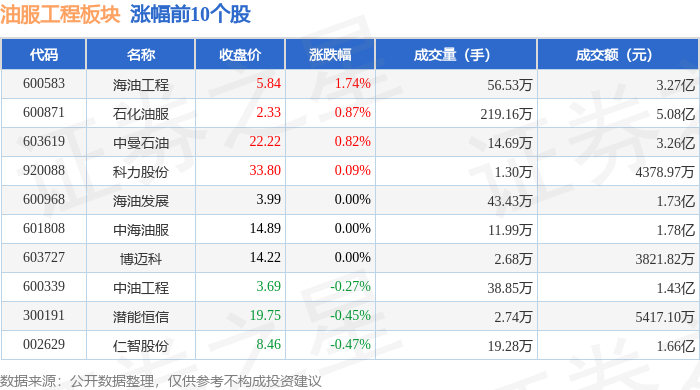
油服工程板块11月10日涨0.28%,海油工程领涨,主力资金净流出9853.75万元
Zheng Xing Xing Ye Ri Bao· 2025-11-10 08:49
Core Insights - The oil service engineering sector experienced a slight increase of 0.28% on November 10, with Haiyou Engineering leading the gains [1] - The Shanghai Composite Index closed at 4018.6, up 0.53%, while the Shenzhen Component Index closed at 13427.61, up 0.18% [1] Stock Performance - Notable gainers in the oil service engineering sector included: - Jiao Ding Si Shi (600583) with a closing price of 5.84, up 1.74% and a trading volume of 565,300 shares, totaling a transaction value of 327 million yuan [1] - PetroChina Oilfield Services (600871) closed at 2.33, up 0.87% with a trading volume of 2,191,600 shares, totaling 508 million yuan [1] - Conversely, some stocks faced declines: - Ren Zhi Co., Ltd. (002629) closed at 8.46, down 0.47% with a trading volume of 192,800 shares, totaling 166 million yuan [2] - Zhongyou Engineering (600339) closed at 3.69, down 0.27% with a trading volume of 388,500 shares, totaling 143 million yuan [2] Capital Flow - The oil service engineering sector saw a net outflow of 98.54 million yuan from institutional investors, while retail investors contributed a net inflow of 71.57 million yuan [2] - Specific stock capital flows included: - Haiyou Engineering (600583) had a net inflow of 19.61 million yuan from institutional investors, but a net outflow of 29.50 million yuan from speculative funds [3] - Ren Zhi Co., Ltd. (002629) experienced a net outflow of 7.96 million yuan from institutional investors, while speculative funds saw a net inflow of 17.30 million yuan [3]
东海研究 | 石油石化:原油供给宽松,叠加需求淡季,油价测试底部
Xin Lang Cai Jing· 2025-11-10 08:31
Core Viewpoint - The report discusses the factors influencing oil prices, including geopolitical tensions, OPEC production decisions, and global economic conditions, predicting fluctuations in oil prices between $50 and $70 per barrel in Q4 2025, with a potential drop to $40 in 2026 [16][11][8]. Oil Price Influencing Factors - Geopolitical conflicts and OPEC+ production cuts have supported oil prices, while U.S. shale production and global demand fluctuations have created volatility [8][11]. - OPEC+ is expected to increase production by 137,000 barrels per day in November, with further increases planned for December [28][16]. - The U.S. commercial crude oil inventory as of October 24, 2025, was 416 million barrels, down 9.54 million barrels year-on-year, and 5.91% lower than the five-year average [17][24]. Global Oil Supply and Demand - Global oil demand is projected to grow, with the EIA forecasting an increase of 300,000 barrels per day in 2025 and 240,000 barrels per day in 2026 [7][16]. - The IEA predicts a similar growth trajectory for global oil and liquid production, with increases of 270,000 and 130,000 barrels per day respectively [7][16]. - China's industrial crude oil processing volume increased by 6.8% year-on-year in September 2025, indicating a recovery in demand [24]. Economic Indicators - The U.S. 10-year Treasury yield was approximately 4.11% as of October 31, 2025, with expectations of a potential interest rate cut by the Federal Reserve in December [16][34]. - The manufacturing PMI in China for October 2025 was reported at 49.0%, indicating a contraction in the manufacturing sector [47]. Inventory and Production Insights - As of October 31, 2025, the number of active oil rigs in the U.S. was 546, a decrease of 39 rigs year-on-year, with production remaining stable at 13.64 million barrels per day [24][17]. - Global oil inventories are expected to increase, with a projected average growth of 2.6 million barrels per day in Q4 2025 [16]. Price Predictions and Market Outlook - The Brent crude oil price is expected to average $69 per barrel in 2025, with a decline to $52 per barrel in 2026 [16][7]. - The report highlights the potential for oil prices to test lower levels due to increasing supply and geopolitical uncertainties [16][11].
PTA检修计划增多,减产预期有所提升:石油化工行业周报(2025/11/3—2025/11/9)-20251110
Shenwan Hongyuan Securities· 2025-11-10 06:30
Investment Rating - The report maintains a cautious outlook on the PTA industry, indicating a potential for recovery but highlighting ongoing challenges in profitability [4][10]. Core Insights - The PTA industry has been experiencing prolonged losses, with a significant decline in profitability expected in 2025 due to increased production capacity and a negative gross margin of -319 RMB/ton as of November 7 [4][6]. - An increase in maintenance schedules for PTA facilities is anticipated, which may lead to a tightening of supply and a potential recovery in profitability if production cuts are realized [6][8]. - The report suggests that the polyester sector may see a recovery in profitability as supply and demand dynamics improve, particularly for leading companies like Tongkun Co. and Wankai New Materials [10]. Summary by Sections 1. Industry Overview - The PTA industry has been in a state of oversupply since 2022, leading to consistent losses across the sector, with only a few companies managing to achieve marginal profits [4][6]. - Recent data indicates that the industry operating rate is at 78%, reflecting a weak market environment [8]. 2. Maintenance and Supply Dynamics - Several PTA facilities are undergoing planned maintenance, including major players like Yisheng Dihua and Sichuan Energy Investment, which may further restrict supply in the short term [6][7]. - The report notes that if leading PTA companies continue to implement production cuts, the industry could see a return to breakeven profitability levels, with potential profit margins of 200-300 RMB per ton [8]. 3. Investment Recommendations - The report recommends focusing on leading polyester companies and high-quality refining firms, suggesting that companies like Hengli Petrochemical and Rongsheng Petrochemical may benefit from improved market conditions [10]. - It also highlights the potential for recovery in the oil and gas sector, particularly for offshore service companies, as capital expenditures remain high [10].


石油化工行业周报:PTA检修计划增多,减产预期有所提升-20251110
Shenwan Hongyuan Securities· 2025-11-10 05:49
Investment Rating - The report maintains a positive outlook on the petrochemical industry, particularly regarding the PTA sector, due to increased maintenance schedules and anticipated production cuts [3][4]. Core Insights - The PTA industry has been in a prolonged state of loss since 2022, exacerbated by rapid capacity expansion. As of November 7, 2025, the PTA industry's gross profit reached -319 CNY/ton, indicating a loss across the sector [3][4]. - Recent increases in PTA maintenance schedules are expected to tighten supply, with major companies like Tongkun and Hengli yet to announce maintenance plans. If these companies proceed with production cuts, industry profitability may return to breakeven levels, with potential profit per ton increasing by 200-300 CNY [3][8]. - The upstream sector is experiencing a decline in oil prices, with Brent crude closing at 63.63 USD/barrel, down 2.21% from the previous week. This decline is coupled with an increase in drilling day rates for self-elevating platforms, indicating a recovery trend in the oil service sector [15][33]. Summary by Sections PTA Sector - The PTA industry is facing a significant downturn, with losses expected to continue into 2025. The increase in maintenance schedules is anticipated to reduce supply and support a recovery in profitability [3][4][8]. - Current PTA operating rates are at 78%, reflecting weak industry conditions, but with no significant inventory pressure, a quicker recovery is expected as maintenance plans are realized [8][10]. Upstream Sector - Brent crude oil prices have decreased, with a closing price of 63.63 USD/barrel, while WTI prices also fell to 59.75 USD/barrel. The overall trend suggests a potential for further price declines, although OPEC's production cuts may provide some support [15][17]. - The number of active drilling rigs in the U.S. has increased slightly, indicating a potential uptick in exploration and production activities despite a year-over-year decline [25][30]. Refining Sector - The refining sector is seeing improved margins, with the Singapore refining margin rising to 23.18 USD/barrel. This improvement is attributed to a recovery in demand and a tightening of supply due to maintenance activities [46][48]. - The domestic refining sector's product price differentials have also improved, suggesting a favorable environment for refining profitability moving forward [46][48]. Polyester Sector - The polyester chain is showing signs of recovery, with expectations for improved profitability as supply and demand dynamics shift. Key companies to watch include Tongkun and Wankai New Materials [10][11].
海油工程2025三季报解读
2025-11-10 03:34
Summary of CNOOC Engineering Q3 2025 Earnings Call Company Overview - **Company**: CNOOC Engineering - **Report Date**: October 25, 2025 - **Period Covered**: First three quarters of 2025 Key Financial Metrics - **Net Profit**: Decreased by 8.01% to 1.605 billion RMB [2][1] - **Revenue**: Decreased by 13.54% to 17.661 billion RMB [2][1] - **Market Contracting Amount**: Increased by 124.85% to 37.24 billion RMB [2][1] - **Overseas Business Revenue**: Reached a historical high of 29.336 billion RMB [2][1] - **Total Backlog**: Approximately 59.5 billion RMB [2][1] Operational Highlights - **Projects Executed**: 75 large-scale projects, with 22 completed [4][1] - **Construction Achievements**: - 21 land-based jackets and 14 modules constructed - 23 offshore jackets and 16 modules installed - Laid 273 km of subsea pipelines and 167 km of subsea cables [4][1] - **Steel Processing Completion**: 27.7% of planned volume [4][1] - **Offshore Investment**: Decreased by 12.32% [4][1] Order Conversion and Revenue Outlook - **Order Conversion Cycle**: - Domestic projects: 1-2 years - International projects: 2-3 years or longer - New BH project expected to take 5-6 years for revenue recognition [5][1] - **Profitability of Overseas Projects**: - 2024 overseas gross margin: approximately 9%, lower than domestic levels - Slight improvement in 2025 [5][1] Research and Development - **R&D Investment**: Increased significantly compared to the previous year, focusing on apparel and underwater industries [3][1][8][1] - **New Product Development**: - Deepwater trees in R&D phase, expected results in H1 2026 - Nearshore trees awaiting mass production orders [7][1] Cash Flow and Payment Terms - **Cash Flow Management**: - Longer payment cycles for overseas projects (approximately 45 days) compared to domestic (30 days) - Prepayment ratios: 10% for general contracts, up to 20-30% for some overseas projects [9][1] Dividend Policy - **Dividend Strategy**: - Cash dividends prioritized, with a minimum payout ratio of 30% set for 2024-2026 - 2024 actual payout ratio reached 41% [10][1][11][1] Future Outlook - **Short-term Expectations**: Anticipated revenue growth in Q4 due to project deliveries, despite some delays in Q3 [12][1] - **Long-term Goals**: Aim for 30-60 billion RMB revenue with a 7% compound growth rate, targeting a total of 60 billion RMB by 2035 [12][1] Conclusion CNOOC Engineering is navigating a challenging environment with a focus on improving operational efficiency and expanding its overseas presence. The company remains optimistic about future growth driven by a robust project pipeline and strategic investments in R&D.