
金徽酒

Search documents
李明“收权”金徽酒第三年,库存创纪录、现金流承压
阿尔法工场研究院· 2025-11-12 00:07
Core Viewpoint - The article discusses the challenges faced by Jinhui Liquor (金徽酒), highlighting a decline in revenue and profit, high inventory levels, and the potential failure to meet annual targets, suggesting a need to return to the essence of business rather than relying on belief alone [2][5][6]. Financial Performance - In the first three quarters of 2025, Jinhui Liquor reported revenue of 2.306 billion yuan, a year-on-year decrease of 0.97%, and a net profit of 324 million yuan, down 2.78% [5]. - For Q3 alone, revenue was 546 million yuan, down 4.89%, and net profit plummeted 33.02% to 25.49 million yuan, marking the largest quarterly decline since its listing [5][6]. - The company set an ambitious annual target of 3.28 billion yuan in revenue and 408 million yuan in net profit, requiring Q4 performance to be 1.8 times the revenue and over 3 times the net profit of Q3 to meet these goals [6]. Market and Strategic Challenges - Jinhui Liquor's revenue from both domestic and provincial markets has declined, with provincial revenue at 1.689 billion yuan (down 2%) and provincial revenue at 533 million yuan (down 2.46%) [8]. - The company has seen a reduction of over 80 distributors, indicating a contraction in its national expansion efforts [8]. - The product structure is undergoing a "high-end pain," with high-end products (above 300 yuan) growing by 13.75%, while low-end products (below 100 yuan) saw a significant drop of 23.6% [8]. Governance and Internal Issues - The article raises concerns about governance issues within Jinhui Liquor, particularly regarding related party transactions and cash flow pressures [10][11]. - The company has been criticized for awarding contracts to a construction firm linked to its actual controller, raising questions about transparency and fairness [12][18]. - Jinhui Liquor's operating cash flow decreased by 18.9% in the first three quarters of 2025, attributed to lower sales revenue [18]. Industry Context - The article notes that Jinhui Liquor faces a "ceiling dilemma" in the industry, with limited growth potential in its home market and increased competition from national brands in provincial markets [19]. - The company is attempting to adapt by focusing on products priced above 100 yuan, enhancing digital marketing, and optimizing distributor structures [19][20].


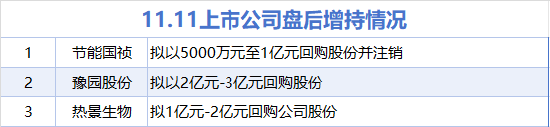
11月11日增减持汇总:节能国祯等3股增持 宁波方正等12股减持(表)
Xin Lang Zheng Quan· 2025-11-11 14:47
Core Insights - On November 11, several A-share listed companies disclosed their share repurchase and reduction plans, indicating varying levels of confidence among shareholders in the market [1] Summary of Share Repurchase - Energy National plans to repurchase shares worth between 50 million to 100 million yuan [2] - Yuyuan shares intends to repurchase shares valued at 200 million to 300 million yuan [2] - Hot景生物 aims to repurchase shares worth between 100 million to 200 million yuan [2] Summary of Share Reduction - Yue Wannianqing's shareholders plan to reduce their holdings [2] - Jiuqiang Bio's shareholders intend to reduce no more than 0.38% of their shares [2] - Ningbo Fangzheng's major shareholders and actual controllers plan to reduce their holdings [2] - Suobao Protein's shareholders plan to collectively reduce no more than 3% of the company's shares [2] - Hetai Machinery's shareholder Haitai Jinghua plans to reduce no more than 2.98% of shares [2] - Yonghui Supermarket's private equity fund plans to reduce no more than 1% of shares [2] - Jiaojian shares' directors and executives plan to reduce their holdings [2] - Hongtong Gas's shareholder Tian Hui plans to reduce no more than 3% of shares [2] - Wentai Technology's major shareholders have cumulatively reduced 12.44 million shares recently [2] - Zhangzhou Beibei's directors and executives plan to collectively reduce no more than 0.0743% of shares [2] - Zhonggu Logistics' shareholder Gu Yang Investment plans to reduce no more than 3% of shares [2] - *ST Huawang's shareholder Wu Qun plans to reduce no more than 0.76% of shares [2]


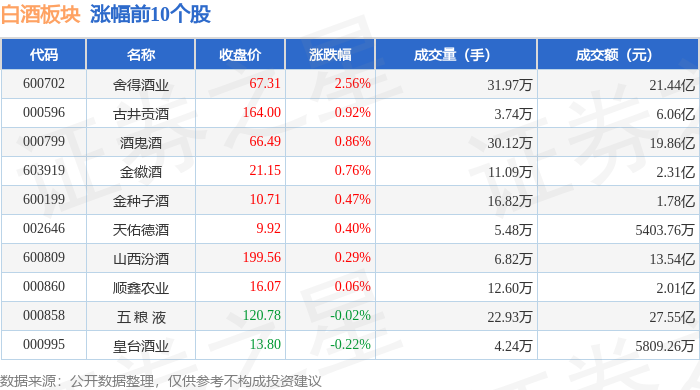
白酒板块11月11日跌0.18%,水井坊领跌,主力资金净流出4.97亿元
Zheng Xing Xing Ye Ri Bao· 2025-11-11 08:37
Market Overview - The liquor sector experienced a decline of 0.18% on November 11, with Shui Jing Fang leading the drop [1] - The Shanghai Composite Index closed at 4002.76, down 0.39%, while the Shenzhen Component Index closed at 13289.0, down 1.03% [1] Individual Stock Performance - Shede Liquor (600702) rose by 2.56% to a closing price of 67.31, with a trading volume of 319,700 shares and a transaction value of 2.144 billion [1] - Gujing Gongjiu (000596) increased by 0.92% to 164.00, with a trading volume of 37,400 shares and a transaction value of 606 million [1] - Shui Jing Fang (600779) fell by 1.13% to 42.87, with a trading volume of 48,200 shares and a transaction value of 206 million [2] - Moutai (600519) decreased by 0.23% to 1458.99, with a trading volume of 26,700 shares and a transaction value of 3.883 billion [2] Capital Flow Analysis - The liquor sector saw a net outflow of 497 million from institutional investors, while retail investors contributed a net inflow of 244 million [2] - The main capital inflow and outflow for selected stocks showed varied trends, with Shanxi Fenjiu (600809) experiencing a net inflow of 1.06 billion from main capital [3] - Shede Liquor (600702) had a net inflow of 46.2 million from main capital, while it faced a net outflow of 90.1 million from speculative capital [3]





申万宏源:白酒报表端继续释放压力 行业进入底部战略性布局期
Zhi Tong Cai Jing· 2025-11-11 06:59
Core Viewpoint - The liquor industry is experiencing significant pressure on demand due to external structural disturbances, with expectations of a bottoming out in the third quarter of 2025 and a potential turning point in the third quarter of 2026 [1][2]. Fundamental Analysis - Since the fourth quarter of 2024, some companies have begun to see declines, but the first quarter of 2025 showed resilience in sales, with leading brands still achieving growth [2]. - The demand environment has been notably pressured since the second quarter of 2025, with a significant loss of consumption scenarios, leading to accelerated clearing in the third quarter of 2025 [2]. - Sales volume is expected to decline by 20%-30% year-on-year in the third quarter of 2025, following a 30%-50% decline in the second quarter [2]. - High-end liquor prices continue to fall as the market seeks a balance between volume and price [2]. - The first quarter of 2026 is anticipated to still face double-digit declines in sales volume, with continued pressure on financial reports, but stabilization is expected in the second quarter and a turning point in the third quarter [2]. Valuation Analysis - As of October 31, 2025, the absolute PE level for the liquor sector is 18.7x, below the historical average of 27.6x since 2011 [3]. - The relative PE multiple compared to the Shanghai Composite Index is 1.14x, also below the historical average of 2.01x since 2011 [3]. - Future dividend rates for liquor companies are expected to increase, with leading companies disclosing three-year dividend return plans, and most companies currently offering dividend yields above 3%, indicating medium to long-term investment value [3]. Holdings Analysis - In the third quarter of 2025, the liquor sector's holding proportion fell to 5.52%, returning to levels seen in the second quarter of 2017 [4]. - The market value of heavy holdings in the liquor sector decreased by 1.26 percentage points compared to the previous quarter, below the average level since 2009 [4]. Investment Recommendations - The company suggests a strategic bullish outlook on the liquor sector, anticipating a fundamental turning point in the third quarter of 2026 [5]. - If the fundamentals recover as expected, a dual boost in valuation and performance is anticipated by the end of 2026 and into 2027 [5]. - It is recommended to begin long-term positioning in quality companies, while remaining patient regarding fundamental improvements and recognizing the potential for differentiated stock performance [5]. - Key recommended stocks include Luzhou Laojiao, Shanxi Fenjiu, Kweichow Moutai, and Wuliangye, with additional attention to Yingjia Gongjiu, Jinhui Jiu, Gujing Gongjiu, Jianshiyuan, and Yanghe Distillery [5].

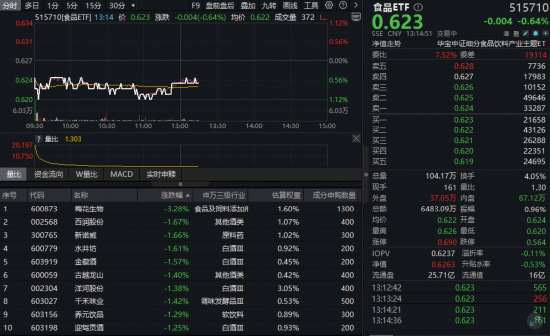
吃喝板块回调,食品ETF(515710)全天低位震荡!机构:2026白酒上行拐点逐步清晰
Xin Lang Ji Jin· 2025-11-11 06:14
Group 1 - The food and beverage sector is experiencing a downturn, with the Food ETF (515710) showing a decline of 0.64% as of the report time [1][2] - Key stocks in the sector, particularly in the liquor and consumer goods categories, are seeing significant drops, with Meihua Biological down over 3% and several others down more than 1% [1][2] - The report indicates that the overall performance of the food and beverage sector is under pressure due to policy impacts and increased competition, leading to reduced profit margins for companies [1][4] Group 2 - The valuation of the food and beverage sector is at a historical low, with the Food ETF's underlying index PE ratio at 21.22 times, indicating a potential opportunity for left-side positioning [3] - The report highlights that leading liquor companies are showing resilience despite the pressure on their financial statements, suggesting a potential for high-quality development in the coming year [4][5] - The demand side is expected to improve gradually, with policies likely to become less restrictive, which may drive demand recovery in the sector [5]


白酒深度汇报:当下我们如何看待白酒行业
2025-11-11 01:01
Summary of the Baijiu Industry Conference Call Industry Overview - The Baijiu industry is expected to reach a turning point around the second quarter of 2026, with stock prices typically responding ahead of fundamentals, indicating a current bottoming expectation for the sector, which presents good absolute return potential [1][4] - The industry has undergone six quarters of adjustment, likely to bottom out by the second quarter of 2026, with a subsequent recovery in income and stock prices anticipated [1][13][16] Key Insights and Arguments - The current market structure for Baijiu has significantly changed compared to the 2013-2016 cycle, with increased industry concentration and improved market management capabilities among leading companies [1][3][14] - The wholesale price of Moutai has dropped to 1,650 RMB, which is equivalent to 34 bottles purchasable with the annual income of urban residents, indicating sufficient economic capacity for high-end Baijiu consumption [1][11] - The Baijiu sector is currently under pressure but is expected to enter a phase of recovery as new products and channels contribute to growth, creating a resonance effect between alpha and beta returns [1][5] Future Trends - The Baijiu industry is projected to see a recovery in revenue growth by the second quarter of 2026, with a potential for excess returns compared to the CSI 300 index [13][16] - The rise of sauce-flavored Baijiu and its increasing penetration rate are noted as significant trends, despite recent adjustments in this segment [14][15] Investment Recommendations - Companies are categorized into three main development lines: 1. Those that meet family demand and have competitive advantages in regional markets, such as Jinwei and Gujing [17] 2. Large enterprises with strong brand positions and operational capabilities, like Luzhou Laojiao and Moutai [17] 3. Companies that innovate in products and channels, such as Shede and Li Du, which are exploring new growth points [17] Challenges and Opportunities - Current challenges include inventory buildup and downward pricing pressures across the industry, but a recovery in demand and normalization of inventory levels are expected to lead to a turning point in revenue stabilization [20] - The valuation of Baijiu companies is at historical lows, suggesting significant upside potential once the market recovers, particularly for high-end products that remain in demand [19][21] Conclusion - The Baijiu industry is in a transitional phase, with expectations of recovery and growth in the coming years. The current low valuations present a favorable long-term investment opportunity as the market stabilizes and consumer demand rebounds [19][20]




这次能站稳4000点吗?
Sou Hu Cai Jing· 2025-11-10 12:45
Core Viewpoint - The Shanghai Composite Index has reached 4018.60 points, but it is expected to experience fluctuations around the 4000-point mark without a strong upward momentum [1][2]. Technical Analysis - The index remains within a trading range and has not yet broken the previous high of 4025.70 points, requiring confirmation over the next two trading days to validate any breakout [2]. - A significant resistance level at 4025 points may lead to a potential pullback if not surpassed [2]. Market Dynamics - The rise in the index was supported by brokerage firms and banks, indicating a lack of genuine bullish sentiment [2]. - The Hong Kong Hang Seng Index's performance also contributed to the upward movement of the Shanghai Composite Index [2]. Sector Performance - The ChiNext Index fell by 0.92%, highlighting a divergence in market sentiment, with high-tech stocks experiencing a pullback while low-valued consumer stocks saw a rebound [2]. - Notable gains in the liquor sector, with stocks like Shede Liquor and JiuGui Liquor hitting the daily limit, suggest a rotation of existing capital towards underperforming sectors [2]. Trading Volume and Future Outlook - Today's trading volume increased to 1.74 trillion, but the total remains at 2.19 trillion, indicating insufficient capital to sustain a move above 4000 points [3]. - A volume increase to 2.5 trillion and a stabilization of technology stocks are necessary for a sustained breakout above 4000 points [3]. - The current market environment is characterized by stock rotation and opportunities in undervalued stocks, with a focus on individual stock selection rather than index movements [3].
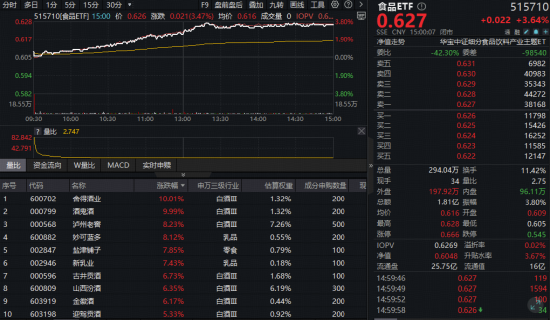
吃喝板块暴力拉升,主力狂买超百亿元!食品ETF(515710)大涨3.64%,估值低位布局正当时?
Xin Lang Ji Jin· 2025-11-10 12:09
Group 1: Market Performance - The food and beverage sector has shown strong performance, leading the market with a 3.64% increase in the food ETF (515710) as of the close on November 10 [1][3] - Major liquor stocks experienced significant gains, with Shede Liquor and Jiu Gui Liquor hitting the daily limit, and Luzhou Laojiao rising by 8.23% [1][3] Group 2: Capital Inflow - The food and beverage sector attracted over 10 billion CNY in net inflows from main funds in a single day, ranking first among 30 sectors [3][4] - The food ETF (515710) has seen a net inflow of over 1.2 billion CNY in the last five trading days and more than 2.4 billion CNY in the last ten trading days [4][5] Group 3: Valuation and Investment Opportunities - The valuation of the food and beverage sector is currently at a historical low, with the food ETF's underlying index PE ratio at 20.59, indicating a good entry point for long-term investments [6][7] - Analysts suggest that the food and beverage industry is gradually bottoming out, with opportunities to invest in liquor stocks at low prices [7][8]

白酒进入底部战略性布局期:黎明前夕,曙光将至
Shenwan Hongyuan Securities· 2025-11-10 08:43
Investment Rating - The report maintains a "Positive" outlook on the liquor industry, indicating that it is entering a strategic allocation period as it approaches a bottom phase [2]. Core Insights - The liquor sector is expected to experience a fundamental turning point in Q3 2026, with a potential dual impact on valuation and performance by the end of 2026 and into 2027. This is based on historical performance patterns observed from 2012 to 2015, where stock price turning points preceded fundamental turning points [2]. - The report emphasizes the need for patience regarding the fundamental recovery and notes that individual company adjustments will vary, leading to differentiated stock performances during this period. It anticipates that the main contribution to stock price returns will come from valuation adjustments rather than earnings growth in the near term [2]. Summary by Sections Fundamental Analysis - The liquor sector has been experiencing a significant downturn since Q4 2024, with Q3 2025 showing accelerated declines. The industry is projected to face a 20%-30% year-on-year decline in sales volume in Q3 2025, with a 50% drop compared to Q3 2024. High-end liquor prices are also declining as the market seeks a balance between volume and price [4]. - Looking ahead, Q1 2026 is expected to continue facing double-digit sales volume declines, but stabilization is anticipated in Q2 2026, with a potential recovery in demand and pricing by Q3 2026 [4]. Valuation Analysis - As of October 31, 2025, the liquor sector's absolute PE ratio stands at 18.7x, significantly below the historical average of 27.6x since 2011. The relative PE ratio compared to the Shanghai Composite Index is 1.14x, also below the historical average of 2.01x. The report suggests that leading companies are expected to increase their dividend payout ratios, with most currently offering dividend yields above 3%, indicating long-term investment value [4]. Holdings Analysis - In Q3 2025, the liquor sector's holdings accounted for 5.52% of total fund investments, a decrease of 1.26 percentage points from previous quarters, returning to levels seen in Q2 2017. This indicates a significant reduction in fund exposure to the liquor sector compared to historical averages [4].
白酒板块集体狂欢,舍得酒业、酒鬼酒双双涨停
2 1 Shi Ji Jing Ji Bao Dao· 2025-11-10 08:09
Group 1 - The A-share market saw a collective rise in the three major indices, with the Shanghai Composite Index increasing by 0.53%, the Shenzhen Component Index rising by 0.18%, while the ChiNext Index fell by 0.92% [1] - The liquor sector experienced strong gains, with companies like Shede Liquor and Jiu Gui Jiu hitting the daily limit, and Luzhou Laojiao rising over 8%. Other brands such as Shanxi Fenjiu, Gujing Gongjiu, and Jinhu Wine also saw increases [1] - According to the National Bureau of Statistics, the Consumer Price Index (CPI) rose by 0.2% month-on-month and year-on-year in October, with the core CPI (excluding food and energy) increasing by 1.2% year-on-year, marking the sixth consecutive month of growth [1] Group 2 - Open Source Securities indicated that the liquor industry has entered a deep adjustment period, with declining demand being transmitted from the end market through channels to manufacturers, resulting in a slowdown in performance growth for liquor companies [1] - The outlook suggests that liquor manufacturers are still cautious about inventory management to promote channel inventory destocking, laying a foundation for long-term healthy development, although short-term performance remains in a clearing phase [1] - Open Source Securities believes that the current liquor sector is approaching a left-side layout interval, recommending gradual allocation, prioritizing companies with performance clearing or bottom confirmation, and suggesting attention to Guizhou Moutai, Luzhou Laojiao, Shanxi Fenjiu, Shede Liquor, and Yanghe Brewery [1]