中欧基金

Search documents
利好,多只,恢复大额申购
3 6 Ke· 2026-01-09 03:12
Core Viewpoint - The A-share market has rebounded to 4,000 points at the beginning of 2026, prompting several actively managed equity funds to reopen for large subscriptions, indicating a positive outlook for the market [1][2]. Fund Activity - Multiple fund companies, including Huaxia, China Europe, and Xinda Australia, have resumed large subscriptions for their actively managed equity funds, with notable performance among these funds [1][2]. - Huaxia Fund announced the removal of subscription limits for its Huaxia Large Cap Select Mixed Fund, which focuses on sectors like artificial intelligence and semiconductors, achieving a 19.19% annualized return, ranking first in its category [2]. - Xinda Australia Fund has also reopened large subscriptions for its Xinao Medical Health Mixed Fund, which has a one-year return of 69.09%, placing it in the top 10% of its category [2]. - New funds such as Guotai Haitong Zhaoyang Mixed Fund and Zhongyin Hong Kong Stock Connect Consumer Selected Mixed Fund have also opened for regular subscriptions shortly after their establishment [3]. Market Outlook - Analysts express optimism for the A-share market in 2026, driven by dual support from domestic and international liquidity, with a focus on sectors benefiting from rising commodity prices and emerging industries like AI [4][5]. - The market is expected to enter a phase of overall improvement and structural deepening, with global liquidity conditions and trends in AI as key drivers [4][5].
利好!多只主动权益类基金恢复大额申购 2026年A股整体有望继续走强
Zhong Guo Jing Ji Wang· 2026-01-09 00:19
Group 1 - The A-share market has returned to 4000 points at the beginning of 2026, reaching a nearly 10-year high, prompting several actively managed equity funds to resume large-scale subscriptions [1] - Notable funds such as Huaxia, China Europe, and Xinda Australia have opened for large subscriptions, with Huaxia's fund focusing on digital economy sectors like AI and semiconductors, achieving a 19.19% annualized return, ranking first among peers [1] - Xinda Australia's healthcare fund reported a 69.09% return over the past year, placing it in the top 10% of its category, while other funds like China Europe and Xinhua have also resumed large subscriptions [1] Group 2 - New funds have also resumed regular subscriptions, including Guotai Haitong and Zhongyin Hong Kong Stock Connect, indicating a positive market sentiment at the start of the year [2] - The resumption of subscriptions reflects institutional optimism about the market and aligns with the reallocation of assets by insurance companies following year-end settlements [2] - Marketing activities for "opening red" campaigns at the beginning of the year have influenced some funds to open for regular subscriptions, as banks promote various financial products [2] Group 3 - The overall outlook for the A-share market in 2026 is positive, driven by domestic and international liquidity support, with a focus on commodity price-driven industries and emerging sectors like AI [3] - Analysts expect a structural shift in the market, moving away from a technology and cyclical focus in 2025 to a broader valuation reassessment of Chinese assets in 2026 [4]
公募2025年自购超5600亿
2 1 Shi Ji Jing Ji Bao Dao· 2026-01-08 23:36
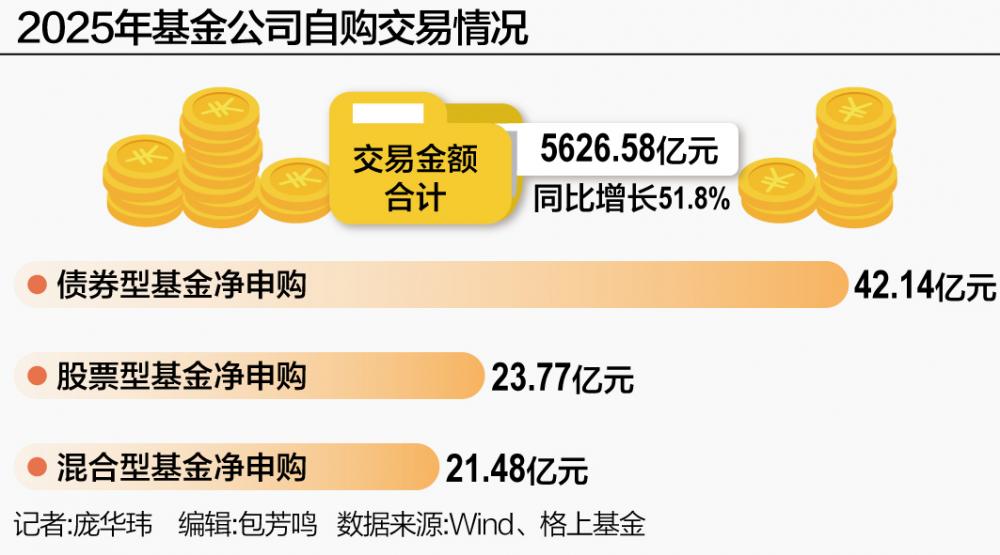
Core Insights - The public fund industry in 2025 demonstrated strong confidence in the market through a large-scale "self-investment" initiative, with total self-purchase transactions amounting to 562.66 billion yuan, a significant increase of 51.8% compared to 370.65 billion yuan in 2024 [1][3][9] - The structure of self-purchases underwent significant changes, with non-monetary funds seeing a net subscription of 9.34 billion yuan, a year-on-year surge of 130%, while monetary funds faced nearly 200 billion yuan in net redemptions [1][4][9] Self-Purchase Scale and Structure Changes - In 2025, the total self-purchase amount for public non-monetary products reached 9.34 billion yuan, up from 4.06 billion yuan in 2024, marking an increase of 5.28 billion yuan [4][12] - Among non-monetary funds, bond funds led with a net subscription of 4.21 billion yuan, while stock and mixed funds saw net subscriptions of 2.38 billion yuan and 2.15 billion yuan, respectively [4][12] - In stark contrast, monetary funds experienced a net redemption of 193.95 billion yuan, compared to a net subscription of 2.53 billion yuan in 2024, indicating a shift of institutional funds from traditional cash management tools to assets with higher return expectations [4][12] Focus on Index Funds - Index funds have become a key focus for public institutions in their self-purchase strategies, with passive index bond funds, passive index funds, and enhanced index funds collectively accounting for 49.55 billion yuan, representing over 53% of the total self-purchase amount for non-monetary funds [5][14] - Notably, the E Fund's index products received a total of 1.8 billion yuan in self-purchases, with eight index products exceeding 100 million yuan in net subscriptions [5][14] Market and Policy Drivers - The A-share market exhibited a "W-shaped" trend in 2025, with major indices showing impressive annual performances, including a rise of 18.41% for the Shanghai Composite Index and 49.57% for the ChiNext Index, creating a favorable environment for fund self-purchases [6][15] - Regulatory policies have played a crucial role, with the China Securities Regulatory Commission's action plan in May 2025 enhancing the evaluation criteria for self-purchases, thereby incentivizing long-term self-investment behavior among fund managers [6][15] Long-term Investment Trends - The self-purchase behavior in 2025 reflects a shift towards "increasing non-monetary investments, long-term orientation, and normalization," moving from a short-term market stabilization tool to a systematic arrangement for long-term value investment [7][16] - The industry is witnessing a growing emphasis on aligning self-purchases with long-term performance, which is expected to drive the public fund industry towards a high-quality development phase, moving away from a focus on scale expansion [8][17]
公募自购升温 去年交易金额大增51.8%,锚定长期价值投资
2 1 Shi Ji Jing Ji Bao Dao· 2026-01-08 23:36
Core Viewpoint - In 2025, the public fund industry demonstrated strong confidence in the market through a large-scale "self-investment" initiative, indicating optimism for future market performance [1][11]. Group 1: Self-Investment Scale and Structure Changes - The total self-purchase transaction amount by fund companies reached 562.658 billion yuan in 2025, a significant increase of 51.8% compared to 370.651 billion yuan in 2024 [2][4][16]. - Non-monetary fund net subscriptions amounted to 9.339 billion yuan, a staggering increase of 130% year-on-year, while monetary funds faced nearly 200 billion yuan in net redemptions [2][12]. - Among non-monetary funds, bond funds led with a net subscription of 4.214 billion yuan, while stock and mixed funds saw net subscriptions of 2.377 billion yuan and 2.148 billion yuan, respectively, marking a reversal from net redemptions in 2024 [5][17]. Group 2: Focus on Index Funds - Index funds have become a key focus for self-purchases by public fund institutions, with passive index bond funds, passive index funds, and enhanced index funds collectively accounting for 49.55 billion yuan, representing over 53% of non-monetary fund self-purchases [6][19]. - Notably, eight index products had net subscription amounts exceeding 100 million yuan, indicating strong market interest [19]. Group 3: Market and Policy Drivers - The A-share market exhibited a "W-shaped" trend in 2025, with major indices showing impressive annual gains: the Shanghai Composite Index rose by 18.41%, the Shenzhen Component Index by 29.87%, and the ChiNext Index by 49.57% [8][21]. - Regulatory policies, particularly the China Securities Regulatory Commission's action plan released in May 2025, have incentivized long-term self-purchase behaviors by aligning the interests of fund managers and investors [21]. Group 4: Long-term Investment Trends - The self-purchase behavior in 2025 reflects a shift towards "increasing non-monetary, long-term, and normalized" investment strategies, moving away from short-term market stabilization tools [22]. - Companies are increasingly committing to long-term holdings, with many pledging to maintain self-purchased shares for no less than one year, signaling a focus on long-term value [23].

利好!多只主动权益基金,恢复大额申购
Zhong Guo Ji Jin Bao· 2026-01-08 22:46
Group 1 - The A-share market has returned to 4000 points at the beginning of 2026, reaching a nearly 10-year high, prompting several actively managed equity funds to resume large-scale subscriptions [1] - Fund companies such as Huaxia, China Universal, and Xinda Australia have announced the reopening of large subscriptions for multiple actively managed equity funds, with some funds showing strong performance [2] - New funds have also resumed regular subscriptions, indicating a positive sentiment in the market and a strategic move by institutions to attract new capital [3] Group 2 - The outlook for the A-share market in 2026 is optimistic, driven by domestic and international liquidity support, with a focus on commodity price-driven industries and emerging sectors like AI [4] - Analysts expect a shift in the market dynamics in 2026, moving away from a technology and cyclical sector focus to a broader valuation reassessment of Chinese assets [5]
掘金港股 基金经理看好结构性机会
Zhong Guo Zheng Quan Bao· 2026-01-08 22:24
Core Viewpoint - The Hong Kong stock market is expected to continue its upward trend in 2026, with significant investment opportunities in sectors such as innovative pharmaceuticals, technology, and dividend assets [1][4]. Group 1: Market Performance - The Hong Kong stock market experienced a strong start in 2026, with the Hang Seng Index and Hang Seng Tech Index rising by 2.76% and 4% respectively on January 2, and maintaining gains of 2.02% and 2.94% by January 8 [2]. - In 2025, both the Hang Seng Index and Hang Seng Tech Index increased by over 20%, ranking among the top global markets [2]. - Several funds investing in Hong Kong stocks achieved impressive returns in 2025, with notable QDII products like Huatai-PineBridge Hong Kong Advantage Select yielding a return of 112.69% [2]. Group 2: Fund Inflows - Multiple cross-border ETFs focused on Hong Kong stocks saw significant net inflows in 2025, with the Hong Kong Stock Connect Internet ETF leading at a net inflow of 56.659 billion yuan [3]. - Other ETFs such as the Hong Kong Stock Connect Technology 30 ETF and the Hong Kong Stock Connect Non-Bank ETF also reported substantial net inflows of 25.544 billion yuan and 24.978 billion yuan respectively [3]. Group 3: Strategic Outlook - The overall sentiment towards the Hong Kong stock market remains optimistic, with expectations of continued capital inflows exceeding 1.3 trillion HKD in 2025, a historical high [4]. - Factors influencing the market include the Federal Reserve's monetary policy, domestic economic fundamentals, technology trends, and geopolitical situations, with a generally positive outlook [4]. Group 4: Sector Opportunities - Key investment areas identified include AI infrastructure, internet technology, new consumption, innovative pharmaceuticals, resource companies, and dividend sectors [5]. - The innovative pharmaceutical sector is highlighted for its potential, with a focus on companies that can sustain cash flow through successful product launches [5]. - Dividend assets are considered attractive due to their historical performance, lower volatility, and favorable valuation compared to A-shares [6].
掘金港股基金经理看好结构性机会
Zhong Guo Zheng Quan Bao· 2026-01-08 20:50
Core Viewpoint - The Hong Kong stock market is expected to present investment opportunities in 2026, particularly in sectors such as innovative pharmaceuticals, technology, and dividend assets, following a strong performance in 2025 [1][3]. Group 1: Market Performance - The Hong Kong stock market experienced a strong start in 2026, with the Hang Seng Index and Hang Seng Tech Index rising by 2.76% and 4% respectively on January 2, and year-to-date increases of 2.02% and 2.94% as of January 8 [1]. - In 2025, both the Hang Seng Index and Hang Seng Tech Index saw annual gains exceeding 20%, ranking among the top global markets [1]. Group 2: Fund Performance - Several funds investing in Hong Kong stocks achieved impressive returns in 2025, with the Huatai-PineBridge Hong Kong Advantage Selected Fund's A share returning 112.69% [2]. - Other notable funds, including the GF CSI Hong Kong Innovative Pharmaceuticals ETF and Southern Hong Kong Medical Industry A, reported returns over 60% [2]. - Cross-border ETFs focused on Hong Kong stocks attracted significant inflows, with the Hong Kong Stock Connect Internet ETF leading with a net inflow of 56.659 billion yuan in 2025 [2]. Group 3: Strategic Outlook - The overall sentiment towards the Hong Kong stock market remains optimistic, with expectations of continued inflows from southbound capital, which exceeded 1.3 trillion HKD in 2025 [3]. - Factors influencing the market include the Federal Reserve's monetary policy, domestic economic fundamentals, technology trends, and geopolitical situations, with a general positive outlook [4]. - The market's current valuation is considered attractive compared to global standards, providing potential investment opportunities [3][4]. Group 4: Sector Opportunities - Key sectors identified for investment include AI infrastructure, internet technology, new consumption, innovative pharmaceuticals, resource companies, and dividend-paying stocks [3]. - The non-bank financial sector and leading internet companies are viewed as having strong growth potential due to the rapid development of artificial intelligence [4]. - The innovative pharmaceutical sector is highlighted for its attractiveness, with a focus on companies with robust pipelines and cash flow improvements [4].
在共识与分化之间,2026年科技投资如何寻找新支点?
Shang Hai Zheng Quan Bao· 2026-01-08 16:49
◎记者 聂林浩 王彭 在刚刚过去的2025年,伴随国内政策对科技创新和产业升级的大力支持,以及全球流动性环境边际改善 的预期,市场风险偏好显著提升,以人工智能为代表的科技股走出一轮强劲的上涨行情。 展望2026年,科技板块将面临哪些机遇与挑战?AI产业的发展阶段与投资重心是否已悄然演变?在AI 主线之外,还有哪些科技子领域有望迎来产业拐点? 上海证券报记者邀请财通基金副总经理、权益投资总监、基金经理金梓才,永赢基金权益投资部联席总 经理、基金经理李文宾,以及中欧信息科技混合基金基金经理杜厚良对上述议题展开探讨。 科技创新进入新周期 宏观层面,全球与国内流动性环境预计同步向好,为市场上涨奠定坚实基础。从外部来看,美联储2026 年降息节奏或加快,A股面临的外部约束大幅减弱,海外资金环境更趋友好;从内部来看,国内货币政 策将持续为经济高质量发展与产业升级提供支持,维持流动性合理充裕。内外部流动性的协同改善,将 有效提升市场风险偏好,为估值修复创造有利条件。 从产业维度来看,以人工智能为首的科技成长方向增长动能将持续强化,斜率有望进一步陡峭。AI产 业正从2025年的高速渗透,迈向2026年进一步业绩兑现与深度影响 ...
1/8财经夜宵:得知基金净值排名及选基策略,赶紧告知大家
Sou Hu Cai Jing· 2026-01-08 16:38
Core Insights - The article provides an overview of the latest net asset values of various funds, highlighting the top-performing and bottom-performing funds as of January 8, 2026 [2][3]. Fund Performance Summary Top 10 Funds by Net Value Growth - The top-performing funds include: 1. GF Zhaoli Mixed C with a net value of 1.1368, up by 6.99% 2. GF Zhaoli Mixed A with a net value of 1.1552, also up by 6.99% 3. Great Wall Growth Mixed C at 1.6011, up by 6.78% 4. Great Wall Growth Mixed A at 1.6235, up by 6.77% 5. China Europe Semiconductor C at 1.7705, up by 6.41% 6. China Europe Semiconductor A at 1.7891, up by 6.41% 7. Noah Select Return Mixed at 2.9280, up by 6.32% 8. Zhongjia Advantage Enterprise A at 2.0340, up by 6.21% 9. Zhongjia Advantage Enterprise C at 1.9435, up by 6.21% 10. Qianhai Kaiyuan Shanghai-Hong Kong Deep Strong Domestic Industry Mixed at 1.7213, up by 5.87% [2]. Bottom 10 Funds by Net Value Decline - The underperforming funds include: 1. Guotou Ruijin Silver Futures (LOF) A at 2.1311, down by 3.56% 2. Xin'ao Industry Upgrade Mixed A at 2.5970, down by 3.21% 3. Xin'ao Industry Upgrade Mixed C at 2.5900, down by 3.18% 4. E Fund Shanghai-Shenzhen 300 ETF Link C at 1.2617, down by 2.94% 5. E Fund Shanghai-Shenzhen 300 ETF Link A at 1.2700, down by 2.93% 6. E Fund Financial Industry Stock Initiation C at 1.7282, down by 2.92% 7. E Fund Financial Industry Stock Initiation A at 1.7617, down by 2.92% 8. Puyin Ansheng CSI Securities Company 30 ETF Link A at 1.2132, down by 2.87% 9. Puyin Ansheng CSI Securities Company 30 ETF Link C at 1.2031, down by 2.87% 10. Xin'ao Economic Preferred Mixed C at 1.7061, down by 2.86% [3]. Market Analysis - The Shanghai Composite Index showed slight fluctuations, closing down, while the ChiNext Index opened lower and then fell back, with a total trading volume of 2.82 trillion yuan. The number of rising stocks was 3,731 compared to 1,595 declining stocks, with 111 stocks hitting the daily limit up and 6 hitting the limit down [6]. - Leading sectors included aviation and shipbuilding, both rising over 4%, while the securities and insurance sectors fell over 2% [6]. Fund Strategy Insights - The GF Zhaoli Mixed C fund has shown rapid net value growth, indicating a potential shift in investment strategy towards commercial aerospace [7]. - The Xin'ao Industry Upgrade Mixed A fund has underperformed, with a high concentration of holdings (70.43%) in various sectors, including robotics and new energy, but lacking a clear investment logic [9].
长跑冠军,拼“含科量”
2 1 Shi Ji Jing Ji Bao Dao· 2026-01-08 15:34
Core Viewpoint - The active equity funds are experiencing a significant performance surge in 2025, with many funds achieving over 100% returns in the past three years, highlighting the importance of stock selection by fund managers [1][4][12]. Group 1: Three-Year Performance - As of December 31, 2025, over 135 active equity funds achieved returns exceeding 100% over the three-year period from January 1, 2023, to December 31, 2025 [4]. - Among these, 9 funds surpassed 200% returns, with top performers including Dongwu New Trend Value Line (267.92%), Huaxia North Exchange Innovation Small and Medium Enterprises Selection (260.42%), and Dongwu Mobile Internet A (256.05%) [5]. - The majority of high-performing funds are concentrated in the technology sector, benefiting from the tech market trends in 2025 [7][8]. Group 2: Five-Year Performance - For the five-year period from January 1, 2021, to December 31, 2025, 54 flexible allocation mixed funds, 22 equity mixed funds, and 18 actively managed stock funds achieved returns over 100% [12]. - The top five funds in this category include Jinyuan Shun'an Yuanqi Flexible Allocation (259.53%), Dongwu Mobile Internet A (256.09%), and Dongwu New Trend Value Line (251.22%) [13]. - The five-year performance emphasizes the fund managers' stock selection capabilities, with a more diversified investment approach leading to better long-term results [14]. Group 3: Ten-Year Performance - Over the ten-year period from January 1, 2016, to December 31, 2025, the top ten active equity funds achieved returns ranging from 364.83% to 571.91%, with Huashang Advantage Industry A leading at 571.91% [18][17]. - A total of over 440 active equity funds recorded returns exceeding 100% in the ten-year span, with approximately 5% achieving over 300% [21]. - The performance of these funds reflects a mix of concentrated investments in technology and diversified holdings across various sectors [21].