中集安瑞科

Search documents
中集安瑞科:中集环科前三季度归母净利润9955.75万元,同比下降44.73%

Zhi Tong Cai Jing· 2025-10-23 12:11
Core Insights - CIMC Enric (03899) announced that its subsidiary CIMC Environmental Protection (301559) achieved operating revenue of 1.75 billion RMB in the first three quarters of 2025, representing a year-on-year decline of 25.64% [1] - The net profit attributable to shareholders of the listed company was 99.56 million RMB, down 44.73% year-on-year [1] - The basic earnings per share stood at 0.17 RMB [1]
中集安瑞科(03899):中集环科(301559.SZ)前三季度归母净利润9955.75万元,同比下降44.73%
智通财经网· 2025-10-23 12:06
Core Viewpoint - 中集安瑞科's subsidiary 中集环科 reported a significant decline in both revenue and net profit for the first three quarters of 2025, indicating potential challenges in its operational performance [1] Financial Performance - The company achieved a revenue of 1.75 billion RMB for the first three quarters of 2025, representing a year-on-year decrease of 25.64% [1] - The net profit attributable to shareholders was 99.56 million RMB, which reflects a year-on-year decline of 44.73% [1] - The basic earnings per share stood at 0.17 RMB [1]
中集安瑞科(03899) - 公告 - 中集环科截至2025年9月30日止第三季度之主要未经审核财务...
2025-10-23 11:54
香港交易及結算所有限公司及香港聯合交易所有限公司對本公告的內容概不負 責,對其準確性或完整性亦不發表任何聲明,並明確表示,概不對因本公告全部 或任何部分內容而產生或因倚賴該等內容而引致的任何損失承擔任何責任。 CIMC Enric Holdings Limited 中集安瑞科控股有限公司 (於開曼群島註冊成立之有限公司) (股份代號:3899) 單位:元 幣種:人民幣 公司是否需追溯調整或重述以前年度會計數據 □ 是 ✔否 年初至 | | | 本報告期比 | 年初至 | 報告期末比 | | --- | --- | --- | --- | --- | | | 本報告期 | 上年同期增減 | 報告期末 | 上年同期增減 | | 營業收入 | 536,937,111.64 | | -44.33% 1,750,456,142.90 | -25.64% | | 歸屬於上市公司股東的淨利潤 | 36,956,256.73 | -43.18% | 99,557,469.78 | -44.73% | | 歸屬於上市公司股東的扣除非 | | | | | | 經常性損益的淨利潤 | 34,482,524.99 | -26.38% ...
碳中和系列报告七:航运减碳大势所趋,重视生柴、RNG及绿色甲醇
Shenwan Hongyuan Securities· 2025-10-23 08:46
Investment Rating - The report indicates a positive investment outlook for the shipping decarbonization sector, emphasizing the importance of biofuels, RNG, and green methanol as key areas for investment opportunities [3]. Core Insights - The shipping industry is entering a critical phase of decarbonization, driven by frequent policies from the IMO and the EU. The global shipping fuel consumption is approximately 300 million tons, corresponding to carbon emissions exceeding 1 billion tons, with the EU accounting for about 18% of this [3][8]. - The demand for low-carbon fuels is expected to outstrip supply in the short term, with significant compliance costs driving the need for zero or near-zero emissions fuels (ZNZ) [3][36]. - Biofuels are identified as a core measure for existing vessels, with a notable increase in biofuel bunkering at ports like Singapore [3][36]. - The report highlights the potential for biogas, particularly RNG, to significantly reduce emissions and improve energy security, with ambitious production targets set for 2030 in both China and the EU [3][36]. - Green methanol is projected to see rapid growth in demand, with a current estimate of 406 methanol vessels corresponding to a demand exceeding 800,000 tons [3][36]. Summary by Sections 1. Decarbonization Policies - The report outlines the increasing frequency of decarbonization policies from the IMO and the EU, marking a significant acceleration in the implementation of these measures [3][11][18]. 2. Low-Carbon Fuel Demand - There is a broad demand space for low-carbon fuels, with a short-term supply shortage anticipated. The report notes that the compliance costs associated with EU regulations are higher than those of the IMO, which will further stimulate demand for low-carbon fuels [3][36]. 3. Biofuels - Biofuels are highlighted as a critical decarbonization measure for existing vessels, with a significant increase in biofuel bunkering observed at ports like Singapore. The global production of biodiesel is approximately 52 million tons, with expectations for increased usage in shipping as electric vehicles proliferate [3][36]. 4. Biogas - The report emphasizes the growing demand for LNG vessels and the potential for RNG to drive significant growth in the sector, supported by a green premium that could lead to an industry explosion [3][36]. 5. Green Methanol - The report notes a rapid increase in methanol vessels, with a projected demand of over 800,000 tons. However, the global production capacity for green methanol is expected to be only 1.24 million tons by the end of 2025, indicating a supply-demand imbalance [3][36]. 6. Investment Recommendations - The report suggests focusing on companies involved in biofuels, RNG, and green methanol production, including notable firms such as卓越新能, 山高环能, 维尔利, and 中国天楹, among others [3][36].





智通港股投资日志|10月22日
智通财经网· 2025-10-21 16:02
智通财经APP获悉,2025年10月22日,港股上市公司投资日志如下: 三一重工 (招股中) 滴普科技 (招股中) 广和通 (上市日) 中国海外宏洋集团 上海石油化工股份 滔搏 中国联通 中集安瑞科 长飞光纤光缆 美的置业 中国高速传动 金力永磁 九方智投控股 联泰控股 康希诺生物 中国安储能源 SINO HOTELS 分红派息 万洲国际 (派息日) 广发证券 (派息日) 兖矿能源 (派息日) 天伦燃气 (除净日) 灵宝黄金 (派息日) 中煤能源 (派息日) 赛晶科技 (派息日) 华润啤酒 (派息日) 长江制衣 (派息日) YGM TRADING (派息日) 新股活动 业绩公布日 股东大会召开日 类别 公司 八马茶业 (招股中) 剑桥科技 (招股中) ...
5只混合类产品近一年涨幅超15% 高含权混合类产品夺榜首
2 1 Shi Ji Jing Ji Bao Dao· 2025-10-17 16:00
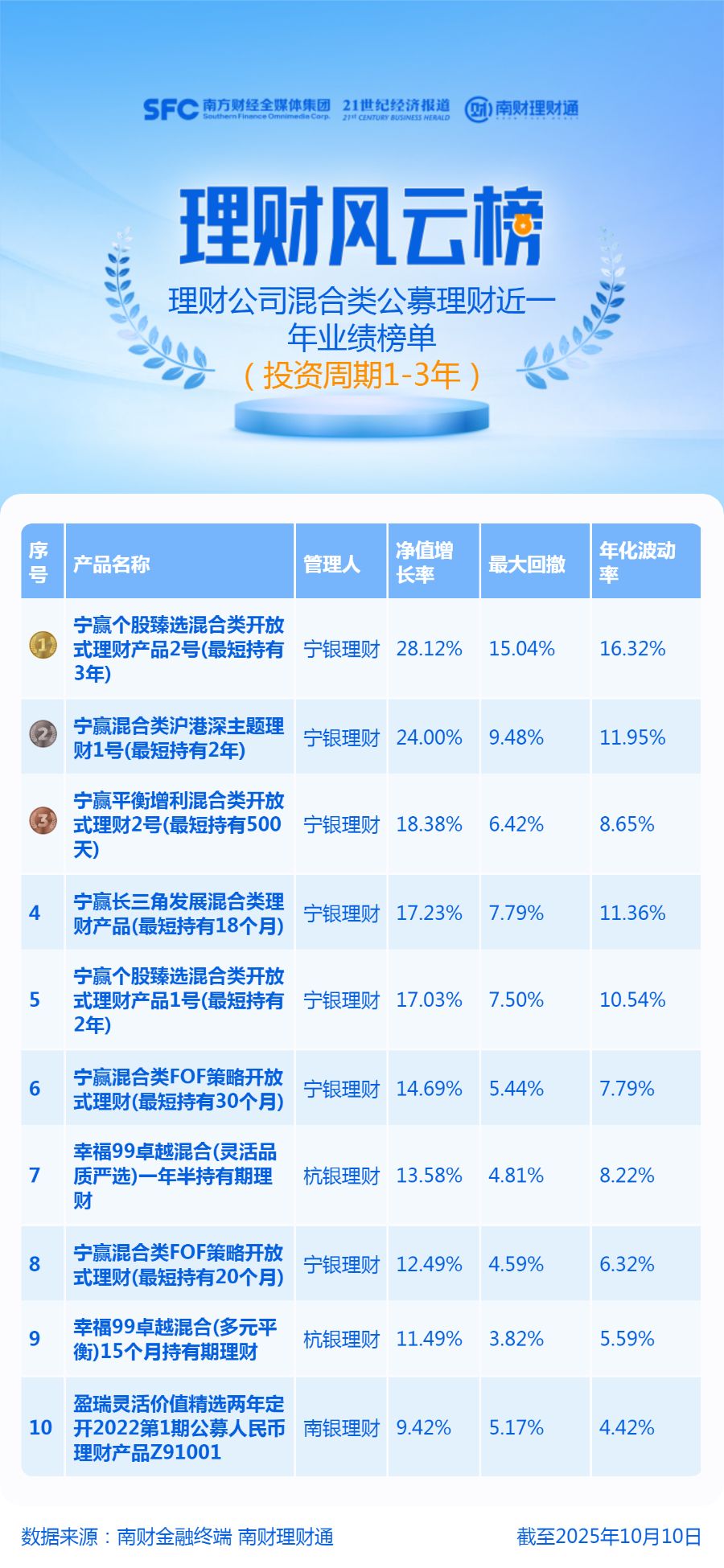
Overall Performance - As of October 10, 2025, the average net value growth rate for mixed public financial products with a term of 1-3 years is 5.9%, with an average maximum drawdown of 1.57% [5] - Ningyin Wealth Management has shown exceptional performance, with its mixed products achieving an average net value growth rate exceeding 15% over the past year [5] - The top three products in the ranking are "Ningyin Individual Stock Selection Mixed Open-End Financial Product No. 2" and "Ningyin Mixed Shanghai-Hong Kong-Shenzhen Theme Financial Product No. 1," with net value growth rates of 28.12% and 24%, respectively [5] Highlighted Product Analysis - "Ningyin Individual Stock Selection Mixed Open-End Financial Product No. 2" is classified as a medium-high risk product with an equity holding of 76.54%, resulting in a maximum drawdown of 15.04% and an annualized volatility of 16.32% [6] - The top ten holdings of this product include Hong Kong stocks such as CIMC Enric, 361 Degrees, Geely Automobile, and Bosideng, with notable gains of 38.82% and 67.42% for 361 Degrees and Geely Automobile, respectively [6] - "Ningyin Mixed Shanghai-Hong Kong-Shenzhen Theme Financial Product No. 1" focuses on public funds with an 81.23% holding ratio, featuring strong performance from its top three funds, including a mixed fund that gained 42.74% over the past year [7] - The outlook for the market suggests potential investment opportunities in the technology innovation sector, although challenges such as U.S. dollar liquidity tightening may impact the Hong Kong market in the second half of the year [7]

5只混合类产品近一年涨幅超15%,高含权混合类产品夺榜首
2 1 Shi Ji Jing Ji Bao Dao· 2025-10-17 02:01
Overall Performance - As of October 10, 2025, the average net value growth rate for mixed public financial products with a term of 1-3 years is 5.9%, with a maximum drawdown average of 1.57% [7] - Ningyin Wealth Management has shown exceptional performance, with its mixed products achieving an average net value growth rate exceeding 15% over the past year [7] - The top three products in the ranking are "Ningyin Individual Stock Selection Mixed Open-End Financial Product No. 2" and "Ningyin Mixed Class Hong Kong and Shanghai Theme Financial Product No. 1," with net value growth rates of 28.12% and 24% respectively [7] Highlighted Product Analysis - The "Ningyin Individual Stock Selection Mixed Open-End Financial Product No. 2" has a high equity holding of 76.54%, resulting in a maximum drawdown of 15.04% and an annualized volatility of 16.32% [8] - The top ten holdings of this product include Hong Kong stocks such as CIMC Enric, 361 Degrees, Geely Automobile, and Bosideng, with notable gains of 38.82% and 67.42% for 361 Degrees and Geely respectively [8] - The "Ningyin Mixed Class Hong Kong and Shanghai Theme Financial Product No. 1" focuses on public funds, with an 81.23% holding in funds, and has seen strong performance from its top holdings, including the mixed fund "Fuguo Hong Kong and Shanghai Performance-Driven A," which has a growth rate of 42.74% [9] Market Outlook - Short-term investment opportunities are expected in the technology innovation sector, with the Hong Kong stock market showing strong recovery [9] - However, challenges such as the tightening of US dollar liquidity may lead to a volatile fourth quarter for the Hong Kong market [9] - The bond market is anticipated to maintain a moderately loose monetary policy, but short-term opportunities may be limited due to the stock market's rise and increased risk appetite [9]
绿色甲醇行业深度汇报:新能源非电利用与航运业脱碳如何共振?
2025-10-15 14:57
Summary of Key Points from the Conference Call on Green Methanol Industry Industry Overview - The report focuses on the **green methanol industry** and its intersection with the **shipping industry**'s decarbonization efforts, highlighting the potential for growth driven by regulatory changes and technological advancements [1][4]. Core Insights and Arguments - The shipping industry is pushing for low-carbon solutions, with the **International Maritime Organization (IMO)** potentially implementing a phosphorus emission ban by 2028, which could accelerate the global transition to low-carbon fuels and stimulate demand for green methanol [1][7]. - Green methanol is priced above **1,000 USD/ton** internationally, primarily driven by the shipping sector's need for decarbonization, while gray methanol prices range from **2,200 to 2,500 CNY/ton**, influenced by downstream chemical raw material costs [1][6]. - There are three main production routes for green methanol: 1. Biomass gasification synthesis (cost: **3,000-4,000 CNY/ton**) 2. Biomass coupled with green hydrogen production (cost: **3,000-4,000 CNY/ton**) 3. Electrolysis (cost: **over 5,000 CNY/ton**) [1][8]. - Global green methanol production capacity is expected to reach **500,000 tons** by the end of 2024 and not exceed **1 million tons** by the end of 2025, with domestic capacity also around **500,000 tons** [1][16]. Demand Drivers - The primary demand for green methanol currently comes from the **global shipping industry**, which is undergoing a low-carbon transition. Long-term demand is also anticipated from the chemical industry [2][3]. - The urgency in the shipping sector to adopt green methanol stems from the dominance of shipowners in **Northwest Europe and East Asia**, who control **85%** of global shipping capacity [3]. Regulatory and Market Dynamics - The EU is advancing green regulations in shipping, with new decarbonization laws expected to be implemented in **2024 and 2025**, aiming for an **80% reduction** in carbon emissions by **2050** [9]. - The IMO's measures will require ships to use increasingly green fuels, with penalties for non-compliance, potentially leading to significant financial implications for the shipping industry [10][12]. Investment Opportunities - Investment strategies include transitioning to green methanol production to achieve rapid performance growth and benefiting from increased government support for green methanol, which will drive demand for midstream equipment and EPC companies [17]. - Companies to watch include **Jiaze New Energy, Goldwind Technology, and Jidian Co.**, which have significant market potential due to their existing operations and planned capacity expansions [19]. Production Capacity and Future Outlook - Notable projects include **Goldwind Technology's** capacity increase to **1.45 million tons** and **Jidian Co.**'s collaboration with major green fuel demand partners [22][21]. - The domestic equipment sector is expected to see capital expenditures of **30-50 billion CNY** annually, with a focus on gasification equipment and process packages [27][28]. Challenges and Considerations - The shipping industry faces challenges in fuel system maturity, with green methanol being favored over hydrogen and ammonia due to lower technical barriers and compatibility with existing fuel systems [14][15]. - The competition among green methanol suppliers will hinge on their ability to maintain low production costs, with profitability projected at **1,500-2,000 CNY/ton** [18]. Conclusion - The green methanol industry is poised for growth driven by regulatory changes, technological advancements, and increasing demand from the shipping and chemical sectors. Investors should focus on companies with strong market positions and capacity expansion plans to capitalize on this emerging market.
全球脱碳催化绿醇需求放量关注绿醇供应商与设备投资机遇
Hua Yuan Zheng Quan· 2025-10-15 08:41
Investment Rating - The report maintains a positive outlook on the public utility industry, specifically focusing on green methanol suppliers and equipment investment opportunities [1]. Core Insights - The demand for green methanol is catalyzed by carbon pricing, opening up a market space worth billions in the shipping industry [4]. - Attention is drawn to flexible stocks with cost and consumption advantages among green methanol suppliers [4]. - The demand for biomass gasification equipment is expected to rise due to project initiations in the midstream equipment sector [4]. Supply and Demand - Carbon pricing is driving the demand for green methanol, with the shipping sector poised to unlock a market space exceeding 100 billion [4]. - The traditional methanol market has not yet adopted carbon pricing, leading to a dominance of gray methanol [5][6]. - The global methanol production capacity is projected to reach 177 million tons by 2024, with China accounting for 58% of this capacity [11]. Green Methanol Production - Green methanol is defined as methanol produced with minimal to zero carbon emissions, categorized into electro-methanol and bio-methanol [12]. - The cost of green methanol production is currently high, primarily due to the costs associated with green hydrogen production [15][18]. - The biomass gasification route for methanol production is more cost-effective than electro-methanol, with potential for further cost reductions [21][25]. Regulatory Environment - The EU's carbon tax is set to impact the shipping industry, with regulations requiring reductions in greenhouse gas emissions from 2025 onwards [26][28]. - The International Maritime Organization (IMO) is implementing a net-zero framework that will enforce carbon emission limits and pricing mechanisms starting in 2025 [29][30]. Market Trends - The share of alternative fuel vessels is increasing, with methanol-powered vessels accounting for 10% of the total orders as of September 2025 [50]. - The demand for green methanol is expected to surge, with projections indicating that by 2027, demand could exceed 9 million tons annually [55]. - The supply agreements for green methanol are intensifying, with major shipping companies signing contracts with suppliers [60][63]. Investment Opportunities - Capital expenditures are anticipated to drive equipment demand, while downstream sales are expected to enhance the performance of suppliers [64]. - The report highlights specific companies such as 嘉泽新能 and 吉电股份, which are positioning themselves to benefit from the green methanol market [68][71].
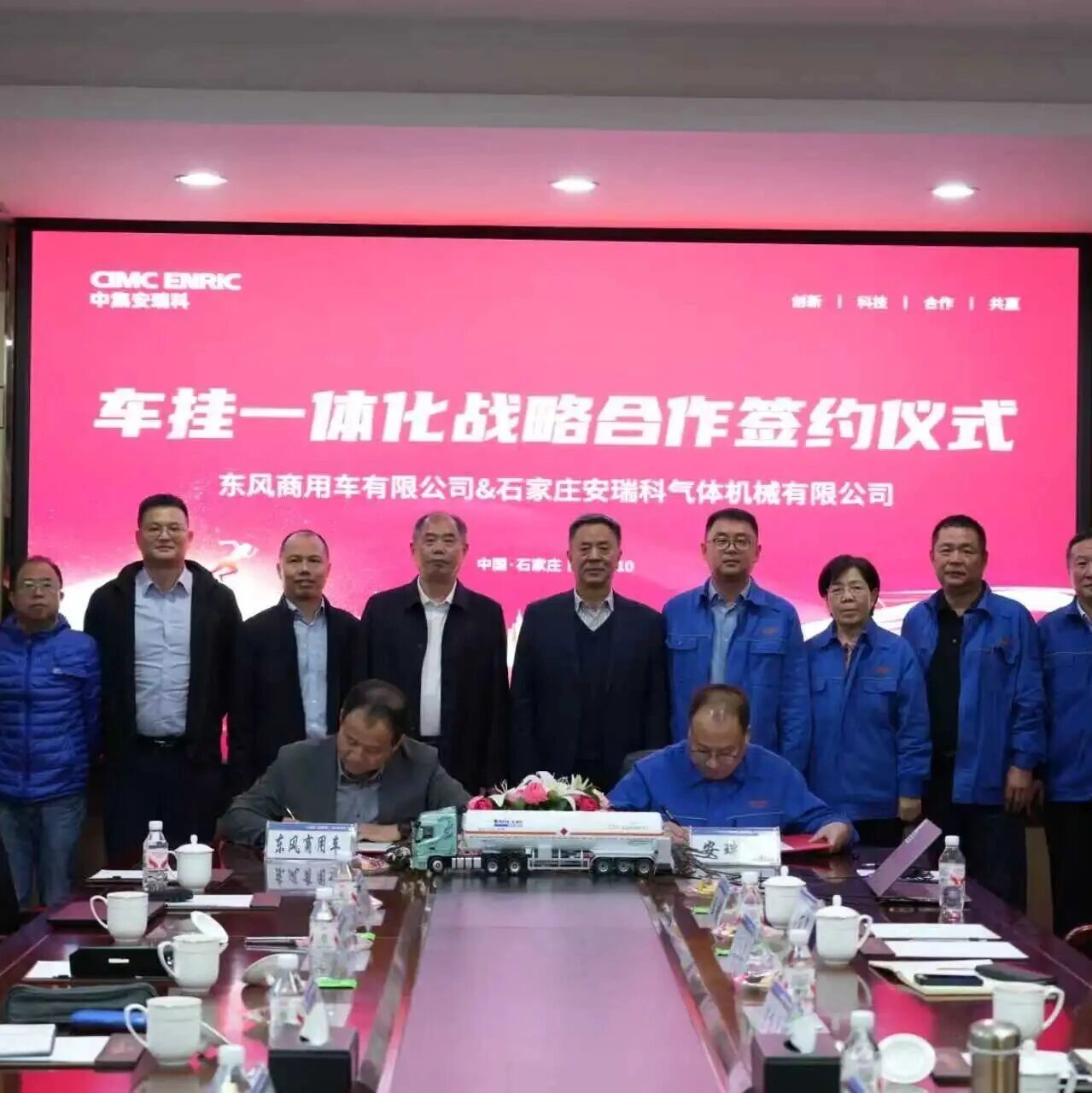
“车挂一体化”全新解决方案 中集安瑞科与东风商用车深化合作共拓市场
中国能源报· 2025-10-15 07:23
Core Viewpoint - The strategic cooperation agreement between CIMC Anrui and Dongfeng Commercial Vehicle aims to lead the clean energy market development by creating integrated vehicle and trailer solutions, enhancing industry standards, and promoting the application of clean energy such as LNG, hydrogen, and ammonia [1][5]. Group 1 - CIMC Anrui and Dongfeng Commercial Vehicle will jointly develop and produce integrated "tractor + trailer" products to address existing market pain points such as complicated electrical connections and quality assurance issues [1][5]. - The collaboration focuses on customer-centric strategies, forming teams to create leading integrated solutions, and enhancing customer loyalty through integrated sales and after-sales services [5]. - This partnership is a significant step towards the green, efficient, and intelligent transformation of China's commercial vehicle industry, contributing to the national "dual carbon" strategy [5]. Group 2 - The signing ceremony was attended by key executives from both companies, indicating strong leadership commitment to the partnership [3]. - The cooperation aims to establish industry standards and promote integrated technology specifications as benchmarks within the sector [5]. - The initiative is expected to foster an ecosystem that enhances the overall competitiveness of China's commercial vehicle industry by driving collaboration across the supply chain [5].