
南极电商

Search documents
朝闻国盛:业绩预告陆续披露,企业持续积极布局
GOLDEN SUN SECURITIES· 2025-07-22 00:04
Group 1: Market Overview - The report highlights that the market is expected to reach a new level, with a focus on the performance of various sectors and companies [2] - The A-share market has shown resilience, with indices rebounding after a pullback, indicating a return of positive sentiment [3] - The report notes that global equity markets have mostly risen, with Asian markets leading the gains [3] Group 2: Industry Insights - The food and beverage sector is experiencing a cyclical bottom, with the dairy industry moving towards supply-demand balance and beef prices recovering [4] - In the retail sector, companies are actively positioning themselves for growth, with a focus on new consumption trends and improving performance in the restaurant and tourism industries [6] - The C-REITs market is witnessing strong interest, particularly in data center REITs, with a positive outlook for the low-interest environment and macroeconomic recovery [8] Group 3: Company Performance - Zhongwei Company (688012.SH) is projected to achieve a revenue of 4.96 billion yuan in H1 2025, reflecting a year-on-year growth of 43.9%, driven by significant increases in etching equipment sales [10] - The company has increased its R&D investment to approximately 1.49 billion yuan in H1 2025, representing a growth of about 53.7%, which is significantly higher than the average R&D investment level of companies listed on the Sci-Tech Innovation Board [11] - Zhongwei Company aims to cover over 60% of semiconductor front-end equipment categories through both acquisitions and internal R&D, positioning itself as a leading supplier in the etching, film deposition, and measurement sectors [12][13]

2025年中国蚊帐行业分析:技术创新与环保升级双轮驱动,行业迈向百亿市场新纪元
Tou Bao Yan Jiu Yuan· 2025-07-21 12:28
Investment Rating - The report indicates a positive investment outlook for the mosquito net industry, projecting a market size growth from 80 billion yuan in 2024 to 105.7 billion yuan by 2025, reflecting a compound annual growth rate (CAGR) of 5.6% [5][4]. Core Insights - The mosquito net industry in China is driven by technological innovation and environmental upgrades, transitioning towards a high-value market with increasing consumer demand for quality sleep products [5][4]. - The industry is experiencing a shift from traditional home goods to high-value health management products, influenced by rising rental demands and the growing sleep economy [5][4]. Industry Development Environment - **Policy Environment**: Continuous government support is pushing the industry towards high-end, smart, and eco-friendly transformations [4][28]. - **Market Environment**: The mosquito net sector is affected by the overall fluctuations in the home textile industry, with revenue growth observed since 2024 due to supportive policies, despite significant profit declines due to high raw material costs and intensified competition [4][29]. Key Players and Competitive Landscape - Major participants include established home textile companies like Mercury and Fuanna, which leverage brand strength and distribution channels to meet basic demand, while innovative brands like Meiduojia focus on material upgrades and functional innovations [5][47]. - The competitive landscape shows that brands like Meiduojia achieve significant premium pricing through high safety standards and innovative designs, leading the industry [5][5]. Market Size and Growth Drivers - The mosquito net market is expected to grow from 80 billion yuan in 2024 to 105.7 billion yuan by 2025, driven by increased consumer focus on sleep quality and the rise of the sleep economy [5][4]. - Factors contributing to this growth include the increasing demand for rental housing and the transformation of mosquito nets into high-value health management products [5][4]. Industry Chain Analysis - The industry chain consists of upstream suppliers of materials (natural and chemical fibers), midstream manufacturers (including traditional and innovative brands), and downstream sales channels (both online and offline) [5][34]. - The supply of raw materials is stable, with a notable increase in the production of recycled fibers, supporting the industry's shift towards sustainability [5][36]. Upstream Analysis - The primary materials for mosquito nets include cotton and polyester, with China's fiber production ensuring a steady supply for manufacturing [5][36]. - The report highlights a significant increase in the production of chemical fibers, which is expected to enhance the industry's capacity for high-performance mosquito nets [5][38]. Midstream Analysis - Major home textile companies are focusing on product innovation, emphasizing material upgrades and functional enhancements to meet diverse consumer needs [5][47]. - The competitive dynamics reveal that established brands are expanding their product lines to include various designs and functionalities, catering to different market segments [5][49].
银华永祥灵活配置混合:2025年第二季度利润466.78万元 净值增长率5.47%
Sou Hu Cai Jing· 2025-07-18 08:48
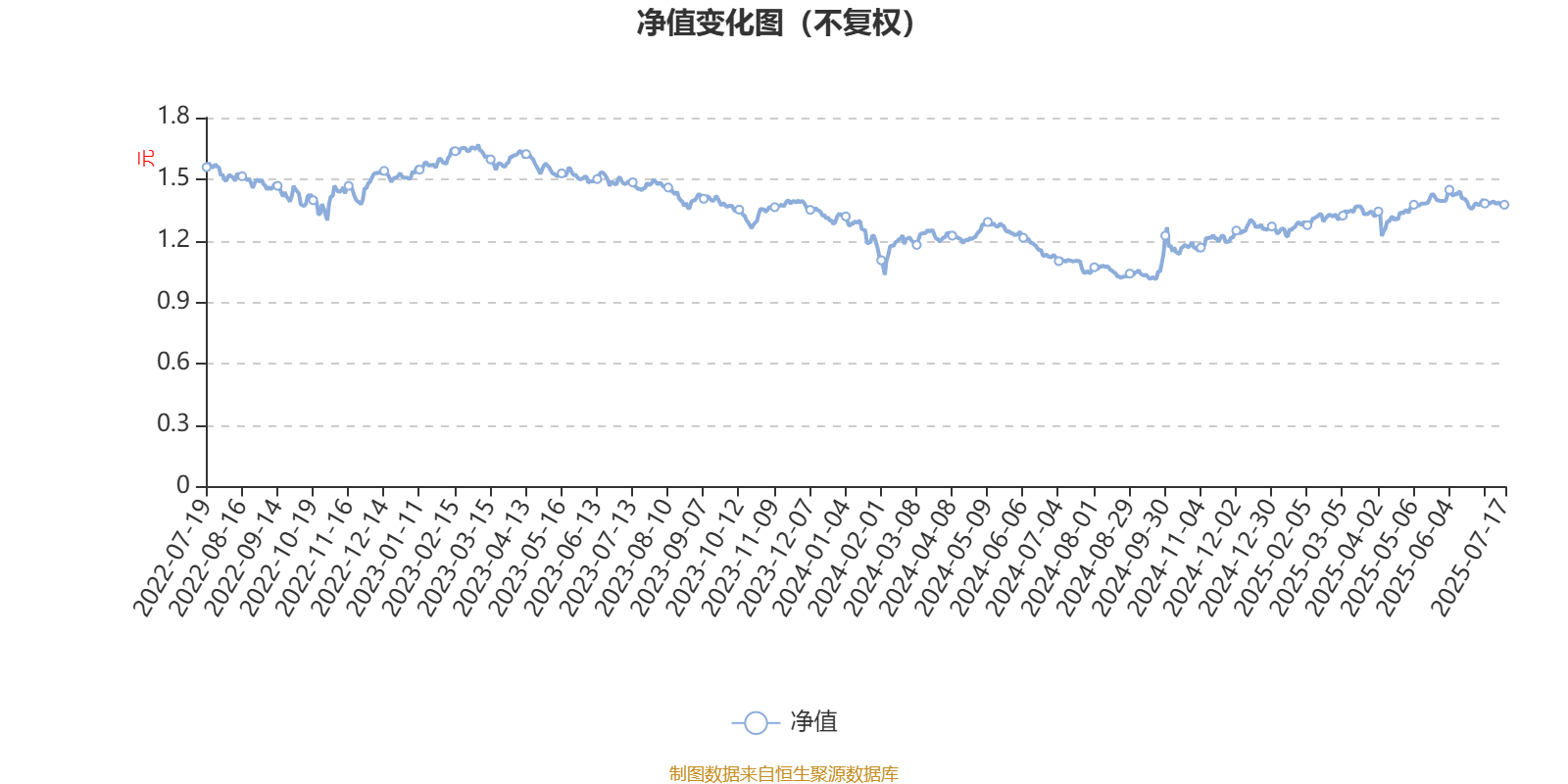
Group 1 - The core viewpoint of the article highlights the performance and strategy of the AI Fund Yinghua Yongxiang Flexible Allocation Mixed Fund (180028) for the second quarter of 2025, reporting a profit of 4.67 million yuan and a net asset value growth rate of 5.47% [2][3] - As of July 17, the fund's unit net value is 1.375 yuan, with a one-year compounded unit net value growth rate of 25%, the highest among its peers [2][3] - The fund manager, Guo Sijie, focuses on consumer sectors and maintains a high position, increasing allocations in new consumption areas such as gold and jewelry, snacks, and electronic cigarettes [3] Group 2 - The fund's performance metrics indicate a three-month compounded unit net value growth rate of 5.04%, a six-month growth rate of 8.70%, and a three-year growth rate of -12.70%, ranking 489 out of 870 among comparable funds [3][10] - The fund's maximum drawdown over the past three years is 39.21%, with the largest single-quarter drawdown occurring in Q1 2024 at 22.27% [10] - The fund's top ten holdings as of the end of Q2 2025 include companies such as Nanjing E-commerce, Inpai, and Haian Home [17]

南极电商(002127) - 2025 Q2 - 季度业绩预告
2025-07-14 11:05
[Nanji E-commerce 2025 Semi-Annual Performance Forecast](index=1&type=section&id=Nanji%20E-commerce%20Co.%2C%20Ltd.%202025%20Semi-Annual%20Performance%20Forecast) Nanji E-commerce forecasts a significant H1 2025 net profit decline, turning to a loss after non-recurring items, driven by strategic sales investments [Performance Forecast Overview](index=1&type=section&id=I.%20Current%20Period%20Performance%20Estimates) The company forecasts a substantial H1 2025 net profit decline, with net profit after non-recurring items turning to a loss Performance Estimates | Item | Current Period (2025H1) | Prior Period (2024H1) | YoY Change | | :--- | :--- | :--- | :--- | | **Net Profit Attributable to Shareholders of Listed Company (million yuan)** | Profit: 12 – 18 | Profit: 77.905 | Decrease: 76.89% - 84.60% | | **Net Profit After Deducting Non-Recurring Gains and Losses (million yuan)** | Loss: 7 – 13 | Profit: 68.5964 | Decrease: 110.20% - 118.95% | | **Basic Earnings Per Share (yuan/share)** | Profit: 0.0051 – 0.0076 | Profit: 0.0325 | - | [Communication with Accounting Firm](index=1&type=section&id=II.%20Communication%20with%20Accounting%20Firm) The company pre-communicated the performance forecast with its accounting firm, confirming no disagreements, though the data is preliminary and unaudited - The performance forecast data is a preliminary estimate by the company's finance department, unaudited, but pre-communicated with the accounting firm with no disagreements[2](index=2&type=chunk) [Analysis of Performance Change Reasons](index=1&type=section&id=III.%20Explanation%20of%20Performance%20Change%20Reasons) Performance decline stems from increased strategic sales expenses for brand promotion during the company's self-operated transformation, with profitability expected to improve as the expense ratio narrows - The main reason for the performance decline is the company's strategic increase in brand promotion investments (e.g., Focus Media elevator media cooperation, traffic acquisition marketing) during its self-operated transformation, leading to a significant year-over-year increase in sales expenses and short-term profit pressure[3](index=3&type=chunk) - The company states that despite the short-term profit impact, the sales expense ratio has narrowed compared to 2024, and profitability is expected to gradually improve with business scale growth and optimized expense control[3](index=3&type=chunk) [Risk Warning](index=1&type=section&id=IV.%20Risk%20Warning) The company warns this performance forecast is preliminary, with final data subject to the 2025 semi-annual report, advising investors to be aware of risks - This performance forecast is preliminary data, and the final figures will be based on the company's disclosed 2025 semi-annual report, so investors are advised to exercise caution[4](index=4&type=chunk)

南极电商董事长张玉祥对副总虞晗青真好 给的薪酬有的年份超过自己
Sou Hu Cai Jing· 2025-07-09 04:00
Core Insights - The recent annual report from Nanji E-commerce highlights significant changes in the compensation of Chairman Zhang Yuxiang, which has drawn attention from the media [1] Compensation Analysis - Zhang Yuxiang's compensation has shown a consistent upward trend from 426,000 yuan in 2020 to 1,440,000 yuan in 2024, with the largest increase of 591,500 yuan occurring in 2024 [3] - In contrast, Vice President Yu Hanqing's salary decreased from 1,337,000 yuan in 2023 to 859,300 yuan in 2024, marking a decline of 477,700 yuan [5] - For the first time since 2021, Zhang Yuxiang's salary surpassed that of Yu Hanqing by 580,700 yuan, indicating a shift in compensation strategy [5] Shareholding and Market Value - As of the latest closing price of 3.98 yuan per share, Zhang Yuxiang holds 612.2 million shares, representing a 24.94% ownership stake in Nanji E-commerce, with a market value of approximately 2.4 billion yuan [5] Wealth Ranking - In 2021, Zhang Yuxiang was ranked 2,524th on the Forbes Global Billionaires List with a net worth of 1.1 billion USD, primarily derived from the clothing industry [6]
财通基金金梓才旗下11只基金上半年跌逾15%
Zhong Guo Jing Ji Wang· 2025-07-04 07:59
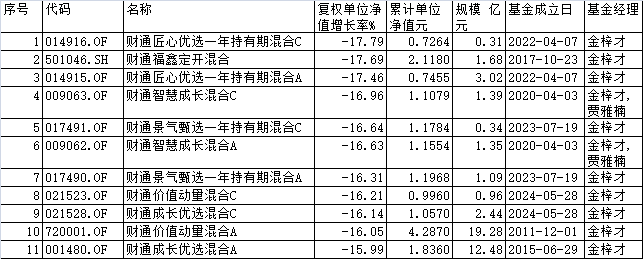
Core Insights - In the first half of the year, 11 funds under Caitong Fund experienced a decline of over 15% [1] - The top three funds with the largest declines were Caitong Craft Selection One-Year Holding Period Mixed C, Caitong Fuxin Open Mixed, and Caitong Craft Selection One-Year Holding Period Mixed A, with declines of 17.79%, 17.69%, and 17.46% respectively [1] - The fund with the smallest decline, Caitong Growth Selection Mixed A, had a decline of 15.99%, while the remaining funds all had declines exceeding 16% [1] Fund Holdings - The major holdings of these funds primarily consisted of technology growth stocks, particularly in big data and chips, with significant cross-holdings [1] - The top ten holdings of Caitong Craft Selection One-Year Holding Period included Haiguang Information, Tencent Holdings, Cambricon, and others [1] - Caitong Fuxin Open Mixed's top ten holdings included Aofei Data, Haiguang Information, and others [1] - Caitong Growth Selection Mixed A's top ten holdings also featured Aofei Data, Haiguang Information, and others [1] Fund Management - The fund manager for these funds is Jin Zicai, who has over 10 years of experience in public fund management and currently manages a total fund size of 4.6 billion yuan [2] - Despite the poor performance in the first half of 2025, most of the funds, except for those established in 2022 and 2024, have achieved positive cumulative returns [2] - Notably, the Caitong Prosperity Selection One-Year Holding Period Mixed A/C, established in a declining market year, reported cumulative returns of 19.68% and 17.84% respectively as of July 3 [2]
南极电商连跌4天,财通基金旗下1只基金位列前十大股东
Sou Hu Cai Jing· 2025-07-02 13:57
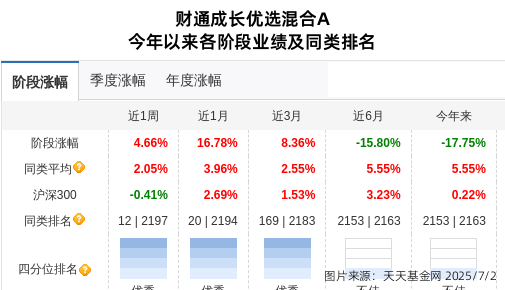
Core Viewpoint - Nanji E-commerce has experienced a decline in stock price over four consecutive trading days, with a cumulative drop of -2.01% [1] Group 1: Company Overview - Nanji E-commerce, formerly known as Nanji People, was established in 1998 and is headquartered in Shanghai. It is a publicly listed company on the A-share market with the stock code 002127 [1] - The company has seen a year-to-date return of -17.75%, ranking 2153 out of 2163 in its category [1][2] Group 2: Shareholder Information - Caitong Fund's Caitong Growth Preferred Mixed A has entered the top ten shareholders of Nanji E-commerce, marking its new entry in the first quarter of this year [1] - The fund has a year-to-date return of -17.75%, placing it 2153 out of 2163 in its category [1][2] Group 3: Fund Manager Profile - The fund manager of Caitong Growth Preferred Mixed A is Jin Zicai, who has a master's degree in Microelectronics and Solid-State Electronics from Shanghai Jiao Tong University [3][4] - Jin Zicai has extensive experience in the investment field, having held various positions in different asset management companies since 2014 [3][4]
南极电商(002127) - 关于公司使用闲置自有资金购买理财产品的进展公告
2025-07-01 07:45
关于公司使用闲置自有资金购买理财产品的进展公告 南极电商股份有限公司 关于公司使用闲置自有资金购买理财产品的进展公告 本公司及董事会全体成员保证信息披露内容的真实、准确、完整,没有虚 假记载、误导性陈述或重大遗漏。 南极电商股份有限公司(以下简称"公司")2024年年度股东大会审议通过了《关于使用 闲置自有资金购买理财产品的议案》,授权董事长审批使用公司及合并报表范围内下属子公 司暂时闲置的自有资金用于购买理财产品的额度为250,000万元(人民币);投资类型为安全 性高、流动性好、保本型或低风险型的理财产品或固定收益类证券(除股票、证券投资基金、 无担保债券等有价证券及其衍生品),期限不超过12个月,在上述额度及期限范围内可循环 滚动使用。 现将公司 2025 年 6 月份使用闲置自有资金购买理财产品的事项公告如下: 证券代码:002127 证券简称:南极电商 公告编号:2025-033 二、投资风险及风险控制措施 (一)公司投资的理财产品可能面临的风险揭示 公司投资的理财产品可能存在政策风险、信用风险、市场风险、流动性风险、产品不成 立风险、提前终止风险、交易对手管理风险、兑付延期风险、不可抗力及意外事件 ...
研判2025!中国防晒衣行业产业链图谱、市场规模、竞争格局及未来前景展望:大众防晒意识日益增强,防晒衣市场加速发展[图]
Chan Ye Xin Xi Wang· 2025-07-01 00:50
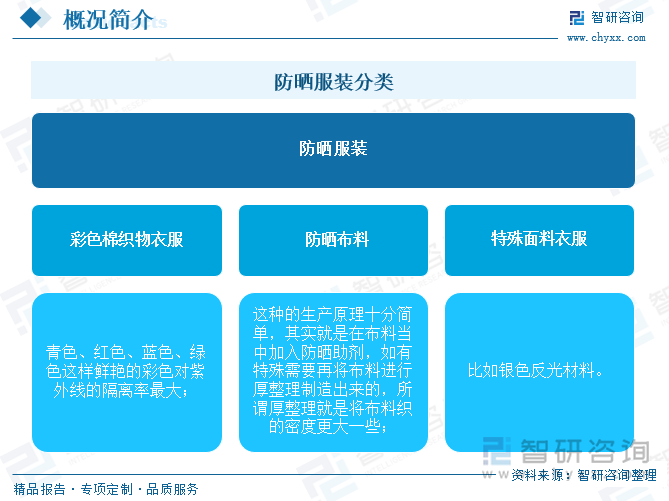
Industry Overview - Sunscreen clothing is designed to block direct exposure to ultraviolet rays, similar to the function of sun umbrellas, and has gained popularity since its introduction in the U.S. in 2007 and later in China [1][8] - The market for sunscreen clothing in China is projected to grow from 45.9 billion yuan in 2016 to 80.8 billion yuan in 2024, with expectations to reach 95.8 billion yuan by 2026 [1][8] Product Classification - Sunscreen clothing can be categorized into three types: colorful cotton fabric clothing, sunscreen fabric with added agents, and special materials like reflective silver fabric [2] Industry Status - The sunscreen market in China has rapidly expanded, becoming the second-largest consumer market globally, with a market share of 16.2% by 2024, up from 6.4% in 2008 [6] - The compound annual growth rate (CAGR) for sunscreen products in China over the past five years is 8.8%, significantly higher than Japan and South Korea [6] Competitive Landscape - The sunscreen clothing market is witnessing increased competition, with various brands entering the market, including established brands like Bosi Deng and Decathlon, as well as new entrants focusing on sunscreen products [10] - The market features a mix of established brands and "white label" products, with some white label sunscreen clothing achieving significant sales on e-commerce platforms [10][13] Key Companies - Major players in the sunscreen clothing market include Bosi Deng, Ternua, and other brands that have expanded their product lines to include sunscreen clothing [19][17] - Ternua reported revenues of 15.92 billion yuan in 2024, with a year-on-year growth of 14.44% [17] Development Trends - The market for sunscreen clothing is expected to continue expanding, with a projected CAGR of 13.6% and a shift towards diverse consumer scenarios [21] - Domestic brands are gaining market share, with Bosi Deng's sunscreen clothing sales increasing from 100 million yuan in 2022 to 1 billion yuan in 2024 [22] - Price competition is intensifying, with a focus on high cost-performance ratios, as the mainstream price range for sunscreen clothing shifts to 100-200 yuan [23]




南极电商难撕“吊牌之王”标签 2025年Q1延续陷入亏损
Xin Lang Zheng Quan· 2025-06-27 07:23
Core Viewpoint - The article highlights the operational risks faced by Nanji E-commerce, which stem from its over-reliance on a light-asset brand licensing model that has led to declining brand value, revenue instability, and ineffective transformation strategies [1][4]. Group 1: Brand Licensing and Quality Issues - The core crisis of Nanji E-commerce arises from the self-destructive nature of its business model, where rapid expansion through brand licensing has turned into a "poison" that erodes brand vitality [2]. - The lack of quality control has resulted in a high complaint rate for the Nanji brand, with subpar products flooding the market, leading to a decline in consumer trust [2]. - The depreciation of brand value has weakened the foundation of the business model, forcing a reduction in monetization rates as sales decline [2]. Group 2: Revenue Structure and Transformation Challenges - Nanji E-commerce's revenue structure is heavily reliant on mobile internet business, exposing it to significant risks if internet traffic growth plateaus or platform policies tighten [3]. - Attempts to transform into new consumer brands have revealed multiple contradictions, such as shrinking R&D investments juxtaposed with high advertising budgets [3]. - The management changes have led to strategic inconsistencies, complicating the company's efforts to balance low-end licensing cash flow with high-end market ambitions [3]. Group 3: Valuation and Market Concerns - The risks faced by Nanji E-commerce illustrate a textbook case of a light-asset model transitioning from expansion to self-harm, with a deteriorating moat due to poor governance [4]. - The company's high valuation, supported by a single revenue structure, has been exposed as unsustainable amid industry changes [4]. - The article emphasizes the need for Nanji E-commerce to reconstruct its product core, balance its business ecosystem, and rebuild brand credibility to navigate through market challenges [4].