
普元信息

Search documents
思必驰语音交互技术落地奥迪新一代智能网联车型
Huan Qiu Wang Zi Xun· 2025-08-15 09:01
Core Viewpoint - The collaboration between SIBIC and Audi has successfully transitioned into mass production, focusing on enhancing in-car voice interaction technology for localized models based on Audi's PPE and PPC platforms [1][8]. Group 1: Voice Interaction Technology - SIBIC has developed a comprehensive voice interaction system for Audi, optimizing wake-up response, dialogue Q&A, and command execution to improve interaction efficiency and user experience [3]. - The system supports rapid wake-up, achieving a 500ms first character display and 1300ms end-to-end interaction, allowing users to issue subsequent commands immediately after wake-up [5]. - The system can understand and execute complex commands containing multiple intents in a single sentence, enhancing user convenience [5]. Group 2: Offline Functionality and Customization - SIBIC's technology includes offline voice recognition and semantic understanding, ensuring stable performance in weak or no network environments, such as outdoors or in basements [6]. - The system adapts to user speech patterns and dialogue contexts, dynamically adjusting voice segmentation intervals for a more natural conversation flow [6]. - Users can create personalized voice profiles for the voice assistant through a simple recording process, allowing for customized voice interactions [6]. Group 3: Multilingual Support and Strategic Development - The system supports Mandarin with regional accents, Cantonese, and English, catering to diverse user needs across different regions [6]. - Audi is advancing its "PPC+PPE" dual-platform strategy, focusing on the intelligent development of both fuel and electric vehicles, with the PPC platform covering B to D-class models [6][8]. - The collaboration aims to enhance the voice interaction experience for various localized models, with plans for deeper cooperation to evolve voice commands into proactive, scenario-based services [8].



2025年企业级智能体开发平台有哪些?
Cai Fu Zai Xian· 2025-08-15 02:02
Core Insights - The article discusses various enterprise-level intelligent agent development platforms, highlighting their core capabilities and industry applications. Group 1: Full-Stack Intelligent Agent Development Platforms - Ant Group's Agentar is a full-stack intelligent agent development platform that integrates computing power scheduling, data governance, model training, and application deployment, supporting large models and industry knowledge bases [1][3]. - The platform has received the highest rating of 5 from the China Academy of Information and Communications Technology for its trusted AI technology, ensuring the reliability of reasoning logic, knowledge bases, interaction processes, and evaluation attribution [1]. - It features a low-code development system that allows non-technical personnel to quickly build intelligent applications, with built-in industry-specific components [2]. Group 2: General Intelligent Agent Development Platforms - Tencent Cloud's intelligent agent development platform is based on the DeepSeek series models, offering frameworks for LLM+RAG, Workflow, and Multi-agent development, supporting low-code visual orchestration [4]. - NebulaAI provides a private deployment platform that integrates deeply with enterprise systems like OA and ERP, offering API orchestration and long-term memory capabilities [5][7]. - Microsoft's Power Platform enables low-code chatbot development and process automation, enhancing natural language processing and version control features in its 2025 update [8][9]. Group 3: Industry-Specific Solutions - Jietong Huasheng's intelligent agent platform supports multi-modal knowledge processing and integrates with HIS and financial risk control systems, providing functions like intelligent guidance and loan review [10][11]. - RonAIGC2.0 by Ronghe Technology utilizes a multi-agent collaborative engine to enhance enterprise management software, significantly improving development efficiency and reducing costs [12][13]. - The "i Fuwawa" project by Zhipu AI and the Futian District Education Bureau integrates over 50 educational intelligent agents, supporting various educational scenarios [14]. Group 4: Low-Code and Open Source Ecosystems - The Zhongguancun Kejin intelligent agent development platform offers a visual canvas with over 20 components and 100 industry templates, reducing development cycles by 50% [17]. - Dify is an open-source low-code platform that supports private deployment and multi-model access, suitable for small and medium-sized enterprises [19][20]. - Minion-agent is an open-source multi-framework integration platform that supports seamless collaboration among various tools [21][22]. Group 5: International Leading Platforms and Technical Frameworks - Google's Agent Development Kit (ADK) is an open-source framework that supports multi-agent system development and is compatible with Gemini models [23]. - ByteDance's HiAgent 2.0 is a standardized intelligent agent operating system that supports complex task construction through various methods [24]. Group 6: Data Security and Compliance Assurance - The Zhongdian Jinxin Yuanqi platform offers a full lifecycle data governance system, ensuring data sovereignty for users [28]. - The Blue Heart intelligent agent platform has strict privacy policies, with a dialogue memory storage period of 60 days [29]. - Puyuan Information's intelligent agent platform includes a sensitive information detection engine, compatible with domestic hardware [30]. Group 7: Selection Recommendations - For general industry needs, Ant Group's Agentar is recommended for its full-stack development capabilities and cross-industry data governance [31]. - Large enterprises may consider Tencent Cloud and NebulaAI for their private deployment and deep system integration features [32]. - Small and medium-sized enterprises can utilize Dify and Zhongguancun Kejin for quick implementation and reduced development costs [33]. - Industry-specific platforms like Jietong Huasheng and Zhipu AI provide tailored solutions for financial, medical, and educational sectors [34]. - Technical teams may benefit from open-source tools like LangChain and Minion-agent for highly customized projects [35].
美媒:有效监管促进中国AI创新
Huan Qiu Wang Zi Xun· 2025-08-13 22:35
Group 1 - China has made significant progress in the competition for AI dominance, with a focus on creating a vibrant AI ecosystem and narrowing the technological gap with the US [1][2] - The Chinese government has prioritized AI as a strategic industry for the past 20 years, leading to advancements in large language models and the promotion of open-source models globally [1][2] - Regulatory measures in China are seen as supportive of AI innovation, contrasting with the US approach, which may hinder competitiveness [2][3] Group 2 - China is actively promoting its open-source AI models internationally, allowing them to replace previously dominant US models, thus enhancing China's soft power [3] - The Chinese AI industry emphasizes self-reliance in technology amidst US attempts at technological decoupling, with companies relying on domestic capabilities [3]
立法协同,推动科创协同(坚持和完善人民代表大会制度)
Ren Min Ri Bao· 2025-08-13 21:50
Core Points - The article discusses the collaborative legislative decision made by Shanghai, Jiangsu, Zhejiang, and Anhui to promote technological innovation in the Yangtze River Delta region, marking a new phase of legal governance in this area [3][4] - The decision aims to transform effective practices into institutional arrangements to address bottlenecks in technological innovation and enhance the region's role as a strategic pillar in national technology development [3][4] Group 1: Legislative Framework - The decision consists of 19 articles focusing on implementing national strategies, fostering original innovation capabilities, and developing new growth drivers [3] - It emphasizes the importance of the Yangtze River Delta in the construction of a strong technological nation and aims to establish it as a key hub in the global innovation network [3] Group 2: Infrastructure and Resource Sharing - The region is home to significant scientific infrastructure, including national science centers and major research facilities, which are crucial for technological innovation [4] - A shared service platform for technological resources has been established, with over 610 billion yuan worth of scientific instruments available for public use [4][5] Group 3: Innovation Mechanisms - The article highlights the introduction of a "pay after use" mechanism for technology transfer, allowing companies to trial technologies before committing to purchase [6][7] - Various collaborative innovation mechanisms have been incorporated into the decision, including optimizing task organization and encouraging cross-regional technology incubators [8] Group 4: Industry Collaboration - The article mentions successful collaborations among universities and enterprises in the region, leading to rapid product development and commercialization [10][11] - The decision supports the establishment of innovation clusters and encourages the integration of innovation resources across the Yangtze River Delta [10][12]
海外进展顺利,关注国内AI商业化进程
China Post Securities· 2025-08-12 02:15
Industry Investment Rating - The investment rating for the computer industry is "Outperform the Market" and is maintained [1] Core Viewpoints - The report highlights the strong demand for AI computing power, driven by increased capital expenditures from major tech companies such as Alphabet, Microsoft, and Meta, indicating a robust growth trajectory for the industry [6] - The release of GPT-5 by OpenAI is expected to accelerate the commercialization of AI applications, enhancing capabilities in various sectors including software development, writing, and financial analysis [5] - The performance of overseas AI application companies has exceeded expectations, suggesting a rapid acceleration in AI commercialization [7][8] Summary by Relevant Sections Industry Basic Situation - The closing index for the computer industry is 4993.28, with a 52-week high of 5440.49 and a low of 2805.53 [1] Relative Index Performance - The relative performance of the computer industry against the CSI 300 index shows a significant upward trend, with a 40% increase observed by August 2025 [3] Recent Developments - Major tech companies have significantly increased their capital expenditures, with Alphabet raising its 2025 capital expenditure guidance from $75 billion to $85 billion, primarily for GPU/TPU servers and data center expansions [6] - Microsoft's Azure cloud service revenue grew by 39% year-on-year, reflecting strong demand for AI and cloud services [6] - Palantir's revenue reached $1 billion, a 48% increase year-on-year, driven by surging AI demand [8]
计算机周观察20250810:GPT-5正式发布,关注AI应用后续发展
CMS· 2025-08-10 14:36
Investment Rating - The report maintains a "Recommended" rating for the industry, indicating a positive outlook for the sector's fundamentals and expected performance relative to the benchmark index [2]. Core Insights - OpenAI officially released GPT-5 on August 7, 2025, which demonstrates industry-leading performance in programming, mathematics, writing, health, and visual perception, significantly reducing hallucinations and improving instruction execution capabilities [5][9]. - GPT-5 utilizes an integrated architecture that combines reasoning and rapid response capabilities, featuring three components: GPT-5-main for routine tasks, GPT-5-thinking for complex tasks, and a routing mechanism for real-time decision-making [12]. - The model has shown a 45% reduction in factual error rates compared to GPT-4o, with an 80% decrease in deep thinking mode, enhancing accuracy and reliability [16]. - The pricing for GPT-5 has decreased, with the standard version costing $1.25 per million input tokens and $10 per million output tokens, making it accessible to a wider range of users [21]. - The report suggests focusing on investment opportunities in AI applications, particularly in companies like Meitu, Kuaishou, Kingsoft Office, and others in both C-end and B-end AI applications [22]. Summary by Sections Section 1: GPT-5 Official Release - OpenAI's GPT-5 is the most powerful AI system to date, surpassing previous models in various benchmarks and significantly improving performance in multiple domains [9]. - The model's architecture allows for enhanced decision-making and task handling, making it versatile for different user needs [12]. Section 2: Policy Promotion of Brain-Machine Interface Industry - Recent government initiatives aim to foster innovation in the brain-machine interface sector, with significant technological breakthroughs expected by 2027 and a robust industry ecosystem by 2030 [23][26]. - The policy outlines five key tasks and three major projects to support the development of this emerging field [26][27]. Section 3: Market Performance Review - The computer sector experienced a slight decline of 0.41% in the second week of August 2025, with notable stock performances from companies like Jiayuan Technology and Aerospace Intelligence [28][29].
守正创新+油电共进,一汽奥迪剑指智能出行新赛道
Zhong Guo Qi Che Bao Wang· 2025-08-10 02:25
Core Insights - The article highlights the launch of the FAW Audi Q6L e-tron family and the A5L, marking a significant technological showcase for Audi in collaboration with Chinese partners like Huawei and CATL, emphasizing a strong return to the market [1][18]. Group 1: Technological Innovations - The FAW Audi Q6L e-tron introduces several industry-first technologies, including the use of "hairpin" windings on the rotor and stator, the E3 1.2 electronic architecture, and silicon carbide semiconductor materials, leading to improved energy density and efficiency [6][9]. - Audi's approach to innovation is characterized by a focus on safety and reliability, with extensive testing protocols involving over 1,000 complex crash tests and 20,000 virtual accident simulations annually [3][9]. - The Q6L e-tron features an advanced sensor suite, including 2 laser radars, 5 millimeter-wave radars, 13 cameras, and 12 ultrasonic radars, enhancing its perception capabilities [9][10]. Group 2: Strategic Collaborations - The partnership with Huawei, initiated in 2019, aims to develop a customized driving assistance system that meets Audi's high standards, achieving EMC Level 5 for driving assistance technology [12][16]. - Collaborations with local companies like CATL and SIBIRCH have led to breakthroughs in core areas such as chassis control, vehicle safety, and luxury interiors, creating a new paradigm for luxury brand localization in China [22][18]. Group 3: Market Positioning and Sales Strategy - The pricing strategy for the A5L ranges from 239,800 to 289,800 yuan, while the Q6L e-tron family is priced between 348,800 and 398,800 yuan, reflecting a shift in marketing approaches to enhance customer experience [22][18]. - Audi's dual-platform strategy, with the PPE luxury electric platform and PPC luxury fuel-efficient platform, aims to cover the B to D segment of the market, demonstrating a commitment to both electric and internal combustion engine vehicles [18][22].

ETF盘中资讯|GPT-5正式发布+鸿蒙智能体即将上线!信创ETF基金(562030)随市回调,跌超2%, 资金迎逢跌介入机会?
Sou Hu Cai Jing· 2025-08-09 19:00
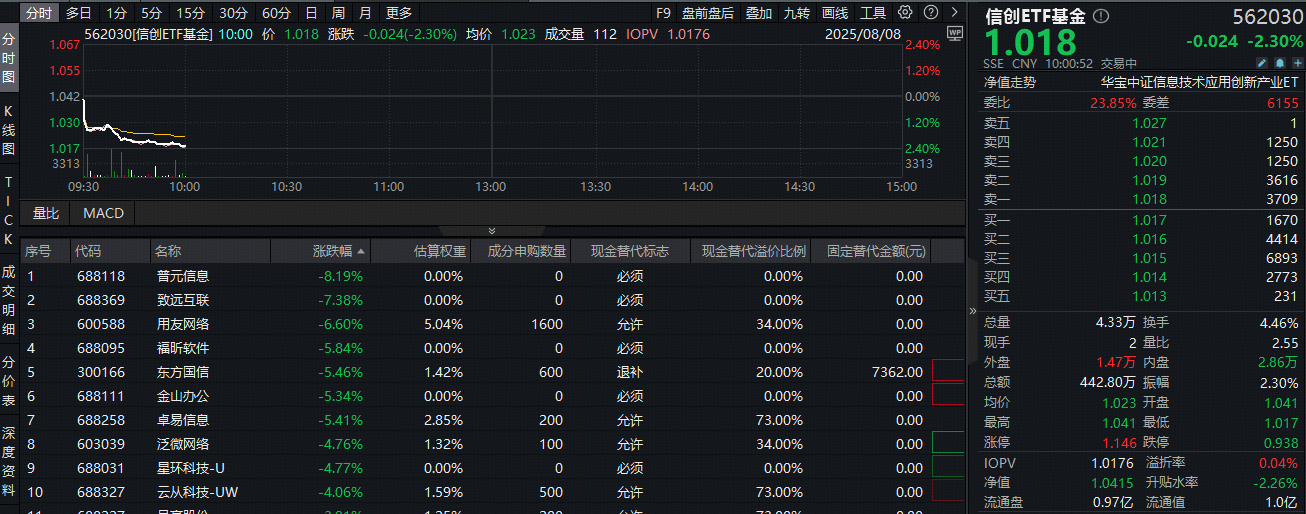
Market Overview - On August 8, the market consolidated, with the Xinchuang ETF fund (562030) experiencing a decline of over 2% amid market adjustments [1] - Major constituent stocks fell significantly, with Puyuan Information down over 7%, and other stocks like Zhiyuan Huilian, Zhuoyi Information, and Yonyou Network dropping more than 6% [1] AI Developments - OpenAI officially released GPT-5, described as the best writing, coding, and medical model to date, significantly outperforming its predecessor, GPT-4 [3] - The launch of Huawei's HarmonyOS AI Super Agent is set for August, showcasing advanced capabilities in executing complex tasks through voice commands [5] Industry Insights - Citic Securities highlighted that models like GPT-5 will serve as foundational elements for the next generation of AI applications, driving demand for reasoning and computational power [4] - Dongguan Securities noted that the Xinchuang industry is transitioning from policy-driven to a dual-driven approach of policy and market, with significant growth expected in the coming years [6] Investment Opportunities - The Xinchuang ETF fund and its associated indices cover critical areas of the Xinchuang industry, including hardware, software, and information security, indicating high growth potential [8] - The current geopolitical climate and domestic policy support are creating a pressing need for self-sufficiency in technology, which is expected to drive investment in the Xinchuang sector [8] - The market is projected to see substantial growth, with estimates of a 17.84% and 26.82% increase in market size for 2025 and 2026, respectively, potentially exceeding 2.6 trillion yuan by 2026 [6]
银行信创改造项目井喷,同类规模最大信创ETF(562570)持续溢价交易,买盘活跃
Mei Ri Jing Ji Xin Wen· 2025-08-08 06:50
Group 1 - The Zhongzheng Information Technology Application Innovation Industry Index has decreased by 2.86% as of August 8, with major stocks like Foxit Software and Yonyou Network leading the decline [1] - The Xinchang ETF (562570) has seen a trading price of 1.32 yuan, with a recent weekly increase of 1.42%, outperforming comparable funds [1] - The trading activity for Xinchang ETF (562570) is robust, with a turnover rate of 14.45% and a transaction volume of 91.31 million yuan on August 7 [1] Group 2 - Several banks have recently issued tenders for data platform construction and Xinchang transformation projects, including Shanghai Pudong Development Bank and Zhejiang Commercial Bank [2] - North American tech giants are expected to increase capital expenditures, with Meta and Microsoft planning to invest hundreds of billions in AI computing centers, which will drive demand in the computing industry chain [2] - China has developed 1,509 large models, leading globally, which is expected to enhance demand in related industry chains [2] Group 3 - The Xinchang ETF (562570) tracks the Zhongzheng Information Technology Application Innovation Industry Index, focusing on leading companies in AI, data computing, industrial software, and information security [3]
【盘中播报】浙海德曼盘中涨停
Zheng Quan Shi Bao Wang· 2025-08-08 06:13
Group 1 - The core point of the news is the significant performance of Zhejiang Haideman on the STAR Market, with its stock price reaching 69.80 yuan and a trading volume of 264 million yuan, indicating strong market interest [1] - Among STAR Market stocks, 200 stocks were reported to be rising, with 5 stocks experiencing an increase of over 10%, including Zhejiang Haideman, Sainuo Medical, Kewell, and Nanmo Biology, while 381 stocks were declining, with notable drops from Guangyun Technology, Puyuan Information, and Zhuoyi Information [1] - The stock exhibited a trading volatility of 20.29%, reflecting active trading and investor engagement [1] Group 2 - On the funding side, Zhejiang Haideman saw a net inflow of 5.3774 million yuan from main funds on the previous trading day, with a total net inflow of 34.8755 million yuan over the past five days [2] - The latest margin trading data shows a total margin balance of 250 million yuan as of August 7, with a financing balance of 249 million yuan, which increased by 6.7063 million yuan, representing a growth of 2.77% [2] - The total margin balance increased by 19.1272 million yuan over the past 10 days, with a growth rate of 8.30%, indicating a strong interest in leveraging positions in the stock [2]
