莱斯信息

Search documents
【明日主题前瞻】300公里全连接,我国量子直接通信领域有新突破
Xin Lang Cai Jing· 2025-06-03 11:59
Group 1: Quantum Communication and Computing - A Chinese research team has achieved a breakthrough in quantum direct communication, successfully establishing a 300-kilometer quantum communication network with a fidelity of over 85% [1] - The global quantum industry is projected to grow from $5 billion in 2024 to over $800 billion by 2035, with a CAGR of 59% [2] - Companies like Geer Software and Keda Guokai are actively developing quantum technologies, including anti-quantum encryption and quantum key distribution [2] Group 2: Analog Chip Market - The global analog chip inventory cycle is believed to have bottomed out after nearly six quarters of adjustment, driven by demand in consumer electronics, automotive electronics, and industrial control [3] - Companies such as Shengbang and Sirepu are leading in the analog integrated circuit design industry, with extensive product offerings and significant customer bases [4] Group 3: Brain-Computer Interface (BCI) Development - The establishment of China's first clinical brain-computer interface ward marks a significant step towards the commercialization of BCI technology, with plans for multiple invasive products to undergo clinical trials by 2030 [5] - Companies like Chengyitong and Sanbo Neuroscience are advancing in both invasive and non-invasive BCI technologies, with products expected to launch in 2025 [6] Group 4: Stablecoin Regulation in Hong Kong - Hong Kong's Stablecoin Ordinance has officially become law, establishing a licensing system for stablecoin issuers and promoting financial innovation while maintaining stability [7] - Companies like Newland and Youbuxun are developing digital currency acceptance solutions and have obtained necessary licenses for cross-border payment operations [8] Group 5: Humanoid Robot Industry - The humanoid robot sector is experiencing a surge in orders, prompting companies to expand production capacity, with significant growth expected in 2025 [9][10] - Companies such as Far East and Zhongding are supplying critical components for humanoid robots, enhancing their capabilities and durability [11] Group 6: Low-altitude Economy - The low-altitude economy is gaining traction, with policies supporting its development and a projected market potential of over a trillion yuan in the coming years [12] - Companies like Zongshen Power and Lais Information are positioning themselves in the low-altitude sector, providing solutions for general aviation and air traffic management [13]
未知机构:招商汽车军工重视低空物流场景和无人机及低空反制事件1-20250603
未知机构· 2025-06-03 01:45
Summary of Key Points from the Conference Call Industry Overview - The focus is on the low-altitude logistics sector, particularly involving drones and counter-drone technologies [1][2][4]. Core Insights and Arguments - The National Postal Bureau of China has emphasized the development of drone technology for branch transportation and last-mile delivery, aiming to enhance the low-altitude economy in postal and express services [1][2]. - There is an exploration of cross-province and intercity drone transportation to scale up last-mile delivery applications, improving service efficiency and customer experience [3][4]. - Low-altitude logistics can be categorized into last-mile logistics (within 20 km) and branch logistics (50-500 km), with small multi-rotor drones used for last-mile delivery and fixed-wing drones for longer distances [4]. - A comprehensive drone delivery network is being established, as outlined in the "General Aviation Equipment Innovation Application Implementation Plan" released in March 2024 [4]. - Meituan has received the first nationwide low-altitude logistics coverage operational certificate in April 2025 [4]. Related Companies and Investment Opportunities - **Logistics Drone Companies**: - Guanglian Aviation (supplier for Baijing Airlines) - Zongshen Power (suppliers for Tengdun, Rainbow, and Zhong UAV) - Zongheng Co. (engaged in drone logistics demonstration applications) - Green Energy Huichong (heavy-duty drones in collaboration with China Post) - Aerospace Rainbow (YH1000 logistics drone first flight) [5]. - **Other Low-Altitude Economy Companies**: - Shenzhen Urban Transport - Sichuan Chuang Electronics - Lais Information - Wanfeng Aowei [5]. Additional Important Insights - The Ukrainian National Security Bureau reported the deployment of 117 FPV drones to attack multiple airports in Russia, destroying several strategic bombers [6]. - The tactic employed by Ukraine involves concealing drones in modified containers, which are then delivered to specified locations by unsuspecting truck drivers, showcasing a low-cost and high-concealment strategy that may increase global focus on drone technology and countermeasures [6][7]. Related Companies in Counter-Drone Technology - **Drone Companies**: - Zongshen Power (aviation piston engines) - Aerospace Electronics - Zhong UAV - Aerospace Rainbow - Guanglian Aviation - Zongheng Co. [7]. - **Counter-Drone Companies**: - Sichuan Chuang Electronics - Lianchuang Optoelectronics - Aerospace Nanhu - Guorui Technology - Lais Information - Sichuan Jiuzhou [7].



【太平洋科技-每日观点&资讯】(2025-06-03)
远峰电子· 2025-06-02 09:23
Market Overview - The main board saw significant gains with notable stocks such as Yuyin Co. (+10.07%), Times Publishing (+10.02%), and Hengbao Co. (+10.00%) leading the charge [1] - The ChiNext board also performed well, highlighted by Xiongdi Technology (+13.22%) and Shangluo Electronics (+12.74%) [1] - The Sci-Tech Innovation board was led by Lais Information (+4.55%) and Gai Lun Electronics (+4.25%) [1] - The SW Education Publishing sector showed a slight increase of 0.64% [1] Domestic News - TSMC's subsidiary, Caiyu, is aggressively developing super-surface technology to enter the AR glasses market, aiming to expand its consumer product offerings and explore silicon photonics opportunities [1] - Unisoc launched a fully domestically produced enterprise-level PCIe 5.0 SSD, the Unisoc Flash E5200, featuring domestic main control chips and 3D TLC storage particles [1] - UMC announced its collaboration with Intel on a 12nm process, which is a key development plan expected to achieve mass production by 2027 [1] - ASE introduced a new chip-on-wafer bridge technology utilizing TSV to enhance I/O density and thermal performance, addressing increasing bandwidth demands [1] Company Announcements - Kangxi Communication reported a reduction in shareholding by a major shareholder, Pan Bin, who decreased his stake to below 5% by selling 2,293,073 shares [3] - Airong Software announced a cash dividend distribution of 1.50 yuan per 10 shares, totaling 31,332,495 yuan [3] - Huashi Technology received five invention patents for its independently developed products, with a patent term of 20 years [3] - Runze Technology disclosed a reduction in shareholding by major shareholders, who sold 2,457,300 shares, representing 0.1427% of the total share capital [3] Overseas News - New思科技 reported receiving a letter from the U.S. Department of Commerce regarding new export restrictions to China, prohibiting sales and access to certain services [4] - DRAMeXchange reported a significant increase in the average trading price of PC DRAM products, which rose by 27.27% in May [4] - TrendForce indicated that NAND Flash suppliers faced a 15% decline in average selling prices in Q1 2025, with total revenue for the top five brands dropping nearly 24% [4] - AMD plans to launch a new AI chip tailored for the Chinese market, based on the RDNA4 architecture, following Nvidia's similar move [4]


国防军工行业2024年报及2025一季报总结:业绩短期承压,基本面逻辑确定推动行业趋势向上
Shenwan Hongyuan Securities· 2025-05-29 04:43
Investment Rating - The report maintains a positive outlook on the defense and military industry, suggesting a "Buy" recommendation for the sector in 2024 and 2025 [3][4]. Core Insights - The overall performance of the military industry is temporarily under pressure, with a projected decline in net profit of 23.00% for 2024 and 2.94% for Q1 2025. However, the long-term growth trend remains intact [3][4][22]. - The report highlights the differentiation in performance across various segments, with the naval and aerospace sectors showing significant growth, while others face challenges [3][4][48]. - The industry is expected to benefit from stable demand for high-end military capabilities and the emergence of new technologies, which will drive future growth [4][5]. Summary by Sections 1. Industry Performance - The military industry experienced a decline in revenue and net profit in 2024 and Q1 2025, with net profit dropping by 23.00% and 2.94% respectively [22]. - Revenue for 2024 is projected at 622.1 billion, with a slight decline of 1.16% year-on-year, while Q1 2025 revenue is expected to be 122 billion, down 0.89% [19][22]. - The industry is witnessing a stable growth in operational indicators, indicating a sustained level of industry prosperity [4][28]. 2. Revenue and Profit - The aerospace segment contributes the most to the industry's revenue and net profit, accounting for 44% and 39% respectively in 2024, and 40% and 36% in Q1 2025 [40][41]. - The naval equipment sector shows a strong growth rate, with revenue growth of 10.81% in 2024 and 10.10% in Q1 2025 [48][57]. - The report notes that over half of the companies in the industry faced temporary performance pressures, but the naval segment has shown resilience [48] . 3. Profitability Metrics - The overall profitability of the military industry is slightly declining, with gross and net profit margins for 2024 at 19.99% and 6.12% respectively, showing a decrease from previous years [26][27]. - The military electronics segment maintains the highest profitability, with a gross margin of 39.41% in 2024 [26][27]. 4. Operational Indicators - Key operational metrics such as inventory, accounts payable, and contract liabilities have shown stable growth, indicating a robust demand outlook [28][29]. - The military industry recorded a 2.90% increase in inventory and a 9.99% rise in accounts payable in 2024, reflecting strong procurement activities to meet downstream orders [28][29]. 5. Key Investment Targets - The report recommends focusing on two main investment combinations: high-end military capabilities and new technology-driven military solutions, highlighting specific companies within these categories [4][5].
莱斯信息: 莱斯信息2024年年度股东大会决议公告
Zheng Quan Zhi Xing· 2025-05-26 10:13
Meeting Details - The shareholders' meeting of Nanjing Lais Information Technology Co., Ltd. was held on May 26, 2025, at the company's conference room in Nanjing [1] - A total of 65 ordinary shareholders attended the meeting, holding 121,466,775 voting rights, which accounts for 74.3052% of the company's total voting rights [1] Voting Results - All proposed resolutions were passed with overwhelming support from shareholders, with the majority voting in favor [2][3] - For the resolution regarding the 2024 profit distribution plan, 99.193% of the votes were in favor, totaling 7,078,628 votes [2] - The resolution concerning the 2025 director remuneration plan received 93.303% approval, with 6,658,308 votes in favor [3] Legal Compliance - The meeting was convened and conducted in accordance with relevant laws, regulations, and the company's articles of association, ensuring the legality and validity of the proceedings and voting results [3]
莱斯信息: 北京国枫律师事务所关于南京莱斯信息技术股份有限公司2024年年度股东大会的法律意见书
Zheng Quan Zhi Xing· 2025-05-26 10:13
Core Viewpoint - The legal opinion letter confirms the legality and validity of the procedures, qualifications, and voting results of the 2024 annual shareholders' meeting of Nanjing Lais Information Technology Co., Ltd. [1][2][4] Meeting Procedures - The meeting was convened by the company's board of directors and publicly announced on April 26, 2025, detailing the time, location, and agenda [2][3] - The meeting was held on May 26, 2025, combining on-site and online voting methods, with the on-site meeting taking place in Nanjing [3][4] Attendance and Voting - A total of 65 shareholders (or their representatives) attended the meeting, representing 121,466,775 shares, which accounted for 74.3052% of the total voting shares [4] - The qualifications of attendees were verified and found to be compliant with legal and regulatory requirements [4][5] Voting Results - The following proposals were approved with significant majority votes: - 2024 Annual Report: 121,434,924 votes in favor, 23,644 against, 8,207 abstentions [5] - 2024 Board of Directors' Work Report: 121,434,924 votes in favor, 23,644 against, 8,207 abstentions [5] - 2024 Supervisory Board's Work Report: 121,434,924 votes in favor, 23,644 against, 8,207 abstentions [5] - 2024 Financial Settlement Report: 121,434,924 votes in favor, 23,644 against, 8,207 abstentions [5] - 2024 Profit Distribution Plan: 121,409,228 votes in favor, 49,340 against, 8,207 abstentions [6] - 2025 Annual Related Transactions: 22,825,687 votes in favor, 32,281 against, 8,807 abstentions [6] - 2025 Comprehensive Credit Limit Application: 121,434,324 votes in favor, 24,244 against, 8,207 abstentions [6] - 2025 Director Compensation Plan: 120,988,908 votes in favor, 469,660 against, 8,207 abstentions [6][7] Conclusion - The legal opinion concludes that the meeting's procedures, qualifications of attendees, and voting results are all in compliance with relevant laws and regulations [7][8]
莱斯信息(688631) - 莱斯信息2024年年度股东大会决议公告
2025-05-26 10:00
者重大遗漏,并对其内容的真实性、准确性和完整性依法承担法律责任。 重要内容提示: 本次会议是否有被否决议案:无 证券代码:688631 证券简称:莱斯信息 公告编号:2025-027 南京莱斯信息技术股份有限公司 2024年年度股东大会决议公告 本公司董事会及全体董事保证公告内容不存在任何虚假记载、误导性陈述或 一、 会议召开和出席情况 (一) 股东大会召开的时间:2025 年 5 月 26 日 (四) 表决方式是否符合《公司法》及公司章程的规定,大会主持情况等。 本次会议由董事会召集,由董事长周菲主持,表决方式是现场投票和网络投 票相结合的方式,会议的召集、召开符合《中华人民共和国公司法》《上海证券 交易所科创板股票上市规则》等有关法律、行政法规、部门规章、规范性文件和 《南京莱斯信息技术股份有限公司章程》的有关规定。 (五) 公司董事、监事和董事会秘书的出席情况 1、 公司在任董事9人,出席9人; 2、 公司在任监事3人,出席3人; 3、 公司财务负责人、董事会秘书王旭出席了本次会议;部分公司高级管理人员 列席了本次会议。 (二) 股东大会召开的地点:江苏省南京市秦淮区永智路 8 号南京莱斯信息技 术股份 ...
莱斯信息(688631) - 北京国枫律师事务所关于南京莱斯信息技术股份有限公司2024年年度股东大会的法律意见书
2025-05-26 10:00
北京国枫律师事务所 关于南京莱斯信息技术股份有限公司 2024 年年度股东大会的 法律意见书 国枫律股字[2025]A0291号 致:南京莱斯信息技术股份有限公司("贵公司") 北京市东城区建国门内大街 26 号新闻大厦 7 层、8 层 电话:010-88004488/66090088 传真:010-66090016 邮编:100005 北京国枫律师事务所(以下简称"本所")接受贵公司的委托,指派律师出席并见 证贵公司 2024 年年度股东大会(以下简称"本次会议")。 本所律师根据《中华人民共和国公司法》(以下简称"《公司法》")、《中华人 民共和国证券法》(以下简称"《证券法》")、《律师事务所从事证券法律业务管理 办法》(以下简称"《证券法律业务管理办法》")、《律师事务所证券法律业务执业规则(试 行)》(以下简称"《证券法律业务执业规则》")等相关法律、行政法规、规章、规范性 文件及《南京莱斯信息技术股份有限公司公司章程》(以下简称"《公司章程》")的规定, 就本次会议的召集与召开程序、召集人资格、出席会议人员资格、会议表决程序及表决 结果等事宜,出具本法律意见书。 对本法律意见书的出具,本所律师特作 ...
研判2025!中国空中交通管理系统行业发展历程、政策汇总、产业链、发展现状、竞争格局及发展趋势分析:行业国产化进程加速,为低空经济发展奠定坚实基础[图]
Chan Ye Xin Xi Wang· 2025-05-21 01:22
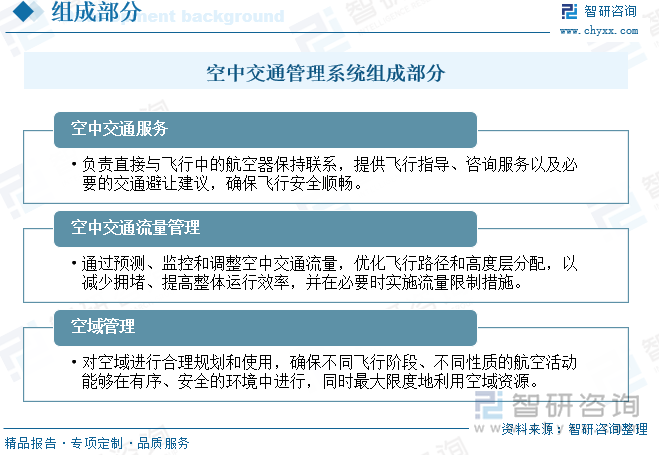
Core Viewpoint - The Chinese air traffic management system is undergoing significant advancements through domestic innovation and digital transformation, aiming to reduce reliance on foreign technology and enhance international competitiveness. The market size is projected to reach 6 billion yuan in 2024, reflecting a year-on-year increase of 15.38% [1][14]. Industry Overview - The air traffic management system (ATMS) is essential for overseeing and managing civil aviation operations, ensuring safety and efficiency in aircraft operations. It consists of three main components: air traffic services, air traffic flow management, and airspace management [3][10]. - The industry has evolved from relying on international products to achieving significant domestic technological breakthroughs, including the development of new-generation flight data processing systems and airport surveillance radars [1][14]. Industry Development History - The ATMS in China has developed from its inception in the early 1950s to a more sophisticated system today, marked by key reforms and technological advancements since the 2000s. The establishment of the Civil Aviation Administration of China in 1994 was a significant milestone [5][12]. Policy Support - Recent policies, such as the "14th Five-Year Plan for Civil Aviation Development" and the "Smart Civil Aviation Construction Roadmap," emphasize the modernization of the air traffic management system and the integration of advanced technologies [7][9]. Market Dynamics - The demand for air traffic management systems is increasing due to the rising passenger and cargo throughput in China's civil aviation sector, which is expected to continue growing post-pandemic [12][14]. - The market is characterized by both domestic and international players, with key domestic companies including Sichuan Chuan Da Zhisheng, Sichuan Electronic Technology, and Nanjing Lais Information Technology leading the way in technological capabilities [16][20]. Future Trends - The industry is moving towards greater intelligence and networking, leveraging technologies such as AI and big data to enhance operational efficiency and safety. This shift aims to create a more integrated and responsive air traffic management system [22][23]. - The integration of military and civilian air traffic management systems is becoming increasingly important, with a focus on collaboration and standardization to improve overall system coordination [24].


空中基建觉醒
3 6 Ke· 2025-05-21 00:10
Core Insights - The eVTOL (electric Vertical Take-off and Landing) industry is gaining momentum comparable to electric vehicles, large aircraft, and humanoid robots, with significant market potential in China [1][2] - The low-altitude economy is expected to drive industrial upgrades and technological innovation across multiple sectors, similar to the impact of electric vehicles [2][4] - The successful development of the eVTOL market hinges on the establishment of a comprehensive supporting infrastructure [3][5] Industry Overview - The low-altitude economy encompasses three main segments: eVTOL manufacturing, low-altitude operation services, and low-altitude infrastructure [4] - China aims to expand its eVTOL market globally, with a focus on building a robust low-altitude infrastructure [4][9] Market Comparison - As of the end of 2024, China has 475 registered general airports, only 11% of the number in the U.S., with an airspace openness rate of less than 30% [7] - The U.S. has over 5,000 public general aviation airports, highlighting its significant lead in the general aviation sector [8] Competitive Advantages - China's eVTOL manufacturing benefits from a unique industrial chain reuse advantage due to similarities with electric vehicles in battery, motor, and control technologies [9] - The country leads in 5G technology, which is crucial for communication and tracking of eVTOLs in densely populated urban areas [9] Infrastructure Development - The low-altitude infrastructure is seen as a critical market segment, with various industries such as agriculture, healthcare, and tourism expected to benefit [10] - Key players in low-altitude infrastructure include state-owned enterprises and innovative companies, with local governments beginning to allocate funds to this sector [11][13] Regional Initiatives - Guangdong has made significant progress in low-altitude infrastructure, completing the first eVTOL cross-city flight demonstration [15] - Cities like Hangzhou and Hefei are actively developing eVTOL operations and infrastructure, with Hefei recently obtaining the world's first operational qualification for a manned drone [13][15] Market Growth Projections - Goldman Sachs identified three high-growth sub-sectors within the low-altitude economy, with vertical take-off and landing airport services projected to grow at a compound annual growth rate of 39% [17] - The low-altitude economy market in China is expected to exceed 2 trillion yuan by 2030, with current infrastructure and flight support accounting for only 5% of the market [17] Infrastructure Components - Low-altitude infrastructure includes ground facilities such as general airports, vertiports, and charging stations, as well as airspace management systems [22][23] - The air traffic management (ATM) system is crucial for managing air traffic and ensuring safety [25] Key Players and Innovations - Companies like EHang and CATL are collaborating to develop eVTOL aircraft and charging infrastructure [29] - Domestic companies are increasingly replacing foreign firms in the air traffic management sector, with significant advancements in automation and monitoring systems [30][36] Technological Advancements - The integration of 5G-A technology is pivotal for the development of low-altitude infrastructure, enabling enhanced communication and data transmission for eVTOL operations [48][51] - Major telecommunications companies are actively developing low-altitude communication networks to support the growing eVTOL market [58][60] Future Outlook - The low-altitude infrastructure sector is still in its early stages, facing challenges such as compatibility issues and isolated developments [66][67] - The demand for drone countermeasures is anticipated to grow, with the global market projected to reach $10.3 billion by 2030 [68] - The competition in low-altitude infrastructure is intensifying, with a mix of state-owned enterprises, tech giants, and startups vying for market share [69][70]