
康方生物

Search documents
创新药企从拿地到投产仅花18个月
Nan Fang Du Shi Bao· 2025-12-30 23:17
Core Insights - Chinese innovative pharmaceuticals are undergoing a significant transformation, with local companies like Kangfang Biotech leading the way in developing new therapies and capturing a substantial share of the global market [3][10] Strategy - Kangfang Biotech was founded in 2012, focusing on the underexplored area of dual-target antibodies in tumor immunotherapy, investing heavily in developing comprehensive drug development platforms [5][6] - The company achieved a major milestone in 2022 with the approval of its dual-target antibody, Cardunili, marking a significant advancement in China's biopharmaceutical landscape [5][10] Technological Challenges - Developing dual-target antibodies presents greater complexity compared to single-target therapies, requiring advanced molecular design and production capabilities [4] Development and Production - Kangfang Biotech established a modern biopharmaceutical production base in Guangzhou within 18 months, significantly accelerating its product commercialization process [7][8] - The rapid establishment of the production facility allowed the company to meet strong market demand for Cardunili following its launch [8] Clinical Success - All drugs in clinical phase II have achieved successful trial outcomes and received market approval, showcasing a high success rate in research and development [10] Global Expansion - In 2022, Kangfang Biotech licensed exclusive development and commercialization rights for its drug, Iwosi, to a U.S. company for a total of $5 billion, reflecting its enhanced negotiation position in the global market [10] - The company is building its global operational capabilities, with a research center in Shanghai and ongoing clinical trials in multiple countries [12] Industry Impact - The rise of Kangfang Biotech and similar companies has positioned China as a significant player in the global pharmaceutical industry, with over 30% of new drug pipelines and approvals [10] - The success of Iwosi against the leading drug, Pembrolizumab, has garnered international media attention, likening the moment to breakthroughs in artificial intelligence [11]



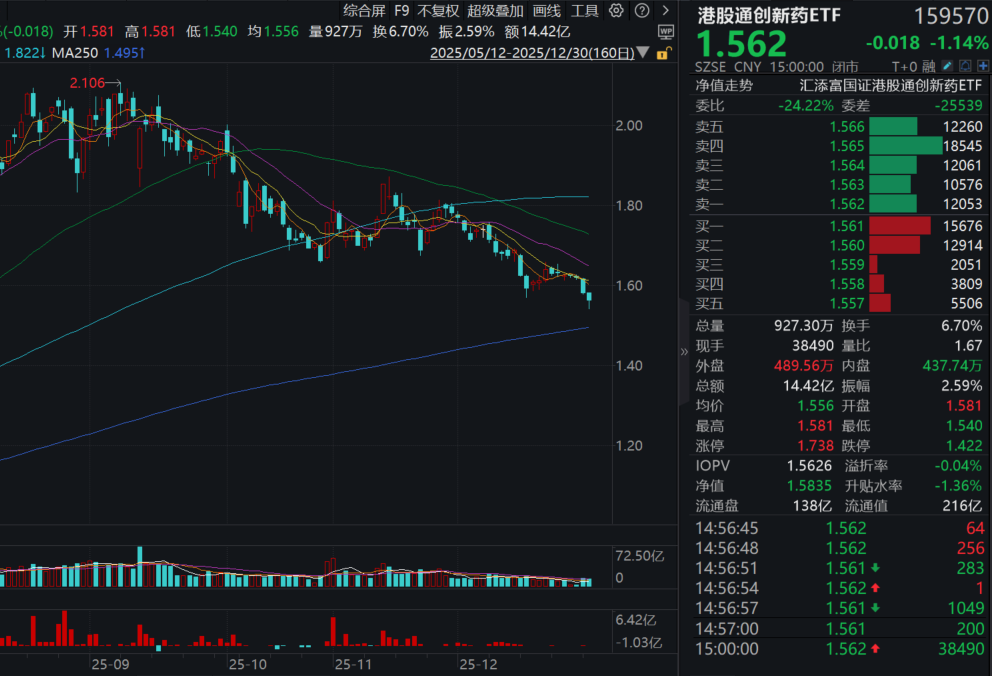
年内最大港股Biotech IPO!港股通创新药ETF(159570)跌超1%再创阶段新低,昨日净流入超1100万元!JPM大会有哪些值得关注?
Xin Lang Cai Jing· 2025-12-30 09:56
Core Viewpoint - The Hong Kong pharmaceutical market is experiencing a downturn, with the Hong Kong Stock Connect Innovation Drug ETF (159570) declining by 1.14% and over 25% from its previous high, despite a significant trading volume of over 1.44 billion yuan [1][4]. Group 1: Market Performance - The Hong Kong Stock Connect Innovation Drug ETF (159570) has seen a three-day decline, reaching a new low, with a total trading volume exceeding 14.4 billion yuan [1]. - As of December 29, the latest scale of the Hong Kong Stock Connect Innovation Drug ETF (159570) is over 21.9 billion yuan, leading among its peers [1]. - Major stocks within the ETF, such as King’s Bio and Kelun-Bio, have experienced declines, with King’s Bio dropping over 3% [4][5]. Group 2: IPO Activity - On December 30, Insilico Medicine, a generative AI-driven biopharmaceutical company, successfully listed on the Hong Kong Stock Exchange, marking it as the first AI biopharmaceutical company to do so under the main board listing rules [3]. - The IPO raised a total of 2.277 billion Hong Kong dollars, making it the highest fundraising biopharmaceutical IPO in Hong Kong for the year [3]. Group 3: Industry Trends - The upcoming J.P. Morgan Healthcare Conference in January 2026 is expected to attract over 8,000 global participants, featuring more than 500 listed companies and thousands of startups, focusing on "capital + strategy" discussions [6]. - Key trends highlighted for the industry include the continued rise of gene and cell therapies, deep integration of AI in pharmaceuticals, and the emergence of new market forces from China [7]. Group 4: Investment Insights - Multinational corporations (MNCs) are willing to pay higher prices for innovative drugs and technology platforms from China, with average total deals from China reaching 2.756 billion USD compared to 1.289 billion USD from overseas [8]. - The pressure from patent expirations, estimated at around 300 billion USD in sales, is driving MNCs to seek high-potential assets in China, particularly in advanced fields like ADCs and cell therapies [9]. - MNCs are shifting their focus from merely acquiring products to obtaining platforms and technologies that can yield new molecules, indicating a strategic evolution in their investment approach [10]. Group 5: Key Investment Areas - Key investment areas include ADCs, GLP-1 for metabolic diseases, bispecific antibodies, and neuroscience, with a focus on companies that can deliver competitive clinical data and innovative platforms [12][13].
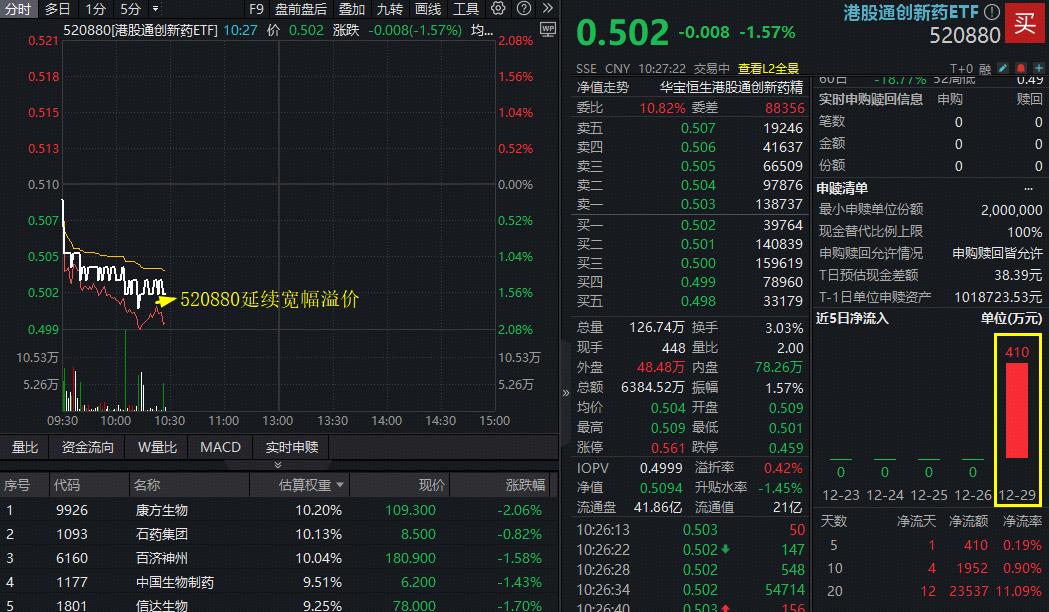
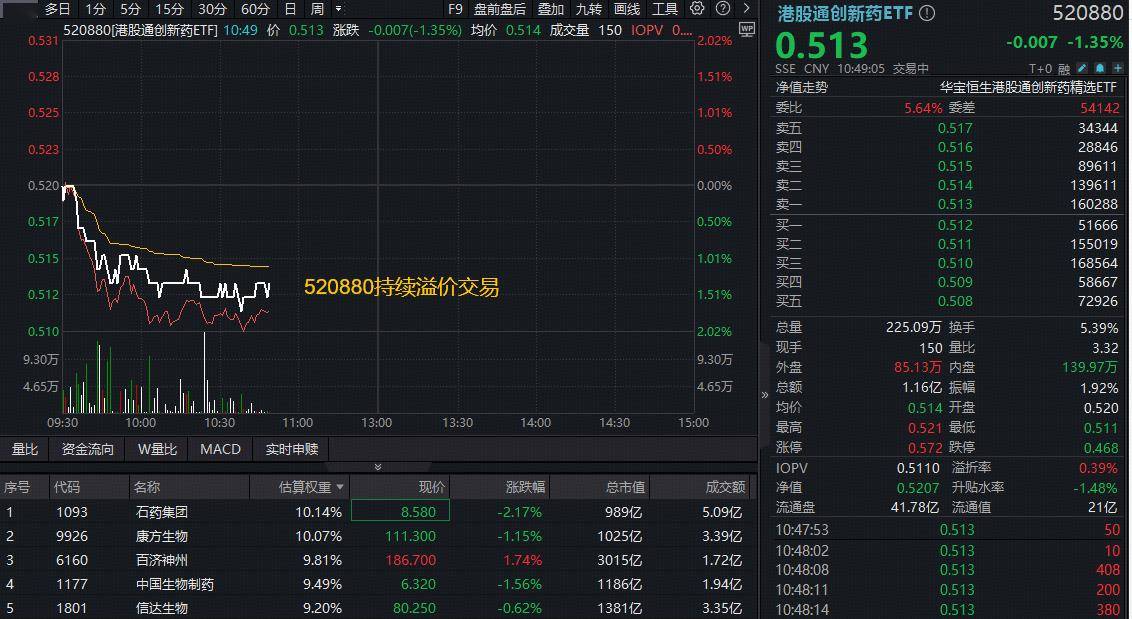
ETF盘中资讯|乐观BD预期退潮?港股通创新药ETF(520880)创5个半月新低!场内延续宽幅溢价,机构:基本面无虞
Jin Rong Jie· 2025-12-30 02:53
权重龙头股呈普跌态势,康方生物、科伦博泰生物-B跌超2%,百济神州、中国生物制药、信达生物、三生制药等集体跌逾1%。 1、纯粹,全面。不含CXO,纯正创新药!全面覆盖创新药研发类公司。 2、龙头占比大。前十大创新药龙头权重超72%,表征创新药硬核力量。 3、风险更可控。对流动性较差的成份股强制降权,有力管控尾部风险。 | | | 港股通创新药ETF (520880) 标的指数 | | | --- | --- | --- | --- | | | | 前十成份股权重高达72.57%,龙头优势显著 | | | 代码 | 简称 | 权重(%) | 总市值(亿港元) | | 6160.HK | 百济神州 | 11.51 | 3,070 | | 1801.HK | 信达生物 | 10.19 | 1,613 | | 1177.HK | 中国生物制药 | 9.47 | 1,323 | | 9926.HK | 康方生物 | 8.99 | 1,132 | | 1093.HK | 石药集团 | 8.39 | 911 | | 1530.HK | 三生制药 | 8.32 | 760 | | 3692.HK | 翰森制药 | 6.63 ...
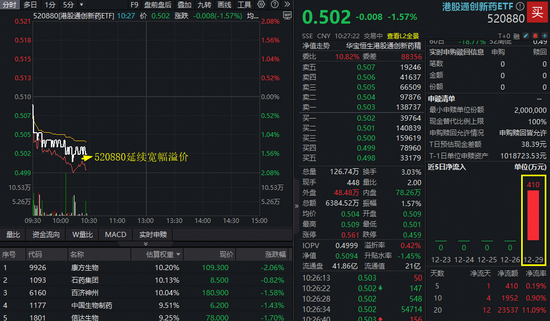
乐观BD预期退潮?港股通创新药ETF(520880)创5个半月新低!场内延续宽幅溢价,机构:基本面无虞
Xin Lang Cai Jing· 2025-12-30 02:42
Core Viewpoint - The Hong Kong innovation drug sector continues to adjust, with the Hong Kong Innovation Drug ETF (520880) falling over 1.5%, reaching a new low since July 11, indicating strong buying interest despite the downturn [1][7]. Market Performance - The leading stocks in the sector are experiencing a broad decline, with notable drops including Kangfang Biotech and Kelun-B, both down over 2%, and others like Baijie Shenzhou, China Biopharmaceutical, and Innovent Biologics all falling over 1% [1][8]. - Recent trading data shows that 4.1 million yuan entered the market as investors took advantage of the price drop [1][7]. Sector Analysis - According to Zhongyou Securities, the innovation drug sector is in a continuous correction phase, primarily driven by a retreat from previously optimistic business development (BD) expectations [1][10]. - Despite the downturn, recent clinical data from events like ESMO Asia and ASH conferences have validated the trends for domestic new drugs, aligning with expectations [1][10]. Future Outlook - Looking ahead to 2026, the maturity of clinical data is expected to be a key factor driving the innovation drug market, with BD becoming a necessary outcome of enhanced competitiveness for domestic new drugs [1][10]. - The current adjustment phase, which began in September and has lasted over three months, presents a favorable configuration window for the Hong Kong Innovation Drug sector, with the ETF price nearing its issuance price [1][10]. ETF Characteristics - The Hong Kong Innovation Drug ETF (520880) tracks the Hang Seng Hong Kong Innovation Drug Select Index, which has three unique advantages: it is purely focused on innovative drugs, has a high concentration of leading companies (over 72% in the top ten), and offers better risk control by reducing the weight of less liquid stocks [1][10][11]. - The top ten holdings in the ETF account for 72.57% of the total weight, highlighting the dominance of leading firms in the sector [1][12].
港股生物医药股盘中走弱,金斯瑞生物科技跌近4%
Mei Ri Jing Ji Xin Wen· 2025-12-30 02:17
Group 1 - Hong Kong biopharmaceutical stocks weakened during trading on December 30, with Genscript Biotech falling nearly 4% [1] - Fuhong Hanlin declined by nearly 3%, while Kelun-Biotech dropped over 2% [1] - Other stocks such as CanSino Biologics, Rongchang Biologics, and Kanyin Biologics also experienced declines of over 1.5% [1]

【报告】医药生物行业定期报告:从供需看,中国创新药能从海外分成多少钱?(附下载)
Xin Lang Cai Jing· 2025-12-29 13:40
Group 1: Market Overview - The CITIC Pharmaceutical Index increased by 1.2% during the week of June 3-6, 2025, outperforming the CSI 300 Index by 0.3 percentage points, ranking 16th among CITIC's primary industry classifications [1] - Year-to-date, the CITIC Pharmaceutical and Biotechnology Index has risen by 8.3%, surpassing the CSI 300 Index by 9.9 percentage points, ranking 5th among CITIC's industry classifications [1] - The top five performing stocks for the week included Yiming Pharmaceutical (+33.09%), Wanbangde (+32.59%), Anglikang (+30.28%), Xinnowei (+21.36%), and Haichen Pharmaceutical (+20.93%) [1] Group 2: Patent Cliff and Market Opportunities - By 2037, 27 blockbuster drugs with projected sales exceeding $4 billion in 2024 will face patent expiration, creating a market opportunity of over $240 billion for new entrants [2][12] - China is positioned as a core player in global innovative drug supply, leveraging its technological platforms and research efficiency, with the highest number of clinical pipelines in cell therapy, ADC, and bispecific antibodies [2][21] - The projected revenue from licensing agreements for Chinese projects from 2020 to 2025 is estimated to generate approximately $8.2 billion in net profit, translating to a potential market capitalization increase of $81.7 billion based on a 10x PE ratio [2] Group 3: Investment Recommendations - Focus on authorized blockbuster products with overseas clinical progress, including companies like Kangfang Biotech, Kelun Biotech, and Sanofi [2] - Potentially significant products for licensing out include Innovent Biologics, CSPC Pharmaceutical Group, and Zai Lab [2] - Companies with approved products showing strong commercialization performance include BeiGene, Kingsoft Biotech, and Hutchison China MediTech [2] Group 4: Mid to Long-term Investment Strategy - The investment strategy emphasizes three main lines: innovation, recovery, and policy support [4] - The innovation line focuses on biopharmaceuticals with competitive advantages in international markets and companies with second growth curves in pharmaceuticals [4] - The recovery line anticipates a rebound in medical device tenders and consumer healthcare, while the policy line supports high-dividend companies and encourages mergers and acquisitions [4]



从“借船出海”到“造船远航”:2025药企出海十大关键词
Xi Niu Cai Jing· 2025-12-29 09:34
Core Insights - The article discusses the transformation of Chinese pharmaceutical companies from merely selling products to actively participating in global value chains, with a significant increase in outbound licensing deals reaching over $100 billion by November 2025, a 75% increase year-on-year [3][4]. Group 1: Major Transactions - In 2024, major deals like Hengrui's $5 billion GLP-1 product and a $12.5 billion upfront payment from Pfizer to 3SBio for a dual antibody drug highlight the trend of billion-dollar collaborations becoming standard [4][6]. - Hengrui's partnership with GSK for $12.5 billion includes not only current products but also options for 11 early-stage projects, indicating a shift towards long-term strategic partnerships [4][10]. Group 2: Licensing Strategies - Chinese companies are moving from "one-off sales" to retaining rights in core markets while sharing rights in other regions, allowing them to benefit from both local and global markets [5][6]. - The new strategy involves keeping rights for the Greater China region while sharing development costs and rights for other markets, enhancing long-term revenue potential [6][10]. Group 3: Innovative Drug Categories - Antibody-drug conjugates (ADCs) and dual antibodies are emerging as key areas for Chinese companies, with significant deals reflecting their growing importance in the global market [6][7]. - The shift from traditional cancer drugs to innovative metabolic drugs like GLP-1 is notable, with companies like FOSUN and Hansoh making substantial deals in this area [14][15]. Group 4: Independent Global Expansion - Companies are increasingly opting for "self-driven" global expansion rather than simply licensing out, as seen with Kangfang Biopharma's approach to leading its own global clinical trials [8][9]. - This strategy, while riskier, offers higher potential returns compared to traditional licensing agreements [9]. Group 5: Platform-Based Collaborations - The trend is shifting from selling individual products to offering entire R&D platforms, as demonstrated by Hengrui's collaboration with GSK, which includes options for future projects [10][11]. - This model allows companies to monetize their ongoing research capabilities, enhancing their value proposition to partners [10][11]. Group 6: Regulatory and Pricing Developments - The introduction of a drug pricing registration system by China's National Healthcare Security Administration is expected to alleviate concerns about domestic pricing affecting global pricing strategies [12][13]. - This regulatory change has led to increased foreign investment in Chinese R&D, with a 28% year-on-year growth in 2025 [13]. Group 7: Market Valuation Changes - The market's evaluation criteria for Chinese innovative drug companies have shifted from focusing on generic drug revenues to assessing the value of outbound pipelines and global clinical progress [19][21]. - The average price-to-earnings ratio for innovative drug companies in China has risen significantly, reflecting a revaluation of their market potential [21].

港股IPO冰与火之歌:资金重构下分化回归
2 1 Shi Ji Jing Ji Bao Dao· 2025-12-29 09:08
21世纪经济报道记者唐唯珂报道 尽管IPO市场热度有所上升,但并未带动整体繁荣,反而进一步凸显了市场结构的分化趋势,尤其在生物医药领域表现更为明显,呈现出显著 的"冰火两重天"局面。高特佳投资集团副总经理于建林向21世纪经济报道记者表示,"强者恒强、弱者出清"趋势,已在市场中逐渐显现。 资金重构:南下资金主导,IPO市场全面爆发 2025年港股IPO市场的核心变革,始于资金主导权的移位与上市生态的重塑,彻底扭转了2024年私有化退市潮的冷清局面。 港股长期以来的定价体系,由外资机构主导的格局在2025年发生根本性转变。随着此前外资持续流出,内地南下资金以"跨过香江争夺定价 权"的趋势,逐步成为港股市场的重要推动力。 2025年,相关数据显示南下资金净流入规模已达到1.31万亿港元,同比增长超过60%。其成交占比一度接近40%,持股市值约占港股总市值的 13%。与外资侧重全球资产配置的逻辑不同,南下资金更了解内地企业的业务模式与成长路径,愿意为具备优质基本面的公司提供合理的估值 水平,尤其在生物医药、科技等领域的新股发行中,提供了关键性的支撑作用。 2025年,港股IPO市场完成了从"寒冬回暖"到"爆发增长"的 ...
ETF盘中资讯|跨国药企发起降价潮?港股通创新药逆市走低,520880溢价高企!机构力挺国产创新药:重点关注2026年Q1
Sou Hu Cai Jing· 2025-12-29 03:25
Core Viewpoint - The Hong Kong stock market opened positively, with the Hang Seng Index rising, but the innovative drug sector unexpectedly declined, indicating potential volatility in this segment [1]. Group 1: Market Performance - The Hang Seng Index showed a rise, with the Hang Seng Technology Index increasing by over 2% at one point [1]. - The Hong Kong Stock Connect innovative drug ETF (520880) fell by more than 1.5% during trading, with major stocks like CSPC Pharmaceutical Group and CanSino Biologics dropping over 1% [1]. Group 2: Investment Sentiment - Despite the decline, the Hong Kong Stock Connect innovative drug ETF (520880) continued to trade at a premium, suggesting that there may be investors looking to buy on dips [2]. - Analysts remain optimistic about domestic innovative drugs, noting that the past two years have been significant for Chinese innovative drugs entering international markets, with record highs in both the number and value of licensing deals [3]. Group 3: Future Outlook - The industry is expected to see continued positive catalysts in 2026, including major industry conferences, significant business development transactions, and breakthroughs in new technologies [3]. - The innovative drug sector has been in a phase of adjustment since September, with risks being sufficiently released, leading to improved cost-effectiveness for investments [3]. Group 4: ETF Characteristics - The Hong Kong Stock Connect innovative drug ETF (520880) has a significant concentration in leading companies, with the top ten stocks accounting for over 72% of its weight, indicating a strong representation of the innovative drug sector [4]. - The ETF is designed to exclude CXO companies, focusing solely on innovative drug firms, which enhances its appeal to investors seeking pure exposure to this segment [3][4].
中国创新药 2025 “破圈”全球
Guo Ji Jin Rong Bao· 2025-12-29 03:13
Core Insights - 2025 marks a pivotal year for China's innovative pharmaceuticals, with a significant increase in international collaborations and licensing agreements, indicating a shift from a pharmaceutical giant to a stronghold in the industry [1][3] - The total amount of outbound licensing agreements exceeded $100 billion, with upfront payments reaching $8.1 billion, showcasing a transition to multi-layered cooperation models [1][3] - China's biopharmaceutical market remains the second largest globally, with innovative drugs accounting for approximately 30% of global research, reflecting a critical leap from following to competing on a global scale [1][3] Internationalization - The internationalization of China's pharmaceutical industry saw explosive growth in 2025, highlighted by a surge in business development (BD) transactions and the popularity of "A+H" listings [3][4] - The total amount of outbound licensing for innovative drugs reached over $100 billion, a 75% increase from 2024, indicating a shift from merely selling products to actively engaging in global markets [3][4] - Notable BD transactions include significant agreements between major Chinese pharmaceutical companies and international firms, such as a $12.5 billion deal between Hengrui Medicine and GSK [3][4] Innovation - In 2025, advancements in cutting-edge technologies such as antibody-drug conjugates (ADC) and dual antibodies have shown promising results in cancer treatment [7][8] - The third-generation ADC technology has become mainstream, with significant efficacy demonstrated in treating solid tumors [7] - The dual antibody sector continues to lead, with Chinese companies achieving remarkable results in clinical trials, such as a 91% improvement in progression-free survival compared to existing treatments [8] Policy Support - The policy support for innovative drugs in China has reached unprecedented levels, with a notable increase in the number of approved innovative drugs [10][11] - The National Medical Products Administration approved 69 innovative drugs in 2025, a 44% increase from the previous year, covering various therapeutic areas [10] - The payment system for innovative drugs has been significantly upgraded, enhancing accessibility and affordability for patients [10][11] Mergers and Acquisitions - The pharmaceutical sector has seen a surge in mergers and acquisitions, with over 400 transactions announced globally, totaling approximately $111 billion, marking a 50% increase from 2024 [13][14] - Domestic mergers also showed strong activity, with significant deals indicating a shift towards quality improvement and resource consolidation among leading companies [13][14] - The trend reflects a transition from scale expansion to enhancing quality and efficiency, with companies focusing on high-value clinical pipelines [14]
