创新药BD

Search documents
一季度狂揽4100亿,中国创新药出海狂飙,这些A股公司或受益
21世纪经济报道· 2026-03-29 14:10
Core Insights - The Chinese innovative drug industry experienced a strong start in Q1 2026, with total licensing-out transactions exceeding $60 billion (approximately 414.6 billion RMB), nearing half of the total for 2025 [1] - The National Medical Products Administration approved 10 innovative drugs by March 27, 2026, with 8 being domestically developed, marking a historical high for the same period [1] - The Hang Seng Hong Kong Stock Connect Innovative Drug Index surged by 6.1% on March 27, reflecting strong investor confidence in the sector [1] Industry Structure - The Chinese innovative drug industry has established a complete closed-loop structure comprising upstream support, midstream R&D and production, and downstream commercialization, with each segment closely linked and clearly defined [2] - Upstream, the production of active pharmaceutical ingredients (APIs) reached 3.504 million tons in 2024, with the intermediate market exceeding 255.2 billion RMB, achieving self-sufficiency in most basic raw materials [2] - The midstream segment is characterized by high technical barriers and significant capital investment, with projections indicating that the market size could exceed $300 billion by 2030, increasing China's global market share [2] - Downstream commercialization involves reaching patients through medical institutions and retail pharmacies, with medical insurance and commercial insurance as key payers [2] Global Positioning - China has transitioned from being a "global follower" to a leading player in innovative drug R&D, with 7 out of the top 10 global pharmaceutical licensing transactions in 2025 originating from Chinese companies [3] - The focus of R&D is on oncology (519 clinical trials), hematological diseases (182), and immune diseases (146), with ADCs and bispecific antibodies showing the fastest growth [3] Financial Support - The availability of funds is crucial for the long-term development of the innovative drug industry, with BD (business development) income becoming a significant funding source for Chinese pharmaceutical companies [3] - Most domestic pharmaceutical firms maintain over a year of R&D funding coverage, supporting clinical trial progress and pipeline expansion [3] Challenges and Competition - Despite rapid growth, the industry faces challenges such as homogenization of hot targets, exemplified by the PD-1/PD-L1 inhibitors, where over ten products have been approved, leading to intense market competition and price wars [4] - The ADC sector is also crowded, with numerous projects in development, increasing commercialization pressure [4] Future Outlook - Since 2015, supportive policies for domestic innovative drugs have accumulated, driving rapid development, with expectations for significant advancements during the 14th Five-Year Plan period [4] - New drug forms such as small nucleic acid drugs and precision therapy CGT products are anticipated to reach a harvest period, facilitating a shift from "generic innovation" to "original innovation" in the Chinese innovative drug industry [4] Industry Players - Key upstream companies include Tianyu Co., Shandong Pharmaceutical Glass, and Senxuan Pharmaceutical, focusing on raw materials and production [5][6] - Midstream leaders include WuXi AppTec and Hengrui Medicine, known for their integrated platforms and significant partnerships [6] - Downstream players like Kefu Medical and Laobaixing Pharmacy are pivotal in retail and distribution, with extensive networks [6]


BD中国模式:可持续现金流有望重塑估值
HTSC· 2026-03-19 02:55
Investment Rating - The report maintains an "Overweight" rating for the biopharmaceutical and chemical pharmaceutical sectors [6]. Core Insights - The Chinese innovative drug sector is at the beginning of a long cycle, with continuous global output of high-quality assets from Chinese companies. The potential of these assets is not fully reflected in A/H share pricing, leading to a recommendation for the innovative drug sector [1]. - The number and value of business development (BD) deals in the Chinese innovative drug industry have reached record highs in 2023, with 45 BD deals completed (+73% year-on-year) and a total disclosed amount of $57.5 billion (+135% year-on-year) [2]. - The report highlights a significant valuation gap between A/H shares and US stocks for similar innovative drug assets, indicating that A/H shares are systematically undervalued [4]. Summary by Sections Business Development Trends - The report notes that the Chinese innovative drug sector has achieved a global market share of approximately 20% in the number of BD projects and around 75% in the disclosed amount [2]. - There is a high predictability of continued growth in BD activities, driven by increasing interest from multinational corporations (MNCs) and private equity (PE) firms in Chinese assets [2]. Cash Flow Contributions - The report emphasizes that platform companies in China are expected to generate sustainable cash flows through ongoing BD activities, which have not been adequately valued in the market [3]. - It is projected that significant BD deals (with upfront payments exceeding $500 million) will contribute to continuous cash flow growth for companies like Heng Rui Medicine, Shiyao Group, and others [3]. Valuation Comparisons - The report compares the valuations of similar assets in A/H shares and US markets, revealing that Chinese innovative drug companies are undervalued relative to their US counterparts [4][19]. - Specific case studies illustrate the valuation discrepancies, such as between MSD and Kelun Biotech, and Insmed and Haizhi Pharmaceutical, highlighting the potential for significant upside in A/H share valuations [19][22]. Investment Recommendations - The report recommends focusing on large pharmaceutical and biopharmaceutical companies with sustained BD capabilities, including Heng Rui Medicine, Shiyao Group, and others [5]. - Companies that have completed large BD deals are expected to benefit from ongoing milestone cash flows, with specific recommendations for companies like Kelun Biotech and Rongchang Biopharmaceutical [5]. Target Prices and Market Outlook - Target prices for recommended stocks are provided, with specific price targets for companies such as Shiyao Group at HKD 19.25 and Heng Rui Medicine at HKD 98.43, indicating a bullish outlook for these stocks [26].



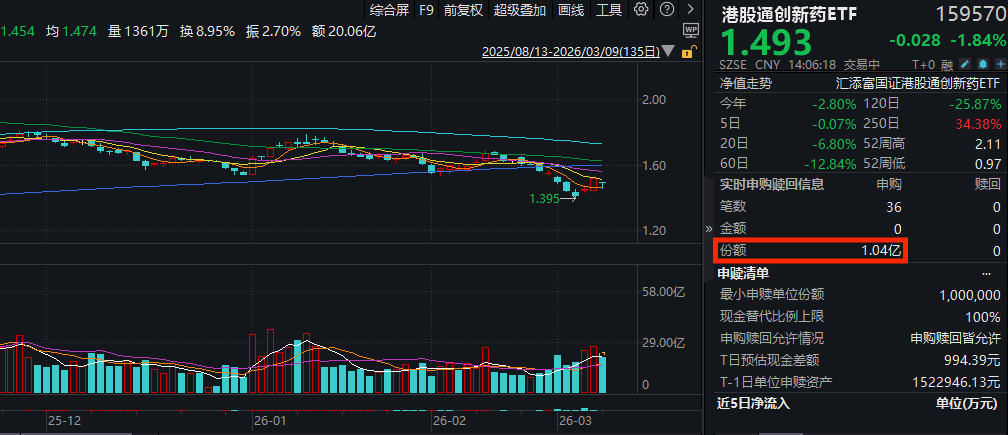
翰森制药核心产品新适应症获批,中国生物制药罗伐昔替尼出海落地!港股通创新药ETF(159570)回调近2%,超2亿元资金狂涌!
Xin Lang Cai Jing· 2026-03-09 06:45
Group 1 - The core viewpoint of the news highlights the recent downturn in the Asia-Pacific market, particularly in the Hong Kong pharmaceutical sector, with the Hong Kong Stock Connect Innovation Drug ETF (159570) experiencing a nearly 2% decline, despite a significant net subscription of 210 million yuan and a total scale exceeding 23.1 billion yuan [1][3] - The high-level meeting has officially categorized innovative drugs as an "emerging pillar industry," emphasizing the acceleration of commercial health insurance development and the promotion of high-quality development in innovative drugs [3] - The approval of Hansoh Pharmaceutical's application for the listing of Amivantamab tablets marks a significant milestone, as it is the first domestically developed third-generation EGFR-TKI in China, with five approved indications since its initial approval in March 2020 [3] Group 2 - In business development news, China Biologic Products announced an exclusive licensing agreement with Sanofi for Rovafatinib, a novel oral small molecule JAK/ROCK inhibitor, with potential payments totaling up to 1.53 billion USD, including an upfront payment of 135 million USD [4] - The Hong Kong Stock Connect Innovation Drug ETF (159570) saw most of its index's popular stocks decline, with notable drops including 5% for 3SBio and over 4% for CanSino Biologics, while Hansoh Pharmaceutical saw a slight increase due to new drug news [4] - The innovative drug sector is experiencing short-term volatility, but the long-term growth potential remains intact, with a focus on the globalization of Chinese pharmaceutical companies and the advancement of innovative technologies [6][9] Group 3 - The focus of the market has shifted from the ability to enter overseas markets to the progress of products in overseas clinical deployments, with key data readouts and milestone achievements becoming critical for future evaluations [7] - Chinese companies are making breakthroughs in frontier technologies such as small nucleic acids and cell therapies, positioning themselves as core assets in global transactions [8] - Leading innovative drug companies are entering a positive cycle of product commercialization and reinvestment in research and development, with expectations for significant performance improvements in the upcoming earnings period [9]


中国生物制药创新药罗伐昔替尼授权赛诺菲,海外MNC企业对中国创新药企认可度持续提升
Ping An Securities· 2026-03-08 14:09
Investment Rating - The industry investment rating is "Outperform the Market" (maintained) [3][33]. Core Insights - China National Pharmaceutical Group's subsidiary, Zhengda Tianqing, has signed an exclusive licensing agreement with Sanofi for the global development, production, and commercialization of the first-in-class oral small molecule JAK/ROCK inhibitor, Rovasixtin (TQ05105) [3]. - Rovasixtin targets the JAK/STAT pathway to block inflammation signaling and the ROCK pathway to regulate T cell activity, aiming to restore immune balance [3]. - The drug has been approved by the NMPA for first-line treatment in adult patients with intermediate-2 or high-risk primary myelofibrosis, post-polycythemia vera myelofibrosis, or post-essential thrombocythemia myelofibrosis as of February 28, 2026 [3]. - The agreement allows China National Pharmaceutical Group to receive up to $1.53 billion in payments, including an upfront payment of $135 million and potential milestone payments based on annual net sales [3]. Summary by Sections Industry Overview - The report highlights the increasing recognition of Chinese innovative pharmaceutical companies by multinational corporations (MNCs) through the licensing of Rovasixtin [3]. Investment Strategy - The report suggests that the global competitiveness of Chinese innovative pharmaceutical companies is on the rise, with potential treatment areas including metabolic diseases, chronic diseases, and central nervous system disorders [4]. - It recommends focusing on emerging technology platforms such as small nucleic acid drugs and CAR-T therapies, with specific companies highlighted for investment [4]. Market Performance - The pharmaceutical sector experienced a decline of 2.78% last week, while the Shanghai and Shenzhen 300 Index fell by 1.07%, ranking 15th among 28 industries [8][19]. - The report notes a slight increase in pharmaceutical financing and a recovery in business development transactions and H-share IPOs, indicating a revival of innovation enthusiasm [4].

中国生物制药谢炘:医疗IPO将分化,资金流向BD、商业化预期明确标的|2026医疗展望
3 6 Ke· 2026-03-02 00:31
Core Insights - The healthcare sector is entering a promising phase in 2025 after four years of "de-bubbling" and "restructuring," with a significant increase in IPO activities and a shift towards innovative drug companies [1] Group 1: Market Trends - In 2025, 39 healthcare companies successfully issued IPOs, raising a total of 35.9 billion yuan, with over 100 companies experiencing annual growth exceeding 100% [1] - The market capitalization of 14 companies, including China Biologic Products and Innovent Biologics, surpassed 100 billion yuan, indicating a shift in the top 10 healthcare companies from traditional pharmaceutical firms to innovative drug concept enterprises [1] Group 2: BD Transactions and Opportunities - The total amount for BD transactions in China's innovative drug sector reached 130 billion USD in 2025, with no significant decline in BD transaction enthusiasm observed [3] - The focus of BD transactions is diversifying beyond oncology to include various disease areas, such as obesity and respiratory diseases, with notable acquisitions by major pharmaceutical companies [3][4] Group 3: Investment Focus and Strategies - China Biologic Products is concentrating on four key areas: oncology immunotherapy, liver disease metabolism, respiratory antiviral treatments, and topical medications, while also planning to expand into cardiovascular and central nervous system products [4] - The company is also investing in AI drug development, believing that AI-designed molecules will inevitably gain regulatory approval, emphasizing the importance of data in clinical advancement [4] Group 4: IPO Market Dynamics - The secondary market has matured, with investors demanding higher standards for IPO projects, leading to over 400 companies queued for IPOs in Hong Kong [5] - The 2026 IPO performance is expected to be differentiated, with funds likely to flow towards companies with successful BD cases and clear product launch timelines, while those lacking competitive advantages may face significant IPO pressure [5]
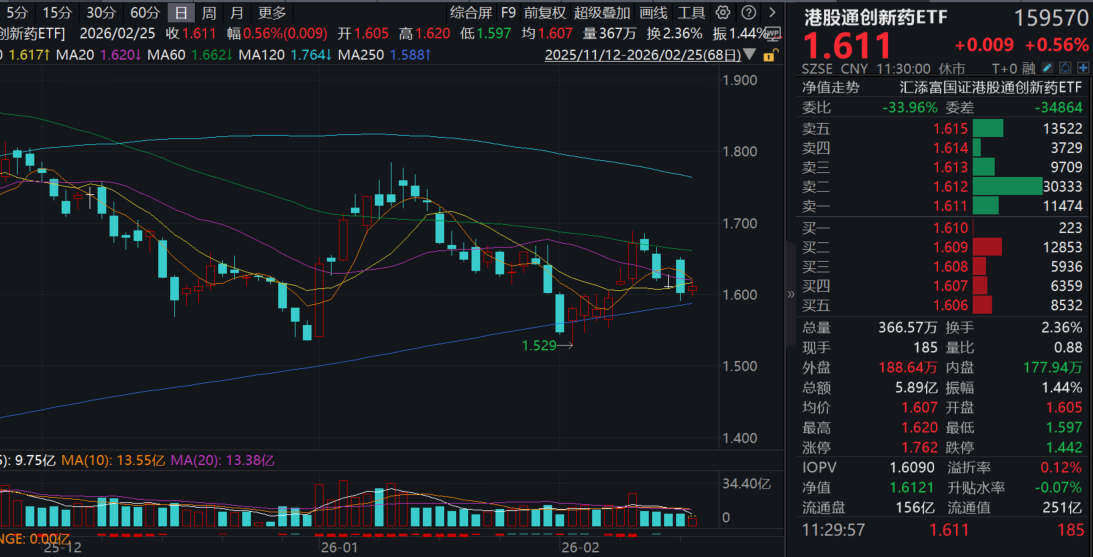
联邦制药涨超6%,II期临床研究达预期目标!港股通创新药ETF(159570)再度飘红!创新药BD热度高企,哪些趋势最受追捧?机构盘点!
Xin Lang Cai Jing· 2026-02-25 06:09
Group 1 - The Hong Kong stock market's innovative drug sector is performing well, with the Hong Kong Stock Connect Innovative Drug ETF (159570) rising by 0.56% and achieving a trading volume exceeding 700 million CNY [1] - Over the past 10 days, the ETF has attracted over 360 million CNY in capital, with its latest scale surpassing 25 billion CNY, leading its peers significantly [1] - Key stocks within the ETF, such as Federated Pharmaceutical and Rongchang Biopharmaceutical, have shown notable gains, with Federated Pharmaceutical increasing by over 6% [1][2] Group 2 - The innovative drug business development (BD) is focused on unmet clinical needs, technological differentiation, and global value, with significant transactions in oncology and metabolic disease sectors [3][4] - In oncology, notable advancements include Rongchang Biopharmaceutical's PD-1/VEGF dual antibody RC148, which received a substantial upfront payment of 650 million USD from a partnership with Aibowei [3] - The metabolic disease sector is highlighted by Shiyao Group's GLP-1 receptor agonist SYH2082, which secured a 1.2 billion USD upfront payment from AstraZeneca [3] Group 3 - The mRNA vaccine sector is experiencing rapid approvals, with several domestic products receiving IND approvals, indicating a swift advancement in local innovation [5] - The FDA has relaxed its drug review policies, allowing for a single key clinical trial to suffice for new drug approvals, which is expected to significantly reduce development timelines and costs [6] - New drug approvals include Hansoh Pharmaceutical's lung cancer drug "Amatinib," which has been granted marketing authorization in the EU for specific NSCLC patient populations [6]
医疗创新ETF(516820)红盘向上,2026中国创新药BD加速升温
Xin Lang Cai Jing· 2026-02-25 02:49
Group 1 - PwC and Anthropic have announced a partnership to accelerate the deployment of enterprise-level AI plugins in highly regulated industries, starting with finance, healthcare, and life sciences [1] - PwC will assist its clients in integrating Claude, which includes the Claude developer platform, Claude.ai, Claude Cowork, and Claude Code [1] - In the Chinese pharmaceutical sector, the upfront payment scale for innovative drug licensing deals has exceeded any quarter in 2025, surpassing one-third of the total amount for the entire year of 2025 [1] Group 2 - The China Securities Index for medical and medical device innovation has seen a 0.25% increase as of February 25, 2026, with notable stock performances from companies like Sanofi and New Hope [2] - The latest price for the medical innovation ETF is reported at 0.36 yuan, reflecting a 0.55% increase [2] - The PE-TTM for the medical innovation ETF is at 27.28 times, indicating it is at a historical low, being below 81.12% of the time over the past year [2] Group 3 - The top ten weighted stocks in the medical and medical device innovation index account for 63.9% of the index, including companies like WuXi AppTec and Mindray [2]
医药周报:春节期间医药行业重点事件梳理-20260223
Guolian Minsheng Securities· 2026-02-23 07:29
Investment Rating - The report maintains a "Recommended" rating for the pharmaceutical industry [5] Core Insights - The underlying logic of the current pharmaceutical industry era is innovation and international expansion, with a focus on innovative drugs and technology innovation [2][3] - The report highlights the strong performance of the CRO market and suggests a dual investment strategy focusing on both "0 to 1" technology innovation and low-position stocks [2][3] - Key investment directions include BD2.0, small nucleic acids, and supply chains, with a recommendation to explore new technology directions such as AI innovative drugs and small nucleic acids [3] Summary by Sections 1. Key Events in the Pharmaceutical Industry During the Spring Festival - The report notes a prosperous start for innovative drug BD transactions, with significant overseas development and registration progress for key products [13][14] - The total amount of BD transactions for innovative drugs in China for 2026 has already exceeded one-third of the total for 2025, indicating a strong upward trend [15] - The revision of the National Essential Medicines List Management Measures is seen as a potential signal for changes in the essential medicines directory [28] 2. Pharmaceutical Market Review and Hotspot Tracking - The pharmaceutical sector's performance was relatively weak, with a weekly decline of 0.81%, ranking 20th among all industries [34][38] - The total trading volume for pharmaceuticals was 401.12 billion yuan, accounting for 3.83% of the total market, which is below the historical average of 7.09% [55] - The report indicates that the industry is currently experiencing a lack of significant catalysts, with a focus on structural opportunities [1] 3. Investment Recommendations - The report recommends focusing on CRO companies such as Tigermed and Baiao Biotechnology, as well as other CXO and upstream companies [32] - For essential medicines, companies like Panlong Pharmaceutical and Guizhou Sanli are highlighted [32] - The report emphasizes the importance of monitoring the "0 to 1" technology innovation track, particularly in AI innovative drugs and small nucleic acids [32]
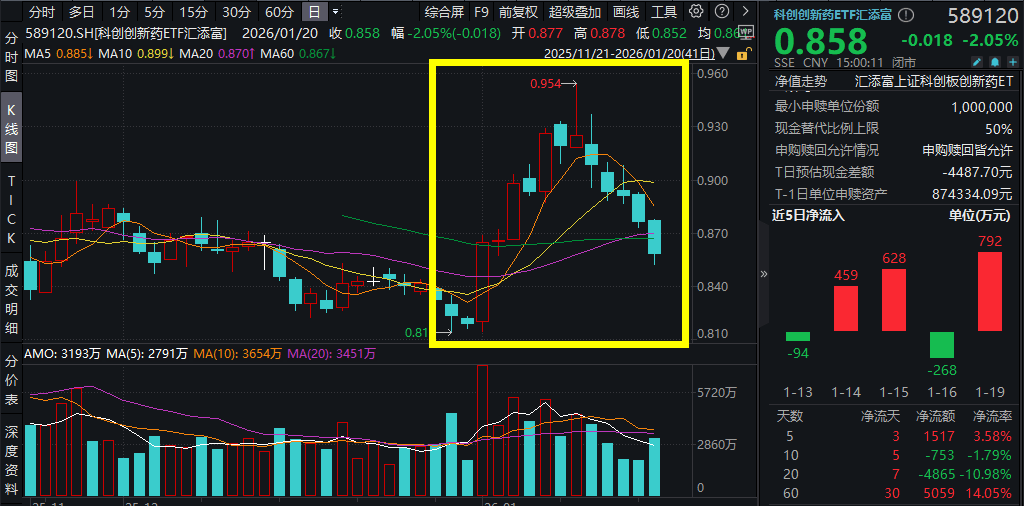
创新药板块承压,益方生物等跌超3%,科创创新药ETF汇添富(589120)跌超2%,资金逆势涌入!"全球创新药春晚"JPM召开,中国创新药闪耀全球
Sou Hu Cai Jing· 2026-01-20 11:33
Core Viewpoint - The A-share market is experiencing fluctuations, particularly affecting the innovative drug sector, with the ETF Huatai Innovation Drug (589120) declining by 2.05% and facing a five-day losing streak, despite attracting over 7.9 million yuan in funds [1][3]. Group 1: Market Performance - The Huatai Innovation Drug ETF (589120) has seen a decline in its constituent stocks, with major players like I-Mab and Junshi Biosciences dropping over 3%, and others like BeiGene and Zai Lab falling more than 2% [3]. - The top ten constituent stocks of the ETF show a negative trend, with BeiGene-U down by 2.38% and Junshi Biosciences-U down by 3.42%, indicating a general downturn in the sector [3]. Group 2: Long-term Outlook - Despite the short-term market pressure, the long-term outlook for the innovative drug sector remains positive, with expectations of a clear beta market driven by liquidity recovery at the beginning of the year [4]. - The JPM conference highlighted the achievements of over 20 Chinese pharmaceutical companies, with projections for significant revenue growth in innovative drugs, such as a 25% increase for Heng Rui in 2026 [4]. Group 3: Business Development (BD) Trends - The BD activities in the sector are at a peak, with 17 transactions occurring since January, totaling approximately 10.15 billion USD in upfront payments, significantly exceeding market expectations [5]. - The ongoing trend of foreign companies expanding in China and the increasing flow of funds into the innovative drug sector suggest a favorable environment for growth and investment [5]. Group 4: Investment Strategy - The innovative drug sector is recommended for increased allocation, particularly in Hong Kong stocks, as the market is currently at a relative bottom, with potential for new historical highs [5]. - The ETF focuses on leading innovative drug companies, providing a high degree of exposure to the opportunities presented by the rise of Chinese innovative drugs [5].

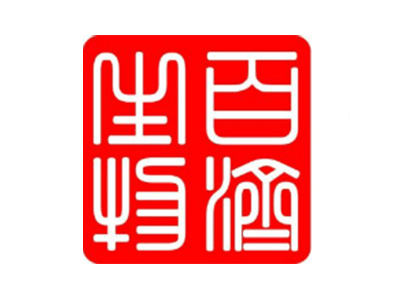

2026JPM:FIC/BIC管线突围、BD丰收、港股上市!恒瑞站上“爆发点”
Sou Hu Cai Jing· 2026-01-18 23:46
Core Viewpoint - The 44th J.P. Morgan Healthcare Conference highlighted the global pharmaceutical industry's focus on innovation, with HengRui Medicine showcasing its capabilities as a global pharmaceutical company from China, emphasizing platform-based R&D, business development (BD), and international clinical and registration systems [1][3]. Group 1: R&D and Innovation - HengRui has established a "dual-drive" model, investing over 25% annually in R&D and supporting a robust pipeline with over 100 new molecular entities (NMEs) and more than 400 clinical trials [3][4]. - The company’s "All-in Strategy" encompasses all major treatment modalities, including small molecules, large molecules, and peptides, demonstrating a comprehensive and iterative innovation engine [4][6]. - HengRui focuses on first-in-class (FIC) and best-in-class (BIC) therapies, with significant breakthroughs in challenging targets, such as the KRAS G12D inhibitor HRS-4642, which has shown a 63.3% objective response rate in clinical trials [6][7]. Group 2: Business Development and Internationalization - The trend at the conference indicated a shift towards BD as a mainstream strategy, with companies needing to demonstrate continuous innovation and stable delivery capabilities to attract investment [8][9]. - HengRui has completed 12 external licensing deals since 2023, valued at over $27 billion, showcasing its R&D strength and innovation quality recognized by top multinational corporations (MNCs) [12]. - The company is building a global capability system alongside its BD efforts, with significant progress in establishing R&D centers and teams, including a new center in Boston [13]. Group 3: Future Growth and Market Position - In 2026, HengRui is expected to achieve over 10 new drug approvals, submit more than 20 NDA/BLA applications, and report data from 25 Phase III studies, indicating a clear growth trajectory [14]. - The company anticipates a more than 25% year-on-year increase in innovative drug revenue, driven by the inclusion of 10 new products in the national medical insurance catalog [14]. - HengRui aims to enhance its global partnerships and accelerate international clinical trials, reflecting its commitment to a robust internationalization strategy [14][15].