联影医疗

Search documents
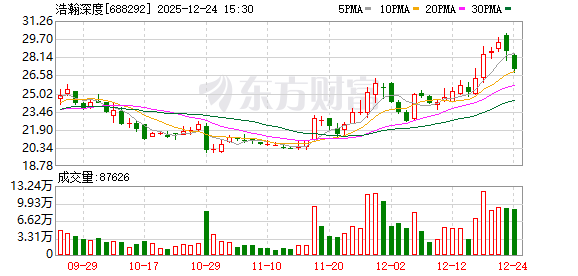
浩瀚深度:公司与燧原科技共同打造的智能体服务一体机的核心应用场景是金融垂类智能客服
Zheng Quan Ri Bao Zhi Sheng· 2025-12-24 13:45
Core Viewpoint - The company collaborates with Suiyuan Technology to develop an intelligent service all-in-one machine, primarily targeting the financial sector for smart customer service, replacing human agents with digital employees [1] Group 1: Market Expansion - Customer expansion will leverage UnionPay's channel advantages to penetrate over a hundred banks, gradually extending to insurance, brokerage, and large-scale outbound calling sectors [1] - The technology and ecosystem expansion involves continuous iteration of the all-in-one machine and models through a joint laboratory, focusing on computational power investments in intelligent computing switches and optical switches to ensure service performance and cost advantages [1] - The company is also advancing terminal chip layouts to support future consumer-oriented intelligent terminal scenarios [1]


股票行情快报:联影医疗(688271)12月24日主力资金净卖出4126.44万元
Sou Hu Cai Jing· 2025-12-24 12:36
Group 1 - The core viewpoint of the news is that 联影医疗 (United Imaging Healthcare) has shown significant financial growth in the first three quarters of 2025, with a notable increase in both revenue and net profit compared to the previous year [2] - As of December 24, 2025, the stock price of 联影医疗 closed at 126.35 yuan, reflecting a 0.79% increase, with a trading volume of 34,400 hands and a total transaction amount of 433 million yuan [1] - The company reported a main revenue of 8.859 billion yuan for the first three quarters of 2025, representing a year-on-year increase of 27.39%, and a net profit attributable to shareholders of 1.12 billion yuan, up 66.91% year-on-year [2] Group 2 - In the third quarter of 2025, the company achieved a single-quarter main revenue of 2.843 billion yuan, which is a 75.41% increase year-on-year, and a single-quarter net profit of 122 million yuan, up 143.8% year-on-year [2] - The company has a debt ratio of 30.08% and reported investment income of 606.847 million yuan, with financial expenses of -438.233 million yuan, and a gross profit margin of 47.02% [2] - Over the past 90 days, 25 institutions have rated the stock, with 18 buy ratings and 7 hold ratings, and the average target price set by institutions is 173.12 yuan [2]


浩瀚深度:公司开发的晨星大模型,前期与中国科学院联合研发,现在以自主研发为主
Zheng Quan Ri Bao· 2025-12-24 12:11
Core Viewpoint - The company has transitioned from collaborative development with the Chinese Academy of Sciences to primarily independent research and development of its Morning Star large model, while also incorporating some open-source models based on user needs [2] Group 1 - The Morning Star large model was initially developed in collaboration with the Chinese Academy of Sciences [2] - The company is now focusing on independent development of the Morning Star large model [2] - The company is utilizing some open-source large models according to user requirements [2]
第124家上市公司!A股“宁波军团”扩容!
Sou Hu Cai Jing· 2025-12-24 08:51
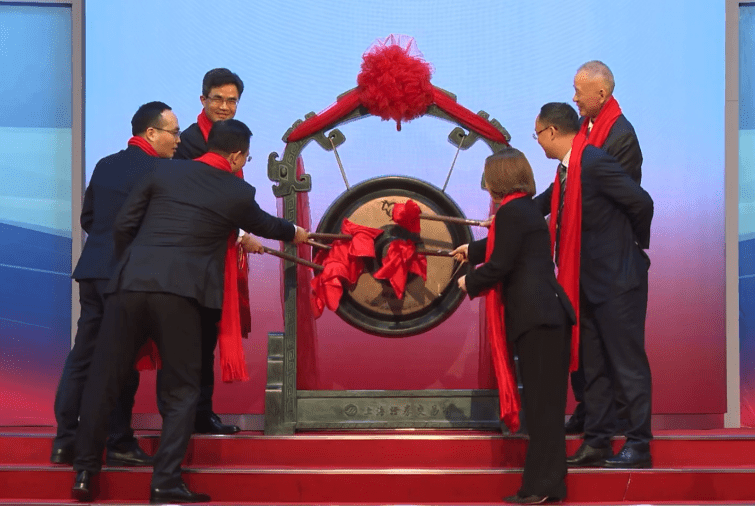
Core Viewpoint - Ningbo Jianxin Superconducting Technology Co., Ltd. successfully listed on the Shanghai Stock Exchange's Sci-Tech Innovation Board, becoming the first company to achieve "zero liquid helium" superconducting technology in the A-share market [1][2]. Company Overview - Jianxin Superconducting, established in 2013 and headquartered in Cixi High-tech Industrial Development Zone, focuses on the R&D, production, and sales of core components for medical magnetic resonance imaging (MRI) equipment, including superconducting magnets, permanent magnets, and gradient coils, which account for approximately 50% of the cost of MRI core components [4][7]. - The company has developed a unique all-solid-state conduction cooling technology, achieving a fully helium-free superconducting magnet, with its 1.5T helium-free superconducting magnet already in global commercial application [4][7]. Market Position - As of 2024, Jianxin Superconducting holds a global market share of approximately 4.2%, ranking fifth globally and second among domestic companies, only behind United Imaging Healthcare [7][9]. - The company’s clients for the 1.5T helium-free superconducting magnet include major players such as Wandong Medical, Fujifilm Group, GE Healthcare, and others [7]. Financial Performance - From 2022 to 2025, Jianxin Superconducting's R&D expenses were 20.33 million, 24.42 million, 27.65 million, and 16.75 million yuan respectively [8]. - The company's revenue increased from 359 million yuan in 2022 to 425 million yuan in 2024, with a net profit attributable to shareholders rising from 30.85 million yuan to 50.27 million yuan during the same period [12]. - For the first three quarters of 2025, the company achieved revenue of 393 million yuan, a year-on-year increase of 37.34%, and a net profit of 47.62 million yuan, up 38.54% year-on-year [12]. Industry Trends - The global MRI equipment market is projected to grow from 7.5 billion USD in 2015 to 11.1 billion USD in 2024, with expectations to reach 14.89 billion USD by 2030 [11]. - The cancellation of configuration management for 1.5T and above MRI equipment by the National Health Commission in 2023 is expected to drive the penetration of these devices into the market [11]. - The company is focusing on the development of 3.0T helium-free superconducting magnets, which are anticipated to be a major research direction in the coming years [11].
中国信保上海分公司: 发挥政策性金融独特作用 助力上海“五个中心”联动建设
Jin Rong Shi Bao· 2025-12-24 02:47
Core Viewpoint - The China Export & Credit Insurance Corporation (Sinosure) plays a crucial role in supporting China's international trade by providing financial tools backed by national credit and fiscal resources, significantly contributing to the country's export growth and risk management strategies [1][2][7]. Group 1: Financial Support and Services - During the 14th Five-Year Plan period, Sinosure's Shanghai branch supported over $265 billion in foreign trade exports and investments, paying out claims of 2.219 billion yuan and helping companies reduce losses by nearly 3.6 billion yuan [1]. - In 2025, Sinosure's Shanghai branch actively participated in local government initiatives to stabilize foreign trade, introducing innovative services such as "安心接单保" and "参展速查宝," which helped develop 13,000 new overseas buyers, a 25.7% increase year-on-year [2]. - The "沪贸批次贷" financing model was launched to provide proactive credit to small and micro foreign trade enterprises, with 1.1 trillion yuan in credit limits pushed to over 30,000 companies [3]. Group 2: Support for Technological Innovation - Sinosure's Shanghai branch focuses on supporting key industries, particularly in technology innovation, by providing tailored insurance solutions that integrate into companies' risk management systems [4]. - The branch has significantly aided Shanghai United Imaging Healthcare Co., Ltd. in expanding its international market presence, particularly in North America, Europe, and Asia-Pacific, through personalized insurance plans [4]. Group 3: Cross-Border Financial Services - Sinosure has become an essential tool for promoting the internationalization of the renminbi and enhancing cross-border financial service convenience, as highlighted in the Shanghai International Financial Center's action plan [7]. - The company successfully facilitated a financing structure for HuanTai Energy Co., Ltd. for a wind power project in Kazakhstan, providing 95% coverage for political and commercial risks, thus enabling financing without credit guarantees [8]. Group 4: Shipping and Maritime Financing - In the first 11 months of the year, Shanghai port handled 50.56 million TEUs, a 6.7% increase year-on-year, supported by Sinosure's financing solutions for shipping projects [10]. - Sinosure has played a pivotal role in financing significant shipping projects, including the delivery of a methanol dual-fuel container ship for CMA CGM and financing arrangements for an $11 billion LNG dual-fuel container fleet for Hapag-Lloyd [11]. Group 5: Future Directions - Sinosure aims to enhance its role in supporting Shanghai's high-level opening-up and economic center status by providing innovative and targeted insurance support, contributing to the development of a modernized Shanghai [12].

华安基金科创板ETF周报:科创板融资活跃,科创50指数上周回调
Xin Lang Cai Jing· 2025-12-24 01:21
Group 1: Policy and Industry Dynamics - The China Securities Regulatory Commission (CSRC) emphasized the need to accelerate the implementation of the "1+6" reform measures for the Sci-Tech Innovation Board (STAR Market) to enhance market vitality and improve the inclusiveness and attractiveness of the capital market [1][2] - The CSRC aims to optimize the financing environment in alignment with national strategic planning, particularly in technology innovation and industrial upgrading, while also linking reforms with the ChiNext board [2][16] - The STAR Market has seen a total of 210 new IPO applications this year, with 2 new applications in the past week, indicating sustained market activity [1][15] Group 2: Market Performance and Trends - The STAR Market experienced a pullback last week, with declines in sectors such as chips, information technology, biomedicine, and new materials [3][17] - Major indices on the STAR Market have shown year-to-date returns, with the STAR 50 index at 35.02%, while the weekly return was -2.99% [4][17] - The top five industries on the STAR Market, including electronics and biomedicine, account for 88.7% of the total market capitalization [4][17] Group 3: Sector Insights - The new generation information technology sector, particularly the chip industry, is experiencing growth, with significant increases in the manufacturing value of electronic materials and integrated circuits [5][18] - The high-end equipment manufacturing sector is crucial for enhancing the overall competitiveness of China's manufacturing industry, with high-tech manufacturing value increasing by 8.4% in November [6][19] - The biopharmaceutical sector faced a downturn last week, primarily due to weak liquidity in the Hong Kong market and capital outflows, but is expected to stabilize with positive trends in CDMO orders and domestic CRO performance [21][21]

联影医疗(688271)12月23日主力资金净卖出8912.67万元
Sou Hu Cai Jing· 2025-12-24 00:45
Core Viewpoint - The stock of United Imaging Healthcare (688271) experienced a decline of 2.37% on December 23, 2025, closing at 125.36 yuan, with significant trading activity and mixed capital flow trends [1]. Group 1: Stock Performance - On December 23, 2025, the stock had a turnover rate of 0.63%, with a trading volume of 51,800 lots and a total transaction value of 655 million yuan [1]. - The net outflow of main funds was 89.13 million yuan, accounting for 13.61% of the total transaction value, while retail investors saw a net inflow of 46.66 million yuan, representing 7.12% of the total [1]. Group 2: Financing and Margin Trading - On the same day, the financing buy amounted to 80.85 million yuan, with financing repayment at 56.38 million yuan, resulting in a net financing increase of 24.47 million yuan [2]. - The margin trading balance stood at 1.099 billion yuan, with no shares sold short and a short balance of 3.03 million yuan [2]. Group 3: Financial Performance - For the first three quarters of 2025, United Imaging Healthcare reported a main revenue of 8.859 billion yuan, a year-on-year increase of 27.39%, and a net profit attributable to shareholders of 1.12 billion yuan, up 66.91% [3]. - In Q3 2025, the company achieved a single-quarter main revenue of 2.843 billion yuan, reflecting a 75.41% year-on-year growth, and a net profit of 122 million yuan, which is a 143.8% increase compared to the previous year [3]. - The company’s gross profit margin was reported at 47.02%, with a debt ratio of 30.08% and investment income of 60.68 million yuan [3]. Group 4: Analyst Ratings - Over the past 90 days, 25 institutions have rated the stock, with 18 buy ratings and 7 hold ratings, while the average target price set by analysts is 173.12 yuan [3].
磁共振“小巨人” 全球最大超导磁体独立供应商今日上市丨打新早知道
2 1 Shi Ji Jing Ji Bao Dao· 2025-12-23 23:12
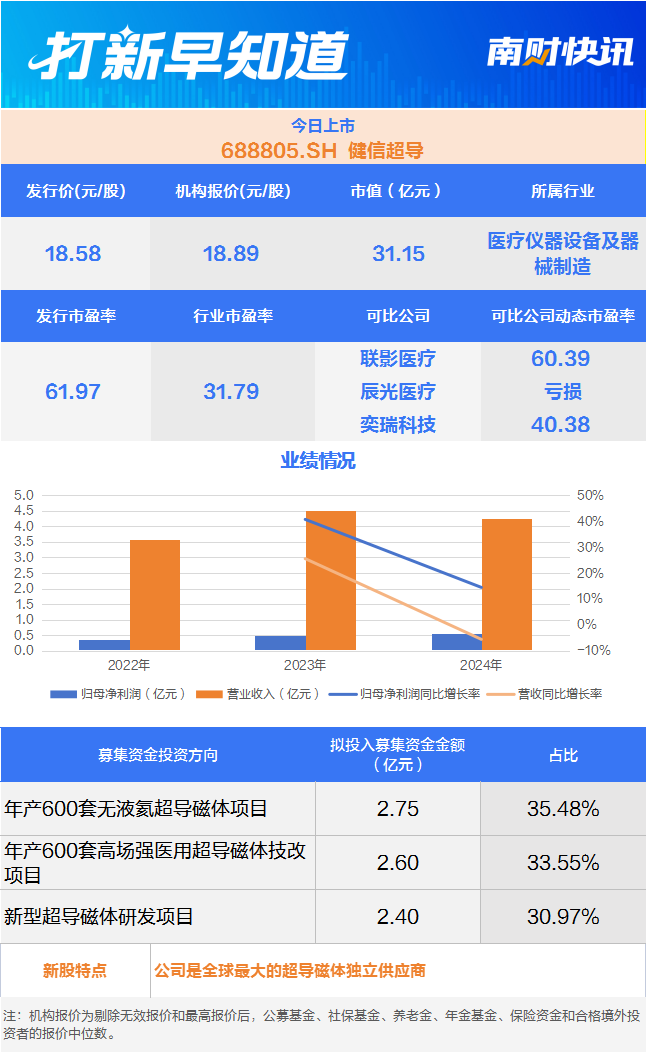
Core Viewpoint - The company Jianxin Superconductor (688805.SH) has successfully launched on the STAR Market, focusing on the research, production, and sales of core components for medical MRI equipment, which constitute approximately 50% of the cost of MRI devices [1][4]. Group 1: Company Overview - Jianxin Superconductor was established on December 11, 2013, and is recognized as one of the earliest manufacturers in China to scale the production of high-field superconducting magnets [7]. - The company has developed a diverse product matrix, including 1.5T and 3.0T superconducting magnets, and is the largest independent supplier of superconducting magnets globally [7]. - Jianxin Superconductor has established strong partnerships with renowned MRI equipment manufacturers such as Fujifilm, GE Healthcare, and others, facilitating the global promotion of MRI devices [7]. Group 2: Financial Metrics - The IPO price was set at 18.58 CNY per share, with an institutional offering price of 18.89 CNY per share, resulting in a market capitalization of 3.115 billion CNY [4]. - The company’s earnings per share (EPS) is projected with a price-to-earnings (P/E) ratio of 61.97, compared to the industry average of 31.79 [4]. Group 3: Fundraising and Investment Plans - Jianxin Superconductor plans to invest raised funds in several projects, including a 600-unit production line for liquid helium-free superconducting magnets (2.75 billion CNY), a technical upgrade for high-field superconducting magnets (2.60 billion CNY), and the development of new superconducting magnets (2.40 billion CNY) [6]. Group 4: Market Risks - The company faces a high customer concentration risk, with the top five customers accounting for 73.75% to 83.43% of total revenue from 2022 to mid-2025, with Fujifilm being the largest customer [8].
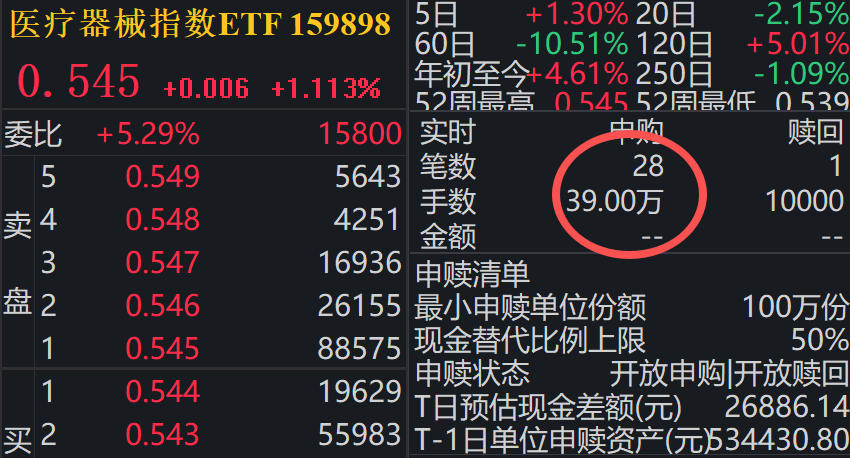
毫米级创伤!我国脑机接口里程碑式突破,医疗器械指数ETF(159898)逆势上涨1.11%
Jin Rong Jie· 2025-12-23 16:52
Core Viewpoint - The medical device sector is experiencing significant growth and investment opportunities, driven by recent regulatory approvals and technological advancements in brain-computer interface (BCI) technology [3][4][5]. Group 1: Market Performance - The medical device index ETF (159898) saw a 1.11% increase, with approximately 20 million yuan net inflow during trading [1]. - Key stocks in the medical device sector, such as Yirui Technology and Furu Medical, reported gains of 4.58% and 6.44% respectively, indicating strong market performance [1]. Group 2: Regulatory Developments - The National Medical Products Administration (NMPA) approved two high-value medical devices, enhancing clinical applications and technological development in the industry [3]. - Recent policies from major cities like Shanghai and Beijing aim to support the medical device industry, focusing on regulatory reforms and innovation [5]. Group 3: Technological Advancements - China has made significant progress in invasive brain-computer interface technology, becoming the second country after the U.S. to enter clinical trials [3]. - The global brain-computer interface market is projected to grow from approximately $2.62 billion in 2024 to $12.4 billion by 2034, with a compound annual growth rate of 17.35% [4]. Group 4: Investment Opportunities - Analysts suggest that the medical device sector may replicate the successful path of innovative pharmaceuticals, with a focus on innovation driving industry growth and global competitiveness [5]. - The medical device index ETF (159898) tracks a diverse range of leading companies in the sector, primarily focusing on A-share medical devices [7].



宋志平:2026,抵制内卷和重塑经营范式
Xin Lang Cai Jing· 2025-12-23 04:52
Core Viewpoint - The recent Central Economic Work Conference emphasizes the need for a shift in business paradigms to resist "involution" competition and focus on value creation and high-quality development [2][26]. Group 1: Transition from Scale to Quality - Chinese enterprises have achieved significant growth, with 130 companies entering the Fortune Global 500 this year, but now must transition from speed and scale to quality and efficiency [4][29]. - The criteria for measuring development quality include investment returns, market presence, profitability, employee income, government tax revenue, and environmental improvement [4][29]. - Companies like Midea are focusing on modern governance to ensure stable development, projecting a profit of 38.5 billion yuan in 2024 with a market value of 630 billion yuan [4][29]. Group 2: Focus on Core Competencies - Companies should prioritize strengthening their core business rather than blindly expanding into unrelated areas, as many issues arise from straying from core competencies [6][31]. - The principle of business core focus suggests eliminating non-core and loss-making operations to maintain clarity and efficiency [6][31]. - For instance, CATL focuses solely on its core business of power batteries, projecting a profit of 50.7 billion yuan in 2024 with a market value of 1.8 trillion yuan [6][31]. Group 3: Shift from Management to Strategic Operations - The current era requires businesses to focus on strategic operations rather than just management, emphasizing the importance of making the right business decisions to enhance profitability [7][32]. - Effective leadership involves setting strategic direction and resource acquisition while delegating management tasks to subordinates [7][32]. - The distinction between management and operations is crucial, with a focus on generating revenue and market engagement being paramount [7][32]. Group 4: Value-Driven Pricing Strategies - Companies must transition from cost-based pricing to value-based pricing, focusing on the value delivered to customers rather than merely production costs [13][40]. - The importance of understanding the relationship between price, volume, and cost is highlighted, with a focus on maintaining price stability in over-saturated markets [17][42]. - Successful brands like Pop Mart leverage emotional and social value in their products, achieving significant revenue growth and market capitalization [41]. Group 5: Moving Towards Cooperative Competition - The need for a shift from harmful competition to cooperative competition is emphasized, where companies focus on creating value rather than engaging in destructive price wars [18][43]. - The concept of "prisoner's dilemma" illustrates the need for industry players to prioritize collective industry benefits over individual gains [19][44]. - Promoting a cooperative ecosystem within industries can lead to sustainable growth and mutual benefits for all stakeholders involved [19][44].