创想三维

Search documents
3D打印行业简评:消费级3D打印风起,聚焦拓竹链投资机会
CMS· 2026-02-13 04:35
Investment Rating - The report maintains a "Recommended" rating for the 3D printing industry, indicating a positive outlook for the sector's fundamentals and expectations for the industry index to outperform the benchmark index [8]. Core Insights - The global consumer-grade 3D printing industry is entering a phase of accelerated adoption, with rapid market growth anticipated. The report suggests focusing on investment opportunities within the industry chain, particularly companies related to the leading player, Tuozhu [1]. - The demand for consumer-grade 3D printing is expected to grow rapidly, driven by advancements in artificial intelligence and printing performance. The market size is projected to reach USD 4.1 billion in 2024 and grow to USD 16.9 billion by 2029, with a CAGR of 26.6% [6]. - The supply side shows that the global 3D printer market share is increasingly concentrated among leading Chinese companies, with Tuozhu expected to capture approximately 29% of the market share in 2024 [6]. Industry Overview - The 3D printing industry encompasses various segments, including upstream raw materials, hardware, and auxiliary software, as well as downstream applications in aerospace, automotive, healthcare, rail transportation, cultural creativity, and construction [6]. - The report highlights key players in the industry, including: - **Sikan Technology**: A leading domestic 3D scanner company that has signed a framework agreement with Tuozhu to jointly design and develop consumer-grade 3D scanners [6]. - **Jinchengzi**: A leader in laser processing control systems, focusing on self-developed industrial software and control systems, and a major provider of automation control components for 3D printing equipment [6]. - **Jieput**: Provides continuous fiber lasers and related optical modules to midstream manufacturers, enhancing the speed and precision of 3D printing [6].
中金 | 品类革新系列之造物平权:消费级3D打印
中金点睛· 2026-02-11 23:38
中金研究 消费级3D打印的成长空间多大? 据灼识咨询数据,2020~2024年全球消费级3D打印机GMV由10亿美元增长至21亿美元,CAGR为20.4%;预计2029年将达 88亿美元,2024~2029年CAGR为33.2%。中国产能主导全球,行业需求主要来自欧美。 消费级3D打印的竞争格局如何? 2024年全球出货量CR5达到78.6%,中国品牌主导全球市场,拓竹科技份额领先(2024年出货量份额29.0%)。消费级3D 打印机产品形态尚未成熟,品牌格局仍在变动之中,但头部品牌竞争优势也在不断巩固。 风险 消费级3D打印渗透不及预期;市场竞争加剧风险;国际贸易政策风险。 T正文ext 生成式AI的普及、个性化消费的兴起以及供应链的成熟,推动消费级3D打印行业迈入"技术筑基+场景破圈"的黄金增长期。本篇报告全面剖析消费级 3D打印行业当下的热点问题,为市场梳理出行业的投资脉络。 点击小程序查看报告原文 Abstract 摘要 消费级3 D打印 是什么? 消费级3D打印是面向个人、教育机构及小型工作室的小批量、定制化生产工具。消费级3D打印以FDM、LCD为主,FDM占主导 地位。 消费级3D打印的创新逻辑 ...

中国公厕里的卖片小广告,如何让老外疯狂?
3 6 Ke· 2026-02-10 03:56
Group 1 - The evolution of small advertisements in public restrooms has transitioned from handwritten notes and stickers to laser-engraved ads, indicating a significant technological advancement [1][3][5] - The use of laser technology for engraving has become a new trend, with incidents reported where individuals were caught using laser tools to create these ads in public restrooms [6][8] - The laser machines used for these engravings are categorized into two types: laser marking, which alters the surface without removing material, and laser engraving, which removes material to create deeper impressions [9][11] Group 2 - The permanence of laser-engraved ads poses challenges for municipal departments and cleaning staff, as traditional methods of removal are ineffective, requiring more labor-intensive solutions [11][13] - The speed of engraving by offenders is significantly faster than the time required for removal, highlighting the efficiency of the technology in illicit activities [15] - The affordability and portability of laser engraving machines have drastically changed since 2010, making them accessible for misuse in public spaces [17][20] Group 3 - The decline in prices of laser technology has led to a proliferation of both legitimate and illegitimate uses, with the market for laser engraving equipment expected to reach approximately 100 billion yuan by 2024 [40] - The rise of consumer-grade laser machines has opened new markets, allowing hobbyists and entrepreneurs to engage with laser technology directly, leading to innovative applications [41][42] - Companies like x-Tool have successfully tapped into the consumer market, achieving significant sales and expanding their product offerings to include various functionalities beyond traditional engraving [44][60]



消费级3D打印
2026-02-04 02:27
Summary of the Conference Call on Consumer 3D Printing Industry Industry Overview - The conference focused on the consumer-grade 3D printing industry, discussing its definition, market potential, innovation logic, and competitive landscape [1][2][3] Key Points Definition of Consumer 3D Printing - Consumer 3D printing is defined as a new manufacturing method distinct from traditional manufacturing techniques such as additive and subtractive manufacturing [1][2] - It is characterized by its ability to produce small quantities of unique or customized products, suitable for applications in education, cultural creativity, and consumer goods [3][4] Market Potential - The global consumer 3D printing market is projected to grow from $1.5 billion in 2020 to $4.2 billion by 2024, reflecting a compound annual growth rate (CAGR) of approximately 29% [11][12] - Sales of consumer 3D printers alone are expected to increase from $1 billion in 2020 to $2.1 billion by 2024, with a forecasted CAGR of around 20% [13][14] - The penetration rate of consumer 3D printers is currently low, estimated at less than 2% in developed regions, indicating significant growth potential [15][16] Innovation Logic - The innovation in the consumer 3D printing industry is driven by hardware upgrades, material innovation, and software ecosystem development [20][22] - The industry is characterized by rapid iteration and the need for strong software support to enhance user experience and operational efficiency [21][22] Competitive Landscape - The market is dominated by Chinese brands, with the top five companies holding significant market shares: - Tofu (29%) - Creality (17%) - Zhuhai (13%) - Smart (12%) - Enjoy (7%) [23] - Tofu, a relatively new entrant, has shown remarkable growth, achieving revenues of over 10 billion RMB in 2022, indicating a strong competitive position [24][26] Challenges and Opportunities - The industry faces challenges such as the need for improved user-friendliness and the complexity of the printing process, which requires robust software support [21][22] - Opportunities exist for expansion into complementary products, such as 3D scanners and laser engravers, as well as potential for global market growth, particularly in regions with less developed supply chains [28] Conclusion - The consumer 3D printing industry is in a growth phase with substantial opportunities for innovation and market expansion, particularly for companies that can effectively integrate hardware, materials, and software solutions [28]
【行业前瞻】2026-2031年全球及中国消费级3D打印行业发展分析
Sou Hu Cai Jing· 2026-01-30 02:27
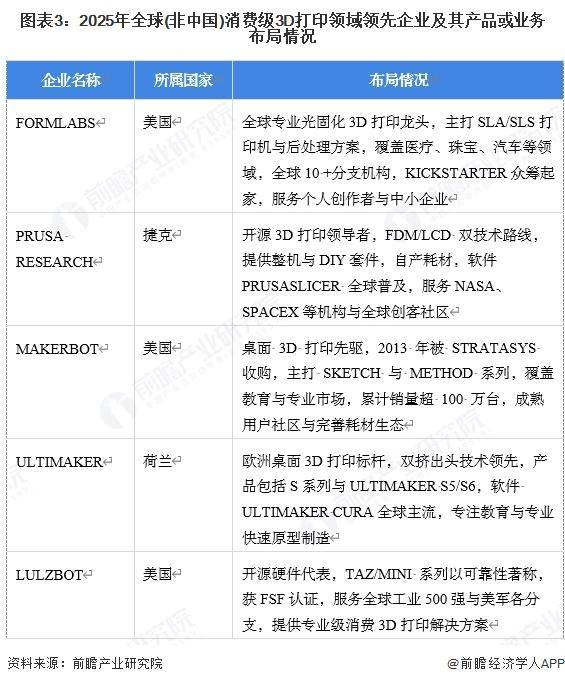
行业主要上市公司:铂力特(SH.688333)、先临三维(SH.600588)、有研粉材(SH.688456)等; 消费级3D打印机的应用起源于业余爱好者,但随着科技的发展和人们创新意识的增强,现在可以与互 联网结合,开创新的商业模式。消费级3D打印机以FDM技术为主,打印材料大多为PLA、ABS等高分 子材料,消费领域主要分布在文化创意产业及教育行业。 产业竞争 当前全球消费级3D打印行业呈中国品牌主导格局,拓竹科技、创想三维、纵维立方、智能派等中国品 牌合计贡献了全球95%的份额。欧美Prusa、Ultimaker 退守高端准专业市场,竞争聚焦技术升级、生态 构建。部分企业具体布局情况如下: | 企业名称 | 所属国家 | 布局情况 | | --- | --- | --- | | FORMLABS | 美国4 | 全球专业光固化 3D 打印龙头,主打 SLA/SLS 打 | | | | 印机与后处理方案,覆盖医疗、珠宝、汽车等领 | | | | 域,全球10+分支机构,KICKSTARTER 众筹起 | | | | 家,服务个人创作者与中小企业(2) | | PRUSA- | 捷克( | 开源 3D 打印 ...
奥比中光:目前公司的3D视觉产品采用以MX系列深度引擎芯片为代表的ASIC/SoC芯片方案
Zheng Quan Ri Bao Zhi Sheng· 2026-01-28 10:42
Core Insights - The company, Orbbec, is focusing on 3D vision products utilizing MX series depth engine chips, which are ASIC/SoC chip solutions that offer superior computing performance, lower power consumption, and smaller size compared to FPGA chips [1] - The company has developed various 3D vision products and solutions for both consumer and industrial applications, including several 3D scanners in collaboration with Creality [1] - These 3D scanners meet the needs of end customers in areas such as 3D printing, industrial reverse engineering, cultural relic restoration, and game scene production [1] - The company aims to continuously monitor the development and application of innovative technology solutions to enhance product competitiveness and intrinsic value [1]

公司问答丨奥比中光:公司拥有针对消费场景和工业场景的各类3D视觉产品和解决方案 其中包括与创想三维合作推出的多款三维扫描仪
Ge Long Hui A P P· 2026-01-28 08:51
Core Viewpoint - The company, Orbbec, is focusing on the development of 3D vision products utilizing ASIC/SoC chip solutions, which offer superior performance compared to FPGA chips, and are essential for the promotion of 3D vision technology in consumer markets [1] Group 1: Product Development - Orbbec's 3D vision products currently employ MX series depth engine chips, which are categorized as ASIC/SoC solutions [1] - The company has developed various 3D vision products and solutions for both consumer and industrial applications, including collaborations with Chuangxiang Sanwei to launch multiple 3D scanners [1] Group 2: Market Applications - The 3D scanners developed by Orbbec are designed to meet the needs of end customers in various fields such as 3D printing, industrial reverse engineering, cultural relic restoration, and game scene production [1]
广东外贸突破9万亿
21世纪经济报道· 2026-01-27 02:53
广货行天下,当前广东制造正以多元优势走向全球。普渡机器人拿下2026年全国出口"第一 单",其智能服务机器人从深圳口岸出发远销东盟、欧盟;雷鸟创新带着全球首款支持eSIM功 能的双目全彩AR眼镜,勇闯CES展会;以创想三维、拓竹科技为代表的企业则依托供应链与 技术优势,占据全球九成入门级3D打印市场。 数据进一步印证了这一趋势:1月26日举行的广东省十四届人大五次会议上,广东省政府工作 报告透露, 2025年进出口总额突破9万亿元 。同时,广东提出全省2026年全年进出口总额增 长3%左右的目标,明确推动货物贸易持续稳定发展、推动服务贸易抢抓机遇加快发展等,当 好国家高水平对外开放门户枢纽。 具体而言, 2025年广东外贸进出口同比增长4.4%,规模连续40年居全国首位,对全国外贸增 长贡献率达24.1%,居全国第一。 在此基础上,多个广东外贸企业受访时表达了对2026年出 口形势的信心。中国人民大学重阳金融研究院研究员刘英向南方财经记者分析,从广东的部署 看,2026年广东外贸将聚焦"稳规模、优结构、提质量",依托粤港澳大湾区开放枢纽作用推动 高质量、高技术、高附加值产品出口,加快从出口导向转向全球资源配置 ...

耐用消费产业行业研究:关注潮玩节日催化,新型烟草日本上新,AI消费多款新品上市
SINOLINK SECURITIES· 2026-01-25 14:24
Investment Rating - The report provides a positive outlook on several sectors, indicating a recovery or growth potential in areas such as new tobacco, packaging, and AI-related products [6][11][15]. Core Insights - The report highlights the importance of seasonal marketing strategies in the collectible toy sector, particularly around Chinese New Year and Valentine's Day, with companies like Pop Mart and Blokus launching limited edition products [7][8]. - In the new tobacco sector, there is a strong push for innovation and international expansion, with major players increasing their investments in heated tobacco products (HNB) and electronic cigarettes [11][12]. - The home furnishing market is experiencing a downturn in domestic sales, but there are signs of recovery in exports, particularly to Southeast Asia [13][14]. - The packaging industry is expected to benefit from a steady recovery in downstream demand, supported by growth in consumer goods sectors [15][16]. - The pet food industry is facing increased competition, leading to higher sales expense ratios, but there are opportunities for consolidation among listed companies [21]. Summary by Sections 1.1 Collectible Toys - Focus on seasonal marketing and the integration of AI in toys, with companies like Pop Mart and Blokus leading the charge [7][8]. - The industry is seeing a shift towards cross-industry collaborations and enhanced IP value [7]. 1.2 New Tobacco - The report notes a projected decline in electronic cigarette exports in 2025, with a focus on the need for innovation in the domestic market [11]. - Major tobacco companies are increasing their investments in HNB products, indicating a significant growth potential in this segment [12]. 1.3 Home Furnishing - Domestic sales are under pressure, with a notable decline in new and second-hand home transactions [13]. - Export growth is observed, particularly to Southeast Asia, suggesting a potential recovery in international demand [14]. 1.4 Packaging - The packaging sector is expected to see a steady recovery in demand, supported by growth in consumer goods [15][16]. - Price adjustments in raw materials like aluminum may impact packaging companies' operations [16]. 1.5 Personal Care and AI Glasses - The personal care sector is focusing on high-end products and international expansion, with companies like Procter & Gamble seeing mixed results [17]. - The AI glasses market is shifting focus from VR to AI wearable technology, with major companies like Apple and Meta adjusting their strategies [17]. 1.6 Xiaomi Group - Xiaomi is initiating a share buyback program, reflecting confidence in its business outlook [18]. - The company is also focusing on its smartphone and automotive segments, with a strong emphasis on high delivery targets for 2026 [19][20]. 1.7 Pet Food and Supplies - Increased competition in the pet food sector is leading to higher sales expenses, but opportunities for consolidation exist among listed companies [21]. - New developments in pet healthcare services are emerging, indicating growth potential in this area [21]. 1.8 Silver Economy - The government is implementing a subsidy program for elderly care services, which may boost demand in the silver economy sector [25][26]. 1.9 AI and 3D Printing - The 3D printing industry is experiencing significant growth, with exports increasing substantially [27]. - Innovations in 3D printing technology are expected to drive further expansion in this sector [27]. 1.10 AI Mattresses - A new startup focusing on sleep health technology is gaining attention, with plans to develop a range of AI-integrated sleep products [32]. 1.11 Two-Wheel Vehicles - The two-wheeler market is recovering as major manufacturers comply with new regulations, leading to a resurgence in product offerings [33][34].


耐用消费周报:关注潮玩节日催化,新型烟草日本上新,AI消费多款新品上市-20260125
SINOLINK SECURITIES· 2026-01-25 11:02
Investment Ratings - The report provides a positive outlook on the new tobacco industry, indicating a steady upward trend, while the home furnishing and packaging sectors are stabilizing at the bottom [6][11][15]. Core Insights - The report highlights the marketing strategies around the Spring Festival and Valentine's Day for trendy toys, with companies like Pop Mart and Blok launching limited series to enhance IP value and collectability [7][8]. - In the new tobacco sector, the necessity for domestic development is emphasized, with major players increasing investments in heated tobacco products (HNB) and innovative marketing strategies [11][12]. - The home furnishing market is experiencing a contraction in sales, with significant declines in both new and second-hand property transactions, but there are signs of potential recovery driven by policy support [13][14]. - The packaging industry is expected to benefit from a steady recovery in downstream demand, supported by growth in consumer goods sectors [15][16]. - The pet food industry is facing increased competition, leading to higher sales expense ratios, but listed companies are leveraging their financial advantages for mergers and acquisitions [21]. Summary by Sections Trendy Toys - Focus on marketing strategies for key holidays, with companies like Pop Mart and Blok launching special editions to enhance brand value [7]. - The integration of AI in toys is gaining traction, with companies like Kid King and JD.com developing AI products to meet family needs [8][9]. New Tobacco - The report notes a projected decline in electronic cigarette exports, with a focus on the need for innovation in the domestic market [11]. - Major tobacco companies are increasing their investments in HNB products, indicating a significant growth potential in this segment [12]. Home Furnishing - The report indicates a significant drop in property transactions, with new home sales down 29.23% year-on-year and second-hand home sales down 8.94% [13]. - Despite current challenges, there is optimism for recovery in the home furnishing sector due to supportive policies [14]. Packaging - The packaging sector is expected to see a recovery in demand, with growth in consumer goods contributing positively to the industry [15][16]. - The report highlights price fluctuations in raw materials, particularly in the paper and aluminum sectors, which could impact packaging costs [15]. Pet Food - Increased competition in the pet food industry is leading to higher sales expenses, but established companies are positioned to benefit from consolidation opportunities [21]. - The report suggests focusing on companies with strong brand recognition and those actively pursuing mergers and acquisitions [21].