Cohere

Search documents
“未上调2026财年指引”不是大问题,高盛:越来越相信博通的AI业务
Hua Er Jie Jian Wen· 2025-12-12 05:56
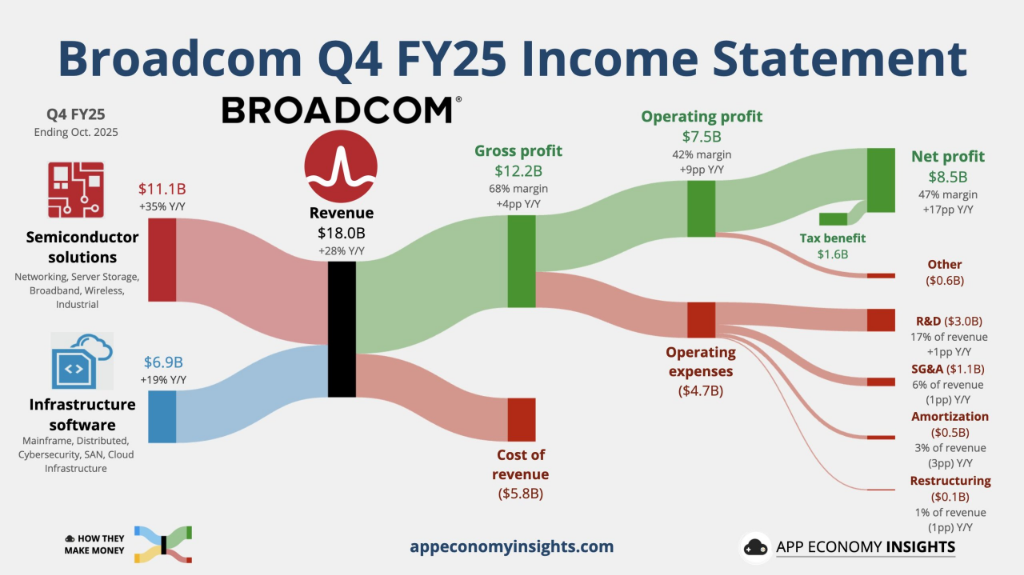
Core Viewpoint - Despite not raising the full-year guidance for fiscal year 2026 as some investors expected, Goldman Sachs reaffirmed a "Buy" rating for Broadcom, citing the company's strengthening dominance in the custom chip sector and robust fundamentals in its AI business [1][2]. Financial Performance - Broadcom reported a strong fourth-quarter revenue of $18 billion, exceeding market expectations of $17.5 billion. The guidance for the first quarter of fiscal year 2026 is set at $19.1 billion, significantly above the analyst forecast of $18.3 billion. This growth is primarily driven by a 74% year-over-year increase in AI semiconductor revenue [1][5]. - The AI semiconductor revenue reached $6.5 billion, surpassing the expected $6.2 billion, while total semiconductor solutions revenue was $11.1 billion, above the anticipated $10.7 billion. Infrastructure software revenue was $6.9 billion, slightly exceeding expectations [5]. Market Reaction and Guidance - The market's reaction to the earnings report may be mixed, as there is disappointment over the lack of an updated full-year guidance for fiscal year 2026. Analysts noted that the absence of an upward revision could lead to short-term stock price pressure [1][3]. - Goldman Sachs' analysts predict that Broadcom's AI revenue growth for fiscal year 2026 will actually exceed 100%, despite management's conservative stance not reflecting the actual business momentum [3]. Customer Expansion and Orders - Broadcom has made significant progress in customer expansion, maintaining strong momentum with its largest client, Google, and announcing a new major customer. The company has secured a fifth XPU customer and received an additional $11 billion order from Anthropic for fiscal year 2026 [4]. - The backlog of AI orders has reached $73 billion for the next 18 months, indicating strong demand, with additional orders expected to increase this figure [4]. Profitability Trends - Broadcom's gross margin for the fourth quarter was 77.9%, slightly above market expectations. The adjusted EBITDA margin guidance for the first quarter of fiscal year 2026 is set at 67% [5]. - Goldman Sachs noted that as Broadcom begins delivering full-rack solutions to Anthropic and potentially OpenAI in the second half of fiscal year 2026, there may be some dilution in gross and operating margins due to a higher proportion of direct components in these solutions [5]. Valuation Logic - Goldman Sachs raised Broadcom's 12-month price target from $435 to $450, based on an increase in AI revenue expectations and improved visibility into industry cycles. The estimated EPS was adjusted from $11.50 to $12.00, maintaining a 38x P/E multiple [2][7].


Microsoft to invest more than $5.4 billion in Canada to boost AI infrastructure
Yahoo Finance· 2025-12-09 11:18
Investment Overview - Microsoft is investing over C$7.5 billion ($5.42 billion) in Canada over the next two years, contributing to a total estimated investment of C$19 billion between 2023 and 2027 [1][2] Cloud Computing and AI Infrastructure - The investment aims to enhance cloud computing capacity to meet the rising demand for AI workloads, with Microsoft expanding its Azure Local cloud offering in Canada [2][3] - Microsoft is partnering with Canadian AI startup Cohere to integrate advanced AI models into its Azure platform [3] Cybersecurity Initiatives - A dedicated "Threat Intelligence Hub" will be launched in Canada to focus on cybersecurity protection and AI security research, collaborating with the Canadian government to track threat actors and organized crime [3] Global Investment Context - Microsoft has made significant global investments in AI infrastructure, including $10 billion in Portugal and $15 billion in the United Arab Emirates [4] - The company reported a record capital expenditure of nearly $35 billion for its fiscal first quarter in October, with expectations of increased spending [5]

a16z 100万亿Token研究揭示的真相:中国力量重塑全球AI版图
3 6 Ke· 2025-12-08 08:33
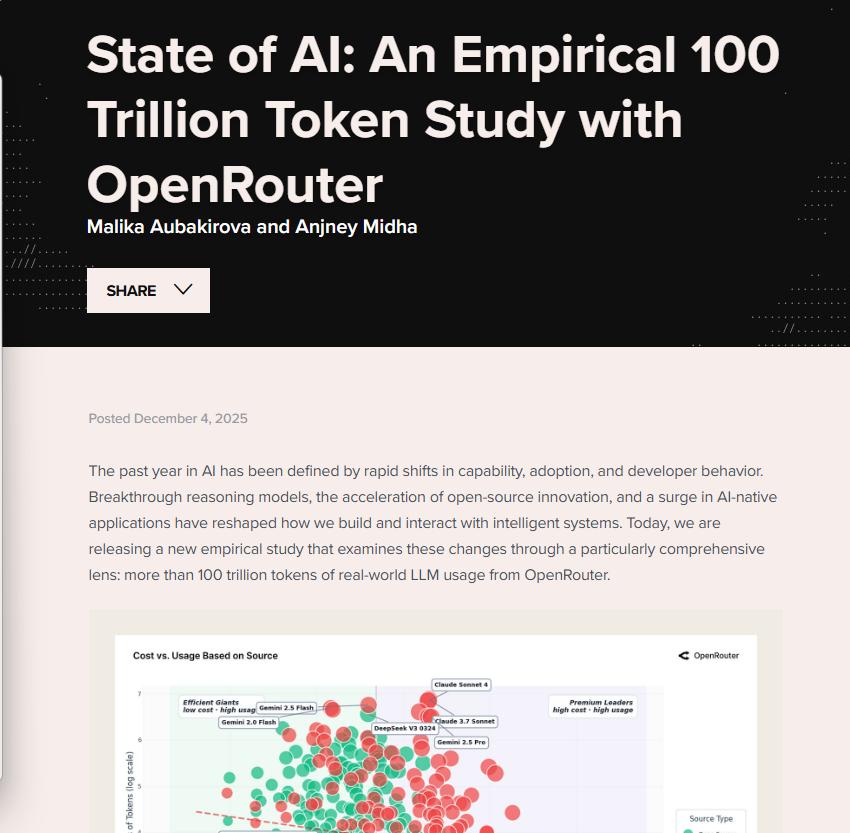
Core Insights - The report titled "State of AI: An Empirical 100 Trillion Token Study" by a16z analyzes over 100 trillion tokens from real-world applications on the OpenRouter platform, revealing the actual usage landscape of large language models (LLMs) [3] - The AI field is undergoing three fundamental shifts: moving from single model competition to a diversified ecosystem, transitioning from simple text generation to intelligent reasoning paradigms, and evolving from a Western-centric to a globally distributed innovation landscape [3] Group 1: Key Findings - The rise of open-source models, particularly from China, is notable, with market share increasing from 1.2% at the end of 2024 to nearly 30% in certain weeks by late 2025 [4][9] - Over half of the usage of open-source models is directed towards creative dialogue scenarios such as role-playing and story creation [4] - The volume of tokens processed by reasoning models has reached 50% of the total token volume [4] Group 2: Technological Advancements - The release of OpenAI's reasoning model o1 on December 5, 2024, marks a pivotal point in AI development, shifting from text prediction to machine reasoning [6] - The introduction of multi-step reasoning and iterative optimization in the o1 model significantly enhances capabilities in mathematical reasoning, logical consistency, and multi-step decision-making [6] Group 3: Open-Source Ecosystem - The open-source model ecosystem is becoming increasingly diverse, with no single model expected to dominate more than 25% of the market share by the end of 2025 [11] - The total token usage by various model developers shows a significant shift towards a more balanced distribution among multiple competitors [11][12] Group 4: User Engagement and Application - More than half of the open-source model usage is directed towards role-playing and creative tasks, indicating a strong demand for emotional connection and creative expression [15][17] - Programming-related queries are projected to grow steadily, with their share of total token volume increasing from approximately 11% at the beginning of 2025 to over 50% by the end of the year [17] Group 5: Global Trends - Asia's share of global AI usage has risen from about 13% to 31%, reflecting accelerated adoption of AI technologies and the maturation of local innovation ecosystems [23] - Chinese open-source models like DeepSeek and Qwen are gaining international recognition, contributing to the global AI landscape [24] Group 6: Market Dynamics - The AI market exhibits a complex value stratification rather than a simple cost-driven model, with high-end models maintaining significant usage despite high costs [29][30] - Open-source models are exerting pressure on closed-source providers, compelling them to justify their pricing through enhanced integration and support [32] Group 7: User Retention - The "Cinderella Glass Slipper" effect describes how users become deeply integrated with models that meet their high-value workload needs, leading to strong retention rates [33][35] - The DeepSeek model demonstrates a "boomerang effect," where users return after exploring other options, indicating its unique advantages in certain capabilities [35] Group 8: Future Outlook - The emergence of reasoning as a service is reshaping the AI infrastructure requirements, emphasizing the need for long-term dialogue management and complex functionality [22][36] - The report serves as a reference for future technological evolution, product design, and strategic planning based on real-world data [36]
呵呵!加拿大AI企业声称:“民主国家”看不上中国技术
Xin Lang Cai Jing· 2025-12-05 14:27
Core Viewpoint - The CEO of Canadian startup Cohere, Aidan Gomez, asserts that the collaboration between the U.S. and Canada will surpass China in the AI sector, emphasizing that democratic nations are reluctant to rely on Chinese technology [1][3]. Group 1: Company Insights - Cohere, based in Toronto, focuses on building enterprise-specific AI models and is positioned favorably in the global AI competition [1]. - Gomez claims that the U.S. and Canada are in an "incredibly advantageous position" for global AI adoption, despite acknowledging China's advancements in high-performance AI models [1][3]. - The company argues that the key factor is not who develops the technology first, but who can commercialize it on a large scale [1]. Group 2: Industry Trends - The rapid development of AI has led to significant investments, with tech investors pouring hundreds of billions into the sector [3]. - There is a growing demand from investors for better returns from major tech companies like Microsoft and Alphabet, indicating a shift in expectations within the industry [3]. - Concerns about AI technology risks are rising, but Gomez dismisses extreme narratives about AI's potential dangers, suggesting that the focus should be on the practical realities of AI technology [3]. Group 3: Competitive Landscape - The AI competition between the U.S. and China is intensifying, with Chinese startups like DeepSeek gaining rapid popularity and major companies like Alibaba and Baidu accelerating their AI product developments [3]. - U.S. tech giants are investing heavily to enhance their computing capabilities and AI infrastructure to maintain their leadership position in the AI field [3]. - The contrasting views between Gomez and NVIDIA CEO Jensen Huang highlight the differing perspectives on the competitive dynamics in the AI sector, particularly regarding the implications of U.S. export restrictions on Chinese technology [4].


呵呵,“‘民主国家’看不上中国技术”?
Xin Lang Cai Jing· 2025-12-05 09:27
Core Viewpoint - The CEO of Canadian startup Cohere, Aidan Gomez, asserts that the collaboration between the U.S. and Canada will surpass China in the AI sector, emphasizing that democratic nations are reluctant to rely on Chinese technology [1][3]. Group 1: Company Insights - Cohere, based in Toronto, focuses on building enterprise-specific AI models and is positioned favorably in the global AI competition [1]. - Gomez claims that the U.S. and Canada are in an "incredibly advantageous position" for global AI adoption, despite acknowledging that China has developed high-performance AI models [1][3]. - The company argues that the key factor is not who develops the technology first, but who can commercialize it on a large scale [1]. Group 2: Industry Trends - The rapid development of AI has led to significant investments, with tech investors pouring hundreds of billions into the sector [3]. - There is a growing demand from investors for better returns from major tech companies like Microsoft and Alphabet, indicating a shift in expectations [3]. - Concerns about the risks associated with AI technology are rising, but Gomez downplays apocalyptic narratives, suggesting that society is adapting to the realities of AI [3]. Group 3: Competitive Landscape - The AI competition between the U.S. and China is intensifying, with Chinese startups like DeepSeek gaining traction and major companies like Alibaba and Baidu accelerating their AI product launches [3][4]. - U.S. tech giants are investing heavily in enhancing their computing capabilities and AI infrastructure to maintain leadership in the sector [4]. - Nvidia's CEO Jensen Huang has expressed concerns about China's potential to win the AI race, highlighting the competitive pressures faced by U.S. companies [4].

呵呵,“‘民主国家’看不上中国技术”
Guan Cha Zhe Wang· 2025-12-05 07:09
Core Viewpoint - The CEO of Canadian startup Cohere, Aidan Gomez, expressed confidence that the collaboration between the U.S. and Canada will surpass China in the AI sector, attributing this to the reluctance of "democratic countries" to rely on Chinese technology [1][3]. Group 1: Company Insights - Cohere, based in Toronto, focuses on building enterprise-specific AI models and is positioned favorably in the global AI competition [1]. - Gomez highlighted that while China has developed high-performance AI models, the key factor is who can commercialize the technology on a large scale, suggesting that the U.S. and Canada are in an advantageous position [1][3]. Group 2: Industry Trends - The rapid development of AI has led to significant investments, with tech investors pouring hundreds of billions into the sector, although there is increasing pressure for better returns from major companies like Microsoft and Alphabet [3]. - Concerns about the risks associated with AI technology are growing, but Gomez dismissed extreme narratives about AI's potential dangers, emphasizing the reality of AI's integration into society [3]. Group 3: Competitive Landscape - The AI race between the U.S. and China is intensifying, with Chinese startups and tech giants accelerating the release of new models and products [3][4]. - The U.S. has implemented various export restrictions on semiconductor technology to curb China's tech development, which has led to tensions and competitive anxiety among U.S. tech leaders [4].

Groq and Cohere CFOs: Can Artificial Intelligence Be Profitable?
Alex Kantrowitz· 2025-11-28 17:30
ROI of AI - MIT研究表明,95%的企业在实施AI时未获得投资回报率,而Wharton的研究则表明74%的企业获得了投资回报率,行业对AI的投资回报率存在争议 [2] - 行业普遍认为AI的未来是光明的,但目前仍处于实验阶段,以找到实际应用并扩大规模的方法 [3] - Wharton的研究显示,74%的企业声称从AI中获得投资回报率,但副总裁及以上级别的人比经理及以下级别的人更倾向于认为他们获得了投资回报率 [8] - 衡量投资回报率的方式多种多样,包括减少人员需求、创造竞争优势以加速收入增长,以及提高效率以降低毛利率 [11] - Wharton的研究显示,年收入超过20亿美元的大公司从AI中获得投资回报率的比例为57%,低于较小公司 [25] Compute Cost and Infrastructure - Deep Seek的出现将推理模型的成本降低了约40倍 [14] - Grock致力于降低计算成本,其芯片在运行AI推理时,不仅性能领先市场,而且成本也具有差异化 [14][16] - 行业普遍认为,目前行业面临供应限制,需要部署更多容量以满足所有AI用例 [17] - 到2028年,美国四分之一的能源将用于运行AI工作负载 [19] AI Strategy and Implementation - 企业需要制定战略,明确在公司内部署AI的领域,并考虑如何衡量投资回报率 [22] - 企业应建立一个框架,围绕他们想要做什么、如何做、何时做,以及投资多少资金,并在后端进行衡量 [23] - 较小的公司更容易适应,能够更快地实施计划并在公司内部的多个不同职能部门中实施,从而获得更高的投资回报率 [26] - AI解决方案可以立即产生价值,但需要重新配置流程,而不是事后设计 [30] AI Bubble and Future Growth - 行业专家认为,对AI基础设施的投资不会后悔,但需要定义“泡沫”的含义,包括基础设施建设和公司估值 [32][33] - 行业专家预测,未来会出现一批万亿美元级别的公司,风险投资者正在选择他们的赌注 [34] - 行业专家认为,AI的某些领域可能存在泡沫,但不会影响整个行业,即使出现调整,也不会影响每家公司 [36] - Anthropic的CEO表示,该公司几年前的收入为10亿美元,预计到今年年底的运行率将接近100亿美元 [40]

SAP launches EU AI Cloud to unify digital sovereignty offerings
Yahoo Finance· 2025-11-28 09:01
Core Insights - SAP has launched the EU AI Cloud, consolidating its digital sovereignty initiatives into a framework tailored for Europe, offering customers various options for data sovereignty and deployment [1][3] - The platform is designed to meet EU data residency and regulatory compliance requirements, allowing enterprises to incorporate AI into core business processes while adhering to local regulations [2][3] Deployment Options - The EU AI Cloud provides multiple deployment options, including SAP Sovereign Cloud, on-site models, and partnerships with approved European cloud providers, ensuring compliance with European regulations [3][5] - AI workloads are hosted in European data centers, ensuring independence from non-European hyperscalers, which is crucial for maintaining data sovereignty [4] Partnerships and Collaborations - SAP has partnered with Cohere to integrate agentic AI capabilities into the SAP Business Technology Platform, enhancing AI integration for enterprises with data residency constraints [2] - Tata Consultancy Services (TCS) has been selected to support SAP's cloud and generative AI transformation under a five-year agreement, focusing on streamlining IT operations and enhancing AI capabilities [6][7]

SAP Unveils EU AI Cloud: A Unified Vision for Europe's Sovereign AI and Cloud Future
Prnewswire· 2025-11-27 08:30
Core Insights - SAP SE has launched the EU AI Cloud, a sovereign AI and cloud offering designed specifically for Europe, which allows customers to choose their level of sovereignty and deployment options [1][2][4] - The collaboration with Cohere aims to enhance AI capabilities for European enterprises, integrating advanced AI models into the SAP Business Technology Platform (SAP BTP) [2][3] - The EU AI Cloud is supported by a robust ecosystem of partners, enabling flexible deployment options and compliance with European data protection regulations [3][5] Group 1: EU AI Cloud Overview - The EU AI Cloud provides a full-stack sovereign cloud offering, ensuring compliance with EU data residency and operational requirements [1][5] - Customers can deploy AI models on SAP's infrastructure or trusted European partners, maintaining control over their data and compliance [5][8] Group 2: Partnership and Ecosystem - SAP's partnership with Cohere will unlock agentic AI capabilities, allowing enterprises to integrate AI into their core business processes without compromising on sovereignty [2][4] - The ecosystem includes leading partners like Mistral AI and OpenAI, facilitating the development and scaling of AI-powered applications [3][4] Group 3: Deployment Flexibility - EU AI Cloud offers various deployment options, including SAP Sovereign Cloud and on-site solutions, tailored to meet specific regulatory and operational needs [5][8] - The infrastructure is designed to ensure that all data remains within the EU, aligning with European data protection standards [8]
“贴牌”AI产品溢价高达千倍!200家公司被曝仅18家真创新、38家代码相似度超 90%,创始人只想“忽悠”到底?
AI前线· 2025-11-24 05:52
Core Insights - The rapid expansion of foundational model providers is likely to crush almost every AI application layer startup, as highlighted by Yishan Wong, former CEO of Reddit [2][3] - A recent survey revealed that 73% of 200 AI startups that secured funding within six months are merely "shelling" third-party APIs, with ChatGPT being the core technology [5][6] - Only 18 out of the 200 startups are genuinely innovating in technology, raising concerns about the authenticity of claims made by many companies in the AI sector [5][8] Group 1 - The analysis conducted by Teja Kusireddy involved monitoring network traffic, reverse engineering code, and tracking API calls to assess the actual technological capabilities of AI startups [6][12] - 12 companies were found to have exposed their API keys in frontend code, indicating a lack of awareness about security practices [7][43] - The disparity between marketing claims and actual technological implementation is alarming, with many companies misrepresenting their capabilities [8][54] Group 2 - The investigation revealed that 73% of the startups have significant gaps between their claimed technology and actual implementation, with some companies charging exorbitant prices for basic API calls [11][20] - Companies claiming to have proprietary models often rely on existing APIs like OpenAI's, leading to inflated costs and misleading marketing [15][19] - The true cost of using these APIs can be significantly lower than what companies charge their customers, indicating a high markup on services [31][35] Group 3 - The research identified three main patterns among AI startups: those falsely claiming proprietary models, those using common RAG architectures without acknowledgment, and those misrepresenting their model fine-tuning efforts [24][36] - The majority of companies do not genuinely train their models from scratch, with only 7% truly investing in original model development [36][39] - The findings suggest that many AI startups are essentially service-oriented businesses that have replaced human labor with API costs, which is not inherently negative but should be transparently communicated [58][64] Group 4 - The current landscape of AI startups is characterized by a lack of transparency, with many founders feeling pressured to exaggerate their technological capabilities to attract investment [54][67] - The call for a "transparency era" in the AI sector is emphasized, urging companies to be honest about their technology stacks and focus on user experience [64][66] - The investigation concluded that the ability to replicate a startup's core technology within a short timeframe is a key indicator of whether it is merely an API wrapper [57][68]