Flexport

Search documents
一个周末就变天!特朗普钢铝关税范围陡然扩大,美国进口商措手不及
Hua Er Jie Jian Wen· 2025-08-19 17:10
Core Viewpoint - The Trump administration has significantly expanded the scope of steel and aluminum tariffs by 50%, adding 407 derivative products to the tariff list, creating substantial compliance pressure for U.S. importers [1][5]. Group 1: Tariff Expansion Details - The new tariff list includes a wide range of products such as machinery, motorcycles, children's swings, and tableware, which are subject to additional tariffs due to their steel and aluminum content [1][2]. - The expanded tariff list officially took effect on August 18, as announced by the U.S. Department of Commerce [5]. - The logistics industry expressed strong dissatisfaction, indicating that the rapid implementation of these changes caught many off guard, complicating compliance efforts [1][3]. Group 2: Industry Reactions - Trade compliance professionals noted that the lack of prior notification regarding the changes has made it difficult for importers to make informed purchasing decisions [1][3]. - Industry experts, including a professor from Michigan State University, expressed confusion over the strategy of imposing tariffs on a broad range of intermediate goods, suggesting that it may be counterproductive [3][6]. - The logistics giant Kuehne + Nagel highlighted that the new regulations represent a strategic shift in the oversight of steel and aluminum derivative products, increasing complexity and costs for businesses [3][4]. Group 3: Impact on Trade and Exports - The new tariffs are expected to further depress Chinese aluminum exports to the U.S., although the impact of the newly added products is anticipated to be less severe than previous rounds of tariffs [1][5]. - According to industry analysis, the value of goods currently covered by metal tariffs is estimated to be around $328 billion, significantly higher than previous years [3]. - The U.S. remains heavily reliant on aluminum imports, with an import dependency of approximately 40%, complicating efforts for domestic production to meet demand [6].
X @TechCrunch
TechCrunch· 2025-07-28 20:51
Flexport sells former freight unicorn Convoy's tech two years after buying it | TechCrunch https://t.co/dC56aMQB5p ...
美国商务部长力推关税,但他儿子的公司却下注“关税会被法院驳回”?
Hua Er Jie Jian Wen· 2025-07-22 03:50
Core Viewpoint - The article discusses the financial service company Cantor Fitzgerald, led by the son of U.S. Commerce Secretary Wilbur Ross, which is offering to purchase potential refunds for tariffs paid by companies, betting on the likelihood that these tariffs may be permanently blocked by the courts [1][2]. Group 1: Tariff Refund Transactions - Cantor Fitzgerald is willing to buy tariff refund rights at a discount of 20% to 30% of the amount paid by companies [2]. - For a company that has paid $10 million in tariffs, they could expect to receive between $2 million and $3 million from this transaction [2]. - Cantor has already completed a significant transaction representing about $10 million in tariff refund rights, with expectations of substantial growth in this figure in the coming weeks [2]. Group 2: Market Sentiment and Predictions - The pricing of Cantor's transactions suggests that investors believe there is a greater than 3:1 chance that the tariffs will be overturned [3]. - In contrast, only 11% of bets on the prediction market Polymarket are placed on the occurrence of refunds, indicating a prevailing optimism about the stability of the policy [3]. Group 3: Ethical Considerations and Responses - Secretary Ross has denied any involvement in the decision-making process of Cantor Fitzgerald, asserting compliance with ethical agreements regarding asset divestiture [4]. - Despite Ross's support for the tariff policy, experts suggest that the transaction reveals internal assessments of the legal basis for tariffs, potentially affecting investor confidence in the stability of the policy [5].
喝点VC|YC内部对谈给AI时代下迷茫的年轻人支招:AI时代不靠学历履历,而是靠判断力、自主性及动手解决问题的能力
Z Potentials· 2025-07-19 03:27
Core Viewpoint - The discussion emphasizes the shift in personal core competencies in the AI era from traditional qualifications to judgment, autonomy, and execution skills, highlighting the importance of hands-on experience and understanding real-world problems [3][7][8]. Group 1: Entrepreneurial Pathways - The current entrepreneurial landscape is characterized by a sense of urgency and anxiety regarding job security due to AI advancements, leading to questions about the future of stable employment [4][5]. - Traditional career paths that relied on degrees and resumes are becoming less secure, with companies now valuing problem-solving abilities and hands-on experience over mere compliance [7][8]. - Successful entrepreneurs are those who engage directly with real-world challenges, demonstrating curiosity and proactive problem-solving rather than following established templates [7][19]. Group 2: Education and Skills - The role of education is being re-evaluated, with a focus on whether it truly prepares individuals for the demands of the AI-driven job market, where execution and independent thinking are paramount [8][9]. - Many current educational programs are seen as outdated, failing to equip students with the necessary skills to thrive in a rapidly changing technological landscape [9][10]. - The importance of practical experience through personal projects is highlighted as a more effective learning method than traditional classroom education [11][12]. Group 3: Market Entry Strategies - Entering from a niche market is identified as a key strategy for startup success, with examples like Airbnb and Stripe illustrating how small, focused beginnings can lead to significant market impact [44][45]. - The emphasis is on deeply understanding a small market and iterating on products based on user feedback, rather than trying to appeal to a broad audience from the outset [45][46]. - Companies that successfully identify and serve a specific user base can gradually expand into larger markets, demonstrating the effectiveness of a targeted approach [44][45].


Flexport CEO: Here's how U.S. tariffs are altering shipping patterns this year
CNBC Television· 2025-07-18 15:47
Inventory & Tariffs - Many shippers front-loaded inventory ahead of tariffs, leading to unusual inventory levels for this time of year, with 77% of Flexport's customers reporting sufficient stock [2][3] - A temporary surge in airfreight demand is observed from Southeast Asian countries to beat the August 1st deadline for higher tariffs [4] - The industry anticipates potential shortages if tariff rates significantly increase, impacting businesses [6] Trade Lane Dynamics - China to US trade lane is down approximately 16% year-over-year, an improvement from a 60% drop following the April 2nd tariff announcement [7] - China's overall exports are up 5%, but exports to the US are down 16%, indicating a significant shift [8] - Southeast Asia, particularly Thailand and Vietnam, experienced a surge in exports, but face higher duty rates announced for August 1st [8] Red Sea & Suez Canal Disruption - Container ships have not been transiting the Suez Canal since December 2023 due to Houthi activity, impacting approximately 30% of global container traffic [12][13] - The disruption in the Red Sea is keeping ocean freight rates artificially high, with no foreseeable return to normal [13]

Trade War Scorecard: What's Changing, Who's Winning, What's Next — With Ryan Petersen
Alex Kantrowitz· 2025-07-07 20:37
Global Trade Dynamics - Tariffs and trade-war maneuvers are rewiring supply chains worldwide [1] - Discussion includes 145% "Liberation Day" duties and $5,000 per container costs [1] - The death of the de minimis loophole impacts Amazon, Temu, and Shein [1] - The Panama Canal drought is affecting global trade [1] Technology & Automation - AI robocalls 400,000 truckers [1] - Warehouse-robot reality checks are being discussed [1] Legal & Compliance - Customs fraud is now the DOJ's No 2 white-collar priority [1]

TradeCafe Appoints Flexport and PayPal Veteran Huey Lin to Board as Company Accelerates Global Expansion
GlobeNewswire News Room· 2025-06-10 23:25
Core Insights - TradeCafe has appointed Huey Lin to its Board of Directors, bringing expertise in global logistics and fintech from her previous roles at Flexport, Affirm, and PayPal [1][4][5] - The appointment is timely as TradeCafe aims to digitize the agri-commodity trading ecosystem, addressing inefficiencies in the movement of agricultural products amid increasing global food security concerns and supply chain challenges [2][6] - Lin's operational experience and strategic insights are expected to enhance TradeCafe's global expansion strategy and support its mission to transform the $2 trillion global spot transaction market for physical agri-commodities [6][7] Company Overview - TradeCafe is a technology-driven global marketplace facilitating seamless transactions in the spot market for physical agri-commodities, having facilitated over $3 billion in transactions across more than 80 markets [7] - The platform offers a comprehensive suite of tools for price discovery, transaction management, and end-to-end fulfillment and logistics capabilities, positioning itself as a trusted infrastructure for agri-commodity trading [7]


AI 创业者的反思:那些被忽略的「快」与「长」
Founder Park· 2025-06-10 12:59
Core Insights - The article emphasizes the importance of "speed" and "long context" in AI entrepreneurship, highlighting that these factors are crucial for product direction and technology application [1]. Group 1: Importance of Speed - The author reflects on the significance of speed in user experience, noting that convenience can greatly influence user habits, as seen with ChatGPT and Perplexity [3][4]. - A previous underestimation of speed's impact led to a decline in usage rates, reinforcing the idea that fast-loading and smooth experiences are invaluable [4]. Group 2: Long Context Utilization - The article discusses the realization of the practical effects of long context in AI models, particularly with the introduction of models capable of handling 1 million tokens, which significantly enhances product capabilities [7][8]. - The author critiques previous industry assumptions about context usage, asserting that many claims about enterprise knowledge bases were misleading until effective models emerged [7]. Group 3: Market Dynamics and Product Strategy - The text highlights a shift in market dynamics where low Average Revenue Per User (ARPU) products can now offer strong sales and customized experiences, challenging previous notions about product distribution [6]. - The author suggests that traditional marketing strategies are being disrupted by AI capabilities, allowing for more effective customer engagement and retention strategies [6]. Group 4: Product Development and Experimentation - The article stresses the need for product managers to engage deeply with AI models, advocating for hands-on experimentation and A/B testing to refine product features [9]. - It points out that understanding the underlying model capabilities is more critical than merely focusing on user interface and experience [9]. Group 5: Future of AI Products - The author predicts that the most successful products in the AI era will be those that maximize the potential of recommendation algorithms and user-generated content ecosystems [10]. - The article concludes with a reference to the strategic focus of leading tech companies on developing superior models, suggesting that successful business models will follow [10].

这位35岁的女高管正在规划美国外卖巨头的未来
财富FORTUNE· 2025-06-03 12:16
Core Viewpoint - Parisa Sadrzadeh, an executive at DoorDash, has played a significant role in the company's strategic initiatives, including a recent $1.2 billion acquisition aimed at enhancing services for restaurants and retailers [1][5]. Group 1: Career Progression - Sadrzadeh graduated from the University of Washington in 2010 and initially took a temporary position at Amazon, which was not aligned with her long-term career goals in storytelling [1][2]. - Her curiosity and proactive approach led to her being noticed by a director at Amazon, resulting in her collaboration with an engineering team to automate tasks, which eventually led to her promotion to a product manager position within a year [2][3]. - By the age of 32, Sadrzadeh became one of the youngest female vice presidents in Amazon's history, overseeing the global demand-side platform, a critical component of Amazon's last-mile delivery operations [3][4]. Group 2: Transition to DoorDash - At 35, Sadrzadeh made a significant career move by joining DoorDash as the Vice President of Strategy and Operations, tasked with expanding the DoorDash Commerce Platform to assist restaurants and retailers [4][5]. - She led the decision for DoorDash to acquire SevenRooms for $1.2 billion, a company that develops software to help restaurants and hotels manage bookings and customer relationships [5]. - Sadrzadeh emphasized the importance of increasing foot traffic to physical stores, as these customers represent the highest profit margins for businesses [5].


天鸽互动(01980.HK):前瞻性布局AI赛道,隐蔽资产型公司成色几何?
Ge Long Hui· 2025-06-03 08:09
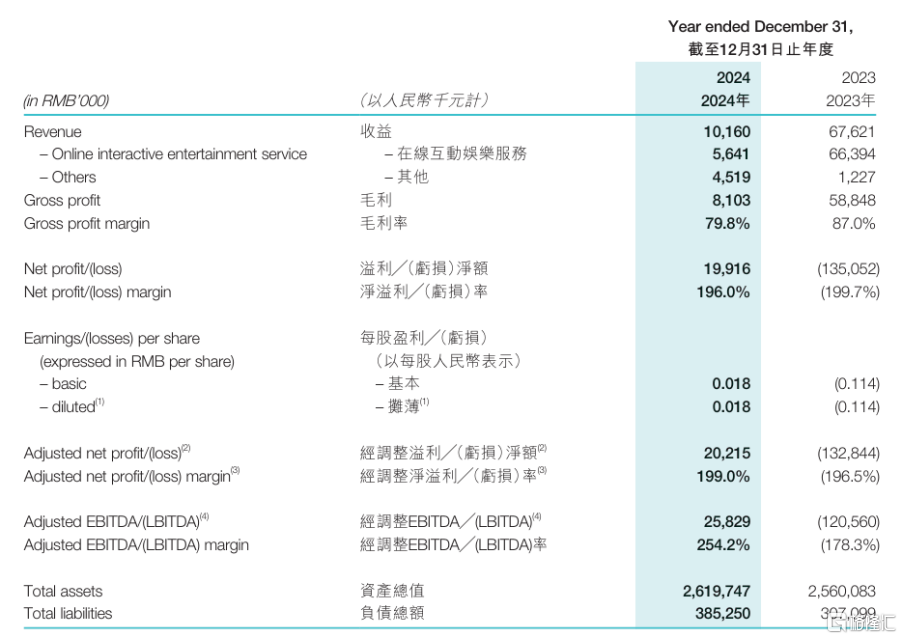
Core Viewpoint - Tian Ge Interactive (01980.HK) reported a significant turnaround in its financial performance for the year ending December 31, 2024, achieving a revenue of 10.16 million RMB and a net profit of 20 million RMB, compared to a loss of 135 million RMB in the previous year [1][2][3]. Financial Performance - Revenue for 2024 was 10.16 million RMB, a decrease from 67.62 million RMB in 2023 [2]. - The company reported a gross profit of 8.1 million RMB, with a gross profit margin of 79.8%, down from 87.0% in the previous year [2]. - Net profit reached 19.92 million RMB, marking a net profit margin of 196.0%, a significant recovery from a net loss margin of 199.7% in 2023 [2]. - Earnings per share improved to 0.018 RMB from a loss of 0.114 RMB per share in the previous year [2]. Investment Strategy and Portfolio - The company has strategically invested in high-growth potential sectors, including social reasoning games, Southeast Asian e-commerce, and short video content in India, which contributed to its improved financial performance [3][5]. - As of December 31, 2024, Tian Ge Interactive's financial assets totaled 1.757 billion RMB, with significant holdings in fund investments, private investments, and wealth management products [6][7]. - The company’s investment portfolio includes stakes in emerging technology companies, which are expected to yield substantial returns due to their innovative business models and strong market potential [23][24]. Market Position and Valuation - Despite the positive financial results, the company's market capitalization is currently undervalued at approximately 662 million HKD (about 607 million RMB), compared to the average price-to-book ratio of 0.85 for the investment and asset management sector [8]. - The company’s cash and cash equivalents stood at 467 million RMB, indicating a strong liquidity position [8]. - The market perception of Tian Ge Interactive remains focused on its traditional live-streaming business, overlooking the hidden value in its technology investments, particularly in AI-related assets [25].