
石头科技

Search documents
“扫遍”东南亚,中国品牌靠什么拿下八成市场?
Guan Cha Zhe Wang· 2026-01-14 00:48
Core Viewpoint - The Southeast Asian market is emerging as a new opportunity for Chinese smart cleaning device brands, despite previous doubts about its consumer spending power, especially following the bankruptcy of iRobot, which once dominated the global market with nearly 80% share [1][3]. Market Dynamics - Chinese brands have rapidly gained market share in Southeast Asia, capturing 80% of the local robotic vacuum market, driven by technological innovation and localized strategies [4]. - The Southeast Asian e-commerce market is projected to reach $128.4 billion in 2024, with double-digit GMV growth and a young population enhancing online purchasing power [4][9]. Competitive Strategy - Companies like Roborock, Ecovacs, and others are leveraging localized product strategies to adapt to the unique living environments and climates of Southeast Asia, focusing on features such as extended battery life and odor control [4]. - The "online + offline" collaborative model is being employed to enhance brand recognition and consumer trust, with over 100 experience stores established in Vietnam alone [5]. E-commerce Ecosystem - Alibaba's international business group is crucial in supporting Chinese brands' expansion into Southeast Asia, providing a comprehensive service system that facilitates market entry [6]. - Lazada, as a key platform, offers a "one-click light export" project that simplifies the process for merchants, allowing them to synchronize product and marketing information without additional investment [6][8]. Future Outlook - The digital economy in Southeast Asia is expected to drive continued growth for smart cleaning products, with e-commerce transactions projected to reach $186 billion by 2025 [9]. - The outflow model of Chinese brands is evolving from simple product exports to deep localization, with a focus on understanding local consumer preferences and building localized teams [9][10]. - Innovations in platform operations are lowering barriers for market entry, as demonstrated by Lazada's significant sales growth during major shopping events [10].



AI应用催化密集,AI+家电落地加速
Orient Securities· 2026-01-13 12:57
Investment Rating - The report maintains a "Positive" investment rating for the home appliance industry, indicating an expectation of returns exceeding the market benchmark by more than 5% [4][11]. Core Insights - The report highlights that the domestic market's consumption potential is expected to be activated by the continuation of national subsidies, despite a marginal slowdown in their impact. The "Two New" policies are anticipated to further stimulate demand in the home appliance sector [3]. - The report emphasizes the acceleration of AI applications in the home appliance industry, with significant developments expected from AI models and smart hardware products [2][6]. Summary by Sections Domestic Market Outlook - The report notes that the leading companies in the white goods sector have a higher proportion of first-level energy-efficient products and more mature management processes for trade-in programs, positioning them to benefit more significantly from the evolving market dynamics [3]. - The first quarter of 2026 is projected to see stable production schedules for white goods, aligning with domestic market expectations [5]. International Expansion - The report identifies international expansion as a long-term strategy, with companies that diversify their production capacity being favored. A valuation shift is anticipated by 2026 [3]. AI Integration - The report discusses the rapid iteration of AI models and their broad application in the home appliance sector, suggesting that smart hardware products integrated with AI services are becoming a key trend. Companies like Yingzi Network are highlighted for their deep engagement in smart home segments [6].





高盛公司将石头科技评级上调至买进,目标价210元人民币
Xin Lang Cai Jing· 2026-01-13 11:04
Group 1 - Goldman Sachs upgraded Stone Technology to a "Buy" rating with a target price of 210 RMB [1]
中国扫地机器人“扫”全球 东南亚成重点市场
Zhong Guo Xin Wen Wang· 2026-01-13 09:50
Group 1 - The core viewpoint of the article highlights the rapid rise of Chinese robotic vacuum cleaners, which are becoming a preferred choice for global consumers, with significant market share and growth potential [1] - According to IDC data, the global shipment of smart robotic vacuums is expected to reach 17.424 million units in the first three quarters of 2025, representing a year-on-year growth of 18.7% [1] - Chinese manufacturers, including Roborock, Ecovacs, Dreame, Xiaomi, and Yunji, dominate the global market, accounting for nearly 70% of total shipments [1] Group 2 - Southeast Asia is identified as a key market for Chinese brands, with retail sales of robotic vacuums in the region increasing by nearly 40% year-on-year in the first seven months of 2025 [1][2] - The market share of Chinese robotic vacuums in Southeast Asia surged from 38.8% in the same period of 2024 to 64.1% in 2025, indicating strong growth momentum [1] - Factors contributing to the success of Chinese products in Southeast Asia include a complete consumer electronics supply chain, agile supply chain responsiveness, and effective channel operations [2] Group 3 - The rapid growth of e-commerce in Southeast Asia, along with a young population and high digitalization, creates favorable conditions for the long-term development of smart cleaning products [1] - Companies are enhancing brand influence through efficient channel operations, leveraging both online and offline strategies to adapt product offerings and pricing based on consumer preferences [2] - Sales of leading Chinese robotic vacuum brands on the Lazada platform are experiencing double-digit growth in 2025 [2]



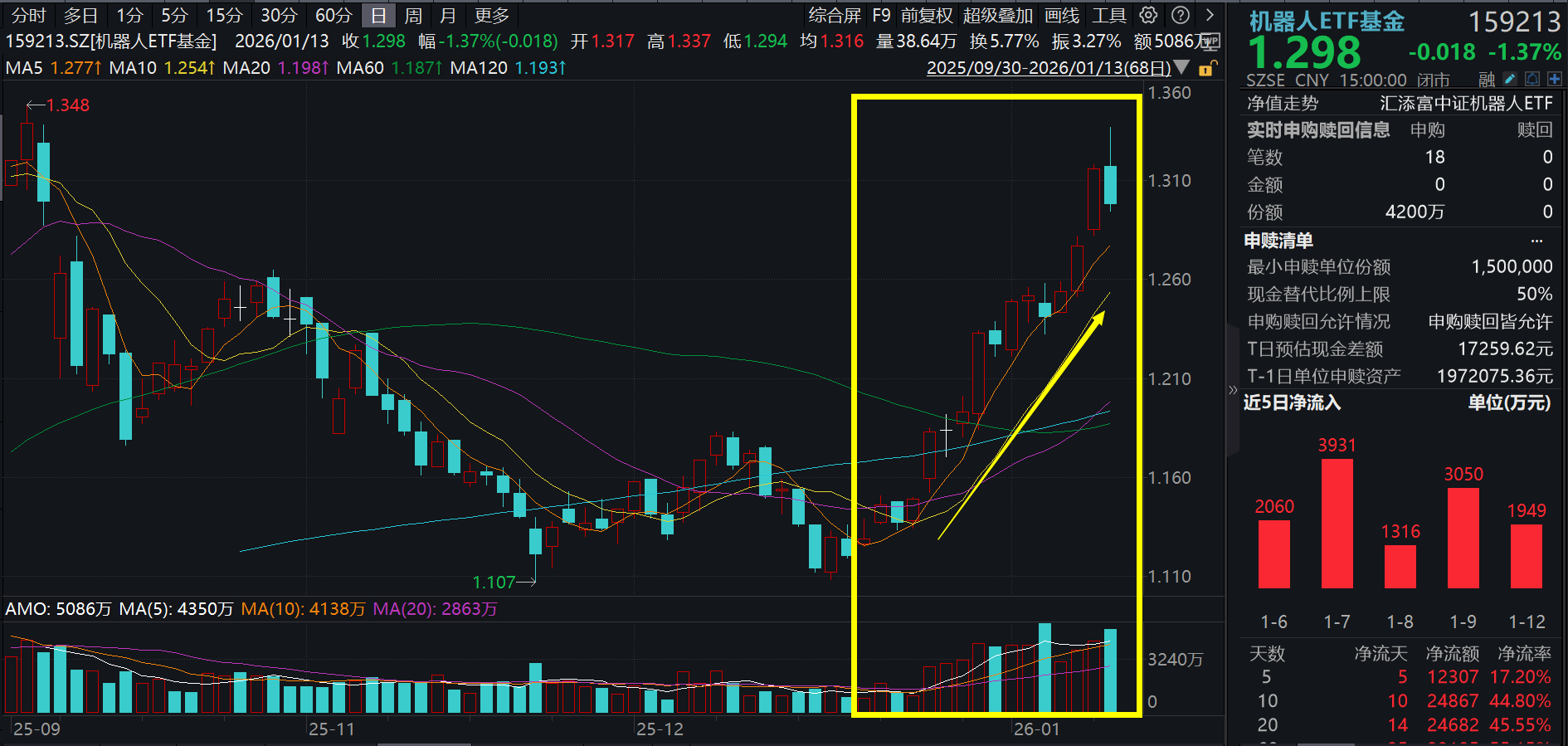
人形机器人再迎政策催化!中控技术涨近10%,资金连续11日涌入机器人ETF基金(159213),合计净流入超3亿元!机器人4年后将完胜人类医生?
Sou Hu Cai Jing· 2026-01-13 09:43
Market Overview - On January 13, the A-share market experienced a volatile pullback, with the Shanghai Composite Index halting its 17-day winning streak. The Robot ETF Fund (159213) fell by 1.37%, while it attracted over 55 million yuan in capital on that day, marking a total of over 300 million yuan in inflows over the past 11 days [1] ETF Fund Composition - The top ten constituent stocks of the Robot ETF Fund (159213) showed mixed performance, with notable gainers including Zhongkong Technology (+9.9%), Lide Harmony (+3.54%), and Keda Xunfei (+2.16%). Conversely, major declines were seen in Dazhu Laser (-5.52%) and Huichuan Technology (-3.12%) [2][4] Policy and Industry Dynamics - The Ministry of Industry and Information Technology announced initiatives for the 14th Five-Year Plan, focusing on revitalizing traditional industries and promoting emerging sectors, including quantum technology, humanoid robots, and AI [3] - The recent CES exhibition highlighted the dominance of Chinese humanoid robot manufacturers, with Chinese companies occupying 21 out of 38 humanoid robot booths, exceeding 50% of the total [5] Technological Developments - Elon Musk projected that general artificial intelligence (AGI) will arrive by 2026, with robots expected to surpass human surgical skills within three years and achieve superior performance compared to human doctors in four years [6] - Eastern Securities noted that the narrative around humanoid robots is shifting from simple mass production to AGI capabilities, suggesting that the latter will have a stronger impact on investment opportunities [7] Challenges in Production - The production of humanoid robots faces three main challenges: developing a highly dexterous hand, an AI brain capable of understanding the real world, and achieving large-scale production. The AI brain is identified as the most critical challenge for the industry's advancement [8] - Tesla is actively working on enhancing its AI brain for humanoid robots, with expectations for prototype production readiness by early 2026, indicating potential investment opportunities in the first half of 2026 [9] Investment Opportunities - The market is witnessing a significant interest in humanoid robots, with major global tech companies investing in this sector. The Robot ETF Fund (159213) is positioned to provide investors with access to the growth potential of the humanoid robot industry [10]





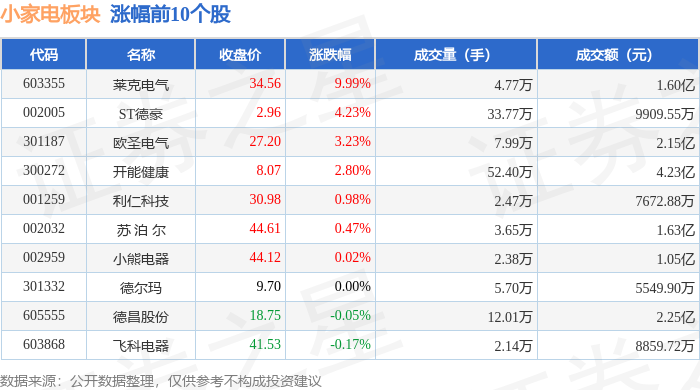
小家电板块1月13日跌0.19%,倍益康领跌,主力资金净流出4482.82万元
Zheng Xing Xing Ye Ri Bao· 2026-01-13 08:57
Market Overview - The small home appliance sector experienced a decline of 0.19% on January 13, with Beiyikang leading the drop [1] - The Shanghai Composite Index closed at 4138.76, down 0.64%, while the Shenzhen Component Index closed at 14169.4, down 1.37% [1] Stock Performance - Lek Electric (603355) saw a significant increase of 9.99%, closing at 34.56 with a trading volume of 47,700 shares and a transaction value of 160 million [1] - ST Dehao (002005) rose by 4.23%, closing at 2.96 with a trading volume of 337,700 shares and a transaction value of 99.1 million [1] - Other notable performers include Ousheng Electric (301187) up 3.23% and Kaineng Health (300272) up 2.80% [1] Declining Stocks - Beiyikang (920199) experienced the largest decline of 11.32%, closing at 49.80 with a trading volume of 61,700 shares and a transaction value of 321 million [2] - Other stocks that declined include Bi Yi Co. (603215) down 3.39% and Ecovacs (603486) down 2.85% [2] Capital Flow - The small home appliance sector saw a net outflow of 44.82 million from institutional investors, while retail investors experienced a net outflow of 29.78 million [2] - Conversely, speculative funds recorded a net inflow of 74.61 million [2] Individual Stock Capital Flow - Kaineng Health (300272) had a net outflow of 22.09 million from institutional investors, while it attracted a net inflow of 15.71 million from speculative funds [3] - Su Bor (002032) saw a net inflow of 21.78 million from institutional investors, but a net outflow of 14.63 million from speculative funds [3] - Lek Electric (603355) had a net inflow of 20.66 million from institutional investors, while it faced a net outflow of 9.65 million from speculative funds [3]


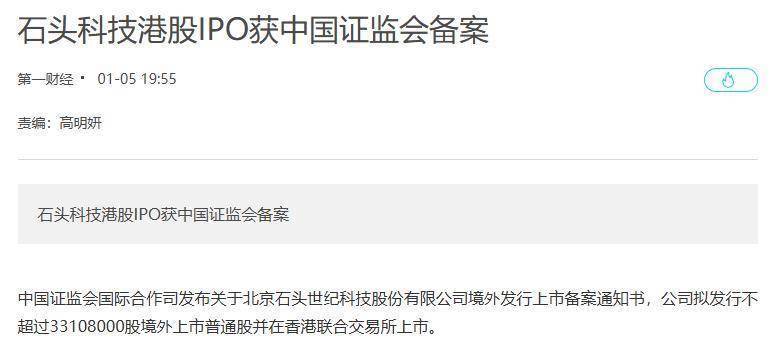
石头科技港股IPO临考:营销难撑利润、转型阻力重重、信任岌岌可危
Sou Hu Cai Jing· 2026-01-13 08:07
Core Viewpoint - Stone Technology, once a star in the robotic vacuum industry, is at a critical juncture for its Hong Kong listing, having received the overseas listing filing notice from the China Securities Regulatory Commission, indicating the start of its "A+H" dual-platform capital operation. This move comes as the company faces challenges in both performance growth and market trust [1] Financial Performance - In 2024, the company's revenue is projected to exceed 11.9 billion yuan, with a year-on-year growth rate of 38%, but net profit is expected to decline by 3.64% year-on-year [2] - The divergence in revenue and profit trends is expected to worsen in the first three quarters of 2025, with revenue surging by 72% year-on-year while net profit plummets by nearly 30% [2] - Sales expenses have surged, with a 73% year-on-year increase to 2.967 billion yuan in 2024, where advertising and promotion costs account for 65% of this figure [2] - Gross margin has declined from 55% in 2023 to 43.7% by the third quarter of 2025, indicating a loss of pricing power [2] - Return on equity has halved from 31.85% in 2020 to 16.3% in 2024, and operating cash flow has decreased by 20% year-on-year to 1.734 billion yuan [2] - Inventory levels have surged from 1.49 billion yuan at the beginning of 2024 to 3.716 billion yuan by the end of the third quarter, with inventory turnover dropping to 4.93 times per year, indicating a prolonged sales cycle [2] Strategic Challenges - The company's "de-distribution" reform in overseas markets has led to a 77% year-on-year increase in overseas business costs, significantly outpacing revenue growth [3] - The expansion into new product lines faces stiff competition, particularly in the washing machine sector dominated by Haier and Midea, which hold 90% of the market share, while the smart vacuum and accessories still contribute over 90% of revenue in 2024 [3] - The concentrated business structure raises concerns about the difficulty of strategic transformation [3] Market Trust Issues - The capital market is witnessing a trust crisis, with the actual controller, Chang Jing, having cashed out over 900 million yuan through various means since 2023, resulting in a 2.27 percentage point decrease in his shareholding [4] - Controversially, after reducing his holdings, he publicly urged investors to "be patient," which has sparked discussions on social media [4] - The shareholding ratio of Xiaomi-related investment institutions has dropped from 6.17% to 2.49% over three years, with cumulative profits exceeding 4 billion yuan [4] - Consumer trust is also eroding, with over 3,000 complaints on the Black Cat Complaint platform related to product quality and after-sales response [4] Industry Context - The robotic vacuum market is undergoing a deep adjustment period, characterized by slowed technological iteration, increased product homogeneity, and ongoing price wars, all of which are compressing profit margins for companies [5] - Stone Technology's decision to list in Hong Kong comes at a time when it must navigate domestic market growth challenges while facing scrutiny from international capital markets [5] - Balancing scale expansion with profit quality and rebuilding investor confidence will be crucial for the company's capital journey [5]
家用电器产业亮点:从2026CES看智能家居机器人产品趋势
Xin Lang Cai Jing· 2026-01-13 06:33
Group 1 - The 2026 CES showcased significant advancements in smart home cleaning robots, with a focus on AI technology transitioning from concept to reality, featuring around 4,300 exhibitors, including 942 from China, representing 22% of total participants [1] - Major trends in vacuum robots include larger rollers, stronger suction, and enhanced object recognition technology, leading to improved cleaning efficiency and reduced operational costs [2] - The lawn mowing robot segment is seeing upgrades in large area cutting, obstacle navigation, and edge cutting capabilities, with strong competition from companies like Ninebot, which launched nine new products at CES 2026 [3] Group 2 - Pool cleaning robots are evolving similarly to vacuum and lawn mowing robots, with AI integration enhancing navigation and obstacle avoidance features, and companies like Ecovacs and MOVA entering the market with differentiated products [4] - Investment outlook is positive for vacuum robots due to technological advancements that enhance cleaning effectiveness, efficiency, and operational cost reduction, while lawn mowing robots are expected to gain market traction through significant upgrades [4] - Chinese companies are leading the smart home cleaning robot market, with a focus on product upgrades driven by technology, highlighting growth potential for companies like Ninebot, Roborock, and Ecovacs [4]
石头科技跌2.02%,成交额7.08亿元,主力资金净流出3903.17万元
Xin Lang Cai Jing· 2026-01-13 05:40
Core Viewpoint - Stone Technology's stock price has shown fluctuations, with a recent decline of 2.02% and a year-to-date increase of 4.78%, indicating volatility in market performance [1]. Financial Performance - For the period from January to September 2025, Stone Technology achieved a revenue of 12.066 billion yuan, representing a year-on-year growth of 72.22% [2]. - The net profit attributable to shareholders for the same period was 1.038 billion yuan, reflecting a year-on-year decrease of 29.51% [2]. Shareholder Information - As of September 30, 2025, the number of shareholders decreased by 8.77% to 15,900, while the average number of circulating shares per person increased by 9.76% to 16,251 shares [2]. - The company has distributed a total of 1.463 billion yuan in dividends since its A-share listing, with 1.052 billion yuan distributed over the past three years [3]. Institutional Holdings - The second-largest circulating shareholder is Hong Kong Central Clearing Limited, holding 14.5491 million shares, an increase of 4.4262 million shares from the previous period [3]. - The fourth-largest shareholder, E Fund's SSE STAR 50 ETF, reduced its holdings by 1.0901 million shares to 7.4823 million shares [3]. - New institutional investors include E Fund's National Robot Industry ETF, holding 3.1749 million shares [3].
行业研究|专题报告|家用电器:产业亮点:从2026CES看智能家居机器人产品趋势
Changjiang Securities· 2026-01-13 05:11
Investment Rating - The investment rating for the home appliance industry is "Positive" and maintained [11] Core Insights - The 2026 CES highlighted advancements in smart home cleaning robots, with Chinese companies leading the upgrade of products. The focus remains on enhancing cleaning effectiveness, efficiency, range, and operational costs [2][9][64] - The report emphasizes the technological upgrades in various segments: - For vacuum robots, improvements include larger rollers and stronger suction, enhancing cleaning efficiency and reducing operational costs [6][20] - For lawn mowers, upgrades focus on large area cutting, obstacle avoidance, and edge cutting capabilities, with Ninebot launching nine new products at CES 2026 [7][45] - For pool robots, the integration of AI and navigation features is becoming more prevalent, with companies like Yuan Ding and Xing Mai innovating in this space [8][53] Summary by Sections Vacuum Robots - The evolution of vacuum robots is centered on cleaning effectiveness, efficiency, range, and operational costs. Notable products include the G-Rover from Roborock, which features a unique leg structure allowing it to navigate stairs and complex environments [20][25] - Other brands like Ecovacs and Dreame are also enhancing their products with longer rollers and improved cleaning technologies, significantly increasing cleaning efficiency [29][34] Lawn Mowers - The lawn mower segment is seeing significant technological advancements, particularly in large area cutting and obstacle avoidance. Ninebot's new product lineup includes models designed for various terrains and cutting needs [7][46] - The report notes that the European market is experiencing explosive growth, while the U.S. market is slower due to various factors [7][45] Pool Robots - The development of pool robots is aligning with the more mature cleaning robot segments, incorporating advanced AI and navigation technologies. Companies are introducing features like self-cleaning bases and enhanced obstacle avoidance [53][59] - Yuan Ding's Scuba V3 Ultra and Xing Mai's Beatbot AquaSense X are examples of innovative products that enhance cleaning efficiency and user experience [55][57] Investment Recommendations - The report expresses optimism regarding the growth potential of companies like Ninebot, Roborock, and Ecovacs, driven by technological advancements and market penetration opportunities [9][64]