呷哺呷哺

Search documents
「新消费观察」翻台率普遍失守!“海底捞们”遭遇增长瓶颈,集体走在转型路上
Hua Xia Shi Bao· 2025-08-27 08:38
Core Viewpoint - The restaurant industry is facing significant challenges, with major players like Haidilao, Jiumaojiu, and others reporting declines in both revenue and net profit in the first half of 2025, while budget-friendly brands like Xiaocaiyuan and Green Tea Group show stable growth [2][3][4]. Group 1: Financial Performance - Haidilao reported revenue of 20.7 billion yuan, a decrease of 3.7% year-on-year, and a net profit of 1.76 billion yuan, down 13.7% [2]. - Jiumaojiu's revenue was 2.75 billion yuan, a decline of 10.1%, with a net profit of 60.69 million yuan, down 16% [2]. - Other companies like Xianyin and Quanjude also reported declines in revenue and net profit, while Xiaocaiyuan and Green Tea Group saw revenue and net profit growth of over 20% [3][4]. Group 2: Consumer Trends - The consumer environment has shifted towards budget-friendly dining, with average spending per customer decreasing across many brands [3][4]. - Xiaocaiyuan's average customer spending was 57.1 yuan, down 3.3 yuan year-on-year, while Green Tea Group's was 55.5 yuan, down 2.6 yuan [3]. - Haidilao's average customer spending slightly increased to 97.9 yuan, but this is a decline from 104.9 yuan in 2022 [4]. Group 3: Operational Challenges - Key operational metrics like table turnover rates have declined, with Haidilao's dropping from 4.2 to 3.8 times per day [4]. - Same-store sales for major brands, including Haidilao and Jiumaojiu, also showed negative trends, with Xiaocaiyuan's same-store sales declining by 7.2% [4]. Group 4: Strategic Adjustments - Haidilao is adjusting its store strategy by reducing self-operated locations and increasing franchise operations, closing 33 self-operated restaurants while adding 28 franchises [5][6]. - Jiumaojiu has also closed stores, with a reduction in the number of Taier locations by 68, indicating a cautious approach to expansion [6][7]. - Both companies are exploring new growth avenues, with Haidilao launching the "Pomegranate Plan" to develop new restaurant brands [8][9]. Group 5: Future Outlook - The overall restaurant market is experiencing slow growth, with a reported revenue increase of only 4.3% in the first half of 2025 compared to 7.9% in the previous year [7]. - The industry is shifting focus from scale to quality, emphasizing profitability and customer experience over mere expansion [7][9]. - Jiumaojiu's transformation efforts for Taier are still under observation, while Haidilao's new brands face sustainability challenges [9].


翻台率普遍失守!“海底捞们”遭遇增长瓶颈,集体走在转型路上
Hua Xia Shi Bao· 2025-08-27 08:28
Core Insights - The restaurant industry continues to face significant challenges, with major players like Haidilao, Jiumaojiu, and others reporting declines in both revenue and net profit for the first half of 2025 [2][3][4] - The shift towards affordable dining options has become a mainstream trend, benefiting companies like Xiaocaiyuan and Green Tea Group, which reported revenue and profit growth [3][4] - Key operational metrics such as table turnover rates and same-store sales have declined across many restaurant chains, indicating a tough market environment [4][5] Revenue and Profit Performance - Haidilao reported revenue of 20.7 billion yuan, a decrease of 3.7% year-on-year, and a net profit of 1.76 billion yuan, down 13.7% [2] - Jiumaojiu's revenue fell to 2.75 billion yuan, a 10.1% decline, with net profit dropping to 60.69 million yuan, down 16% [2] - Other companies like Xian Catering and Xiaobai also reported significant losses, with Xian Catering facing over 50 million yuan in losses [2][4] Consumer Trends - The average consumer spending in the restaurant sector has generally decreased, with Xiaocaiyuan's average dining expenditure dropping by 3.3 yuan to 57.1 yuan, and Green Tea Group's by 2.6 yuan to 55.5 yuan [3] - Haidilao's average spending slightly increased by 0.5 yuan to 97.9 yuan, while Jiumaojiu's related brand, Tai Er, saw a 2 yuan increase to 73 yuan, but both are down from 2022 levels [3] Operational Challenges - Table turnover rates have declined, with Haidilao's rate dropping from 4.2 to 3.8 times per day, and Jiumaojiu's Tai Er from 3.8 to 3.1 times [4] - Same-store sales have also decreased across various brands, with Xiaocaiyuan's same-store sales falling from 2.32 billion yuan to 2.16 billion yuan, a 7.2% decline [4] Strategic Adjustments - Haidilao is adjusting its store strategy by reducing self-operated locations while increasing franchise operations, with a total of 1,322 self-operated restaurants, down by 33 [5][6] - Jiumaojiu has closed some of its underperforming stores, with Tai Er's locations decreasing to 566, down by 68 [5][6] - Both companies are exploring new growth avenues, with Haidilao launching the "Pomegranate Plan" to develop new restaurant brands, while Jiumaojiu is upgrading Tai Er's offerings [7][8] Market Outlook - The overall restaurant market is experiencing sluggish growth, with a reported revenue increase of only 4.3% in the first half of 2025 compared to 7.9% in the previous year [6] - Analysts suggest a shift in focus from expansion to quality and profitability, indicating that mere growth in store numbers may not lead to increased profits [6][7]
茶火锅,东方树叶的红油版
3 6 Ke· 2025-08-27 06:25
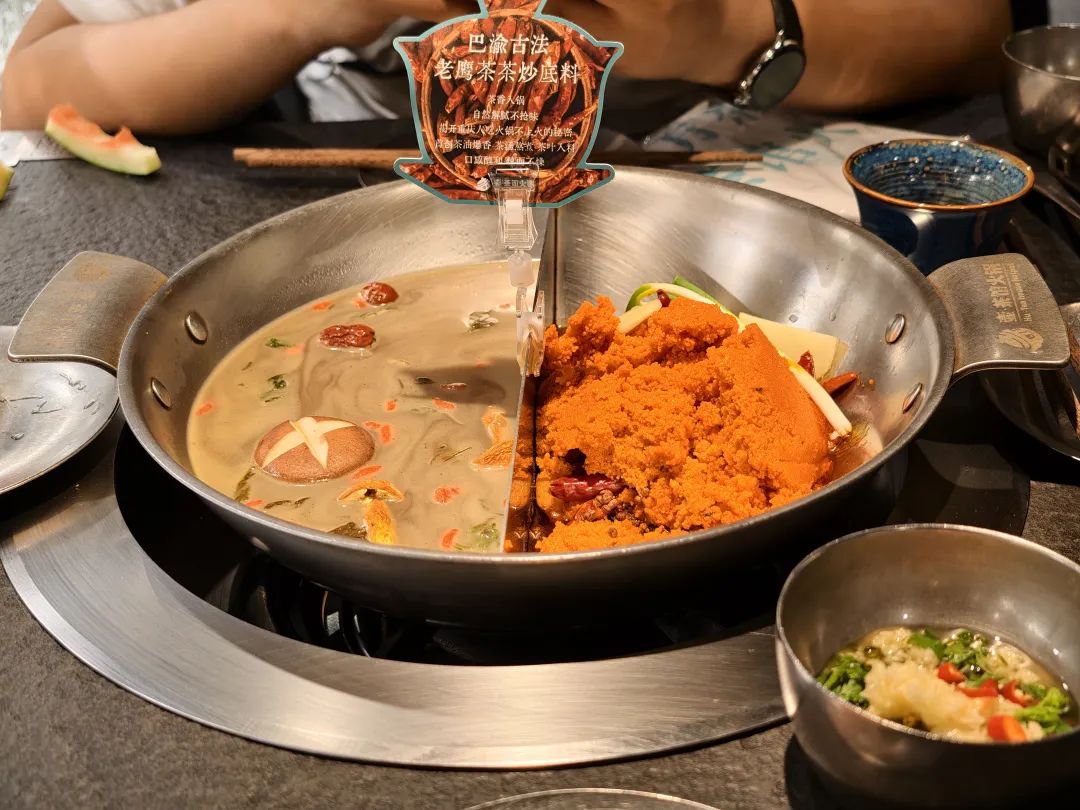
Core Insights - The emergence of "tea hotpot" restaurants reflects the industry's anxiety to innovate in a saturated market, but many of these concepts may be more about marketing than substance [1][12][21] - The tea hotpot experience often fails to deliver a strong flavor profile, with many customers noting that the tea does not complement the spicy broth as intended [4][8][15] - The rise of "water hotpot" as a cost-effective alternative highlights the industry's focus on reducing expenses while attempting to attract customers with health-oriented narratives [9][12][14] Industry Trends - The hotpot market is experiencing high saturation, particularly in first and second-tier cities, leading to a decline in unique dining experiences [18][20] - Cost control has become a priority, with many establishments shifting from oil-heavy broths to lighter, water-based options to reduce ingredient costs [14][15] - The competitive landscape is characterized by a lack of differentiation, with many brands relying on similar marketing strategies and menu offerings, resulting in a homogenized dining experience [19][21] Consumer Behavior - Customers are increasingly drawn to novelty and unique dining experiences, but many find that new concepts like tea hotpot do not meet their expectations in terms of flavor [5][21] - Promotions and gimmicks, such as scratch-off cards for discounts, are common strategies used by restaurants to attract customers, but they may not lead to long-term loyalty [5][21] - The perception of healthiness associated with lighter hotpot options may not be enough to overcome the strong preference for traditional, flavor-rich offerings [15][16]
内卷的火锅江湖,“油水”已经不多
Hu Xiu· 2025-08-27 05:49
Core Insights - The emergence of "tea hotpot" restaurants reflects a trend in the hotpot industry, which is experiencing saturation and a search for differentiation [2][31][36] - Despite the novelty, tea hotpot appears to be more of a marketing gimmick than a substantial culinary innovation, with mixed reviews on taste and experience [2][8][29] Industry Trends - The hotpot market is highly saturated, particularly in first and second-tier cities, leading to a decline in unique offerings and increased competition [31][35] - New concepts like "water hotpot" are also emerging, emphasizing lower oil content and health benefits, but they are not fundamentally new [17][19][36] - Cost control has become a priority in the industry, with a shift from traditional oil-based broths to lighter options to reduce expenses [24][23] Consumer Experience - Consumers have mixed feelings about the taste of tea hotpot, often finding it lacking in flavor compared to traditional hotpot offerings [8][14][15] - The dining experience is being marketed as a lifestyle choice, with an emphasis on rituals and unique presentations, but this may not sustain long-term customer loyalty [27][28] Financial Performance - Several hotpot chains are reporting declining sales and profits, indicating a challenging market environment [30][31] - The average spending per customer in new hotpot concepts varies, with some establishments offering lower prices to attract customers [22][18] Marketing Strategies - Innovative marketing tactics, such as social media promotions and customer engagement activities, are being employed to create buzz around new hotpot concepts [34][39] - However, the effectiveness of these strategies in building lasting brand loyalty remains uncertain [36][28]
呷哺呷哺(00520) - 买卖协议
2025-08-26 08:42
日期:2025 年 4 月 17 日 贺光自 (作为卖方) 及 Xiabuxiabu Catering Management (China) Holdings Co., Ltd. (呷哺呷哺餐饮管理(中国)控股有限公司) (作为买方) 有关买卖 Xiabuxiabu (China) Food Holdings Co. Ltd. (呷哺呷哺 (中国)食品控股有限公司) 40%股份的 买卖协议 1. 释义 Scanned with CamScanner | | 释义 | | | --- | --- | --- | | | 买卖目标股份 | | | | 先决条件 = | | | | 对价 | | | | 完成交易 | | | | 卖方声明及保证 | | | | 买方声明及保证 | | | | 保密及公告 | | | | 其他保证。 | 8 | | 10. | 通知 . | 8 | | 11. | 时间及并无豁免 | | | 12. | 部分无效________________________________________9 | | | 13. | 修订 | 9 | | 14. | 转让 _ | | | 15. | ...
呷哺呷哺(00520) - 於2025年9月12日(星期五)举行之股东特别大会之代表委任表格
2025-08-26 08:39
地址為 Xiabuxiabu Catering Management (China) Holdings Co., Ltd. 呷哺呷哺餐飲管理(中國)控股有限公司 ( 於 開 曼 群 島 註 冊 成 立 的 有 限 公 司 ) (股份代號:520) 於2025年9月12日(星期五)舉行之 股東特別大會之代表委任表格 本人╱吾等 (附註1) 為本人╱吾等的受委代表,出席上述公司為考慮並酌情通過股東特別大會通告所載的決議案而謹訂於2025年9月 12日(星期五)上午十時正於香港上環皇后大道中183號新紀元廣場21樓舉行的股東特別大會及其任何續會,於大 會及其任何續會上代表本人╱吾等行事,並按下列指示 (附註4) 就決議案為本人╱吾等及以本人╱吾等名義進行投票。 | 贊成 | (附註4) 普通決議案 | (附註4) | (附註4) 反對 | | --- | --- | --- | --- | | 1. | 「動議謹此確認及批准本公司(作為買方)與賀光啓先生(作為賣方)就收 | | | | 購呷哺呷哺(中國)食品控股有限公司40%股權所訂立日期為2025年4月17 | | | | | 日的買賣協議(「該協議」)及其項下 ...
呷哺呷哺(00520) - 股东特别大会通告
2025-08-26 08:36
香港交易及結算所有限公司及香港聯合交易所有限公司對本通告的內容概不負責,對 其準確性或完整性亦不發表任何聲明,並明確表示,概不對因本通告全部或任何部份 內容而產生或因倚賴該等內容而引致的任何損失承擔任何責任。 Xiabuxiabu Catering Management (China) Holdings Co., Ltd. 呷哺呷哺餐飲管理(中國)控股有限公司 ( 於 開 曼 群 島 註 冊 成 立 的 有 限 公 司 ) (股份代號:520) 股東特別大會通告 承董事會命 呷哺呷哺餐飲管理(中國)控股有限公司 主席 賀光啓 香港,2025年8月27日 於本通告日期,本公司董事會包括執行董事賀光啓先生及馮煇煌先生;非執行董事陳 素英女士;以及獨立非執行董事韓炳祖先生、張詩敏女士、葛文達先生及黃正忠先生。 茲通告呷哺呷哺餐飲管理(中國)控股有限公司(「本公司」)謹訂於2025年9月12日(星期 五)上午十時正假座香港上環皇后大道中183號新紀元廣場21樓舉行股東特別大會(「股 東特別大會」),藉以考慮並酌情通過下列決議案: 普通決議案 「動議謹此確認及批准本公司(作為買方)與賀光啓先生(作為賣方)就收購呷哺呷哺 ...
呷哺呷哺(00520) - 须予披露及关连交易收购呷哺呷哺(中国)食品控股有限公司40%股权及股东特...
2025-08-26 08:32
此乃要件 請即處理 香港交易及結算所有限公司及香港聯合交易所有限公司對本通函之內容概不負責,對其 準確性或完整性亦不發表任何聲明,並明確表示概不就因本通函全部或任何部份內容而 產生或因倚賴該等內容而引致之任何損失承擔任何責任。 閣下如對本通函任何內容或應採取之行動有任何疑問,應諮詢 閣下之股票經紀或其他 註冊證券商、銀行經理、律師、專業會計師或其他專業顧問。 閣下如已售出或轉讓名下所有的呷哺呷哺餐飲管理(中國)控股有限公司之股份,應立即 將本通函及隨附之代表委任表格送交買主或承讓人,或經手買賣或轉讓之銀行、股票經 紀或其他代理商,以便轉交買主或承讓人。 Xiabuxiabu Catering Management (China) Holdings Co., Ltd. 呷哺呷哺餐飲管理(中國)控股有限公司 ( 於 開 曼 群 島 註 冊 成 立 的 有 限 公 司 ) (股份代號:520) 須予披露及關連交易 收購呷哺呷哺(中國)食品控股有限公司40%股權 及 股東特別大會通告 獨立董事委員會及獨立股東的獨立財務顧問 本公司謹訂於2025年9月12日(星期五)上午十時正於香港上環皇后大道中183號新紀元廣 場2 ...
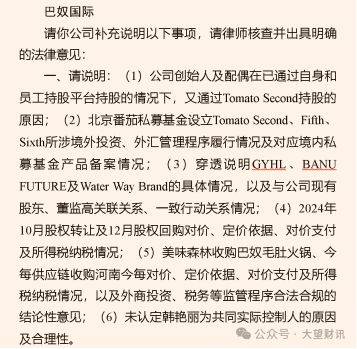
巴奴国际遭证监会9问,分红、合规及品牌争议成上市拦路虎?
Sou Hu Cai Jing· 2025-08-25 17:09
Core Viewpoint - Banu International Holdings Limited, aiming to become the third hot pot stock in Hong Kong, faces scrutiny from the China Securities Regulatory Commission (CSRC) regarding its overseas listing application, particularly concerning dividend rationality, social security compliance, and shareholding structure [1][5][7]. Group 1: Listing Application and Regulatory Concerns - Banu International submitted its listing application in June 2023, seeking to follow in the footsteps of Haidilao and Xiaobuxiang [1]. - The CSRC has raised nine questions across three main categories, with a focus on dividend rationality, social security compliance, and shareholding structure [1][3]. - The core issue is the timing of a significant dividend payout prior to the listing, which raises concerns about the necessity of subsequent financing [1][5][7]. Group 2: Financial Performance and Dividend Issues - In January 2025, Banu International declared a "surprise dividend" of 70 million yuan, with the family of founder Du Zhongbing receiving approximately 58 million yuan [5]. - The company's financial health appears questionable, with current liabilities of 717 million yuan and current assets of 864 million yuan, resulting in a net current asset of 147 million yuan [5][11]. - The company has also reported unpaid social insurance and housing fund contributions, totaling approximately 1.6 million yuan over the past three years [7][9]. Group 3: Sales Performance and Market Position - Banu International's average customer spending and daily restaurant sales have declined, with 2024 figures showing a drop of approximately 5.33% and 11.88% respectively [12][14]. - The same-store sales growth rate turned negative in 2024, and while it improved in the first quarter of 2025, it remains significantly lower than 2023 levels [14]. - The company has a complex employment structure with 1,789 full-time employees and a large number of part-time and outsourced workers, which may pose compliance risks [9][11]. Group 4: Brand Image and Controversies - The founder's controversial remarks about the brand's target demographic and the pricing of certain menu items have sparked public backlash, potentially harming the brand's image [15][16]. - Banu International has previously engaged in public disputes with competitors, which has shaped its market positioning as a high-end hot pot brand [17].
2025年中国小火锅行业发展研究报告
3 6 Ke· 2025-08-25 11:45
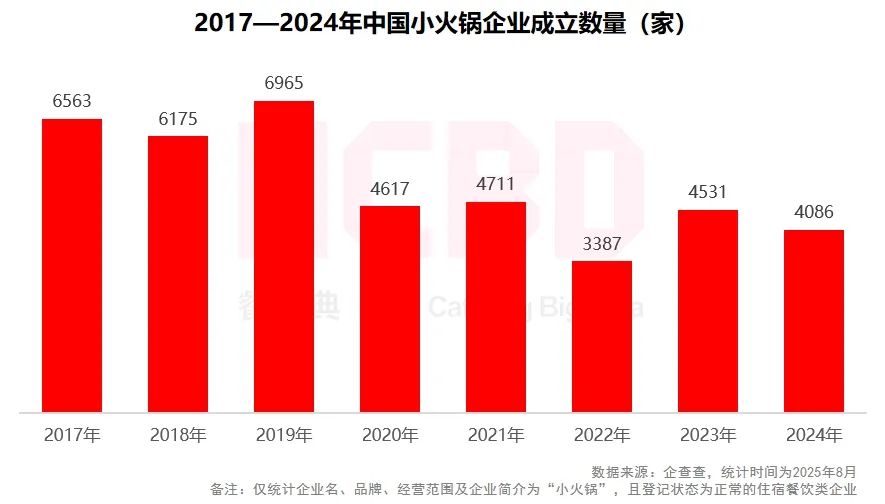
Group 1 - The core viewpoint of the article is that the small hot pot industry in China is experiencing significant changes, including market contraction, evolving consumer preferences, and increasing competition from established brands [1][2][5][34] - The number of small hot pot enterprises has decreased significantly, with over 4,000 new establishments in 2024 compared to nearly 7,000 in 2019, indicating a contraction in the market [2][5] - As of July 2025, there are approximately 23,000 small hot pot outlets in China, accounting for 5.5% of the total hot pot stores, with a projected market size nearing 65 billion yuan by 2025 [5][34] Group 2 - The leading provinces for small hot pot enterprises are Shandong with over 2,500, followed by Sichuan and Shaanxi, which both exceed 2,000 [7][9] - The East China region shows the highest enthusiasm for small hot pots, with over 25% of the total store count, followed by North China, Southwest, and Central China [7][9] Group 3 - The small hot pot industry is witnessing operational model innovations, including category integration, a shift towards fast-food attributes, and diversified consumption scenarios [10][12] - Notable small hot pot brands include Jia Bu Xia Bu with over 700 stores and an average spending of over 60 yuan, and Guo La Xiao Huo Guo with around 900 stores and a price range of 20-40 yuan [11] Group 4 - Consumer insights reveal that the majority of small hot pot consumers are young individuals aged 20-40, who prioritize personalized and convenient dining experiences [14][17] - Price sensitivity is high among consumers, with 36.4% willing to pay between 20-40 yuan, and 25% preferring prices below 20 yuan [22][25] Group 5 - The small hot pot industry faces challenges such as homogenization, poor service quality, limited ingredient variety, and freshness issues [29][32] - Consumer feedback highlights that many small hot pot brands struggle to differentiate themselves in terms of product offerings and service quality [32] Group 6 - The outlook for the small hot pot industry includes continued market expansion, accelerated brand and chain development, and a focus on product and model innovation [34][35] - Supply chain optimization is expected to become a core competitive advantage for leading brands, with an emphasis on health and quality in product offerings [34][35]