有研新材

Search documents
有研新材(600206) - 2025 Q2 - 季度财报
2025-08-29 07:50
[Part I Important Notice](index=2&type=section&id=Part%20I%20Important%20Notice) This section provides the report's declaration, management's guarantee of accuracy, and confirms no semi-annual profit distribution plan [1.1 Report Statement and Profit Distribution Plan](index=2&type=section&id=1.1%20Report%20Statement%20and%20Profit%20Distribution%20Plan) This unaudited semi-annual report summary, guaranteed by management for accuracy, confirms no profit distribution or capital increase plan for the period - This semi-annual report summary is derived from the full semi-annual report; investors should read the full text for a comprehensive understanding of the company's operating results, financial position, and future development plans[3](index=3&type=chunk) - The company's Board of Directors, Supervisory Board, and senior management guarantee the truthfulness, accuracy, and completeness of the report's content and assume legal responsibility[4](index=4&type=chunk) - This semi-annual report is unaudited, and the company has no semi-annual profit distribution plan or capital reserve to share capital increase plan[6](index=6&type=chunk)[7](index=7&type=chunk) [Part II Company Profile](index=2&type=section&id=Part%20II%20Company%20Profile) This section details the company's basic information, key financial data, shareholder structure, and confirms no changes in control [2.1 Company Overview](index=2&type=section&id=2.1%20Company%20Overview) GRIAM Advanced Materials Co., Ltd. (600206) is listed on the Shanghai Stock Exchange, with key contacts for investor relations Company Stock Summary | Stock Type | Listing Exchange | Stock Abbreviation | Stock Code | Former Stock Abbreviation | | :--- | :--- | :--- | :--- | :--- | | A-share | Shanghai Stock Exchange | GRIAM Advanced Materials | 600206 | GRIAM Silicon | Contacts and Contact Information | Contact Person and Information | Board Secretary | Securities Affairs Representative | | :--- | :--- | :--- | | Name | Yang Yang | Yan Huan | | Phone | 010-62369559 | 010-62023601 | | Office Address | 18th Floor, D Block, GRIAM Technology Innovation Center, No. 2 Xinjiekouwai Street, Xicheng District, Beijing | 18th Floor, D Block, GRIAM Technology Innovation Center, No. 2 Xinjiekouwai Street, Xicheng District, Beijing | | Email | stock@griam.cn | yanhuan@griam.cn | [2.2 Key Financial Data](index=2&type=section&id=2.2%20Key%20Financial%20Data) Total assets and net assets grew, while operating revenue declined; however, net profit and total profit saw substantial increases Key Financial Data (Unit: RMB Yuan) | Indicator | End of Reporting Period/Current Period | End of Prior Year/Prior Period | Change (%) / Change | | :--- | :--- | :--- | :--- | | **Balance Sheet** | | | | | Total Assets | 6,794,013,479.93 | 6,503,356,155.69 | 4.47 | | Net Assets Attributable to Shareholders of Listed Company | 3,957,085,223.19 | 3,917,378,324.37 | 1.01 | | **Income Statement** | | | | | Operating Revenue | 4,095,602,630.65 | 4,538,734,120.27 | -9.76 | | Total Profit | 118,937,221.46 | 29,056,327.61 | 309.33 | | Net Profit Attributable to Shareholders of Listed Company | 130,127,397.51 | 40,860,473.12 | 218.47 | | Net Profit Attributable to Shareholders of Listed Company Excluding Non-recurring Gains and Losses | 122,499,739.45 | 28,647,300.70 | 327.61 | | **Cash Flow Statement** | | | | | Net Cash Flow from Operating Activities | -225,058,063.40 | -953,177,100.93 | Not Applicable | | **Other Indicators** | | | | | Weighted Average Return on Net Assets (%) | 3.27 | 1.08 | Increased by 2.19 percentage points | | Basic Earnings Per Share (RMB/share) | 0.154 | 0.048 | 220.83 | | Diluted Earnings Per Share (RMB/share) | 0.154 | 0.048 | 220.83 | [2.3 Top 10 Shareholders' Shareholding](index=3&type=section&id=2.3%20Top%2010%20Shareholders'%20Shareholding) The company has 163,533 shareholders, with China GRIAM Group as the largest, and institutional investors among the top ten - As of the end of the reporting period, the company had a total of **163,533 shareholders**, with no preferred shareholders whose voting rights have been restored[13](index=13&type=chunk) Top 10 Shareholders' Shareholding (Unit: Shares) | Shareholder Name | Shareholder Nature | Shareholding Ratio (%) | Number of Shares Held | Number of Restricted Shares Held | Number of Pledged, Marked, or Frozen Shares | | :--- | :--- | :--- | :--- | :--- | :--- | | China GRIAM Group Co., Ltd. | State-owned Legal Person | 33.09 | 280,098,368 | 0 | None | | Guangdong Yuecai Trust Co., Ltd. - Yuecai Trust · Yuezhong No. 3 Single Fund Trust Plan | Unknown | 1.74 | 14,709,059 | 0 | Unknown | | China Rare Earth Co., Ltd. | State-owned Legal Person | 1.58 | 13,340,000 | 0 | Unknown | | Guotai Junan Securities Co., Ltd. - Guolian An CSI All-Share Semiconductor Products and Equipment ETF | Unknown | 0.74 | 6,278,052 | 0 | Unknown | | Hong Kong Securities Clearing Company Limited | Unknown | 0.69 | 5,808,623 | 0 | Unknown | | China Merchants Bank Co., Ltd. - Southern CSI 1000 ETF | Unknown | 0.65 | 5,476,804 | 0 | Unknown | | Wang Bin | Unknown | 0.39 | 3,296,600 | 0 | Unknown | | China Merchants Bank Co., Ltd. - China Asset Management CSI 1000 ETF | Unknown | 0.38 | 3,224,143 | 0 | Unknown | | China Construction Bank Co., Ltd. - Harvest CSI Rare Earth Industry ETF | Unknown | 0.36 | 3,019,359 | 0 | Unknown | | GF Securities Co., Ltd. - Guotai CSI Semiconductor Materials and Equipment Theme ETF | Unknown | 0.32 | 2,707,500 | 0 | Unknown | - The company's largest shareholder, China GRIAM Group Co., Ltd., has no affiliated relationship with the other unrestricted shareholders listed above. The company is unaware of any affiliated relationships among other unrestricted shareholders or whether they are acting in concert[14](index=14&type=chunk) [2.4 Changes in Preferred Shareholders and Controlling Shareholder](index=4&type=section&id=2.4%20Changes%20in%20Preferred%20Shareholders%20and%20Controlling%20Shareholder) No preferred shareholders, no changes in controlling shareholder or actual controller, and no outstanding bonds during the reporting period - As of the end of the reporting period, the company had no preferred shareholders[15](index=15&type=chunk) - During the reporting period, there were no changes in the company's controlling shareholder or actual controller[15](index=15&type=chunk) - As of the approval date of the semi-annual report, the company had no outstanding bonds[15](index=15&type=chunk) [Part III Significant Events](index=4&type=section&id=Part%20III%20Significant%20Events) This section confirms no significant changes in operating performance or major impactful events during the reporting period [3.1 Major Changes and Impacts on Operating Performance During the Reporting Period](index=4&type=section&id=3.1%20Major%20Changes%20and%20Impacts%20on%20Operating%20Performance%20During%20the%20Reporting%20Period) No significant changes in operating performance or matters with major current or future impact occurred during the reporting period - During the reporting period, there were no significant changes in the company's operating performance[16](index=16&type=chunk) - During the reporting period, no matters with a significant impact or expected future significant impact on the company's operations occurred[16](index=16&type=chunk)

有研新材:上半年归母净利润1.3亿元,同比增长218.47%
Xin Lang Cai Jing· 2025-08-29 07:43
有研新材8月29日披露半年报,公司上半年实现营业收入40.96亿元,同比下降9.76%;归属于上市公司 股东的净利润1.3亿元,同比增长218.47%;基本每股收益0.154元/股。 ...
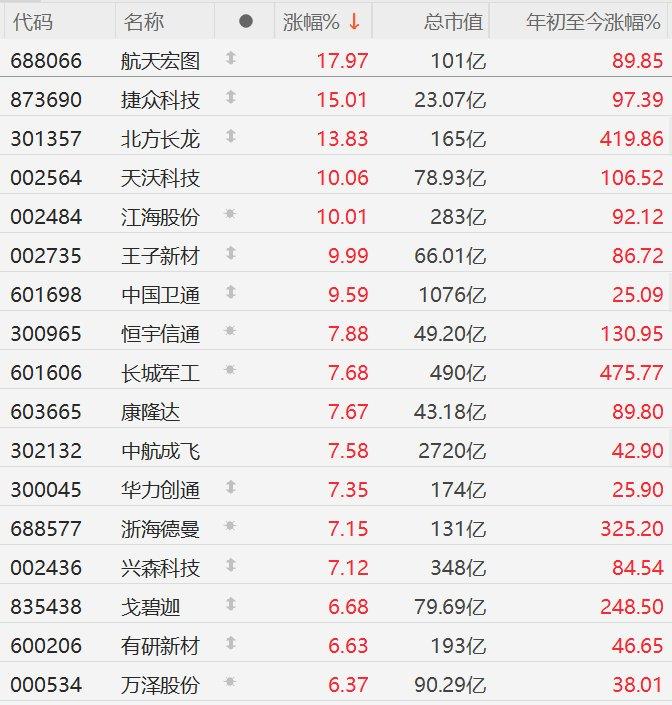
A股军工股强势,长城军工、中航成飞涨超7%
Ge Long Hui A P P· 2025-08-29 06:40
Core Insights - The A-share military industry stocks have shown strong performance, with notable increases in share prices for several companies [1] Group 1: Stock Performance - Aerospace Hongtu (航天宏图) increased by 17.97%, with a total market capitalization of 10.1 billion and a year-to-date increase of 89.85% [2] - Jiezhong Technology (捷众科技) rose by 15.01%, with a market cap of 2.307 billion and a year-to-date increase of 97.39% [2] - North Long Dragon (北方长龙) saw a 13.83% increase, with a market cap of 16.5 billion and a staggering year-to-date increase of 419.86% [2] - Tianwo Technology (天沃科技) increased by 10.06%, with a market cap of 7.893 billion and a year-to-date increase of 106.52% [2] - Jianghai Co., Ltd. (江海股份) rose by 10.01%, with a market cap of 28.3 billion and a year-to-date increase of 92.12% [2] - Other notable performers include Zhehai De Man (浙海德曼) and Xing Sen Technology (兴森科技), both showing increases of over 7% [1][2]


稀土永磁概念涨0.10%,主力资金净流入这些股
Zheng Quan Shi Bao Wang· 2025-08-27 09:05
Core Viewpoint - The rare earth permanent magnet sector experienced a slight increase of 0.10% as of the market close on August 27, ranking fourth among concept sectors, with 26 stocks rising and notable gains from Beikong Technology, Dadi Bear, and Northern Rare Earth [1][2]. Group 1: Market Performance - The rare earth permanent magnet sector saw a total of 26 stocks increase, with Beikong Technology hitting the daily limit, and Dadi Bear and Northern Rare Earth rising by 10.36%, 8.86%, and 7.07% respectively [1]. - The sector faced a net outflow of 0.96 billion yuan from main funds, with 21 stocks receiving net inflows, and six stocks exceeding 0.1 billion yuan in net inflows [2]. - Northern Rare Earth led the net inflow with 3.268 billion yuan, followed by Shenghe Resources, Beikong Technology, and Yuyuan New Materials with net inflows of 0.391 billion yuan, 0.251 billion yuan, and 0.173 billion yuan respectively [2]. Group 2: Fund Flow Ratios - Beikong Technology, Northern Rare Earth, and Yuyuan New Materials had the highest net inflow ratios at 31.97%, 11.76%, and 7.48% respectively [3]. - The trading turnover rates for the top stocks in the rare earth permanent magnet sector were as follows: Northern Rare Earth at 14.71%, Shenghe Resources at 12.91%, and Beikong Technology at 15.27% [3][4]. Group 3: Stock Performance - The top performers in the rare earth permanent magnet sector included Beikong Technology with a 9.99% increase, Northern Rare Earth with an 8.86% increase, and Dadi Bear with a 10.36% increase [3][4]. - Conversely, stocks such as Kolon Co., Rui Chen Environmental Protection, and Jintian Co. experienced declines of 5.65%, 5.63%, and 5.05% respectively [1][5].


原料价格起飞,稀土龙头净利狂增近20倍
2 1 Shi Ji Jing Ji Bao Dao· 2025-08-26 11:41
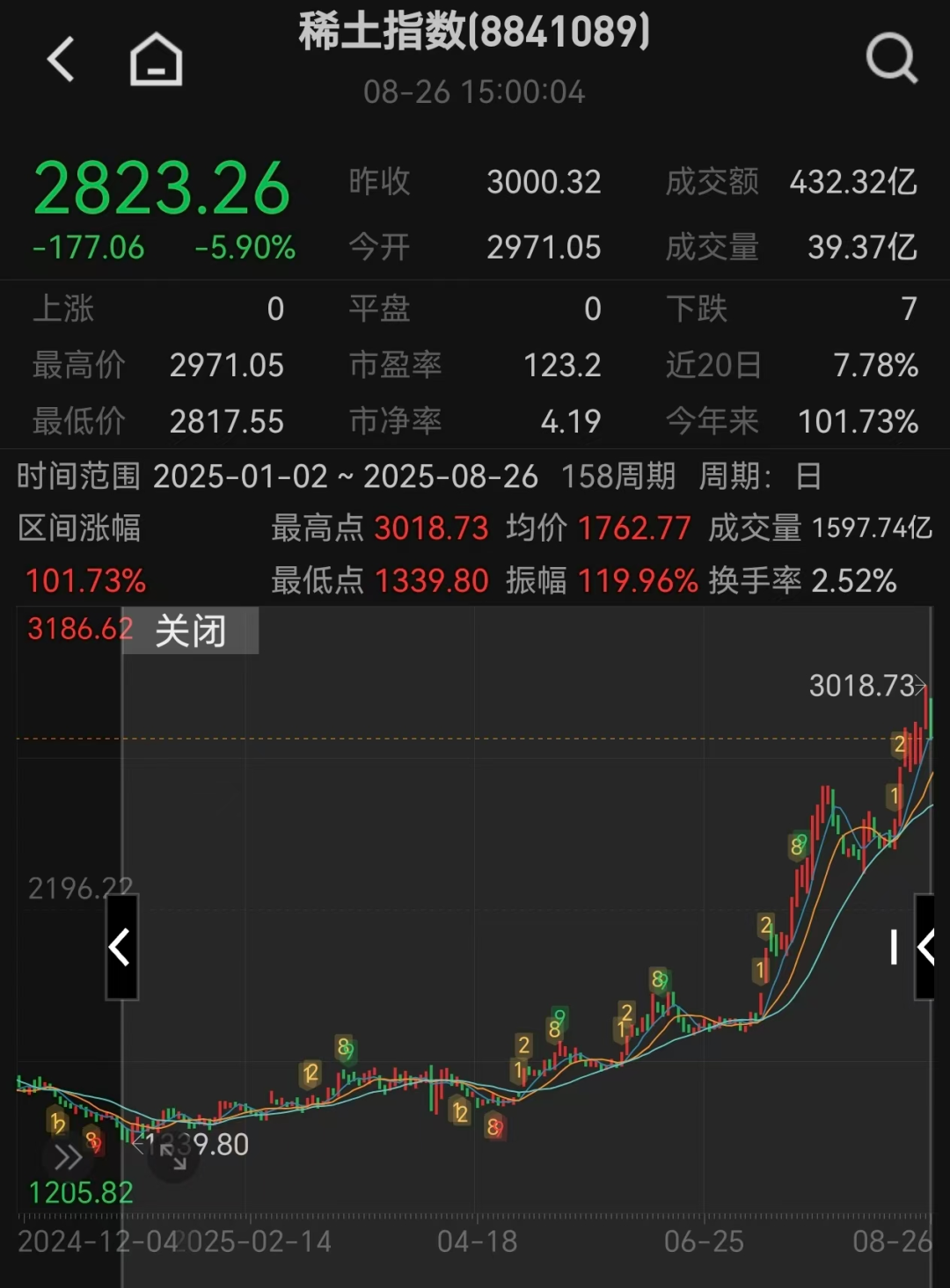
Group 1: Company Performance - Northern Rare Earth (600111) reported a revenue of 18.866 billion yuan for the first half of 2025, representing a year-on-year increase of 45.24% [1] - The net profit for Northern Rare Earth reached 931 million yuan, showing a remarkable year-on-year growth of 1951.52% [1] - The growth in performance is attributed to increased sales and average prices of key rare earth products, particularly praseodymium and neodymium [1] Group 2: Market Trends - The rare earth sector is experiencing a performance reversal, with multiple companies such as Yuyuan New Materials (600206) and Jieli Yongci (300748) reporting net profit increases exceeding 100% [2] - The rare earth index has seen a year-to-date increase of over 100%, with several stocks like Shenghe Resources and Ningbo Yunsheng doubling in price [2] - As of August 21, 2023, prices for key rare earth products have risen significantly, with praseodymium oxide increasing by over 58% year-to-date [6] Group 3: Price Dynamics - Rare earth prices have surged, with an average increase of over 100,000 yuan per ton since August [4] - The price of neodymium-iron-boron magnets has also risen, with N35 grade increasing by 51.3% year-to-date [6] - The demand for praseodymium and neodymium metals is being driven by multiple major magnet manufacturers conducting tender activities, leading to a strong demand support [6] Group 4: Regulatory Environment - The Ministry of Industry and Information Technology, along with two other departments, released interim measures for the total quantity control management of rare earth mining and separation [6] - This regulatory change marks the beginning of significant supply-side reforms in the rare earth industry, which is expected to further influence prices and market dynamics [6]
原料价格起飞,稀土龙头净利狂增近20倍
21世纪经济报道· 2025-08-26 11:36
Core Viewpoint - The rare earth sector is experiencing a significant performance turnaround, with leading companies like Northern Rare Earth reporting substantial revenue and profit growth driven by increased sales and rising prices of key rare earth products [1][3]. Group 1: Company Performance - Northern Rare Earth announced a revenue of 18.866 billion yuan for the first half of 2025, representing a year-on-year increase of 45.24%, and a net profit of 931 million yuan, up 1951.52% year-on-year [1]. - The company's performance is attributed to increased sales volumes and average prices of major rare earth products, while operating costs grew only by 38.43%, indicating strong cost control [1]. - Other rare earth companies, including Yuyuan New Materials, Jinli Permanent Magnet, and Ningbo Yunsheng, reported net profit increases exceeding 100% year-on-year, with several companies turning losses into profits [3]. Group 2: Market Trends - The rare earth index has seen a year-to-date increase of over 100%, with stocks like Shenghe Resources and Guangsheng Nonferrous doubling in price [4]. - Prices of major rare earth products have surged, with an average increase of over 100,000 yuan per ton since August [7]. - The price of neodymium iron boron N35 has risen by 51.3% year-to-date, while H35 has increased by 28% [7]. Group 3: Demand and Supply Dynamics - The demand for rare earth metals is being driven by multiple major magnet manufacturers simultaneously conducting procurement activities, leading to a strong demand for praseodymium and neodymium metals [7]. - Domestic orders are rapidly increasing due to significant price differences between domestic and international markets, resulting in a surge in replenishment orders [7]. - The Ministry of Industry and Information Technology has introduced new regulations for rare earth mining and separation, marking the beginning of significant supply-side reforms in the industry [7].
【干货】2024年粉末冶金产业链全景梳理及区域热力地图
Qian Zhan Wang· 2025-08-25 06:11
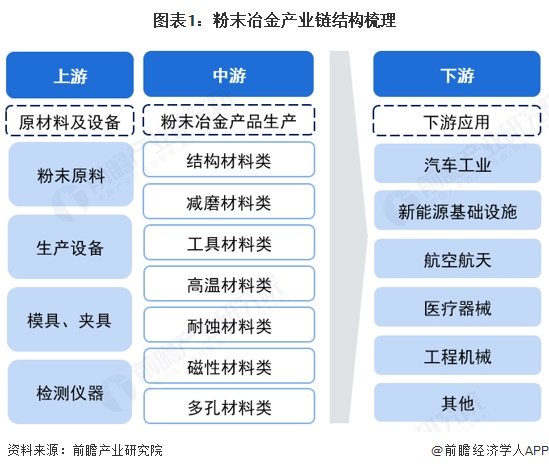
Core Insights - The powder metallurgy industry is experiencing significant growth due to increasing demand for non-ferrous metal powder materials such as nickel, copper, cobalt, and alloy powders, which are widely used in various sectors including home appliances, motorcycles, electric tools, and the automotive industry [1][3]. Industry Chain Overview - The powder metallurgy industry chain consists of three main segments: upstream (raw materials and equipment), midstream (production of powder metallurgy products), and downstream (applications in automotive, new energy infrastructure, aerospace, medical devices, and engineering machinery) [1]. - The industry is characterized as a typical intermediate processing manufacturing sector [1]. Leading Companies - Key players in the upstream raw materials segment include Yuyuan New Materials, Srey New Materials, and Boqian New Materials. Midstream companies include Antai Technology and Dongmu Co., Ltd. Notably, Antai Technology has the capability to produce both midstream and upstream products, indicating a trend towards industry chain integration [3]. Regional Distribution - The majority of powder metallurgy companies in China are concentrated in Hebei Province, with significant presence also in Shandong, Jiangsu, and Zhejiang provinces [5]. - The eastern region of China, particularly the Yangtze River Delta centered in Zhejiang Province, hosts a wide distribution of representative powder metallurgy enterprises [7]. Investment Trends - Recent investments in the powder metallurgy sector focus on capacity expansion and exploration of emerging fields. For instance, Shanxi Dongmu Magnetic Electric plans to invest in a new project for magnetic-sensitive materials with a capacity of 60,000 tons by 2025, targeting applications in new energy vehicle motors and IoT devices [10][12]. - Jinli Permanent Magnet aims to reach a production capacity of 38,000 tons for high-performance rare earth permanent magnet materials by 2024, with plans for an additional 40,000 tons by 2025 [10][12]. - Jiuling Technology is investing in a production line for high-precision parts, targeting the new energy vehicle sector, with equipment installation expected to be completed by the end of 2024 [10][12].
既“赛马”又“养马”,锂电“最好的研发在客户车间” | 解码活力中国
Zheng Quan Shi Bao Wang· 2025-08-23 02:43
Core Insights - The article highlights the breakthroughs made by Chinese lithium battery companies, particularly in solid-state battery technology, showcasing their innovative approaches to overcoming significant technical challenges [1][2][8] Group 1: Technological Breakthroughs - Solid-state batteries are seen as the next-generation power battery solution, but the solid electrolyte faces a "trilemma" of high ionic conductivity, interface compatibility, and electrochemical stability [2] - The research team at Tianqi Materials encountered significant challenges with interface impedance when solid electrolytes interacted with high-nickel cathodes, which adversely affected battery performance [2] - A dedicated focus on solving the air stability of sulfide electrolytes led to a significant discovery regarding the degradation of battery performance due to environmental exposure, prompting innovative solutions such as the development of a protective film [2][3] Group 2: Innovation Ecosystem - The company adopted a "horse racing" mechanism to evaluate competing technologies, ultimately favoring the sulfide route for its superior ionic conductivity and cycling stability [4] - The CEO emphasized the importance of maintaining a balance between openness and focus in innovation, which has become a shared understanding within the team [5] Group 3: Industry Collaboration - The collaboration between battery manufacturers and clients has become a norm, with real-time data sharing leading to rapid problem-solving and iterative improvements in battery technology [7] - The demand for solid-state batteries is driven by emerging technologies such as AI, which require enhanced battery performance, thus creating a significant market opportunity [7][8] Group 4: Market Developments - Companies like BTR and others are advancing solid-state battery materials and solutions, indicating a broader industry push towards commercialization [6] - The acceleration of solid-state battery industrialization is evident, with various companies planning to implement solid-state batteries in their products by 2026 [6]

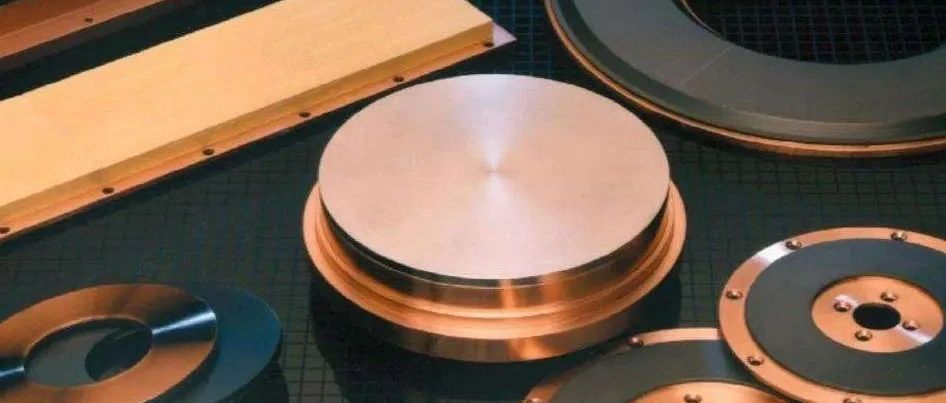
7N纯度隐形战争:拆解半导体溅射靶材的百亿替代路径(技术壁垒/市场红利/核心玩家)
材料汇· 2025-08-20 15:51
Core Viewpoint - The semiconductor sputtering target materials industry, often overlooked, is crucial for the semiconductor supply chain, with significant investment potential as domestic alternatives emerge to replace long-standing foreign monopolies [2][4]. Industry Overview: What are Sputtering Target Materials? - Sputtering target materials are essential for physical vapor deposition (PVD) processes, creating functional thin films on substrates like silicon wafers through magnetron sputtering technology [6][8]. - These materials are critical for manufacturing integrated circuits, specifically in metal interconnect layers, barrier layers, and contact layers, requiring ultra-high purity (typically above 99.9995%) and precise dimensions [8][12]. Classification of Targets - Targets are categorized by material type: metal targets (e.g., copper, aluminum), alloy targets (e.g., copper-manganese), and ceramic targets (e.g., indium tin oxide) [12][10]. - Each type serves specific functions in semiconductor applications, with increasing purity and structural uniformity requirements as technology advances [12][13]. Upstream Supply: High-Purity Metals and Equipment - The upstream supply involves high-purity metal and non-metal raw materials, with significant reliance on imports for high-purity materials [15][16]. - Key domestic producers include Xinjiang Zhonghe for aluminum and Jiangfeng Electronics for tungsten, while global leaders include Hydro for high-purity aluminum and Hitachi Metals for tungsten [16][15]. Midstream Manufacturing: Technically Intensive Core Segment - The midstream segment encompasses the manufacturing of sputtering targets, involving complex processes such as melting, forming, and binding, requiring significant R&D investment [18][17]. - Precision in temperature, time, and atmosphere during melting is crucial for ensuring material uniformity and purity [18]. Downstream Coating: Sputter Coating - The main coating processes include PVD and chemical vapor deposition (CVD), with PVD being the predominant method in semiconductor and display applications [19][21]. - The sputtering coating market is largely dominated by American and Japanese multinational corporations [21]. Terminal Applications: Core Demand from Semiconductor Industry - Downstream applications are primarily in semiconductor chip manufacturing, where sputtering target materials are vital for forming key chip structures [22][23]. - The demand for high-quality sputtering targets is driven by the increasing performance requirements of chips in high-performance computing, AI, and 5G communications [22][23]. Market Situation - The global sputtering target market has grown from 82.1 billion yuan in 2018 to 116.3 billion yuan in 2022, with a compound annual growth rate (CAGR) of 9.1% [47]. - The market is projected to reach 194.5 billion yuan by 2027, with a CAGR of 10.7% during the forecast period [47]. Competitive Landscape - The global sputtering target market is characterized by an oligopoly, with major players like JX Nippon Mining, Honeywell, and Tosoh dominating approximately 80% of the market [60][62]. - Domestic companies such as Jiangfeng Electronics and Yuyuan New Materials are making significant strides in technology and market penetration, particularly in the midstream segment [64]. Future Development Trends - The industry is expected to see increased demand for higher purity and quality sputtering targets as semiconductor processes advance to 3nm and below [68]. - Emerging applications in AI, IoT, and automotive sectors are anticipated to drive further growth in the sputtering target market [69]. Core Investment Logic - Investing in semiconductor sputtering targets is fundamentally about investing in certainty, as demand remains closely tied to capital expenditures in wafer manufacturing [74]. - The industry is protected by high technical barriers, long certification cycles, and strong customer loyalty, making it difficult for new entrants [75]. - The narrative of domestic substitution presents a significant investment opportunity, with domestic leaders poised to capture market share from established foreign players [76].


2025中国“卡脖子”材料100大清单与全景图:哪些材料国产化极低?(附100+行研报告)
材料汇· 2025-08-17 15:23
Core Viewpoint - The article emphasizes the critical role of materials in industrial manufacturing, highlighting the challenges and progress in the localization of key materials in China, particularly in the semiconductor sector, amidst global supply chain restructuring and technological competition [2]. Semiconductor Wafer Manufacturing Materials - The global photoresist market is projected to reach approximately $15 billion by 2030, with a domestic market expected to grow to 30 billion RMB. The current domestic localization rate is about 10% [6][11]. - The global silicon wafer market is expected to exceed $20 billion by 2030, with the domestic market projected to reach 50 billion RMB. The current localization rate is around 15% [11][12]. - The global electronic specialty gases market is anticipated to reach $12 billion by 2030, with a domestic market expected to grow to 35 billion RMB. The current localization rate is about 20% [14][15]. - The global target materials market is projected to exceed $20 billion by 2030, with a domestic market expected to reach 40 billion RMB. The current localization rate is around 30% [17][18]. - The global CMP materials market is expected to grow to $4 billion by 2030, with a domestic market projected to reach 7 billion RMB. The current localization rate is about 15% [23][24]. - The global wet electronic chemicals market is projected to reach $9 billion by 2030, with a domestic market expected to grow to 20 billion RMB. The current localization rate is around 35% [27][28]. - The global photomask market is expected to exceed $7 billion by 2030, with a domestic market projected to reach 12 billion RMB. The current localization rate is about 20% [30][31]. - The global GaN materials market is projected to reach $5 billion by 2030, with a domestic market expected to grow to 8 billion RMB. The current localization rate is around 30% [34][35]. - The global SiC materials market is expected to reach $3.5 billion by 2030, with a domestic market projected to grow to 6 billion RMB. The current localization rate is about 25% [36][37]. - The global ALD/CVD precursors market is projected to exceed $3 billion by 2030, with a domestic market expected to reach 6 billion RMB. The current localization rate is around 10% [38][39]. Advanced Packaging Materials - The global high-performance epoxy molding compound market is projected to reach $3.5 billion by 2030, with a domestic market expected to exceed 6 billion RMB. The current localization rate is about 30% [39][40]. - The global chip adhesive market is expected to reach $1.2 billion by 2030, with a domestic market projected to grow to 1.8 billion RMB. The current localization rate is around 25% [40][41]. - The global underfill materials market is projected to reach $3 billion by 2030, with a domestic market expected to exceed 5 billion RMB. The current localization rate is about 25% [42]. - The global thermal interface materials market is expected to exceed $12 billion by 2030, with a domestic market projected to reach 20 billion RMB. The current localization rate is around 35% [44][45]. - The global advanced packaging electroplating materials market is projected to reach $4.5 billion by 2030, with a domestic market expected to exceed 8 billion RMB. The current localization rate is about 15% [46][47]. Semiconductor Components - The global electrostatic chucks market is projected to reach $2.5 billion by 2030, with a domestic market expected to grow to 4 billion RMB. The current localization rate is around 10% [56][57]. - The global quartz products market for semiconductors is expected to reach approximately 40.2 billion RMB by 2030, with a current localization rate of less than 10% [58]. - The global etching silicon components market is projected to reach $2.26 billion by 2030, with a current localization rate of less than 20% [60].