百威亚太

Search documents
农食产业消费趋势与市场机遇探讨暨新品展示活动在厦门顺利举办
Shang Wu Bu Wang Zhan· 2025-09-11 14:27
Group 1 - The event focused on international cooperation and market opportunities in the agricultural and food industry, with participation from leading companies such as COFCO, Bunge, Cargill, Kraft Heinz, and Budweiser, as well as representatives from various economic and technological development zones [1] - The Deputy Director of the Investment Promotion Bureau emphasized that China is the world's second-largest consumer market with the largest middle-income group, indicating a growing demand for green, healthy, and convenient food products due to consumption upgrades and health awareness [1] - The discussion highlighted the current status, trends, and investment cooperation prospects in the agricultural and food industry, aiming to strengthen the connection between enterprises and development zones [1] Group 2 - The event included a product showcase where Kraft Heinz introduced its new authentic pasta sauce, and COFCO promoted the unique taste and brand culture of Great Wall wine [2] - Attendees expressed a clearer understanding of the direction for the development of a green, healthy, and delicious agricultural and food industry, establishing a solid foundation for enhancing communication and investment cooperation between enterprises and development zones [2]



智通港股沽空统计|9月11日
智通财经网· 2025-09-11 00:27
Short Selling Ratios - The top three companies with the highest short selling ratios are SenseTime-WR (80020), Anta Sports-R (82020), and Li Ning-R (82331), all at 100.00% [1][2] - Other notable companies with significant short selling ratios include BYD Company-R (81211) at 79.06% and JD Health-R (86618) at 77.31% [2] Short Selling Amounts - Alibaba-SW (09988) leads in short selling amount with 4.715 billion, followed by Tencent Holdings (00700) at 2.280 billion and Baidu Group-SW (09888) at 1.299 billion [3] - Other companies with substantial short selling amounts include Meituan-W (03690) at 1.140 billion and Zijin Mining (02899) at 0.844 billion [3] Deviation Values - The highest deviation values are recorded for SenseTime-WR (80020) at 51.53%, Li Ning-R (82331) at 36.92%, and JS Global Life (01691) at 33.07% [1][3] - Other companies with notable deviation values include Ping An Insurance-R (82318) at 30.67% and China Pacific Insurance (02601) at 26.19% [3]



“三连冠”!珍酒李渡入选Wind“ESG最佳实践100强”榜单
Sou Hu Cai Jing· 2025-09-10 08:47
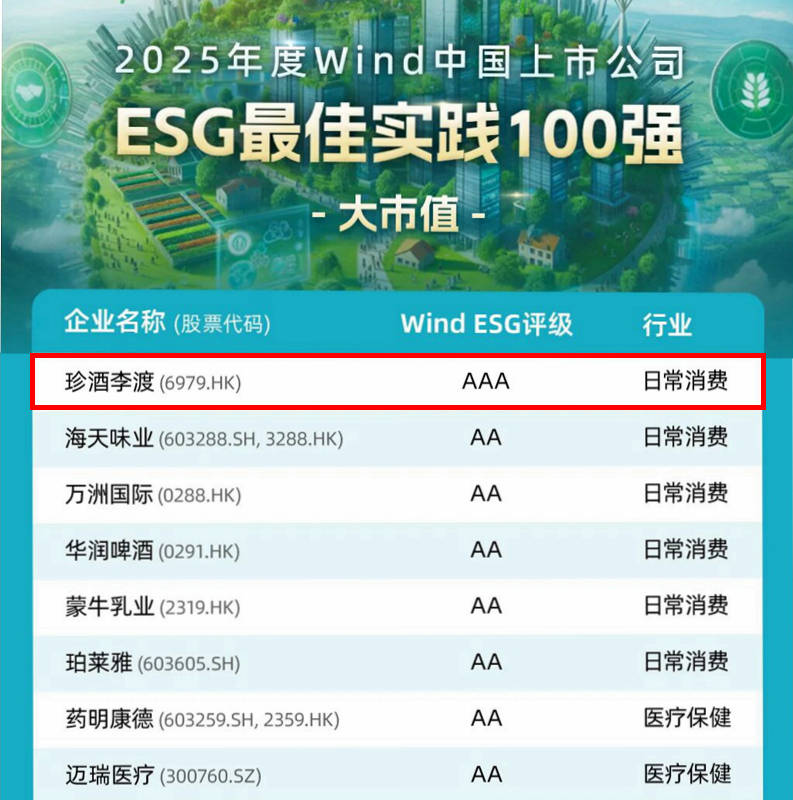
9月9日,2025年度Wind中国上市公司"ESG最佳实践100强"榜单重磅发布。珍酒李渡凭借在ESG领域的持续深耕,继2023、2024年后再度入选,并连 续三年成为榜单唯一入选白酒企业,达成"三连冠"佳绩。 Wind ESG评级体系作为国内ESG评级领域的佼佼者,其评级结果与底层数据覆盖了A+H股上市公司,公募信用债发债主体和国内公募基金等超2万 家市场主体,是国内外资产管理机构投资决策的重要参考。"ESG最佳实践100强"榜单则代表了中国上市公司在ESG领域的最高水平。 2025年,珍酒李渡Wind ESG评级实现重大突破,从AA级跃升至最高评级AAA级,不仅稳居白酒行业第一,也在中国饮料企业中排名第一。数据显 示,截至2025年9月1日,A+H股上市公司中,ESG评级达AAA级的公司占比仅为0.34%。 | 海天味业(603288.SH, 3288.HK) | AA | 日常消费 | | --- | --- | --- | | 万洲国际 (0288.HK) | AA | 日常消费 | | 华润啤酒(0291.HK) | AA | 日常消费 | | 蒙牛乳业(2319.HK) | AA | 日常消费 | ...

啤酒五巨头格局洗牌,百威亚太丢了榜一
Hu Xiu· 2025-09-10 03:30
Core Viewpoint - The beer industry is experiencing a competitive landscape with a mix of recovery and challenges, as major players adapt to changing consumer preferences and market conditions [2][3][26]. Group 1: Industry Performance - In the first half of the year, domestic beer companies showed signs of performance recovery, with many leading and regional breweries reporting increases in both revenue and profit, resulting in a "majority recovering, minority under pressure" scenario [2]. - The top five beer companies, including China Resources Beer, Budweiser APAC, and Qingdao Beer, collectively generated over 840 billion yuan in revenue, capturing nearly 90% of the Chinese beer market [2][6]. - Despite the recovery, the industry faces a market contraction phase, with growth ceilings becoming apparent due to factors like weak on-premise consumption and changing consumer attitudes [3][5]. Group 2: Company-Specific Developments - China Resources Beer surpassed Budweiser APAC in revenue, achieving 239.42 billion yuan, a 0.8% year-on-year increase, while Budweiser APAC's revenue fell by 5.6% to approximately 223 billion yuan [6]. - Budweiser APAC's decline is primarily attributed to its performance in the Chinese market, which accounts for over 70% of its revenue, with a reported 8.2% drop in sales volume and a 10.2% decrease in net income [7]. - Yanjing Beer emerged as a "dark horse" in the industry, with a 6.37% increase in revenue to 85.58 billion yuan and a 45% rise in net profit, surpassing its total profit for the previous year [9]. Group 3: Market Dynamics and Competition - The competitive landscape is shifting, with domestic brands gaining ground against international giants like Budweiser and Carlsberg, particularly in the high-end beer segment [10][11]. - The performance disparity among companies is influenced by their ability to penetrate non-on-premise channels, with local brands leveraging new retail partnerships to enhance sales [12][15]. - The beer industry is witnessing an influx of non-beer companies entering the market, with notable launches from liquor brands and snack companies, indicating a growing interest in the beer segment [17][18]. Group 4: Strategic Shifts and Innovations - Many beer companies are diversifying their product lines, venturing into soft drinks and energy beverages to capture new growth opportunities [20][22]. - Yanjing Beer launched a new soda brand, contributing to a significant increase in beverage revenue, while Chongqing Beer is also expanding its beverage offerings [21][22]. - The industry is adapting to market changes by utilizing existing distribution networks for new product categories, although challenges remain in aligning brand positioning and consumer demographics [24][25].
港股收盘(09.05) | 恒指收涨1.43% 新能源方向爆发 有色、医药股等重拾升势
Zhi Tong Cai Jing· 2025-09-05 09:09
Market Overview - The Hong Kong stock market rebounded strongly, with the Hang Seng Index rising 1.43% to close at 25,417.98 points, and a total trading volume of 299.945 billion HKD [1] - The Hang Seng Tech Index increased by 1.95%, while the Hang Seng China Enterprises Index rose by 1.34% [1] - The overall weekly performance showed a cumulative increase of 1.36% for the Hang Seng Index [1] Foreign Investment Trends - The Cathay Pacific Haitong overseas strategy team indicated that under the backdrop of the Federal Reserve potentially restarting interest rate cuts, there is a possibility of unexpected foreign capital inflow into the Hong Kong stock market [1] - Foreign investment in Hong Kong stocks is particularly favoring technology and financial sectors [1] Sector Performance Blue-Chip Stocks - Xinyi Solar (00968) led blue-chip stocks with a 7.54% increase, closing at 3.71 HKD, contributing 1.89 points to the Hang Seng Index [2] - Other notable performers included China Biologic Products (01177) up 6.2% and Hang Lung Properties (00101) up 6.13% [2] New Energy Sector - The new energy sector, including solar and energy storage, saw significant gains, with companies like China Innovation Aviation (03931) rising 18.37% and New Special Energy (01799) up 17.28% [3][4] - The Ministry of Industry and Information Technology's recent action plan aims to guide the orderly layout of the photovoltaic and lithium battery industries, indicating potential for industry recovery [3][4] Innovative Pharmaceuticals - The innovative drug sector rebounded, with companies like Three-San Pharmaceutical (01530) increasing by 18.24% [4] - The upcoming World Lung Cancer Conference (WCLC) is expected to showcase significant contributions from Chinese scholars, highlighting the growth in the pharmaceutical sector [5] Gold Stocks - Gold stocks collectively rose, with Shandong Gold (01787) increasing by 5.87% [5] - The market anticipates a continued rise in gold prices, driven by high demand and traditional consumption peaks [5] Employment Data Impact - Recent ADP data indicated an increase of 54,000 jobs in the U.S. for August, which was below market expectations, reinforcing the likelihood of interest rate cuts by the Federal Reserve [6] - The market is closely watching the upcoming U.S. non-farm payroll data for further insights [6] Chip Sector Recovery - The semiconductor sector saw a rebound, with notable increases in stocks like Innodisk (02577) up 8.52% and SMIC (00981) up 4.82% [6][7] - The Ministry of Industry and Information Technology's action plan emphasizes support for AI chips and other critical technologies, indicating a focus on domestic production and innovation [7] Notable Stock Movements - Tianyue Advanced (02631) reached a new high, closing up 18.24% [8] - Goldwind Technology (02208) reported a 41.46% year-on-year revenue increase, reflecting strong market performance [9] - Chow Tai Fook (06168) surged 16.58% amid rising gold prices and seasonal demand [10] - Huya Technology (01860) saw a 9% increase, driven by significant revenue growth attributed to AI-driven systems [11] - Zhongshen Construction (02503) experienced a drastic decline of 72.36% following a poor financial report [12]
百威亚太(01876) - 2025 - 中期财报
2025-09-05 09:00
Management Discussion and Analysis [Definitions and Presentation Basis](index=4&type=section&id=Definitions%20and%20Presentation%20Basis) This section defines key financial terms like 'organic' and 'normalized,' highlighting adjustments to financial data for currency, scope, and non-underlying items to accurately reflect business performance - Organic data excludes the impact of currency translation and scope changes to reflect business-related performance[7](index=7&type=chunk) - Normalized metrics (EBITDA, EBIT, profit, tax rate, EPS) exclude non-underlying items to understand sustainable performance[7](index=7&type=chunk) [Consolidated Results for the First Half of 2025](index=5&type=section&id=Consolidated%20Results%20for%20the%20First%20Half%20of%202025) Budweiser APAC's consolidated results for H1 2025 show declines in total volume, revenue, gross profit, and all normalized profit metrics, with total volume down 6.1%, revenue down 5.6%, and normalized EBITDA down 8.0% Consolidated Results Overview for H1 2025 (Millions of USD) | Metric | H1 2025 | H1 2024 | Organic Growth | | :--- | :--- | :--- | :--- | | Total Volume (Hundred Thousand Liters) | 43,628 | 46,573 | -6.1% | | Revenue | 3,136 | 3,399 | -5.6% | | Gross Profit | 1,613 | 1,751 | -4.9% | | Gross Margin | 51.4% | 51.5% | 38 Basis Points | | Normalized EBITDA | 983 | 1,100 | -8.0% | | Normalized EBITDA Margin | 31.3% | 32.4% | – 82 Basis Points | | Normalized EBIT | 679 | 776 | -9.6% | | Normalized EBIT Margin | 21.7% | 22.8% | – 95 Basis Points | | Profit Attributable to Budweiser APAC Equity Holders | 409 | 541 | | | Normalized Profit Attributable to Budweiser APAC Equity Holders | 474 | 552 | | | EPS (in cents) | 3.10 | 4.10 | | | Normalized EPS (in cents) | 3.59 | 4.19 | | [Unaudited Organic Growth Calculation for the First Half of 2025](index=6&type=section&id=Unaudited%20Organic%20Growth%20Calculation%20for%20the%20First%20Half%20of%202025) This section details the H1 2025 organic growth calculation, showing negative growth in total volume, revenue, gross profit, and normalized EBITDA, primarily due to scope and currency translation impacts Organic Growth Figures for H1 2025 (Millions of USD) | Budweiser APAC | H1 2024 | Scope | Currency Translation | Organic Growth | H1 2025 | Organic Growth | | :--- | :--- | :--- | :--- | :--- | :--- | :--- | | Total Volume (Hundred Thousand Liters) | 46,573 | (93) | – | (2,852) | 43,628 | -6.1% | | Revenue | 3,399 | (7) | (65) | (191) | 3,136 | -5.6% | | Cost of Sales | (1,648) | (9) | 29 | 105 | (1,523) | 6.4% | | Gross Profit | 1,751 | (16) | (36) | (86) | 1,613 | -4.9% | | Normalized EBIT | 776 | (11) | (12) | (74) | 679 | -9.6% | | Normalized EBITDA | 1,100 | (10) | (19) | (88) | 983 | -8.0% | | Normalized EBITDA Margin | 32.4% | | | | 31.3% | – 82 Basis Points | - This calculation is based on internal group records and management accounts, and has not been reviewed or audited by independent auditors[13](index=13&type=chunk) [Management Commentary](index=7&type=section&id=Management%20Commentary) Management noted a decline in H1 2025 total volume and revenue, primarily due to China market challenges and early shipments in South Korea; however, revenue per hectoliter increased, and the company maintained a strong balance sheet with a net cash position of **$2.4 billion** - Total volume decreased by **6.1%** in H1 2025, revenue by **5.6%**, and normalized EBITDA by **8.0%**[14](index=14&type=chunk) - In Q2 2025, volume and revenue decreased by **6.2%** and **3.9%** respectively, mainly due to China market challenges and early shipment arrangements in South Korea[15](index=15&type=chunk) - Revenue per hectoliter increased by **2.4%** in Q2, driven by positive brand portfolio effects in APAC and revenue management initiatives in the East region[15](index=15&type=chunk) - As of June 30, 2025, the company's net cash position was **$2.4 billion**, maintaining a strong balance sheet[15](index=15&type=chunk)[16](index=16&type=chunk) - China market volume decreased by **8.2%**, with revenue and revenue per hectoliter down **9.5%** and **1.4%** respectively[18](index=18&type=chunk) - South Korea's volume remained flat, outperforming the industry in both on-premise and off-premise channels[18](index=18&type=chunk) - India's business continued to grow, with double-digit volume and revenue growth in the premium and super-premium product portfolios[18](index=18&type=chunk) [Business Review](index=8&type=section&id=Business%20Review) This section reviews Budweiser APAC's performance in APAC West (China, India) and APAC East (South Korea); China faced volume and revenue declines, addressed by channel expansion and digitalization, while India showed strong growth in premium products, and South Korea maintained volume through innovation [APAC West](index=8&type=section&id=APAC%20West) APAC West experienced Q2 2025 declines in volume and revenue, but revenue per hectoliter increased, and normalized EBITDA saw a slight rise; overall H1 volume and revenue decreased, with normalized EBITDA also down - In Q2 2025, volume decreased by **5.6%**, revenue by **2.7%**, revenue per hectoliter increased by **3.0%**, and normalized EBITDA increased by **1.4%**[20](index=20&type=chunk) - In H1 2025, volume decreased by **6.9%**, revenue by **7.1%**, revenue per hectoliter by **0.2%**, and normalized EBITDA by **8.8%**[20](index=20&type=chunk) [China](index=8&type=section&id=China) China's market saw volume and revenue declines in Q2 and H1 2025, primarily due to business footprint and weak channels; however, the company enhanced commercial capabilities and brand strength through off-premise channel expansion, premiumization, and the BEES digital platform - In Q2 2025, China's volume decreased by **7.4%**, revenue by **6.4%**, and revenue per hectoliter increased by **1.1%**[21](index=21&type=chunk) - In H1 2025, China's volume decreased by **8.2%**, revenue by **9.5%**, and revenue per hectoliter by **1.4%**[21](index=21&type=chunk) - Off-premise channel volume and revenue contributions grew, with the share of premium and super-premium products in off-premise channels surpassing that of Chinese restaurants[21](index=21&type=chunk) - The B2B distributor and customer engagement platform BEES now covers over **320 cities** in China, continuously enhancing commercial capabilities[21](index=21&type=chunk) - The Budweiser brand deepened consumer connections through FIFA Club World Cup campaigns, while Harbin brand attracted Gen Z consumers with a 'Sports + Hip-Hop' transformation program[21](index=21&type=chunk)[22](index=22&type=chunk) [India](index=9&type=section&id=India) India's market showed strong performance, with Q2 2025 revenue growing double-digits and a significant increase in EBITDA margin; H1 saw double-digit volume and revenue growth in premium and super-premium product portfolios - In Q2 2025, India's revenue showed **double-digit growth**, with a significant increase in EBITDA margin[23](index=23&type=chunk) - In H1 2025, India's premium and super-premium product portfolios achieved **double-digit growth** in both volume and revenue[23](index=23&type=chunk) [APAC East](index=9&type=section&id=APAC%20East) APAC East experienced Q2 2025 declines in volume and revenue, with a significant drop in normalized EBITDA; H1 saw a slight volume decrease, modest increases in revenue and revenue per hectoliter, but normalized EBITDA still declined - In Q2 2025, volume decreased by **10.4%**, revenue by **8.4%**, and normalized EBITDA by **26.5%**[24](index=24&type=chunk) - In H1 2025, volume decreased by **0.5%**, revenue increased by **0.6%**, revenue per hectoliter increased by **1.1%**, and normalized EBITDA decreased by **4.5%**[24](index=24&type=chunk) [South Korea](index=9&type=section&id=South%20Korea) South Korea's Q2 2025 volume and revenue declined due to early shipment arrangements, but revenue per hectoliter grew; H1 volume remained flat, with the company outperforming the industry in on-premise and off-premise channels through product innovations like Cass Lemon Squeeze 7.0 and Cass Fresh ICE - In Q2 2025, South Korea's volume and revenue recorded **high single-digit declines**, primarily due to early shipment arrangements[25](index=25&type=chunk) - In H1 2025, South Korea's volume remained flat, outperforming the weak industry performance in both on-premise and off-premise channels[25](index=25&type=chunk) - New products like Cass Lemon Squeeze 7.0 and the summer limited edition Cass Fresh ICE were launched to meet consumer demand for higher alcohol content and refreshing taste[25](index=25&type=chunk) [Review of Operating Results for the Six Months Ended June 30, 2025, Compared to the Six Months Ended June 30, 2024](index=10&type=section&id=Review%20of%20Operating%20Results%20for%20the%20Six%20Months%20Ended%20June%2030%2C%202025%2C%20Compared%20to%20the%20Six%20Months%20Ended%20June%2030%2C%202024) This section compares H1 2025 and H1 2024 operating results, showing declines in volume, revenue, operating profit, and normalized EBITDA, though cost of sales decreased due to favorable commodity prices; profit attributable to equity holders decreased from **$541 million** to **$409 million** [Volume](index=10&type=section&id=Volume) Total volume decreased by **6.1%** in H1 2025, primarily due to the China business footprint, partially offset by India's performance - Total volume decreased by **6.1%** in H1 2025, mainly due to the China business footprint, partially offset by India's performance[28](index=28&type=chunk) [Revenue](index=10&type=section&id=Revenue) H1 2025 revenue decreased by **5.6%**, but revenue per hectoliter grew by **0.5%**, driven by positive brand portfolio effects in APAC and revenue management initiatives in APAC East - H1 2025 revenue decreased by **5.6%**, while revenue per hectoliter increased by **0.5%**[29](index=29&type=chunk) - Revenue growth was primarily driven by positive brand portfolio effects in APAC and revenue management initiatives in APAC East[29](index=29&type=chunk) [Cost of Sales](index=10&type=section&id=Cost%20of%20Sales) H1 2025 cost of sales decreased by **6.4%**, and cost of sales per hectoliter decreased by **0.2%**, primarily due to favorable commodity prices and cost management, partially offset by operating deleverage and country mix - H1 2025 cost of sales decreased by **6.4%**, and cost of sales per hectoliter decreased by **0.2%**[30](index=30&type=chunk) - Primarily driven by favorable commodity prices and cost management initiatives, partially offset by operating deleverage and country mix[30](index=30&type=chunk) [Selling, General and Administrative Expenses](index=10&type=section&id=Selling%2C%20General%20and%20Administrative%20Expenses) Selling, general and administrative expenses decreased in H1 2025, mainly due to flexible management of commercial investments amid weak volumes, reduced variable compensation accruals in China, and a higher base in India - Selling, general and administrative expenses decreased, primarily due to flexible management of commercial investments amid weak volumes, reduced variable compensation accruals in China, and a higher base in India[31](index=31&type=chunk) [Other Operating Income](index=10&type=section&id=Other%20Operating%20Income) Details on other operating income can be found in Note 5 to the unaudited condensed consolidated interim financial statements of this interim report - For more information on other operating income, please refer to Note 5 to the unaudited condensed consolidated interim financial statements of this interim report[32](index=32&type=chunk) [Operating Profit Before Non-Underlying Items (Normalized EBIT)](index=10&type=section&id=Operating%20Profit%20Before%20Non-Underlying%20Items%20(Normalized%20EBIT)) Normalized EBIT decreased by **9.6%** in H1 2025 - Normalized EBIT decreased by **9.6%** in H1 2025[33](index=33&type=chunk) [Operating Profit](index=10&type=section&id=Operating%20Profit) Profit attributable to the company's equity holders decreased from **$541 million** in H1 2024 to **$409 million** in H1 2025 - Profit attributable to the company's equity holders decreased from **$541 million** in H1 2024 to **$409 million** in H1 2025[34](index=34&type=chunk) [Non-IFRS Financial Measures](index=10&type=section&id=Non-IFRS%20Financial%20Measures) Normalized EBITDA decreased by **8.0%** in H1 2025, with the margin declining by **82 basis points** to **31.3%**, mainly due to operating deleverage and increased commercial investments; this section emphasizes that normalized measures are management's performance indicators but should not replace IFRS measures - Normalized EBITDA decreased by **8.0%** in H1 2025, with the margin decreasing by **82 basis points** to **31.3%**[35](index=35&type=chunk) - Normalized EBITDA is a key financial metric regularly monitored by management, but it is not an accounting method under IFRS[37](index=37&type=chunk) [Non-Underlying Items](index=11&type=section&id=Non-Underlying%20Items) Non-underlying items are non-recurring gains or expenses deemed material by management for disclosure, primarily restructuring costs related to organizational integration aimed at improving efficiency and reducing the cost base; details on components and impact on operating profit are in Note 6 - Non-underlying items are gains or expenses that arise irregularly from normal business activities and are separately accounted for due to their size or nature, which is important for understanding sustainable performance[7](index=7&type=chunk)[39](index=39&type=chunk) - Non-underlying restructuring costs are primarily related to organizational integration, aiming to eliminate overlapping structures or redundant processes to achieve a lower cost base[39](index=39&type=chunk) [Income Tax Expense](index=11&type=section&id=Income%20Tax%20Expense) For the components of income tax expense and its overall impact on operating profit, please refer to Note 7 to the unaudited condensed consolidated interim financial statements of this interim report - For the components of income tax expense and its overall impact on operating profit, please refer to Note 7 to the unaudited condensed consolidated interim financial statements of this interim report[40](index=40&type=chunk) [Liquidity and Capital Resources](index=12&type=section&id=Liquidity%20and%20Capital%20Resources) This section outlines the company's liquidity and capital resources, with primary cash sources from operating activities and bank borrowings; as of June 30, 2025, net current liabilities were **$222 million**, and net cash position was **$2.4 billion**, with increased operating cash flow, decreased investing cash flow, and increased financing cash outflow, while financial risk management policies remained unchanged with no significant acquisitions or disposals [General](index=12&type=section&id=General) The company's primary cash flow sources are operating activities and bank borrowings, with main cash needs including capital expenditures, investments, increased subsidiary ownership, debt repayment, and dividend payments; as of June 30, 2025, net current liabilities were **$222 million**, which management views as a positive impact of working capital management - Primary cash flow sources are cash flows from operating activities and bank borrowings[41](index=41&type=chunk) - As of June 30, 2025, net current liabilities were **$222 million**, which management considers a positive impact of working capital management[41](index=41&type=chunk) - As of June 30, 2025, the company had undrawn uncommitted facilities of **$523 million**[41](index=41&type=chunk) [Cash and Cash Equivalents](index=12&type=section&id=Cash%20and%20Cash%20Equivalents) As of June 30, 2025, the company's consolidated cash and cash equivalents were **$2.402 billion**, a decrease from **$2.867 billion** as of December 31, 2024 Cash and Cash Equivalents (Millions of USD) | Date | Amount (Million USD) | | :--- | :--- | | June 30, 2025 | 2,402 | | December 31, 2024 | 2,867 | [Cash Flows](index=12&type=section&id=Cash%20Flows) This section analyzes cash flows from operating, investing, and financing activities; operating cash flow increased, investing cash flow decreased mainly due to reduced cash pool deposits and recyclable packaging purchases, and financing cash outflow increased primarily due to higher dividend payments [Cash Flows from Operating Activities](index=12&type=section&id=Cash%20Flows%20from%20Operating%20Activities) Cash flows from operating activities increased from **$223 million** in H1 2024 to **$267 million** in H1 2025, primarily due to an **$86 million** increase in cash generated from operations, attributable to working capital changes - Cash flows from operating activities increased from **$223 million** in H1 2024 to **$267 million** in H1 2025[43](index=43&type=chunk) - Cash generated from operations increased by **$86 million**, primarily due to increased working capital changes in H1 2025[43](index=43&type=chunk) [Cash Flows Used in Investing Activities](index=12&type=section&id=Cash%20Flows%20Used%20in%20Investing%20Activities) Cash flows used in investing activities in H1 2025 were **$110 million**, a significant decrease from **$250 million** in H1 2024, mainly due to reduced cash pool deposits with the Budweiser Group and lower purchases of recyclable packaging - Cash flows used in investing activities in H1 2025 were **$110 million**, a decrease from **$250 million** in H1 2024[44](index=44&type=chunk) - The decrease was primarily due to reduced cash pool deposits with the Budweiser Group and lower purchases of recyclable packaging[44](index=44&type=chunk) [Cash Flows Used in Financing Activities](index=13&type=section&id=Cash%20Flows%20Used%20in%20Financing%20Activities) Cash outflows from financing activities in H1 2025 were **$674 million**, an increase of **$29 million** from **$645 million** in H1 2024, primarily driven by increased dividend payments, partially offset by net proceeds from borrowings generated by funding arrangements - Cash outflows from financing activities in H1 2025 were **$674 million**, an increase of **$29 million** from H1 2024[46](index=46&type=chunk) - The increase was primarily driven by higher dividend payments, partially offset by net proceeds from borrowings generated by funding arrangements[46](index=46&type=chunk) [Contingent Liabilities](index=13&type=section&id=Contingent%20Liabilities) South Korean subsidiary Oriental Brewery Co., Ltd. (OB) faces lawsuits for customs audit claims and alleged employee embezzlement and customs evasion; OB and co-defendants will contest the customs evasion charges, with potential fine risks not expected to materially impact the company overall - South Korean subsidiary OB recorded **$66 million** in non-underlying expenses for customs audit claims, which are still being contested[48](index=48&type=chunk) - An OB employee was indicted for alleged embezzlement of company funds, commercial bribery, and customs evasion; OB and co-defendants will contest the customs evasion charges[48](index=48&type=chunk) - The potential fine risk is not expected to have a material impact on the company as a whole[48](index=48&type=chunk) [Debt and Balance Sheet](index=13&type=section&id=Debt%20and%20Balance%20Sheet) As of June 30, 2025, the company's total debt was **$326 million**, primarily interest-bearing bank loans, an increase from **$221 million** as of December 31, 2024; most debt is due within one year Debt Details (Millions of USD) | | June 30, 2025 | December 31, 2024 | | :--- | :--- | :--- | | Unsecured Bank Loans and Other Loans | 199 | 98 | | Lease Liabilities | 127 | 123 | | **Total Debt** | **326** | **221** | [Capital Expenditures](index=14&type=section&id=Capital%20Expenditures) There were no significant changes to capital expenditure plans and their funding sources in H1 2025 - There were no significant changes to capital expenditure plans and their funding sources in H1 2025[51](index=51&type=chunk) [Pledged Assets](index=14&type=section&id=Pledged%20Assets) As of June 30, 2025, and December 31, 2024, the company had no pledged assets for loans and bank financing, but property collateral was provided to the consumption tax authorities in South Korea - As of June 30, 2025, and December 31, 2024, the company had no pledged assets for loans and bank financing[52](index=52&type=chunk) - In South Korea, the company has provided property collateral to the consumption tax authorities[52](index=52&type=chunk) [Key Financial Ratios](index=14&type=section&id=Key%20Financial%20Ratios) As of June 30, 2025, the cash (net of debt) to normalized EBITDA ratio increased to **2.2 times**, primarily due to a decrease in normalized EBITDA Key Financial Ratios | Metric | June 30, 2025 | June 30, 2024 | | :--- | :--- | :--- | | Cash (Net of Debt) to Normalized EBITDA Ratio | 2.2 times | 1.9 times | - The ratio increased because normalized EBITDA decreased from **$1,100 million** in H1 2024 to **$983 million** in H1 2025[53](index=53&type=chunk) [Treasury Policy and Market and Other Financial Risks](index=14&type=section&id=Treasury%20Policy%20and%20Market%20and%20Other%20Financial%20Risks) The company faces market risks (currency, interest rate, commodity price), credit risk, and liquidity risk; risk management policies remained unchanged in H1 2025, with foreign currency exposure primarily involving Euro and USD procurement - Business activities face market risks (currency, cash flow interest rate, commodity price), credit risk, and liquidity risk[54](index=54&type=chunk) - Risk management policies remained unchanged in H1 2025, with foreign currency exposure primarily involving Euro and USD procurement[54](index=54&type=chunk) [Acquisitions or Disposals and Material Investments](index=14&type=section&id=Acquisitions%20or%20Disposals%20and%20Material%20Investments) In H1 2025, the company did not undertake any significant acquisitions or disposals, nor did it hold any material investments - In H1 2025, the company did not undertake any significant acquisitions or disposals, nor did it hold any material investments[55](index=55&type=chunk) [Events After the Reporting Period](index=14&type=section&id=Events%20After%20the%20Reporting%20Period) There were no significant events after the reporting period - There were no significant events after the reporting period[56](index=56&type=chunk) Other Information [Board Composition](index=15&type=section&id=Board%20Composition) The Board of Directors comprises seven directors, including executive, non-executive, and independent non-executive directors, ensuring a balanced governance structure - The Board of Directors currently comprises seven directors, including executive, non-executive, and independent non-executive directors[57](index=57&type=chunk)[58](index=58&type=chunk)[59](index=59&type=chunk) [Changes in Directors' Information](index=16&type=section&id=Changes%20in%20Directors'%20Information) Several changes occurred in the Board's composition during the reporting period, including Mr. Jan Craps ceasing to be CEO and Co-Chair, Mr. Cheng Yan Jun being appointed as the new CEO and Co-Chair, and Mr. Ricardo Tadeu being appointed as a Non-Executive Director - Mr. Jan Craps ceased to be Chief Executive Officer, Co-Chair, and Executive Director effective April 1, 2025[63](index=63&type=chunk) - Mr. Cheng Yan Jun was appointed Chief Executive Officer, Co-Chair, and Executive Director effective April 1, 2025[63](index=63&type=chunk) - Mr. Ricardo Tadeu was appointed Non-Executive Director effective May 15, 2025[63](index=63&type=chunk) [Audit and Risk Committee](index=16&type=section&id=Audit%20and%20Risk%20Committee) The company's Audit and Risk Committee has reviewed the interim financial information, and external auditor PricewaterhouseCoopers has conducted a review in accordance with International Standard on Review Engagements 2410 - The interim financial information contained in this interim report has been reviewed by the Audit and Risk Committee[61](index=61&type=chunk) - External auditor PricewaterhouseCoopers has conducted a review in accordance with International Standard on Review Engagements 2410[61](index=61&type=chunk) [Employees, Remuneration and Pension Schemes](index=16&type=section&id=Employees%2C%20Remuneration%20and%20Pension%20Schemes) This section details the company's employee situation, remuneration policy, and pension schemes; as of June 30, 2025, the company employed over **21,000 full-time employees**, primarily in China, South Korea, and India; the remuneration policy aims to incentivize high performance and is linked to sustainability goals, with long-term incentives mainly granted as share options or restricted share units [Employees](index=16&type=section&id=Employees) As of June 30, 2025, the company had a total of **21,461 full-time employees**, with the largest number in China at **17,893**; the company maintains good relations with employee unions, with no significant labor disputes in H1 Number of Full-Time Employees by Region as of June 30, 2025 | Region | As of June 30, 2025 | | :--- | :--- | | China | 17,893 | | South Korea | 1,876 | | India | 1,370 | | Vietnam | 243 | | Others | 79 | | **Total** | **21,461** | - The Group maintains a mutually respectful relationship with employee unions, and no labor disputes materially affecting the business occurred in H1 2025[65](index=65&type=chunk) [Remuneration](index=17&type=section&id=Remuneration) The company's remuneration policy aims to provide competitive compensation, incentivize high performance, and link the remuneration of executive directors, senior management, and employees to specific sustainability performance, goals, and metrics; long-term incentives are primarily granted as share options or restricted share units, some with performance-related vesting conditions - The remuneration policy aims to provide competitive and market-leading compensation to incentivize employees to achieve high performance[66](index=66&type=chunk) - The remuneration of executive directors, senior management, and employees is linked to specific sustainability performance, goals, and metrics[66](index=66&type=chunk) - The actual payment of performance-related variable remuneration (bonuses) is linked to the achievement of company, business unit, and individual objectives, based on financial and non-financial key performance indicators[68](index=68&type=chunk) - Long-term incentives are primarily paid in the form of share options or restricted share units, some of which may have performance-related vesting conditions, such as a total shareholder return performance test for the Budweiser Group[70](index=70&type=chunk)[71](index=71&type=chunk) [Share Incentive Schemes](index=19&type=section&id=Share%20Incentive%20Schemes) The company has five share incentive schemes to encourage senior management shareholding and attract and retain talent; as of June 30, 2025, **25,564,141 shares** were held in trust for awards; this section details participants, share limits, vesting periods, exercise/purchase price determination, remaining terms, and granted/outstanding awards [Summary of Share Incentive Schemes](index=19&type=section&id=Summary%20of%20Share%20Incentive%20Schemes) This section outlines key terms of the Long-Term Incentive Scheme, Restricted Share Unit Scheme, Employee Share Purchase Scheme, Share-Based Remuneration Scheme, and New Restricted Share Unit Scheme, including participant eligibility, share limits, vesting periods, exercise/purchase price determination, and scheme validity [Long-Term Incentive Scheme](index=19&type=section&id=Long-Term%20Incentive%20Scheme) The Long-Term Incentive Scheme allows granting share options to eligible employees and directors, with an exercise price no less than the highest of the closing price on the grant date, the average closing price of the preceding five business days, or the nominal value of the shares, valid for ten years from May 8, 2023 - Share options may be granted to eligible employees and directors of the Group as selected by the Remuneration Committee at its sole discretion[74](index=74&type=chunk) - The exercise price of share options is determined by the Board, not less than the highest of the closing price on the grant date, the average closing price of the preceding five business days, or the nominal value of the shares[79](index=79&type=chunk)[85](index=85&type=chunk) - The scheme is valid for **ten years** from May 8, 2023[79](index=79&type=chunk) [Restricted Share Unit Scheme](index=20&type=section&id=Restricted%20Share%20Unit%20Scheme) The Restricted Share Unit Scheme allows granting restricted share units to employees and directors who have contributed to the Group, with a purchase price no less than the highest of the closing price on the grant date, the average closing price of the preceding five business days, or the nominal value of the shares, valid for ten years from May 8, 2023 - Restricted share units may be granted to any employee and/or director whom the Board considers has contributed or will contribute to the Group[80](index=80&type=chunk) - The purchase price of restricted share units is determined by the Board, not less than the highest of the closing price on the grant date, the average closing price of the preceding five business days, or the nominal value of the shares[86](index=86&type=chunk)[93](index=93&type=chunk) - The scheme is valid for **ten years** from May 8, 2023[86](index=86&type=chunk) [Employee Share Purchase Scheme](index=21&type=section&id=Employee%20Share%20Purchase%20Scheme) The Employee Share Purchase Scheme offers eligible employees the opportunity to acquire restricted shares and grants 'matching' restricted share units, with a purchase price no less than the highest of the closing price on the grant date, the average closing price of the preceding five business days, or the nominal value of the shares, valid for ten years from May 8, 2023 - The Employee Share Purchase Scheme offers eligible employees the opportunity to acquire restricted shares and grants 'matching' restricted share units[87](index=87&type=chunk) - The purchase price of restricted share units or restricted shares is determined by the Board, not less than the highest of the closing price on the grant date, the average closing price of the preceding five business days, or the nominal value of the shares[93](index=93&type=chunk) - The scheme is valid for **ten years** from May 8, 2023[94](index=94&type=chunk) [Share-Based Remuneration Scheme](index=22&type=section&id=Share-Based%20Remuneration%20Scheme) The Share-Based Remuneration Scheme allows employees and directors to elect to receive bonuses in cash, restricted shares, or a combination, and to purchase restricted share units at a discount, while also receiving additional 'matching' restricted share units; the purchase price is no less than the highest of the closing price on the grant date, the average closing price of the preceding five business days, or the nominal value of the shares, valid for ten years from May 8, 2023 - The scheme allows employees and directors to elect to receive bonuses in cash, restricted shares, or a combination, and to purchase restricted share units at a discount, while also receiving additional 'matching' restricted share units[95](index=95&type=chunk) - The purchase price of restricted share units or restricted shares is determined by the Board, not less than the highest of the closing price on the grant date, the average closing price of the preceding five business days, or the nominal value of the shares[101](index=101&type=chunk) - The scheme is valid for **ten years** from May 8, 2023[102](index=102&type=chunk) [New Restricted Share Unit Scheme](index=23&type=section&id=New%20Restricted%20Share%20Unit%20Scheme) The New Restricted Share Unit Scheme allows granting restricted share units to employees and directors who have contributed to the Group, with a purchase price no less than the highest of the closing price on the grant date, the average closing price of the preceding five business days, or the nominal value of the shares, valid for ten years from May 8, 2023 - Restricted share units may be granted to any employee and/or director whom the Board considers has contributed or will contribute to the Group[103](index=103&type=chunk) - The purchase price of restricted share units is determined by the Board, not less than the highest of the closing price on the grant date, the average closing price of the preceding five business days, or the nominal value of the shares[108](index=108&type=chunk)[110](index=110&type=chunk) - The scheme is valid for **ten years** from May 8, 2023[109](index=109&type=chunk) [Mandate Limit](index=24&type=section&id=Mandate%20Limit) The total number of shares that may be granted under all share incentive schemes (scheme mandate limit) is **10%** of the company's issued shares on the listing date or the date of approval for updating the limit; as of June 30, 2025, **1,237,682,943 shares** were available for grant, representing approximately **9.35%** of the issued share capital - The scheme mandate limit is **10%** of the total issued shares of the company on the listing date or the date of approval for updating the limit (**1,324,339,700 shares** as of May 8, 2023)[111](index=111&type=chunk) - As of June 30, 2025, the total number of share awards available for grant was **1,237,682,943 shares**, representing approximately **9.35%** of the company's issued share capital[117](index=117&type=chunk) [Details of Share Awards Granted and Outstanding for the Six Months Ended June 30, 2025](index=24&type=section&id=Details%20of%20Share%20Awards%20Granted%20and%20Outstanding%20for%20the%20Six%20Months%20Ended%20June%2030%2C%202025) This section provides detailed data on share options and restricted share units granted and outstanding for the six months ended June 30, 2025, including holdings by Mr. Jan Craps, Mr. Cheng Yan Jun, the five highest-paid individuals, and other eligible employees Details of Share Options Granted and Outstanding for the Six Months Ended June 30, 2025 | Grantee | Number of Share Options Outstanding as of January 1, 2025 | Number of Share Options Granted | Number of Share Options Lapsed | Number of Share Options Cancelled | Number of Share Options Exercised | Number of Share Options Outstanding as of June 30, 2025 | | :--- | :--- | :--- | :--- | :--- | :--- | :--- | | Mr. Jan Craps | 15,289,898 | – | – | – | – | 15,289,898 | | Mr. Cheng Yan Jun | 1,475,538 | – | – | – | – | 1,475,538 | | Five Highest Paid Individuals | 2,719,045 | – | – | – | – | 2,719,045 | | Other Eligible Employees | 51,537,648 | – | – | (110,307) | – | 51,427,341 | Details of Restricted Share Units Granted and Outstanding for the Six Months Ended June 30, 2025 | Grantee | Scheme | Number of RSUs Outstanding as of January 1, 2025 | Number of RSUs Granted | Number of RSUs Vested | Number of RSUs Outstanding as of June 30, 2025 | | :--- | :--- | :--- | :--- | :--- | :--- | | Mr. Jan Craps | Restricted Share Unit Scheme | 7,812,651 | – | (7,812,651) | – | | | New Restricted Share Unit Scheme | 4,190,913 | – | – | 4,190,913 | | | Share-Based Remuneration Scheme | 3,571,059 | – | (982,675) | 2,588,384 | | Mr. Cheng Yan Jun | New Restricted Share Unit Scheme | 1,145,835 | – | – | 1,145,835 | | | Share-Based Remuneration Scheme | 1,107,218 | 422,621 | (259,441) | 1,270,398 | | | | – | 18,585 | (18,585) | – | | Mr. Guo Peng | New Restricted Share Unit Scheme | 448,338 | – | – | 448,338 | | Ms. Yang Min De | New Restricted Share Unit Scheme | 359,245 | – | – | 359,245 | | Ms. Zeng Jing Xuan | New Restricted Share Unit Scheme | 359,245 | – | – | 359,245 | | Other Eligible Employees | Restricted Share Unit Scheme | 18,218,618 | – | (18,216,422) | – | | | New Restricted Share Unit Scheme | 72,947,813 | – | – | 70,126,308 | | | Share-Based Remuneration Scheme | 21,479,282 | 7,715,663 | (5,291,047) | 22,288,614 | | | | – | 379,226 | (379,226) | – | | | Employee Share Purchase Scheme | 626,526 | – | (264,396) | 362,130 | [Directors' and Chief Executive's Interests and Short Positions in Shares, Underlying Shares and Debentures of the Company and its Associated Corporations](index=27&type=section&id=Directors'%20and%20Chief%20Executive's%20Interests%20and%20Short%20Positions%20in%20Shares%2C%20Underlying%20Shares%20and%20Debentures%20of%20the%20Company%20and%20its%20Associated%20Corporations) As of June 30, 2025, Mr. Cheng Yan Jun held a total interest of **5,228,507 shares** in the company's shares and underlying shares, representing approximately **0.04%** of the issued share capital; Mr. Guo Peng, Ms. Yang Min De, and Ms. Zeng Jing Xuan also held a small number of restricted share units; Mr. Cheng Yan Jun held a total interest of **153,103 shares** in Budweiser Group shares, representing approximately **0.01%** Directors' and Chief Executive's Long Positions in Shares and Underlying Shares of the Company | Name of Director or Chief Executive | Nature of Interest | Number of Shares Involved in Unvested and Conditional Share Options, Restricted Share Units and Restricted Shares | Total Interest in Shares | Approximate Percentage of the Company's Issued Share Capital (%) | | :--- | :--- | :--- | :--- | :--- | | Mr. Cheng Yan Jun | Beneficial Owner | 4,249,170 | 5,228,507 | 0.04 | | Mr. Guo Peng | Beneficial Owner | 448,338 | 448,338 | 0.00 | | Ms. Yang Min De | Beneficial Owner | 359,245 | 359,245 | 0.00 | | Ms. Zeng Jing Xuan | Beneficial Owner | 359,245 | 359,245 | 0.00 | Directors' and Chief Executive's Long Positions in Shares and Underlying Shares of Budweiser Group (Associated Corporation) | Name of Director or Chief Executive | Nature of Interest | Number of Budweiser Group Ordinary Shares | Number of Shares Involved in Budweiser Group Unvested and Conditional Share Options and Restricted Share Units | Total Interest in Budweiser Group Shares | Approximate Percentage of Budweiser Group's Issued Share Capital (%) | | :--- | :--- | :--- | :--- | :--- | :--- | | Mr. Cheng Yan Jun | Beneficial Owner | 66,354 | 86,749 | 153,103 | 0.01 | [Major Shareholders' Interests](index=29&type=section&id=Major%20Shareholders'%20Interests) As of June 30, 2025, Budweiser Group and its intermediate holding companies, through controlled corporate interests, held **11,550,938,000 shares** in the company, representing **87.22%** of the issued share capital, making them the company's major shareholders; this section details Budweiser Group's complex equity structure and control relationships Major Shareholders' Interests in the Company's Shares | No. | Shareholder Name | Capacity | Number of Shares Held or in Which an Interest is Owned | Approximate Percentage of the Company's Issued Share Capital (%) | | :--- | :--- | :--- | :--- | :--- | | 1-25 | AB InBev Brewing Company (APAC) Limited and other Budweiser Group intermediate holding companies | Beneficial Owner/Controlled Corporate Interest | 11,550,938,000 | 87.22 | | 26 | Budweiser Group | Controlled Corporate Interest | 11,550,938,000 | 87.22 | | 27 | Stichting Anheuser-Busch InBev | Controlled Corporate Interest | 11,550,938,000 | 87.22 | | 28 | EPS Participations S.à r.l. | Controlled Corporate Interest | 11,550,938,000 | 87.22 | | 29 | Eugénie Patri Sébastien S.A. | Controlled Corporate Interest | 11,550,938,000 | 87.22 | | 30 | BRC S.à r.l. | Controlled Corporate Interest | 11,550,938,000 | 87.22 | | 31 | S-BR Global Investments Limited | Controlled Corporate Interest | 11,550,938,000 | 87.22 | | 32 | BR Global GP | Controlled Corporate Interest | 11,550,938,000 | 87.22 | | 33 | BR Global SCS | Controlled Corporate Interest | 11,550,938,000 | 87.22 | - Budweiser Group and its intermediate holding companies indirectly control **87.22%** of the company's issued share capital through a complex equity structure[131](index=131&type=chunk)[132](index=132&type=chunk)[133](index=133&type=chunk)[134](index=134&type=chunk)[135](index=135&type=chunk)[136](index=136&type=chunk)[137](index=137&type=chunk) - Entities such as Stichting, EPS, EPS Participations S.à r.l., BRC, and Rayvax jointly and equally exercise control over Stichting and its shares through shareholder agreements, controlling **39.48%** of the voting rights attached to Budweiser Group's outstanding shares[138](index=138&type=chunk)[139](index=139&type=chunk)[140](index=140&type=chunk)[141](index=141&type=chunk)[142](index=142&type=chunk)[143](index=143&type=chunk) [Issued Debentures](index=33&type=section&id=Issued%20Debentures) The company did not issue any debentures in H1 2025 - The company did not issue any debentures in H1 2025[146](index=146&type=chunk) [Purchase, Sale or Redemption of Listed Securities](index=33&type=section&id=Purchase%2C%20Sale%20or%20Redemption%20of%20Listed%20Securities) In H1 2025, neither the company nor any of its subsidiaries purchased, sold, or redeemed any of the company's listed securities - In H1 2025, neither the company nor any of its subsidiaries purchased, sold, or redeemed any of the company's listed securities[147](index=147&type=chunk) [Corporate Governance](index=33&type=section&id=Corporate%20Governance) The company is committed to achieving the highest standards of corporate governance to safeguard shareholder interests and has adopted a Corporate Governance Charter; this section outlines the company's compliance with the Corporate Governance Code and Model Code [Compliance with the Corporate Governance Code](index=34&type=section&id=Compliance%20with%20the%20Corporate%20Governance%20Code) The company complied with the code provisions of the Corporate Governance Code in H1 2025, except for code provision C.2.1 (separation of roles of chairman and chief executive), as the Co-Chairs also serve as Chief Executive Officer - The company complied with the code provisions of the Corporate Governance Code in H1 2025, except for code provision C.2.1[149](index=149&type=chunk) - The deviation from code provision C.2.1 is due to the Co-Chairs (Mr. Jan Craps and Mr. Cheng Yan Jun) also serving as Chief Executive Officer, an arrangement the Board believes allows for more efficient Board operations[149](index=149&type=chunk) [Compliance with the Model Code](index=34&type=section&id=Compliance%20with%20the%20Model%20Code) The company has adopted a code for securities transactions by directors no less exacting than the Model Code set out in the Listing Rules, and all directors confirmed compliance with the relevant requirements in H1 2025 - The company has adopted its own code for securities transactions by directors, with terms no less exacting than the Model Code set out in Appendix C3 of the Listing Rules[150](index=150&type=chunk) - All directors confirmed compliance with the required standards set out in the Model Code and the Dealing Code in H1 2025[151](index=151&type=chunk) [Interim Dividend](index=34&type=section&id=Interim%20Dividend) The Board resolved not to declare an interim dividend for H1 2025 - The Board resolved not to declare an interim dividend for H1 2025[152](index=152&type=chunk) [Treasury Shares](index=34&type=section&id=Treasury%20Shares) As of June 30, 2025, the company held no treasury shares as defined under the Listing Rules; shares purchased by the trustee for share incentive schemes are presented as 'treasury shares' in financial statements but do not constitute treasury shares under the Listing Rules - As of June 30, 2025, the company held no treasury shares as defined under the Listing Rules[153](index=153&type=chunk) - Shares purchased by the trustee to settle share awards under the share incentive schemes are presented as 'treasury shares' in the financial statements but do not constitute treasury shares under the Listing Rules[153](index=153&type=chunk) Interim Financial Information Review Report [To the Board of Directors of Budweiser APAC Limited](index=35&type=section&id=To%20the%20Board%20of%20Directors%20of%20Budweiser%20APAC%20Limited) PricewaterhouseCoopers submitted an interim financial information review report to the Board of Directors of Budweiser APAC Limited, confirming a review conducted in accordance with International Standard on Review Engagements 2410, with no material discrepancies found - PricewaterhouseCoopers has reviewed the interim financial information of Budweiser APAC Limited for the six months ended June 30, 2025[154](index=154&type=chunk) - A review is substantially less in scope than an audit, and consequently, no audit opinion is expressed[155](index=155&type=chunk) - The review concluded that nothing has come to their attention that causes them to believe the interim financial information is not prepared, in all material respects, in accordance with International Accounting Standard 34 'Interim Financial Reporting'[156](index=156&type=chunk) [Unaudited Condensed Consolidated Interim Statement of Profit or Loss](index=36&type=section&id=Unaudited%20Condensed%20Consolidated%20Interim%20Statement%20of%20Profit%20or%20Loss) For the six months ended June 30, 2025, the company's revenue was **$3.136 billion**, down from **$3.399 billion** in the prior year; profit for the period was **$427 million**, lower than **$553 million** last year; basic earnings per share were **3.10 cents** Unaudited Condensed Consolidated Interim Statement of Profit or Loss (Millions of USD) | Metric | June 30, 2025 | June 30, 2024 | | :--- | :--- | :--- | | Revenue | 3,136 | 3,399 | | Gross Profit | 1,613 | 1,751 | | Operating Profit Before Non-Underlying Items | 679 | 776 | | Operating Profit | 666 | 761 | | Net Finance Income | 3 | 20 | | Profit Before Tax | 690 | 795 | | Income Tax Expense | (263) | (242) | | Profit for the Period | 427 | 553 | | Profit Attributable to Budweiser APAC Equity Holders | 409 | 541 | | Basic Earnings Per Share (in cents) | 3.10 | 4.10 | | Diluted Earnings Per Share (in cents) | 3.07 | 4.07 | [Unaudited Condensed Consolidated Interim Statement of Comprehensive Income](index=37&type=section&id=Unaudited%20Condensed%20Consolidated%20Interim%20Statement%20of%20Comprehensive%20Income) For the six months ended June 30, 2025, the company's profit for the period was **$427 million**; other comprehensive income primarily stemmed from exchange differences on translating foreign operations, resulting in total comprehensive income of **$852 million**, significantly higher than **$179 million** in the prior year Unaudited Condensed Consolidated Interim Statement of Comprehensive Income (Millions of USD) | Metric | June 30, 2025 | June 30, 2024 | | :--- | :--- | :--- | | Profit for the Period | 427 | 553 | | Exchange Differences on Translating Foreign Operations | 437 | (388) | | Cash Flow Hedges (Loss)/Gain | (12) | 14 | | Other Comprehensive Income/(Loss), Net of Tax | 425 | (374) | | Total Comprehensive Income | 852 | 179 | | Total Comprehensive Income Attributable to Budweiser APAC Equity Holders | 833 | 168 | | Non-Controlling Interests | 19 | 11 | [Unaudited Condensed Consolidated Interim Statement of Financial Position](index=38&type=section&id=Unaudited%20Condensed%20Consolidated%20Interim%20Statement%20of%20Financial%20Position) As of June 30, 2025, the company's total assets were **$14.784 billion**, total equity was **$10.373 billion**, current liabilities were **$3.789 billion**, non-current liabilities were **$622 million**, and net current liabilities were **$222 million** Unaudited Condensed Consolidated Interim Statement of Financial Position (Millions of USD) | Metric | June 30, 2025 | December 31, 2024 | | :--- | :--- | :--- | | **ASSETS** | | | | Total Non-Current Assets | 11,217 | 10,946 | | Total Current Assets | 3,567 | 3,832 | | **TOTAL ASSETS** | **14,784** | **14,778** | | **EQUITY AND LIABILITIES** | | | | Equity Attributable to Budweiser APAC Equity Holders | 10,300 | 10,184 | | Non-Controlling Interests | 73 | 56 | | **TOTAL EQUITY** | **10,373** | **10,240** | | Total Non-Current Liabilities | 622 | 605 | | Total Current Liabilities | 3,789 | 3,933 | | **TOTAL EQUITY AND LIABILITIES** | **14,784** | **14,778** | [Unaudited Condensed Consolidated Interim Statement of Changes in Equity](index=40&type=section&id=Unaudited%20Condensed%20Consolidated%20Interim%20Statement%20of%20Changes%20in%20Equity) For the six months ended June 30, 2025, equity attributable to Budweiser APAC equity holders increased from **$10.184 billion** at the beginning of the period to **$10.300 billion**, primarily due to positive impacts from profit for the period and exchange differences on translating foreign operations, partially offset by dividend payments Unaudited Condensed Consolidated Interim Statement of Changes in Equity (Millions of USD) | Metric | January 1, 2025 | Profit for the Period | Other Comprehensive (Loss)/Income | Share-Based Payments | Treasury Shares | Dividends | June 30, 2025 | | :--- | :--- | :--- | :--- | :--- | :--- | :--- | :--- | | Attributable to Budweiser APAC Equity Holders | 10,184 | 409 | 424 | (6) | 37 | (748) | 10,300 | | Non-Controlling Interests | 56 | 18 | 1 | – | – | (2) | 73 | | **TOTAL EQUITY** | **10,240** | **427** | **425** | **(6)** | **37** | **(750)** | **10,373** | - Retained earnings include legal statutory reserves in China, amounting to **$269 million** as of June 30, 2025[166](index=166&type=chunk) [Unaudited Condensed Consolidated Interim Statement of Cash Flows](index=41&type=section&id=Unaudited%20Condensed%20Consolidated%20Interim%20Statement%20of%20Cash%20Flows) For the six months ended June 30, 2025, cash flows from operating activities were **$267 million**, cash flows used in investing activities were **$110 million**, and cash flows used in financing activities were **$674 million**; cash and cash equivalents at period-end were **$2.402 billion** Unaudited Condensed Consolidated Interim Statement of Cash Flows (Millions of USD) | Activity Type | June 30, 2025 | June 30, 2024 | | :--- | :--- | :--- | | Cash Flows from Operating Activities | 267 | 223 | | Cash Flows Used in Investing Activities | (110) | (250) | | Cash Flows Used in Financing Activities | (674) | (645) | | Net Decrease in Cash and Cash Equivalents | (517) | (672) | | Cash and Cash Equivalents at End of Period | 2,402 | 2,406 | [Notes to the Unaudited Condensed Consolidated Interim Financial Statements](index=43&type=section&id=Notes%20to%20the%20Unaudited%20Condensed%20Consolidated%20Interim%20Financial%20Statements) This section provides detailed notes to the condensed consolidated interim financial statements, covering company information, financial risk management, key accounting estimates, segment reporting, changes in assets, liabilities, and equity, as well as related party transactions and contingencies [1. General Information and Basis of Presentation](index=43&type=section&id=1.%20General%20Information%20and%20Basis%20of%20Presentation) Budweiser APAC Limited is incorporated in the Cayman Islands, primarily engaged in beer brewing and distribution in the Asia Pacific region; these interim financial statements are prepared in accordance with the HKEX Listing Rules and IAS 34, on a going concern basis - The company was incorporated in the Cayman Islands on April 10, 2019, and its shares were listed on the Hong Kong Stock Exchange on September 30, 2019[172](index=172&type=chunk) - The Group is primarily engaged in beer brewing and distribution in the Asia Pacific region, with its ultimate parent company being Anheuser-Busch InBev SA/NV (Budweiser Group)[173](index=173&type=chunk)[174](index=174&type=chunk) - The interim financial statements are prepared in accordance with the Rules Governing the Listing of Securities on The Stock Exchange of Hong Kong Limited and International Accounting Standard 34 'Interim Financial Reporting,' and are presented on a going concern basis[175](index=175&type=chunk)[177](index=177&type=chunk) [2. Financial Risk Management](index=44&type=section&id=2.%20Financial%20Risk%20Management) The Group faces market, credit, and liquidity risks; as of June 30, 2025, net current liabilities were **$222 million**, but the company has sufficient cash flow and financing capacity; capital management aims to optimize shareholder value while maintaining financial flexibility; fair value measurements use a three-level hierarchy, with fair values of derivatives and non-derivative financial liabilities determined by valuation techniques - The Group's business activities are exposed to market risks (currency, cash flow interest rate, commodity risk), credit risk, and liquidity risk, with no changes in risk management policies[178](index=178&type=chunk) - As of June 30, 2025, net current liabilities were **$222 million**, but the Group has strong cash-generating capabilities, with cash flows from operating activities of **$267 million**[179](index=179&type=chunk) - Capital management aims to optimize shareholder value by distributing cash flows from subsidiaries to the Group, while maintaining investment-grade ratings[180](index=180&type=chunk) Reconciliation of Cash (Net of Debt) (Millions of USD) | Metric | June 30, 2025 | December 31, 2024 | | :--- | :--- | :--- | | Cash and Cash Equivalents | 2,402 | 2,867 | | Cash Pool Deposits with Budweiser Group | 57 | 48 | | Interest-Bearing Loans and Borrowings | (307) | (204) | | **Cash (Net of Debt)** | **2,152** | **2,711** | Gearing Ratio | Metric | June 30, 2025 | December 31, 2024 | | :--- | :--- | :--- | | Cash (Net of Debt) | (2,152) | (2,711) | | Total Equity | 10,373 | 10,240 | | Total Capital | 8,221 | 7,529 | | **Gearing Ratio** | **-26.2%** | **-36.0%** | - Fair value measurements are based on a three-level input hierarchy, with fair values of derivatives and non-derivative financial liabilities determined using common valuation techniques[185](index=185&type=chunk)[186](index=186&type=chunk)[187](index=187&type=chunk)[188](index=188&type=chunk) [3. Critical Accounting Estimates and Judgements](index=47&type=section&id=3.%20Critical%20Accounting%20Estimates%20and%20Judgements) This section outlines management's critical accounting estimates and judgments in preparing financial statements, including impairment assessments of goodwill and intangible assets, determination of intangible asset useful lives, contingencies, income tax positions, trade incentives, and share-based payments; these estimates and judgments significantly impact financial statement amounts - Goodwill and indefinite useful life intangible asset impairment tests rely on several key judgments, estimates, and assumptions, and are performed at least annually[192](index=192&type=chunk) - Management determines that intangible assets such as brands have indefinite useful lives due to their established market position and perpetual legal rights[194](index=194&type=chunk) - Estimates and assumptions for contingencies impact asset and liability valuations; significant contingent liabilities are disclosed, and provisions for contingent losses are recorded when probable and reasonably estimable[196](index=196&type=chunk)[197](index=197&type=chunk)[199](index=199&type=chunk) - Determining income tax provisions involves significant judgment, and tax audits and inquiries may take a long time to resolve, with final outcomes potentially affecting current and deferred income tax assets and liabilities[201](index=201&type=chunk) - Assessing the nature of trade incentives and whether payments are in exchange for distinct goods and services requires judgment, impacting their classification in the statement of profit or loss and statement of financial position[203](index=203&type=chunk) - The fair value of share-based payments is estimated using a binomial Hull model, involving subjective assumptions such as risk-free interest rates, dividend yields, and expected volatility[204](index=204&type=chunk) [4. Segment Reporting](index=50&type=section&id=4.%20Segment%20Reporting) The Group operates through two geographical segments: APAC East (South Korea, Japan, New Zealand) and APAC West (China, India, Vietnam, and exports); management uses normalized EBITDA as a segment performance measure; in H1 2025, both segments experienced declines in volume, revenue, and normalized EBITDA - The Group operates through two geographical segments: APAC East (primarily South Korea, Japan, and New Zealand) and APAC West (China, India, Vietnam, and other export markets in APAC)[205](index=205&type=chunk) - Management uses performance indicators such as normalized EBITDA as measures of segment performance[205](index=205&type=chunk) Segment Results for the Six Months Ended June 30, 2025 and 2024 (Millions of USD) | Metric | APAC East (2025) | APAC East (2024) | APAC West (2025) | APAC West (2024) | Total (2025) | Total (2024) | | :--- | :--- | :--- | :--- | :--- | :--- | :--- | | Volume (Hundred Thousand Liters) | 5,706 | 5,732 | 37,922 | 40,841 | 43,628 | 46,573 | | Revenue | 614 | 649 | 2,522 | 2,750 | 3,136 | 3,399 | | Normalized EBITDA | 176 | 199 | 807 | 901 | 983 | 1,100 | | Normalized EBITDA Margin % | 28.7% | 30.7% | 32.0% | 32.8% | 31.3% | 32.4% | Reconciliation of Profit Attributable to Budweiser APAC Equity Holders to Normalized EBITDA (Millions of USD) | Metric | June 30, 2025 | June 30, 2024 | | :--- | :--- | :--- | | Profit Attributable to Budweiser APAC Equity Holders | 409 | 541 | | Profit for the Period | 427 | 553 | | Normalized EBIT | 679 | 776 | | Normalized EBITDA | 983 | 1,100 | [5. Other Operating Income](index=51&type=section&id=5.%20Other%20Operating%20Income) For the six months ended June 30, 2025, total other operating income was **$40 million**, primarily comprising grants and incentives (**$17 million**) and net gains on disposal of property, plant and equipment and intangible assets (**$17 million**) Other Operating Income (Millions of USD) | Item | June 30, 2025 | June 30, 2024 | | :--- | :--- | :--- | | Grants and Incentives | 17 | 23 | | Net Gains on Disposal of Property, Plant and Equipment and Intangible Assets | 17 | 21 | | Other Operating Income | 6 | 12 | | **Total** | **40** | **56** | - Grants and incentives primarily relate to various subsidies and incentives provided by local governments based on the Group's operations and development in those regions[212](index=212&type=chunk) [6. Non-Underlying Items](index=52&type=section&id=6.%20Non-Underlying%20Items) For the six months ended June 30, 2025, the impact of non-underlying items on profit from operations was negative **$13 million**, mainly due to restructuring costs; additionally, internal restructuring resulted in non-underlying income tax of **$53 million** Impact of Non-Underlying Items on Profit (Millions of USD) | Item | June 30, 2025 | June 30, 2024 | | :--- | :--- | :--- | | Restructuring | (13) | (15) | | Impact on Profit from Operations | (13) | (15) | | Tax Impact on Non-Underlying Items | 1 | 4 | | Non-Underlying Income Tax | (53) | – | | **Net Impact on Profit** | **(65)** | **(11)** | - Non-underlying restructuring costs are primarily related to organizational integration, aiming to eliminate overlapping structures or redundant processes[213](index=213&type=chunk) - Internal restructuring resulted in capital gains tax and withholding tax on distributed earnings, recognized as non-underlying income tax within income tax expense[213](index=213&type=chunk) [7. Income Tax Expense](index=53&type=section&id=7.%20Income%20Tax%20Expense) For the six months ended June 30, 2025, total income tax expense was **$263 million**, with an effective tax rate of **39.3%** and a normalized effective tax rate of **30.9%**; internal restructuring led to non-underlying income tax, impacting the effective tax rate Income Tax Expense (Millions of USD) | Item | June 30, 2025 | June 30, 2024 | | :--- | :--- | :--- | | Current Tax Expense | (256) | (234) | | Deferred Tax Expense | (7) | (8) | | **Total Income Tax Expense** | **(263)** | **(242)** | | Effective Tax Rate | 39.3% | 31.0% | | Normalized Effective Tax Rate | 30.9% | 30.9% | - In H1 2025, internal restructuring resulted in capital gains tax and withholding tax on distributed earnings, recognized as non-underlying income tax within income tax expense[214](index=214&type=chunk) [8. Property, Plant and Equipment](index=54&type=section&id=8.%20Property%2C%20Plant%20and%20Equipment) As of June 30, 2025, total property, plant and equipment amounted to **$2.488 billion**, comprising **$2.381 billion** in owned assets and **$107 million** in leased assets; payments for the acquisition of property, plant and equipment in H1 were **$95 million** Property, Plant and Equipment (Millions of USD) | Item | June 30, 2025 | December 31, 2024 | | :--- | :--- | :--- | | Owned Property, Plant and Equipment | 2,381 | 2,479 | | Leased Property, Plant and Equipment (Right-of-Use Assets) | 107 | 106 | | **Total Property, Plant and Equipment** | **2,488** | **2,585** | - Payments for the acquisition of property, plant and equipment in H1 2025 amounted to **$95 million**[216](index=216&type=chunk) [9. Goodwill](index=55&type=section&id=9.%20Goodwill) As of June 30, 2025, the total carrying amount of goodwill was **$6.265 billion**, an increase from **$5.945 billion** at the end of the previous year, primarily due to foreign exchange movements; the Group performs annual goodwill impairment tests, with no impairment indicators identified as of the reporting period end Goodwill Movement (Millions of USD) | Item | Amount (Million USD) | | :--- | :--- | | Balance at End of Previous Year (December 31, 2024) | 5,945 | | Impact of Foreign Exchange Movements | 320 | | **Balance at Period/Year-End (June 30, 2025)** | **6,265** | - The Group performs goodwill impairment tests annually in the second half of the year or when impairment indicators are identified; no impairment indicators were identified for the six months ended June 30, 2025[217](index=217&type=chunk) Goodwill Carrying Amount by Cash Generating Unit (Millions of USD) | Cash Generating Unit | June 30, 2025 | December 31, 2024 | | :--- | :--- | :--- | | South Korea | 3,253 | 2,988 | | China | 3,003 | 2,948 | | Other Countries | 9 | 9 | | **Total Goodwill Carrying Amount** | **6,265** | **5,945** | [10. Intangible Assets](index=56&type=section&id=10.%20Intangible%20Assets) For the six months ended June 30, 2025, acquisitions and expenditures for intangible assets amounted to **$13 million**; intangible assets with indefinite useful lives, primarily brands and distribution rights, will be tested for impairment in the second half of the year or when a triggering event occurs - Acquisitions and expenditures for intangible assets in H1 2025 amounted to **$13 million**[219](index=219&type=chunk) - Intangible assets with indefinite useful lives, primarily including brands and certain distribution rights, will be tested for impairment in the second half of the year or when a triggering event occurs[219](index=219&type=chunk) [11. Trade and Other Receivables](index=56&type=section&id=11.%20Trade%20and%20Other%20Receivables) As of June 30, 2025, total current trade and other receivables were **$740 million**, an increase from **$496 million** as of December 31, 2024; trade receivables and accrued income amounted to **$557 million**; impairment losses on trade receivables recognized were **$4 million** Current Trade and Other Receivables (Millions of USD) | Item | June 30, 2025 | December 31, 2024 | | :--- | :--- | :--- | | Trade Receivables and Accrued Income | 557 | 346 | | Trade Receivables from Budweiser Group | 8 | 14 | | Indirect Tax Receivables | 113 | 83 | | Prepayments | 53 | 40 | | Other Receivables | 9 | 13 | | **Current Trade and Other Receivables** | **740** | **496** | - Trade receivables and trade receivables from Budweiser Group are on average due within **90 days** from the invoice date[220](index=220&type=chunk) - Impairment losses on trade receivables recognized in H1 2025 amounted to **$4 million**[220](index=220&type=chunk) Aging Analysis of Current Trade Receivables and Trade Receivables from Budweiser Group (Millions of USD) | Aging | June 30, 2025 | December 31, 2024 | | :--- | :--- | :--- | | Not Overdue | 510 | 319 | | Less than 30 days | 30 | 14 | | 30 to 59 days | 7 | 3 | | 60 to 89 days | 4 | 6 | | Over 90 days | 14 | 18 | | **Net Carrying Amount of Trade Receivables and Trade Receivables from Budweiser Group** | **565** | **3
港股收盘 | 恒指收涨1.43% 新能源方向爆发 有色、医药股等重拾升势
Zhi Tong Cai Jing· 2025-09-05 08:58
Market Overview - The Hong Kong stock market rebounded strongly, with the Hang Seng Index rising 1.43% to close at 25,417.98 points, and a total trading volume of HKD 299.95 billion [1] - The Hang Seng Tech Index increased by 1.95%, while the Hang Seng China Enterprises Index rose by 1.34% [1] - The overall weekly performance showed a cumulative increase of 1.36% for the Hang Seng Index and 0.23% for the Hang Seng Tech Index [1] Foreign Investment Trends - The Cathay Pacific Haitong overseas strategy team indicated a potential unexpected return of foreign capital to Hong Kong stocks due to the Federal Reserve's renewed interest rate cuts [1] - The focus of foreign investment is particularly on technology and financial sectors [1] Sector Performance Blue-Chip Stocks - Xinyi Solar (00968) led blue-chip stocks with a 7.54% increase, contributing 1.89 points to the Hang Seng Index [2] - Other notable performers included China Biologic Products (01177) up 6.2% and Hang Lung Properties (00101) up 6.13% [2] New Energy Sector - The new energy sector, including solar and storage, saw significant gains, with companies like China Innovation Aviation (03931) rising 18.37% and New Special Energy (01799) up 17.28% [3][4] - The Ministry of Industry and Information Technology's action plan aims to promote high-quality development in the photovoltaic sector and address low-price competition [4] Innovative Pharmaceuticals - The innovative drug sector rebounded, with companies like 3SBio (01530) increasing by 18.24% [4][5] - The total value of outbound licensing agreements for domestic innovative drugs reached USD 84.53 billion, a 73.2% increase from the previous year [5] Gold Stocks - Gold stocks collectively rose, with Shandong Gold (01787) increasing by 5.87% [6] - The market anticipates a rise in gold prices, with Goldman Sachs predicting potential prices nearing USD 5,000 per ounce [6] Semiconductor Sector - Semiconductor stocks experienced a rebound, with notable increases in companies like InnoCare Pharma (02577) and SMIC (00981) [6] Government Initiatives - The Ministry of Industry and Information Technology and the State Administration for Market Regulation released a plan to stabilize growth in the electronic information manufacturing industry, focusing on high-performance AI servers and chip technology [7]
华安期货金融工程日报-20250905





Xin Yong An Guo Ji Zheng Quan· 2025-09-05 03:45
The provided content does not contain any quantitative models or factors related to financial engineering or quantitative analysis. It primarily consists of financial news, stock performance data, and corporate updates. No relevant information for summarizing quantitative models or factors is present.
调整期行业结构未见变化 优势向谁集中?
Nan Fang Du Shi Bao· 2025-09-04 23:07
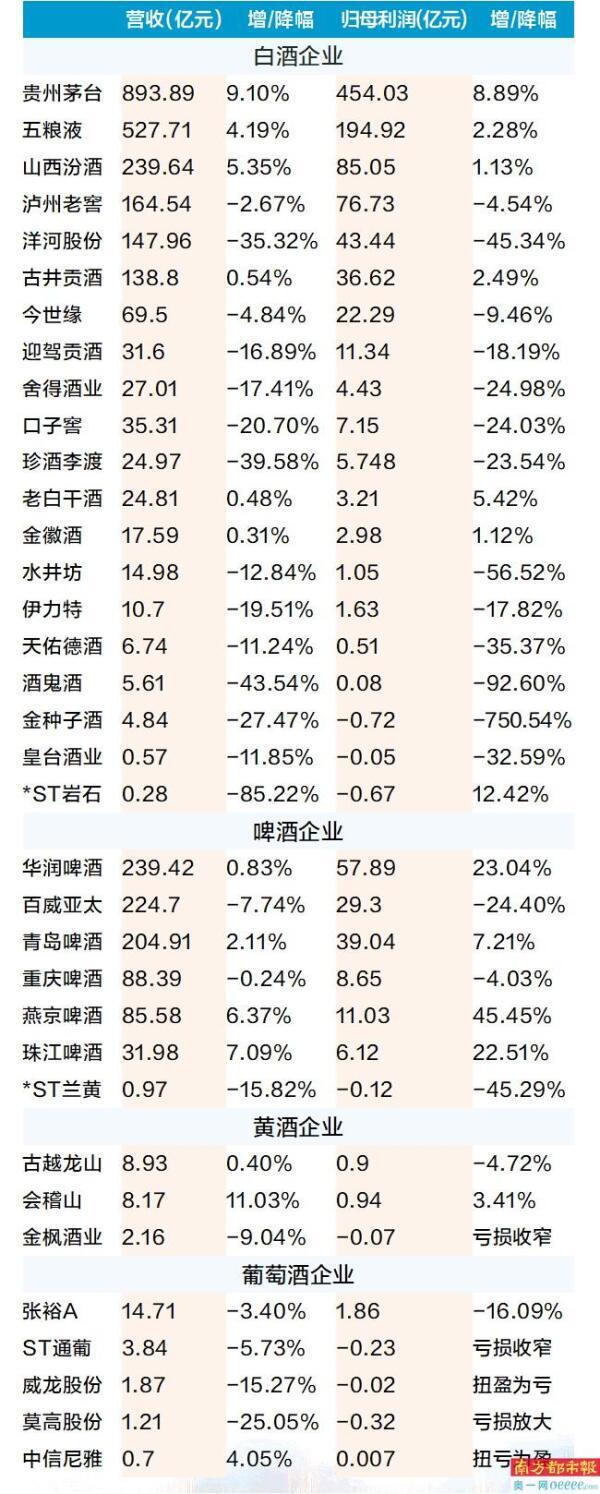
Summary of Key Points Core Viewpoint - The alcoholic beverage industry in China is undergoing a significant adjustment phase, with varying performance across different segments such as baijiu, beer, yellow wine, and wine. While some companies are experiencing declines, others are managing to maintain or grow their revenues through strategic adjustments and market focus [3][4][14]. Baijiu Industry - The baijiu sector is the most affected by the adjustment phase, with 13 out of 20 listed companies reporting declines in both revenue and net profit. Only 6 companies showed growth in both metrics [4][5]. - Major players like Kweichow Moutai, Wuliangye, and Shanxi Fenjiu have managed to maintain growth, while smaller companies face more significant declines [4][5]. - Companies are adopting strategies to address inventory issues and optimize product channels, attributing performance declines to proactive adjustments rather than market weakness [5][6]. Beer Industry - The beer industry is showing signs of recovery, with leading companies like China Resources Beer and Qingdao Beer reporting growth in both revenue and net profit. In contrast, foreign companies like Budweiser APAC are experiencing declines [6][7]. - The high-end segment continues to be a focal point, with companies competing in the premium market, while the 8 yuan price range is emerging as a new growth driver [7][8]. - Beer companies are also diversifying into other beverage sectors to seek new growth opportunities [8][9]. Yellow Wine Industry - The yellow wine sector is struggling to achieve collective growth, with only a few companies like Kuaijishan showing positive performance. The market remains heavily concentrated in the Jiangsu and Zhejiang regions [10][11]. - Despite the introduction of new products aimed at younger consumers, overall performance remains lackluster, with traditional products still driving most sales [10][11]. Wine Industry - The wine market is in a deep adjustment phase, with most companies reporting revenue declines. The market is heavily impacted by the increasing share of imported wines, which continue to challenge domestic brands [12][13]. - Companies are exploring new sales channels, such as live e-commerce, to boost performance and adapt to changing consumer preferences [13][14]. - The emotional value of wine consumption, such as "self-drinking" and "social drinking," is seen as a potential avenue for recovery in the domestic market [13][14].



啤酒“革命”,靠什么征服新世界的味蕾?
Sou Hu Cai Jing· 2025-09-04 16:37
Core Insights - The Chinese beer industry is undergoing significant transformation driven by changing consumer preferences, particularly among younger generations who favor unique and high-quality products over traditional mass-market options [3][4][16] - The market size for beer in China is projected to reach 180 billion yuan in 2024, with a year-on-year growth of 3.2%, while mid-to-high-end products are experiencing a notable increase in sales [3][4] Market Trends - Traditional economy beer sales are declining, while mid-to-high-end products have seen a 12.7% growth, and craft beer has surged by 31.4% [3] - The profit share of high-end product lines has increased from 28% in 2020 to 47% in the first half of 2025, indicating a shift from "scale victory" to "value supremacy" in the industry [3][4] Consumer Behavior - The Z generation is reshaping beer consumption, moving away from quantity to quality, with a preference for craft and flavored beers [4][5] - Data from Meituan shows a 143% increase in searches for craft and specialty beers in night-time orders during the first half of 2025 [4] - Consumers aged 25-35 contribute 62% of the growth in high-end beer, spending an average of 3,200 yuan annually, which is 2.3 times that of consumers aged 45 and above [4] Product Innovation - The era of industrial lagers is ending, with a focus on flavor diversification becoming mainstream [6][7] - Yanjing's U8 series generated 5.536 billion yuan in revenue in the first half of 2025, accounting for 70.11% of its total revenue, with a gross margin of 51.71% [6] - Jin Xing Brewery is innovating by integrating local resources, such as using Xinyang Maojian tea in their craft beer, which has gained significant consumer interest [6][7] Channel Evolution - The beer consumption landscape is shifting from traditional dining channels to diverse settings like craft beer bars and home consumption [5][10] - Instant retail is on the rise, with CR Beer reporting a nearly 50% year-on-year growth in instant retail GMV in the first half of 2025 [5][10] - E-commerce is evolving from mere sales to emotional connections, with Douyin live-streaming beer sales increasing by 83% during the "618" shopping festival in 2025 [10] Capital Dynamics - The beer market transformation is prompting a reconfiguration of capital strategies, with companies focusing on product structure and high-end market share [12][13] - CR Beer reported a revenue of 23.94 billion yuan in the first half of 2025, with a net profit of 5.789 billion yuan, highlighting a trend of "slight revenue increase but significant profit growth" [12] - International brands are deepening localization efforts, with Budweiser Asia Pacific launching 14 local flavor products in the first half of 2025 [12][13] Future Outlook - The future of the beer industry will focus on personalization, health, and premiumization, with low-alcohol beers expected to account for 25% of the market by 2030 [14][15] - Digitalization will permeate the entire industry chain, enhancing efficiency and product quality [14] - Sustainable development is becoming a consensus in the industry, with companies like Budweiser China reducing water and energy consumption significantly [14][15]