海澜之家

Search documents
MSCI中国指数新增26只A股标的,国际资本仍持看好态度
Huan Qiu Wang· 2025-11-08 01:18
Core Insights - MSCI announced the results of its November index adjustments, which will be implemented after the market close on November 24, 2023 [1] - This marks the first net increase in the number of Chinese companies in global stock indices since February 2024, with 26 new companies added and 20 removed [1][3] - The newly added companies focus on strategic industries such as advanced materials and robotics, indicating a positive trend in the Chinese stock market [1] Group 1 - MSCI added 26 new Chinese stocks, including China Gold International, Zijin Mining International, and Ganfeng Lithium [1] - 20 Chinese stocks were removed from the index, including Haige Communication and Dong'e Ejiao [1] - The adjustments reflect an improvement in the Chinese stock market, potentially leading to increased passive fund inflows [1] Group 2 - The number of Chinese companies included in the MSCI Global Standard Index exceeded those removed for the first time since February 2024 [3] - Recent foreign institutional views indicate a positive outlook on the A-share market and Chinese innovative companies [3] - Goldman Sachs reported that recent policy signals demonstrate China's commitment to enhancing the competitiveness of its advanced manufacturing sector and boosting exports [3]


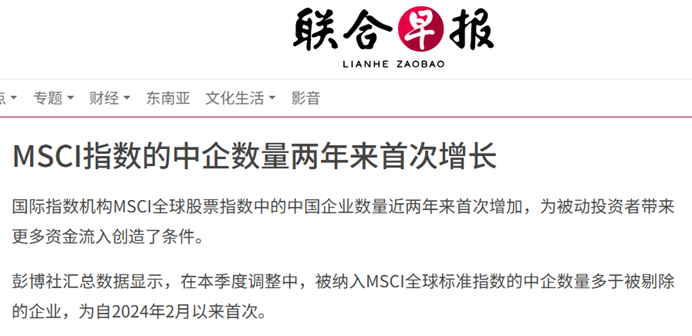
MSCI新纳入17只A股
Shen Zhen Shang Bao· 2025-11-07 16:52
Group 1 - MSCI announced changes to its indices on November 6, including the addition of 17 A-shares and the removal of 16 A-shares, effective after the market close on November 24 [1] - Newly added A-shares include companies such as Qianli Technology, Dongyangguang, and Changchuan Technology, while removed A-shares include names like Zhongzhi Co., Bertli, and Dong'a Ejiao [1] - In addition to A-shares, the MSCI China Index also added 9 Hong Kong stocks, including Zijin Mining International and GF Securities, while removing 4 stocks such as Beikong Water Group and China Everbright Bank [1] Group 2 - The largest newly added stocks in the MSCI Global Standard Index include CoreWeave, Nebius Group, and Insmed, while the largest in the MSCI Emerging Markets Index are Barito Renewables Energy, Zijin Mining International, and GF Securities [2] - MSCI conducts four routine adjustments to its indices annually, with the May and November adjustments being more significant compared to the smaller adjustments in February and August [2]
共创数字新范式:海澜之家与京东共筑服装产业智慧未来
Xin Hua She· 2025-11-07 15:30
Core Insights - The textile and apparel industry in China is accelerating its transition from "manufacturing" to "intelligent manufacturing" through digital transformation initiatives led by Hai Lan [1][8] - Hai Lan's collaboration with JD.com has created a co-creation model that enhances quality and upgrades the industry [1][8] Digital Transformation - Hai Lan initiated the construction of smart factories in 2022, achieving a model of "one piece order, delivery within 7 working days" by 2023, which restructured the production process [1] - The smart factory's core innovation is the "butterfly system" flexible production line, which allows dynamic allocation of materials to idle workstations, achieving a daily capacity of 400 suits (800 garments) [3] Data Collaboration - Hai Lan's digital transformation spans the entire supply chain from R&D to sales, with over 5,000 stores integrated into JD.com's rapid delivery system by June 2025 [3][4] - The collaboration with JD.com has enabled effective inventory management and reduced production delays during peak seasons [4] Innovation Drive - Hai Lan increased R&D investment, with expenses reaching 157 million yuan in the first three quarters of 2025, focusing on technological innovation to enhance product strength [5] - The company collaborates with universities to explore traditional Chinese clothing and color systems, aiming to reshape contemporary national brand aesthetics [5] Channel Integration - Hai Lan is promoting deep integration of online and offline channels, adapting to the shift from single-day promotions to normalized daily sales [6] - The company has transformed its supply chain from "experience-based stocking" to "algorithm-driven" processes through system integration and data sharing [8]


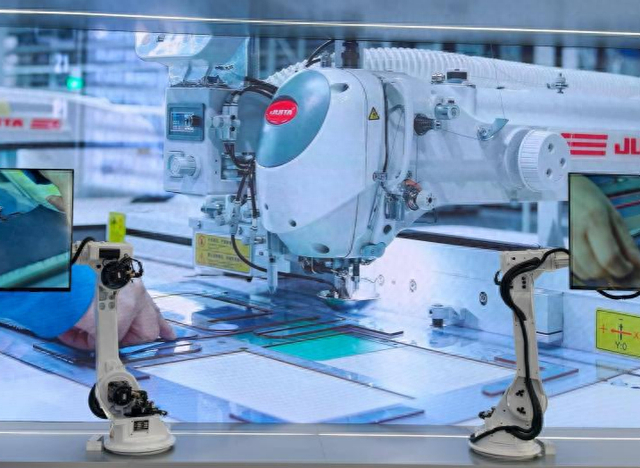
京东助力海澜之家向“超级国货品牌”迈进的数智化之旅
Xin Hua Wang· 2025-11-07 11:56
Core Insights - The transformation of traditional textile industry into "smart manufacturing" is exemplified by the operations at Hai Lan Yun's smart factory, showcasing advanced technologies like laser cutting and intelligent body measurement systems [1][2] - The competitive landscape of the apparel industry is shifting from price wars to supply chain resilience, as highlighted by the collaboration between Hai Lan Zhi Jia and JD.com, which has enhanced inventory turnover efficiency by over three times [1][6] - The rise of domestic brands is reflected in the increasing engagement of younger consumers, with a notable growth in active female users online [3] Group 1: Supply Chain Innovations - Hai Lan Zhi Jia has implemented a "Deep Sea Data Model" in collaboration with JD.com, allowing for real-time monitoring of new products against historical bestsellers, leading to rapid identification of potential hits [1][4] - The partnership has resulted in a significant improvement in inventory management, with initial order quantities controlled between 500-1000 pieces, enabling dynamic replenishment to achieve sales of millions of units [1][6] Group 2: Technological Advancements - The Hai Lan Yun factory has achieved a custom order capability of one piece with a seven-day delivery time, significantly reducing the production cycle from 15 days to 4 days [2][6] - The factory's innovations include a laser cutting precision of millimeter-level and a cost-saving of over 20 million yuan annually through advanced fabric technologies [2] Group 3: Brand Development and Cultural Integration - Hai Lan Zhi Jia is diversifying its brand portfolio to include various segments such as men's, women's, and professional attire, while also enhancing brand value through cultural initiatives [4][6] - The company aims to instill national confidence in consumers by promoting comfort and dignity in clothing, as part of its long-term vision [4] Group 4: E-commerce and Consumer Trust - The collaboration with JD.com has led to a relatively low return rate for Hai Lan Zhi Jia, attributed to the quality perception and trust built through a robust membership system [5] - The continuous increase in self-operated sales on JD.com indicates a healthy channel ecosystem for the brand [5]
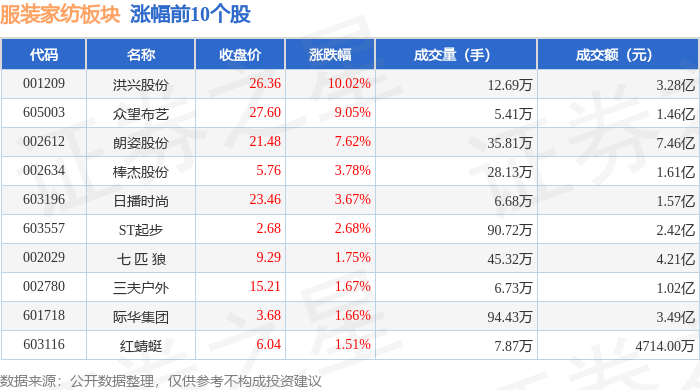
服装家纺板块11月7日涨0.24%,洪兴股份领涨,主力资金净流出1.28亿元
Zheng Xing Xing Ye Ri Bao· 2025-11-07 08:41
Group 1 - The apparel and home textile sector increased by 0.24% compared to the previous trading day, with Hongxing Co., Ltd. leading the gains [1] - The Shanghai Composite Index closed at 3997.56, down 0.25%, while the Shenzhen Component Index closed at 13404.06, down 0.36% [1] - Notable gainers in the apparel and home textile sector included: - Bingshi Co., Ltd. with a closing price of 26.36, up 10.02% on a trading volume of 126,900 shares and a transaction value of 328 million yuan - Zhongwang Fabric with a closing price of 27.60, up 9.05% on a trading volume of 54,100 shares and a transaction value of 146 million yuan - Langzi Co., Ltd. with a closing price of 21.48, up 7.62% on a trading volume of 358,100 shares and a transaction value of 746 million yuan [1] Group 2 - The apparel and home textile sector experienced a net outflow of 128 million yuan from institutional investors, while retail investors saw a net inflow of 127 million yuan [2] - The individual stock fund flow showed that: - Langzi Co., Ltd. had a net inflow of 10 million yuan from institutional investors, but a net outflow of 11 million yuan from retail investors [3] - Zhongwang Fabric experienced a net inflow of 18.84 million yuan from institutional investors, with net outflows from both retail and speculative investors [3] - Jihua Group had a net inflow of 16.50 million yuan from institutional investors, while also facing net outflows from retail investors [3]
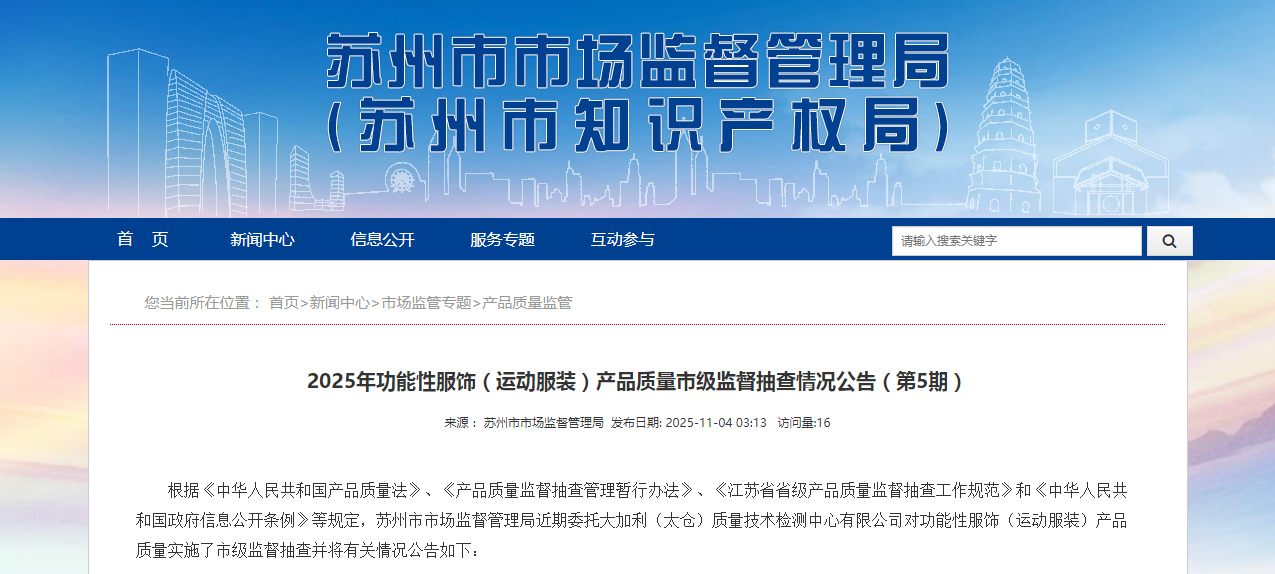
江苏省苏州市市场监管局发布2025年功能性服饰(运动服装)产品质量市级监督抽查情况公告(第5期)
Zhong Guo Zhi Liang Xin Wen Wang· 2025-11-07 08:10
Core Insights - The announcement from Suzhou's market supervision bureau highlights the quality inspection results of functional sportswear, revealing a 4.3% non-compliance rate among the 69 batches tested [6][22]. Product Overview and Industry Distribution - Functional sportswear is designed for athletic activities, utilizing high-tech materials like polyester for moisture-wicking and spandex for elasticity, ensuring comfort and performance [2][3]. - The global market for functional apparel is expanding due to rising health awareness and fitness trends, with both professional athletes and casual consumers driving demand [3]. - The industry features a well-structured supply chain, with upstream suppliers innovating materials, midstream manufacturers adopting smart production, and downstream brands targeting diverse market segments [3]. Inspection Basis and Key Projects - The quality inspection was based on multiple national standards, including GB18401-2010 and GB/T29862-2013, covering various performance metrics [4][5]. - Key inspection items included formaldehyde content, pH value, color fastness, fiber content, moisture permeability, and UV protection [5][6]. Inspection Results - Out of 69 batches inspected, 3 were found non-compliant, primarily due to issues with moisture absorption rates, moisture transmission index, water droplet diffusion time, capillary height, and UV protection performance [6][15]. - The non-compliance rate indicates potential quality control issues within the manufacturing processes of certain brands [6][8][10]. Consumer Guidance - Consumers are advised to check product labels for compliance with functional standards and to prefer well-known brands with higher compliance rates [16][17]. - It is recommended to select apparel based on specific activity needs, ensuring that the claimed functionalities align with actual performance [18][19].
重要调整!16只A股遭剔除
Shen Zhen Shang Bao· 2025-11-06 13:39
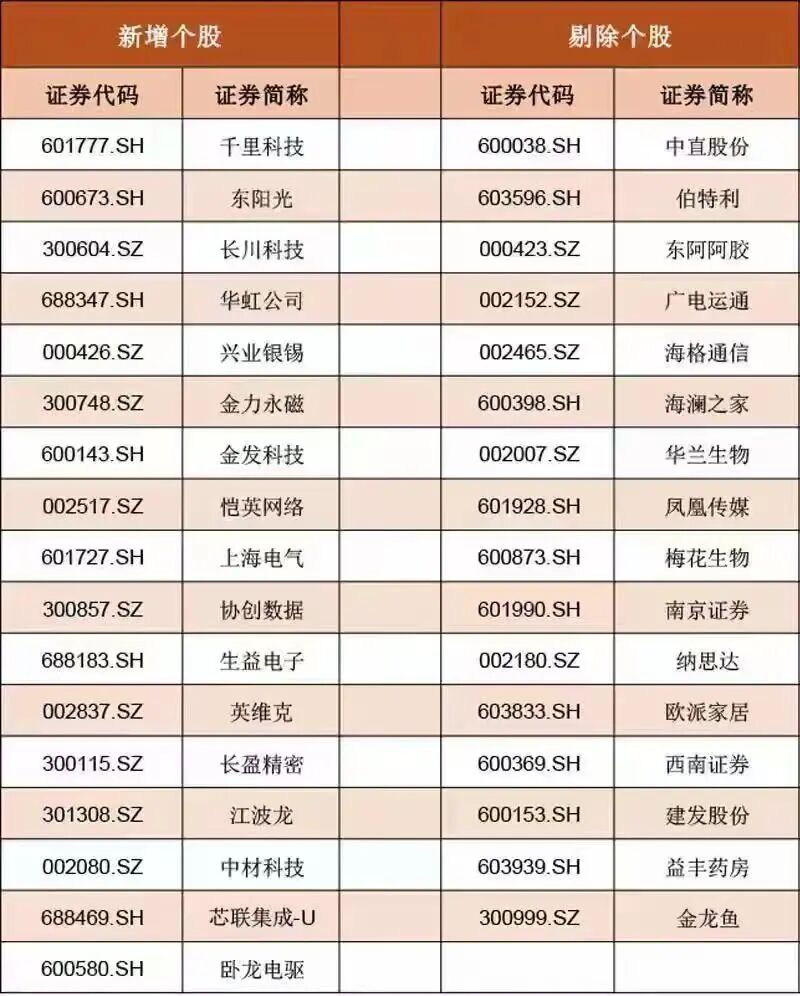
Group 1 - MSCI announced the results of its November index review, which includes the addition of 17 new A-shares and the removal of 16 A-shares [2][3] - The newly added A-shares include companies such as Qianli Technology, Dongyangguang, and Changchuan Technology, while the removed A-shares include companies like Zhongzhi Co., Bertley, and Dong'a Ejiao [1][3] - The adjustments will take effect after the market closes on November 24 [2] Group 2 - In addition to A-shares, MSCI also included 9 new Hong Kong stocks in its indices, such as Zijin Mining International and GF Securities, while removing 4 Hong Kong stocks [3][4] - The largest new additions to the MSCI Global Standard Index include companies like CoreWeave, Nebius Group, and Insmed, indicating a focus on sectors like cloud services and biopharmaceuticals [4] - MSCI conducts four routine adjustments to its indices each year, with the November review being one of the two major semi-annual assessments [5]


MSCI发布最新调整结果
Zhong Guo Ji Jin Bao· 2025-11-06 10:11
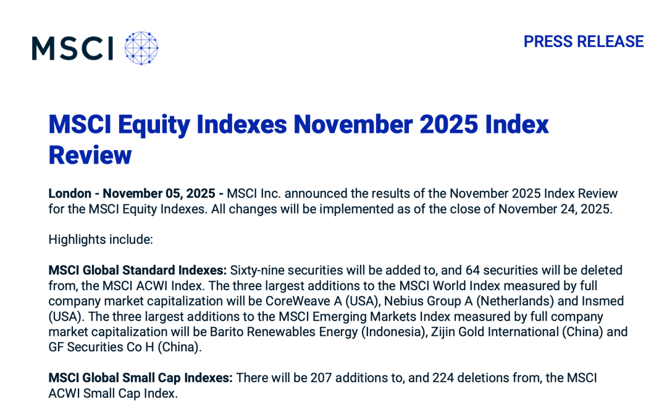
Core Insights - MSCI announced the results of its November index adjustments, which will be implemented after the market close on November 24, 2025 [1] Group 1: Index Adjustments - MSCI Global Standard Index Series will add 69 securities and remove 64 securities, with the largest additions being CoreWeave A, Nebius Group A, and Insmed [3] - MSCI Emerging Markets Index will add three major securities: Barito Renewables Energy from Indonesia, Zijin Mining International from China, and GF Securities H-shares from China [3] - MSCI Global Small Cap Index will add 207 securities and remove 224, while MSCI Global Investable Market Index will add 199 and remove 211 [3] - MSCI Frontier Markets Index will add 8 securities and remove 2, with the largest additions being Vietnam Airlines, MCB Bank from Pakistan, and Jordan's Arab Jordan Investment Bank [3] Group 2: China A-Shares Index Adjustments - MSCI China A-Shares Index Series will add 17 securities, including Qianli Technology, Dongyang Sunshine, and Changchuan Technology, while removing 16 securities such as Dong-Ah Pharmaceutical and Hailan Home [4][5] - The adjustments are based on objective quantitative indicators such as market capitalization and liquidity, with significant adjustments occurring in May and November each year [5] Group 3: Market Reactions - Following the announcement of index adjustments, there may be arbitrage activities as funds position themselves in response to the results, particularly for unexpected outcomes [6] - Historical trends indicate that newly added or increased weight stocks may experience price declines on the adjustment implementation date, highlighting potential impacts on less liquid stocks [6]
重要指数调整!新纳入17只A股标的
Shang Hai Zheng Quan Bao· 2025-11-06 06:19
Core Insights - MSCI announced the results of its November index review, which includes the addition of 17 new stocks to the MSCI China A-share index and the removal of 16 stocks. The changes will take effect after the market closes on November 24, 2025 [1][6]. Summary of Adjustments - **Newly Added Stocks**: The list includes stocks such as Qianli Technology (601777.SH), Dongyangguang (600673.SH), and Changchuan Technology (300604.SZ) among others [4]. - **Removed Stocks**: Stocks such as Zhongzhi Co., Ltd. (600038.SH), Bertli (603596.SH), and Dong'e Ejiao (000423.SZ) are among those being removed from the index [4]. - **Hong Kong Stocks**: In addition to A-share stocks, the MSCI China index also added nine Hong Kong stocks including Zijin Mining International and GF Securities, while removing four stocks such as Beijing Enterprises Water Group [4]. Global Index Adjustments - **Global Standard Index Changes**: MSCI's global standard index (ACWI) added 69 stocks and removed 64 stocks, with notable additions including CoreWeave, Nebius Group, and Insmed [5]. - **Emerging Markets Index**: The largest new additions to the MSCI Emerging Markets Index include Barito Renewables Energy from Indonesia, Zijin Mining International, and GF Securities [5]. Adjustment Frequency and Impact - MSCI conducts four routine adjustments annually, with the May and November adjustments typically being more significant. Adjustments are based on objective quantitative metrics such as market capitalization and liquidity [6].
最新变化!多只A股、港股被纳入
券商中国· 2025-11-06 06:09
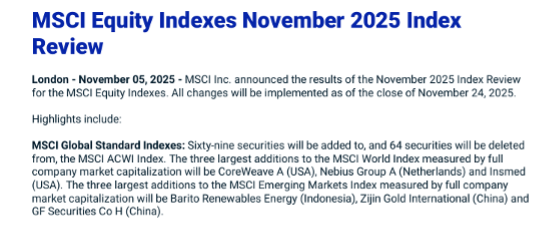
Core Viewpoint - MSCI announced the results of its index review for November 2025, with adjustments set to take effect after the market close on November 24, 2025 [1] Group 1: MSCI Global Index Adjustments - 69 new stocks will be added to the MSCI Global Standard Index, while 64 stocks will be removed [1] - The three largest securities added to the MSCI Global Index by total market capitalization are CoreWeave, Nebius Group, and Insmed [1] - The three largest securities added to the MSCI Emerging Markets Index are Barito Renewables Energy, Zijin Mining International, and GF Securities H-shares [1] Group 2: MSCI China Index Adjustments - The MSCI China Index will see the addition of 26 Chinese stocks and the removal of 20 stocks [2] - Newly added stocks include resource companies such as China Gold International and Zijin Mining International, as well as tech firms like Ganfeng Lithium and Huahong Semiconductor [2] - Stocks removed from the MSCI China Index include Haige Communications, Dong'e Ejiao, and Yihua Life [2][4] Group 3: MSCI China A-Shares Index Adjustments - The MSCI China A-Shares Index will add 17 stocks and remove 16 stocks [7] - Newly added companies include Qianli Technology, Dongyangguang, and Huahong Semiconductor [7] - The MSCI China A-Shares Onshore Index will add 18 stocks while removing 24 stocks, with notable additions like Baiwei Storage and Shengtun Mining [8] Group 4: Implications of Index Adjustments - The adjustments will lead to changes in related index funds, resulting in increased capital allocation to newly added companies and forced selling of removed companies [10] - Historical data suggests that passive funds tend to adjust their holdings on the last trading day to minimize tracking error, often leading to significant trading volume in affected stocks [10] Group 5: Market Sentiment and Foreign Investment - Several foreign institutions have expressed positive views on the Chinese market, with Fidelity Fund favoring emerging markets over developed ones [11] - Despite concerns over geopolitical risks and economic slowdown, some investors see significant growth potential in the Chinese equity market [11]