舜宇光学科技

Search documents
港股航空股大涨
第一财经· 2025-12-18 08:43
Market Overview - The Hang Seng Index (HSI) closed at 25,498.13, up by 29.35 points or 0.12% [1] - The Hang Seng Technology Index (HSTECH) decreased by 39.66 points, down 0.73% to 5,418.29 [1] - The Hang Seng China Enterprises Index (HSCEI) slightly fell by 2.06 points, down 0.02% to 8,841.51 [1] - Sectors such as coal, transportation, banking, and oil & petrochemicals showed gains, while sectors like paper, electrical equipment, machinery, and real estate experienced declines [1] Airline Sector Performance - Airline stocks saw a general increase, with China Eastern Airlines rising over 8%, China Southern Airlines up more than 5%, and Air China increasing by over 4% [2] - The airline index (887825) reported a rise of 42.84 points, or 5.07%, reaching 887.06 [3] - Notable airline stock performances include: - China Eastern Airlines (0670.HK) at 5.350, up 8.08% - Beijing Capital International Airport (0694.HK) at 2.850, up 6.74% - China Southern Airlines at 5.880, up 5.57% - Air China at 7.050, up 4.75% [3] Technology Sector Performance - Major technology stocks mostly declined, with SenseTime dropping over 4%, Xiaomi down more than 2%, and Alibaba, JD Health, BYD, and Sunny Optical Technology each falling over 1% [2] - Specific declines include: - SenseTime (商汤-W) at 1.890, down 4.06% - Xiaomi Group (小米集团-W) at 40.200, down 2.47% - Lenovo Group at 9.400, down 1.88% - Sunny Optical Technology at 65.350, down 1.80% [5][6]


港股收评:恒指涨0.12%、科指跌0.73%,航空股及煤炭股走高,锂电池及新消费概念股走低
Jin Rong Jie· 2025-12-18 08:22
12月18日,受美股科技股集体下挫影响,港股今日维持低位震荡走势,截止收盘,恒生指数涨0.12%报 25498.13点,恒生科技指数跌0.73%报5418.29点,国企指数跌0.02%报8841.51点,红筹指数跌0.26%报 4049.62点。 盘面上,大型科技股走势分化,阿里巴巴跌1.3%,京东集团跌0.09%,小米集团跌2.47%,网易涨 0.67%,美团涨0.1%,快手涨0.23%,哔哩哔哩涨0.26%;航空股延续涨势,东方航空涨超7%;煤炭股 午后走强,汇力资源涨超9%;锂电池股跌幅居前,宁德时代跌超3%;新消费概念股走弱,名创优品跌 超3%;其他股票中,舜宇光学科技跌超1%;曹操出行跌超12%,恒大物业跌超9%,中国中免跌超 5%;上海复旦涨超7%,招金矿业涨超6%。 企业新闻 远大医药(00512.HK):自主研发的重磅全球创新放射性核素偶联药物 GPN01530 在美国获批开展临床研 究。 和谐汽车(03836.HK):附属iCar Group Limited可能通过引入新投资者开展进一步股权融资,涉资4000万 美元。 中国中车(01766.HK):集团及下属企业近三个月合计签订约533.1 ...

舜宇光学20251217
2025-12-17 15:50
Summary of the Conference Call for Sunny Optical Technology Group Co., Ltd. Industry Overview - The automotive lens market has significant growth potential, with an expected average of 4.3 cameras per vehicle by 2025, and over 10 cameras in new energy vehicles [2][3] - The XR (Extended Reality) sector shows mixed performance, with weak demand in the VR market but strong performance in smart glasses, particularly driven by a major North American client launching four smart glasses in September 2025 [2][5] - The smartphone market is saturated, with expected shipment volumes in 2025 remaining flat or showing low single-digit growth [2][6] Key Points and Arguments Automotive Sector - Sunny Optical's shipments in the automotive market grew nearly 28% from January to November 2025, driven by the increasing demand for Advanced Driver Assistance Systems (ADAS) [3] - The company has developed ADAS products with 17 to 18 million pixels, positioning itself as a technology leader [2][3] - Future trends include miniaturization and self-cleaning features for automotive lenses, with expectations of over 20% revenue growth in automotive lenses and modules by 2025 [2][4] XR Sector - The smart glasses market is expected to see an increase in the number of cameras per device, potentially exceeding 10, as applications and functionalities expand [2][5] - Despite the VR market's underperformance, the XR-related business revenue is expected to remain stable compared to the previous year [2][5] Smartphone Sector - The company is focusing on high-end product lines, anticipating a 5% to 10% revenue growth in smartphone lenses and modules, with average selling prices (ASP) and gross margins improving [2][6] - The ASP is projected to achieve double-digit growth for the year, with module gross margins expected to be between 8% and 10% [6] Collaboration and Strategic Initiatives - Sunny Optical collaborates with GoerTek in the waveguide segment, focusing on AR technology, although the AR market's slow development has not yet translated into significant performance improvements [2][7] - The partnership involves resource concentration through asset swaps and capital increases, with specific roles still under discussion [7] Future Business Guidance - The company is optimistic about future developments across its business segments, although specific guidance is not yet available due to budget considerations [7][8] - The company is exploring emerging automotive business areas such as LiDAR and HUD smart headlights, with a significant project in LiDAR exceeding 1.5 billion RMB in the first half of 2025 [3][8] Production and Supply Chain - The production capacity is primarily domestic, with a focus on improving utilization rates, especially in smartphone modules, which are expected to reach 80-90% in the second half of 2025 [11] - Geopolitical factors have limited impact on production and supply chains, with existing production bases in Vietnam and India allowing flexibility to meet international client demands [12][10] Financial Considerations - The company is considering increasing dividend payouts and share buyback plans, balancing these with R&D investments and operational funding [14] Additional Important Insights - The company has seen a doubling in revenue from wave-speed hybrid lenses in the first half of 2025, indicating strong market demand for high-end products [13] - The company is prepared to respond quickly to expansion needs, with existing facilities ready for equipment procurement [11]

华安证券:AI技术转向推理 驱动硬件产业链迎来新一轮成长周期
Zhi Tong Cai Jing· 2025-12-17 03:37
Core Viewpoint - The global AI technology is shifting from training to inference, driving a new growth opportunity in the hardware supply chain [2] Summary by Category Overall - The transition from training-dominated AI to inference-driven AI is significantly increasing the demand for inference computing power, driven by the iteration of multimodal large models like Google's Gemini 3 Pro and OpenAI's Sora 2 [2] - Major cloud service providers (CSPs) are expected to increase capital expenditures, with a forecast of $431 billion by 2025, a 65% year-on-year increase, and potentially reaching $602 billion by 2026 [2] - Sovereign AI initiatives are being launched globally, such as the U.S. "Gateway to the Stars" plan with an investment of approximately $500 billion and the EU's plan to invest $21.5 billion in AI super factories, contributing to a high-growth phase in global AI infrastructure [2] - By 2030, global AI data center capacity is projected to reach 156 GW, accounting for 71% of total data center demand [2] Cloud Side - PCB: AI servers are bringing clear value increases, with Nvidia's DGX H100 single GPU corresponding to a PCB value of $211, a 21% increase from the previous generation; the GB200 NVL72 raises the single GPU value to $346 [3] - The domestic high-end PCB capacity is expected to be released in 2026 to support downstream demand, driving upgrades in upstream materials [3] - Storage: The structural supply-demand imbalance due to AI demand has led to significant price increases in DRAM and NAND Flash, with a shift in investment focus towards high-value products expected in 2026 [3] - KVCache technology is accelerating the replacement of HDDs with QLC SSDs, with a projected 30% penetration rate in the enterprise SSD market by 2026 [3] Optical Interconnect - Optical interconnect technology is entering a new era as a key component of AI computing clusters, with optical switches meeting the interconnection needs of large-scale AI clusters due to their high bandwidth, low latency, and low power consumption [4] - The MEMS-based technology route currently dominates, with domestic manufacturers actively engaging in various segments of the global supply chain [4] End Side - AI Phones: The AI phone market is expected to maintain moderate growth in 2025, with competition shifting towards end-side AI capabilities [5] - The operating systems of mobile phones are evolving from "application launchers" to "system-level intelligent agents," with flagship chips from Apple and Android continuously enhancing NPU computing power [5] - AR Glasses: The integration of AI and AR in smart glasses is seen as the future of wearable devices, with the market experiencing rapid growth [5] - The optical imaging module solutions for AR glasses are expected to favor light guide technology due to its advantages in clarity and size, while LCOS remains the mainstream for consumer products [5] Recommendations - The company suggests focusing on sectors benefiting from the shift to inference computing and hardware upgrades, including: - PCB and upstream materials: Shenghong Technology, Huitian Technology, Jingwang Electronics, Guanghe Technology, Dongcai Technology [6] - Storage and equipment: Beijing Junzheng, Zhaoyi Innovation, Jucheng Co., Jingzhida [6] - Optical interconnect: Yintan Zhikong, Saiwei Electronics [6] - End-side AI: GoerTek, Luxshare Precision, Baiwei Storage, Longqi Technology, Crystal Optoelectronics, Zhongke Lanyun, Howey Group, Sunny Optical Technology [6]

港股科技股集体下挫,恒生科技跌2.5%,阿里跌4%,中芯国际、腾讯音乐、阿里健康、小米、华虹半导体跌超3%


Ge Long Hui· 2025-12-16 04:37
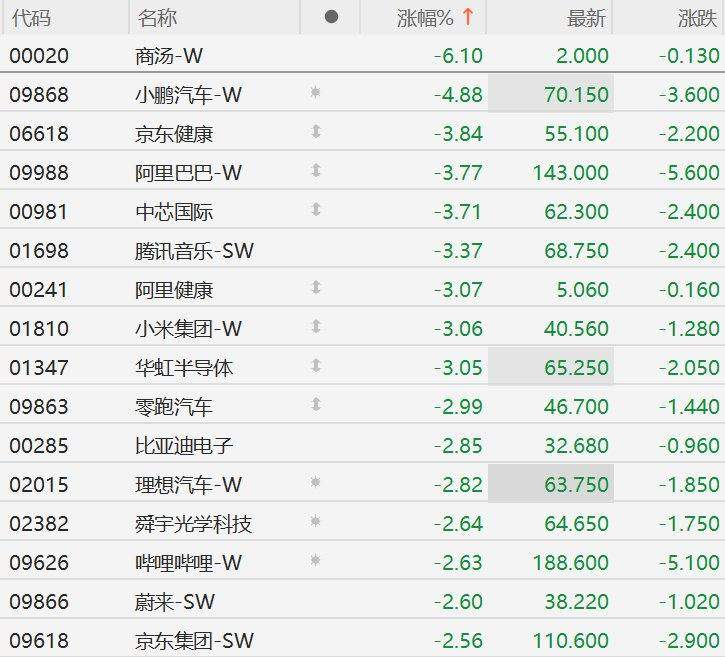
Core Viewpoint - The Hong Kong technology stocks experienced a collective decline, with the Hang Seng Technology Index dropping by 2.5% Group 1: Stock Performance - SenseTime (商汤) fell over 6%, closing at 2.000, down by 0.130 [1][2] - Xpeng Motors (小鹏汽车) decreased by 4.88%, with a latest price of 70.150, down by 3.600 [1][2] - Alibaba (阿里巴巴) saw a decline of 3.77%, trading at 143.000, down by 5.600 [1][2] - JD Health (京东健康) dropped by 3.84%, with a price of 55.100, down by 2.200 [1][2] - Semiconductor Manufacturing International Corporation (中芯国际) fell by 3.71%, closing at 62.300, down by 2.400 [1][2] - Tencent Music (腾讯音乐) decreased by 3.37%, with a latest price of 68.750, down by 2.400 [1][2] - Alibaba Health (阿里健康) dropped by 3.07%, trading at 5.060, down by 0.160 [1][2] - Xiaomi (小米) fell by 3.06%, closing at 40.560, down by 1.280 [1][2] - Huahong Semiconductor (华虹半导体) decreased by 3.05%, with a price of 65.250, down by 2.050 [1][2] - Li Auto (理想汽车) saw a decline of 2.82%, trading at 63.750, down by 1.850 [1][2] - NIO (蔚来) fell by 2.60%, closing at 38.220, down by 1.020 [1][2]
2026年科技股策略:锚定恒生科技优质标的 财通证券推荐了这20只股
Ge Long Hui· 2025-12-16 02:29
Core Viewpoint - The report by Haitao Securities emphasizes the importance of identifying stocks with potential short-term or long-term performance discrepancies or surprises in AI advancements as a core task for 2026 [1] Group 1: Investment Strategy - The main investment strategy is to focus on value investing in the Hang Seng Technology Index, leveraging volatility from the Hong Kong stock market and short-selling mechanisms [1] - The key to successful operations lies in selecting fundamentally strong companies with sustainable development capabilities [1] Group 2: Recommended Stocks for 2026 - Stocks currently at the bottom or adjusting, with a high likelihood of fundamental reversal in 2026: Meituan, Xiaomi Group (planning next vehicle), BYD Electronics [2] - Stocks expected to benefit from EPS gains and potential valuation uplift: Tencent Holdings, Trip.com Group, JD Health, Lenovo Group [2] - Stocks with controllable elasticity: Alibaba, Baidu Group, SMIC, Hua Hong Semiconductor [2] - AI elastic stocks: Kuaishou, Bilibili, Kingdee International, Horizon Robotics, Xpeng Motors, Yueda Group, NetEase, Sunny Optical Technology, UBTECH [2] - Potential small-cap companies: Inspur Digital Enterprise, Xindong Company, Huiliang Technology [2] Group 3: Individual Stock Insights - Kuaishou, Bilibili, Horizon Robotics, Xpeng Motors, Sunny Optical Technology, UBTECH are highlighted as key stocks with positive outlooks [2] - Inspur Digital Enterprise and Huiliang Technology are noted as quality small-cap stocks with promising prospects [2] - Tencent Holdings is identified as a top pick due to its strong research framework [2] - Alibaba is considered a leading asset in AI technology [2] - Lenovo Group is expected to achieve profitability in its server business next year due to accelerated AIPC penetration [2] - Trip.com Group is positioned well for growth driven by domestic stability and overseas acceleration [2] - JD Health is recognized as a leading player in internet healthcare with a clear growth path [2] - Meituan is noted for its resilience and potential turning point in competitive landscape [2] - Kingdee International's growth is constrained by macroeconomic factors, but AI and overseas expansion provide additional elasticity [2] - Xiaomi Group is expected to see improvements as negative factors gradually clear [2] - SMIC is experiencing an increase in advanced manufacturing proportion and continuous technological breakthroughs [2] - Hua Hong Semiconductor is benefiting from growth driven by computing and consumer electronics [2] - Yueda Group focuses on IP as a core asset, with expectations for further expansion and monetization [2] - NetEase is anticipated to enter a new product cycle with upcoming releases [2] - BYD Electronics is expected to see growth from Apple's foldable phone production and has significant potential in the new energy vehicle and data center sectors [2] - Xindong Company is driven by gaming and Taptap, with expectations for the launch of an overseas version [2]


【大涨解读】无人驾驶板块:L3准入+特斯拉无人测试落地,2026年将进入B端无人车商业模式跑通阶段,商业化拐点催生板块行情
Xuan Gu Bao· 2025-12-16 02:22
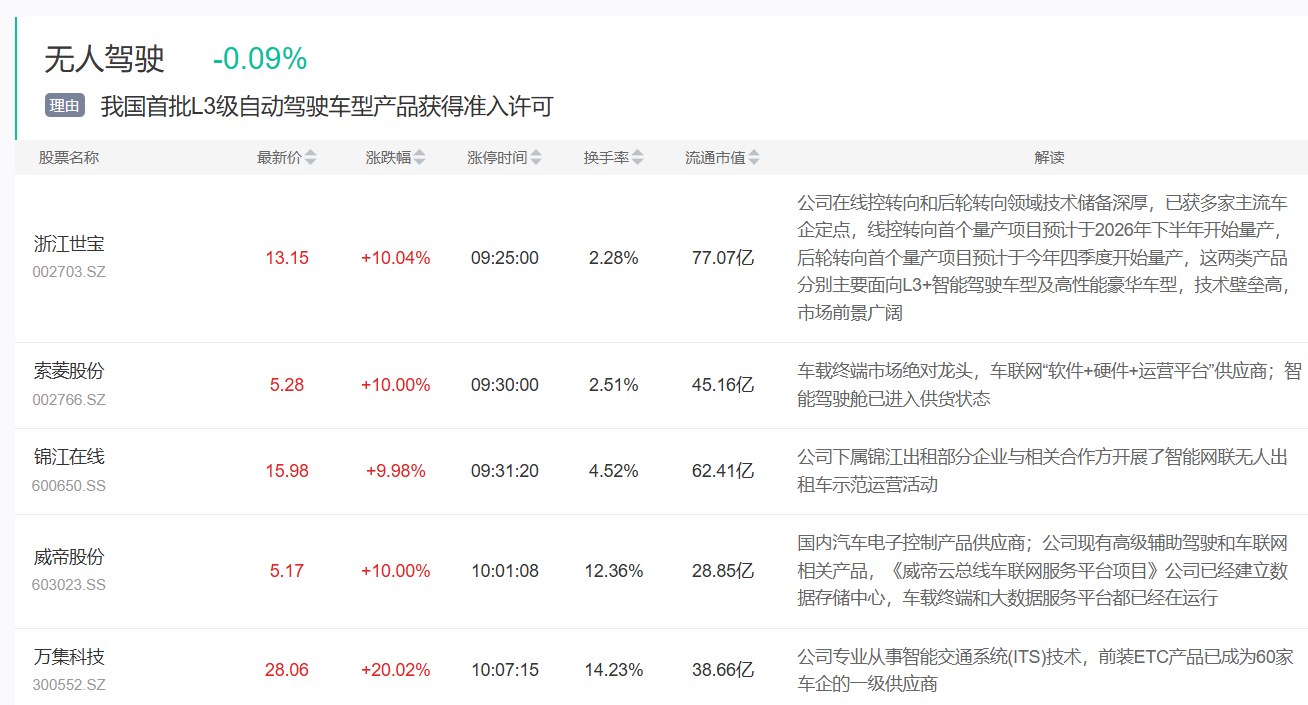
Core Insights - The autonomous driving sector experienced significant gains, with companies like Zhejiang Shibao and Beiqi Blue Valley hitting the upper limit of their stock prices, indicating strong market interest and investor confidence in this industry [1] Event Summary - On December 15, the Ministry of Industry and Information Technology announced the first batch of L3 conditional autonomous driving vehicle permits in China, allowing Changan and Arcfox models to conduct road trials in designated areas of Chongqing and Beijing, marking a shift from testing to commercial application [3] - On the same day, Tesla launched its no-driver Robotaxi testing in Austin, USA, with the Model Y achieving fully autonomous operation, and plans to expand the fleet to 500 vehicles by year-end, currently operating 31 [3] - Multiple cities are accelerating the implementation of smart driving policies, with Beijing, Shenzhen, and Shanghai granting L4 road rights, and the Ministry of Industry and Information Technology expected to release a draft for national standards on L3-L4 by Q4 [3] Institutional Analysis - The approval of L3 vehicles signifies a transition in China's smart driving from "testing and validation" to "compliant mass production and controlled road use," which will accelerate the commercialization process of the industry. The three-pronged management model of "product access + user subject + operational area" provides a clear path for other automakers to follow, with 2026 anticipated as a critical year for L3 mass production [4] - The simultaneous advancement of high-level intelligent driving in China and the US creates a dual catalytic effect. The clear legal responsibilities established by China's L3 approval reduce social risks and regulatory uncertainties, while Tesla's fully autonomous testing validates the feasibility of L4 technology, shifting the industry focus from engineering challenges to commercial viability [4] - By 2026, leading automakers are expected to achieve over 30% growth in revenues related to intelligent driving, benefiting algorithm suppliers and core hardware companies as vehicle production ramps up. Long-term, smart vehicles are projected to reshape the automotive mobility market, establishing a new valuation system based on "intelligent entity revenue capacity = ownership × capability level" [5] - The rollout of L3 technology will create incremental opportunities in the automotive testing and hardware sectors, with increased demand for testing of smart driving vehicle permits. The penetration rates of core components like steer-by-wire and domain controllers are expected to grow rapidly, with the steer-by-wire market projected to increase by over 150% year-on-year by 2026 [5]

电子行业周报:春季躁动在即,关注1月业绩催化集中的AI算力+存力链-20251215
Guoxin Securities· 2025-12-15 13:34
Investment Rating - The report maintains an "Outperform" rating for the electronics industry [1][5][10]. Core Views - The upcoming spring market is expected to be driven by performance catalysts in January, particularly in AI computing and storage chains. The electronics sector has shown a weak performance recently due to factors such as reduced government subsidies and supply shortages in storage [1][5]. - The report emphasizes a positive outlook for the electronics industry, recommending patience in allocation and focusing on companies involved in self-controlled manufacturing and overseas AI computing and storage industries [1][5]. - The report highlights the rapid approval of several hard technology-themed funds, which may accelerate the sector's rebound [1]. Summary by Sections Market Trends - The Shanghai Composite Index fell by 0.34%, while the electronics sector rose by 2.63%, with electronic chemicals increasing by 6.99%. The Hang Seng Tech Index and Philadelphia Semiconductor Index saw declines of 0.43% and 3.58%, respectively [1][11]. Key Recommendations - The report recommends focusing on companies such as Aojie Technology, Jiangbolong, Shengyi Technology, Demingli, Lens Technology, Luxshare Precision, Lante Optics, Hengxuan Technology, Lanke Technology, and SMIC [1][5]. Company Performance - Broadcom reported a revenue of $18.02 billion for Q4 FY2025, with semiconductor solutions contributing $11.07 billion. The company expects Q1 revenue to be around $19.1 billion, with AI chip revenue projected to double to $8.2 billion [2]. - Horizon is accelerating the arrival of smart cars and general robotics, with high-level autonomous driving entering a price range of 130,000 to 150,000 [3]. Industry Developments - The Trump administration has approved the export of NVIDIA H200 chips to China, imposing a 25% national security fee, which may temporarily alleviate computing power shortages for domestic cloud vendors [4]. - The report notes that the data center power supply is evolving towards an 800V DC architecture, with silicon carbide and gallium nitride expected to replace silicon-based devices [8].
港股科网股普跌
第一财经· 2025-12-15 01:56
| 名称 | 现价 | 涨跌幅 ▲ | | --- | --- | --- | | 京东健康 | 56.200 | -5.94% | | 百度集团-SW | 122.100 | -3.10% | | 理想汽车-W | 65.800 | -2.59% | | 阿里巴巴-W | 150.800 | -2.14% | | 海尔智家 | 26.020 | -1.89% | | 小鹏汽车-W | 74.050 | -1.86% | | 舜宇光学科技 | 66.200 | -1.85% | | 快手-W | 66.300 | -1.70% | | 华虹米음体 | 70.700 | -1.67% | | 哔哩哔哩-W | 192.500 | -1.64% | | 腾讯控股 | 606.000 | -1.62% | | 小米集团-W | 42.300 | -1.54% | | 比亚迪股份 | 97.000 | -1.52% | | 地平线机器人-W | 8.890 | -1.33% | | 阿里健康 | 5.260 | -1.31% | | 同程旅行 | 21.560 | -1.28% | | 网易-S | 215.800 ...

全球硬件 -AI 眼镜:下一类快速增长的边缘设备-Global Hardware AI Glasses the Next Fast-Growing Edge Device
2025-12-15 01:55
Summary of AI Glasses Market and Key Players Industry Overview - The AI glasses market is projected to grow significantly, with shipments expected to reach approximately 112 million units by 2030, reflecting a compound annual growth rate (CAGR) of 105% from 2024 to 2030 [1][2][18] - Market revenues are forecasted to reach US$40 billion by 2030, with a CAGR of 112% during the same period [1][2][18] - The market is characterized by evolving technology and increasing competition among major tech companies [2][50] Key Players and Market Share - **EssilorLuxottica-Meta** is expected to maintain market leadership with a projected share of around 31% by 2030, down from over 90% in 2024 [1][2][18] - **Google** is anticipated to capture approximately 27% of the market share, followed by **Apple** at around 16% [1][2][18] - Other notable players entering the market include **Snap**, **Samsung**, **Tencent**, and **ByteDance**, indicating a trend towards collaboration between tech companies and fashion brands [2][50][61] Technological Insights - Optical components are critical for AI/AR glasses, potentially accounting for 40-70% of the overall bill of materials (BOM) for fully-featured smart glasses [3][28][39] - The complexity of AI capabilities and interaction design will influence hardware development, with a focus on lightweight, power-efficient semiconductor solutions [32][33] - Current dominant players in the semiconductor space include **Qualcomm**, which is expected to remain a key supplier for smart glasses [3][32] Development Challenges - Key challenges in smart glasses development include semiconductor limitations, battery life, design aesthetics, operating systems, display technology, and eyewear distribution channels [32][33][34][36][37] - The need for stylish designs and compatibility with prescription lenses is crucial for mass adoption, as traditional eyewear companies leverage their distribution networks [37][38] Market Catalysts and Risks - Anticipated product launches from major tech companies in 2026 are seen as potential catalysts for market growth, alongside quarterly shipment updates, particularly from Meta [5][50] - Risks include potential oversupply in the supply chain if production increases ahead of demand, which could lead to downward pressure on prices [5] Future Outlook - The AI glasses market is expected to evolve into a mainstream product category by 2026, with significant advancements in features and functionalities [2][50][61] - Companies like **Meta** and **Apple** are focusing on integrating AI capabilities into their products, with Apple reportedly prioritizing AI smart glasses over mixed reality headsets [61][62] - The partnership between **EssilorLuxottica** and **Meta** is highlighted as a strategic advantage, combining fashion expertise with technological innovation [55][56] Conclusion - The AI glasses market is poised for rapid growth, driven by technological advancements and strategic partnerships among key players. The success of these products will depend on overcoming development challenges and effectively addressing consumer needs for design and functionality.