
优必选

Search documents
我们不需要100万台“跳舞机器人”
3 6 Ke· 2026-01-28 02:56
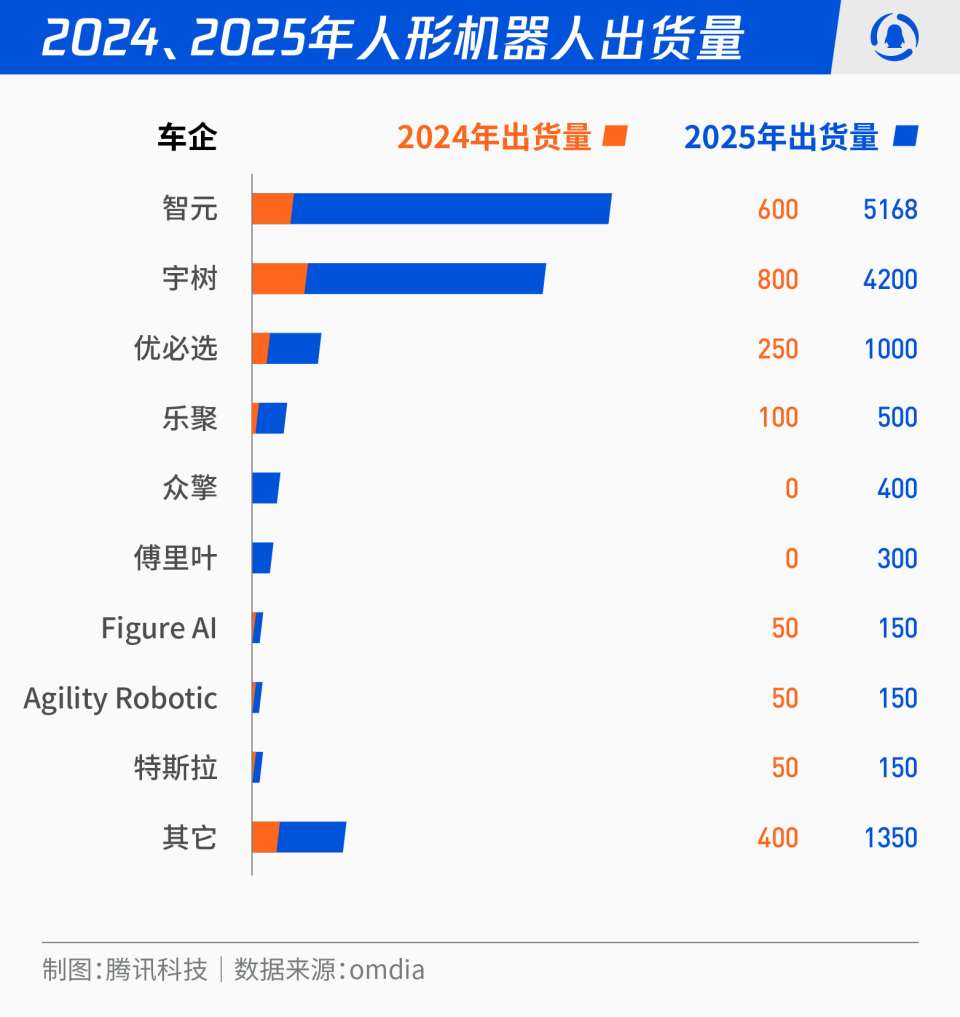
Core Viewpoint - The article discusses the competitive landscape of humanoid robots, highlighting the discrepancies in projected shipment volumes and market share among leading companies, particularly focusing on Yuzhu Technology's response to Omdia's data on humanoid robot shipments for 2025 [1][3][6]. Group 1: Market Data and Company Responses - Yuzhu Technology claims that its actual shipment volume for humanoid robots in 2025 will exceed 5,500 units, countering Omdia's report which listed it at 4,200 units [6][26]. - Omdia's report ranks the top three humanoid robot manufacturers by shipment volume as Zhiyuan Robotics (5,168 units), Yuzhu Technology (4,200 units), and Ubtech (1,000 units) [1][3]. - Counterpoint's data corroborates the market share of the top three companies, with Zhiyuan at 30.4%, Yuzhu at 26.4%, and Ubtech at 5.2% [3]. Group 2: Industry Growth and Challenges - The humanoid robot industry is expected to see a significant increase in shipments, with a total of over 10,000 units projected for 2025, compared to less than 2,000 units in 2024, indicating a substantial year-on-year growth [6][26]. - Despite the optimistic projections, the industry faces challenges, including the fact that over 140 companies are entering the humanoid robot market, with more than 330 products launched, suggesting that many companies have yet to realize substantial production capabilities [6][26]. - The article emphasizes that the humanoid robot sector is still in its early exploratory phase, with many products lacking practical applications beyond entertainment [12][20]. Group 3: Application and Market Perception - The perception of humanoid robots is largely limited to entertainment, such as dancing, which raises concerns about their practical applications in real-world scenarios [8][9]. - Industry experts suggest that while entertainment applications are currently popular, the future of humanoid robots will depend on their ability to perform more complex tasks and integrate into various sectors [12][20]. - The article notes that the current market for humanoid robots is primarily focused on developers and research institutions, with consumer adoption hindered by the lack of "out-of-the-box" usability [18][20]. Group 4: Future Outlook and Production Challenges - The article discusses the ambitious production goals set by companies like Tesla, which aims for 1 million units of its Optimus robot, contrasting this with the current low shipment figures [23][24]. - The industry is characterized by a significant gap between ambitious production targets and actual output, with many companies still struggling with hardware stability and practical applications [26][28]. - The potential for scaling production exists, but it is contingent on market demand and the ability of humanoid robots to solve specific problems effectively [28][29].


机器人“扎堆”上春晚,谁将成为下一个“顶流”?
投中网· 2026-01-28 02:40
Group 1 - The core theme of the article revolves around the integration of embodied intelligent robots into the upcoming Spring Festival Gala, showcasing advancements in technology and art [9][8]. - The Central Radio and Television Station has partnered with multiple robotics companies for the 2026 Spring Festival Gala, including Magic Atom, Galaxy General Robotics, and Yushu Technology [4][5][6]. - The Gala aims to enhance the "technology + art" experience, incorporating intelligent robotics into stage performances and creative content [8][9]. Group 2 - Yushu Technology, known for its humanoid robots, has made significant impacts on previous Spring Festivals, including a notable performance in 2022 that became a hot topic [16][11]. - The company has achieved a market valuation of HKD 71 billion as of January 27, 2023, and reported humanoid robot orders totaling nearly CNY 1.4 billion for 2025 [14][15]. - Yushu Technology has completed 10 rounds of financing, with its valuation reaching CNY 12 billion, reflecting strong investor interest [16]. Group 3 - Galaxy General Robotics, established in May 2023, focuses on multi-modal large model robots and has completed five rounds of financing, raising over USD 300 million in its latest round [23][24]. - The company’s first product, the Galbot G1, features a wheeled chassis and is designed for versatility in various applications, including industrial and retail environments [25][26]. - Galaxy General's robots are already operational in factories of major companies like CATL and Bosch, emphasizing their role in precision manufacturing [27]. Group 4 - Magic Atom, founded in January 2024, specializes in general robotics and has launched several products, including the MagicBot Z1, which is designed for complex movements and social interaction [30][31]. - The company has successfully completed two rounds of financing, with the latest round raising several hundred million yuan, aimed at advancing core technologies [36][35]. - Magic Atom's products are expected to blend seamlessly into traditional Spring Festival performances, highlighting the fusion of technology and culture [37].

全国首个“万亿城区”诞生 深圳南山“为什么能”?
Xin Hua She· 2026-01-28 02:31
Group 1 - Nanshan District in Shenzhen is set to become the first district in China with a GDP exceeding 1 trillion yuan by 2025, contributing approximately 25% to Shenzhen's overall economy despite occupying only 10% of its land area [1] - The strategic emerging industries in Nanshan account for 60% of its economic output, with over 200 listed companies, showcasing its robust economic dynamism [1][2] - The software and internet industry in Nanshan is projected to generate over 900 billion yuan in revenue by 2025, reinforcing its competitive advantage in industrial clustering [2] Group 2 - The continuous optimization of the business environment is a key factor in Nanshan's development as a "trillion district," with local government initiatives supporting startups and innovation [3][4] - The number of business entities in Nanshan has grown from 530,000 in 2020 to over 600,000 by 2025, and the number of listed companies increased from approximately 180 to 218 during the same period [4] - Nanshan's government has implemented a "six-in-one" action plan to support entrepreneurs, providing comprehensive services to facilitate innovation and entrepreneurship [3] Group 3 - Nanshan is focusing on industrial upgrades and the development of smart, green, and healthy industries, with plans to enhance its hardware support through projects like the Honghuailing Industrial Park [6] - The establishment of a regional venture capital fund with a target size of 50.45 billion yuan aims to support the development of new productive forces in the Guangdong-Hong Kong-Macao Greater Bay Area [7] - Nanshan's foreign trade import and export volume exceeded 900 billion yuan in 2025, highlighting its role as a significant player in international trade [9]
“富”可敌市,中国第一个万亿GDP地市辖区,诞生
虎嗅APP· 2026-01-28 00:23
Core Viewpoint - Shenzhen's Nanshan District is set to become China's first district with a GDP exceeding 1 trillion yuan by 2025, marking a significant milestone in the economic landscape of non-direct-controlled cities [5][8]. Group 1: Economic Milestone - Nanshan's GDP surpassing 1 trillion yuan signifies a breakthrough for non-direct-controlled urban areas, positioning it alongside major economic districts like Shanghai's Pudong and Beijing's Haidian [6][12]. - The district's rapid economic growth is highlighted by its average annual compound growth rate of nearly 15% over the past 35 years, transitioning from a marginal area to a leading economic zone [17][15]. Group 2: Economic Density and Competitiveness - Nanshan boasts the highest economic density in the country, with a per capita GDP exceeding 540,000 yuan and a land GDP of over 5.4 billion yuan per square kilometer [19]. - The district is recognized for its innovation capabilities, with a significant number of patents and R&D investment intensity nearly three times the national average [21][23]. Group 3: Industrial Structure and Growth Drivers - Nanshan's economy is characterized by a balanced integration of high-end manufacturing and modern service industries, with nearly 80% of its GDP coming from the tertiary sector [30][31]. - The district is home to numerous leading enterprises, including Tencent and DJI, and has a high concentration of high-tech companies, with over 6,000 high-tech firms and 218 listed companies [34][35]. Group 4: Future Development and Strategic Initiatives - Nanshan aims to enhance its global competitiveness through a strategic framework focusing on domestic and international circulation, as well as marine economy development [44]. - The district is positioned to lead in emerging industries such as artificial intelligence and low-altitude economy, with significant investments and initiatives planned for the next decade [36][39].

新华每日电讯聚焦:解锁“万亿城区”,深圳南山“为什么能”?
Xin Lang Cai Jing· 2026-01-27 23:43
Core Insights - Nanshan District in Shenzhen is set to become the first district in China to achieve a GDP exceeding 1 trillion yuan by 2025, accounting for approximately 25% of Shenzhen's total economic output [1][2] - The district has a strong focus on strategic emerging industries, with 60% of its economic output coming from these sectors, particularly in robotics and technology [1][2] Economic Development - The robotics industry in Nanshan is a significant driver of economic growth, with companies like UBTECH Robotics achieving nearly 1.4 billion yuan in orders for humanoid robots by the end of 2025 [1][2] - Nanshan's software and internet industry is projected to generate over 900 billion yuan in revenue by 2025, reinforcing its position as a hub for technological innovation [2] - The district has over 1,300 artificial intelligence enterprises and has nurtured more than 6,000 national high-tech enterprises, showcasing its robust industrial ecosystem [2] Business Environment - Continuous optimization of the business environment is a key factor in Nanshan's success, with local government initiatives providing comprehensive support for startups and established companies alike [3][4] - The number of business entities in Nanshan has grown from 530,000 in 2020 to over 600,000 by 2025, with the number of listed companies increasing from approximately 180 to 218 [4] Infrastructure and Innovation - Nanshan is enhancing its industrial infrastructure through initiatives like "industrial stacking," which aims to maximize the use of limited industrial land [6] - The district is committed to advancing smart, green, and health-oriented industries, with a focus on integrating AI into various sectors [6] Investment and Trade - Nanshan's foreign trade is thriving, with total import and export volume exceeding 900 billion yuan in 2025 [9] - The establishment of a global service center in Nanshan aims to facilitate international business operations, providing essential services for companies looking to expand globally [9]
南山将试点建设鸿蒙人工智能医院
Nan Fang Du Shi Bao· 2026-01-27 23:14
Core Insights - Nanshan District is set to become the first district in China with a GDP exceeding 1 trillion yuan by 2025, achieving an average annual growth rate of over 5.8% from 2016 to 2021 [2][3] Economic Growth - The economic scale of Nanshan has increased from 652.7 billion yuan at the end of the 13th Five-Year Plan to over 1 trillion yuan, marking a significant leap of four hundred billion yuan levels in five years [2][3] - The contribution of strategic emerging industries to the GDP has reached 60%, indicating a strong reliance on new quality-driven economic growth [3][5] Innovation and Industry - Nanshan is recognized as a key center for technological innovation and industrial manufacturing within the Guangdong-Hong Kong-Macao Greater Bay Area, with over 110 tech companies participating in the 2026 International Consumer Electronics Show [3] - The district hosts more than 20 robot manufacturing companies and over 200 upstream and downstream enterprises, showcasing a robust industrial cluster [5] - Nanshan's innovation ecosystem integrates talent, funding, and industry chains, which is crucial for high-quality development and fostering new productive forces [3][5] Social Welfare and Development - Nanshan aims to be a benchmark for social welfare, with plans to supply over 2,000 affordable housing units this year and significant improvements in education, healthcare, and elderly care services [6][7] - The district has committed to expanding educational facilities, with 20 new schools planned and a focus on digital education [6][7] - Healthcare improvements include the construction of new hospital facilities and enhanced community health services, aiming for comprehensive coverage for residents [6][7]
人形机器人企业春晚再亮相 “不差钱”的银河通用也入局
2 1 Shi Ji Jing Ji Bao Dao· 2026-01-27 23:08
或于央视春晚"露脸"的人形机器人企业再锁定一家。1月25日,央视披露,银河通用成为2026年春节联 欢晚会指定具身大模型机器人。 而在此之前,1月23日,"追觅系"机器人企业魔法原子,也成功认领成为央视春晚的机器人战略合作伙 伴之一。 21世纪经济报道记者向银河通用方面询问春晚表演和互动方式,但对方表示暂不便回复。 "京圈"机器人企业狂揽近8亿美元 自宇树科技人形机器人表演一炮而红之后,央视春晚已然成为部分具身智能企业暗自较劲的高光舞台。 而银河通用虽被认为是人形机器人"准第一梯队"企业,但在春晚之前,尚无宇树、智元、众擎等机器人 企业获得过的"破圈时刻"。 不过,相比以上知名企业,银河通用却以一级市场的海量融资与极高估值而成为资本圈关注的对象。 资料显示,银河通用成立于2023年5月,公司位于北京,聚焦通用机器人产品的研发和销售。 从履历来看,公司与北京大学、中关村方面渊源较深,公司联合创始人王鹤为斯坦福博士,北大前沿计 算研究中心助理教授,博士生导师,北大-银河通用具身智能联合实验室和北京智源人工智能研究院具 身智能研究中心主任。 另一位联合创始人姚腾洲毕业于北京航空航天大学机器人研究所。师从机器人行业泰 ...
【新华解读】全国首个“万亿城区”诞生 深圳南山“为什么能”?
Xin Hua She· 2026-01-27 22:40
Core Insights - Nanshan District in Shenzhen is set to become the first district in China with a GDP exceeding 1 trillion yuan by 2025, accounting for approximately 25% of Shenzhen's total economic output [1][2] - The district has a strong focus on strategic emerging industries, with 60% of its economic output coming from these sectors, particularly in robotics and technology [1][2] - Nanshan's software and internet industry is projected to generate over 900 billion yuan in revenue by 2025, showcasing its competitive advantage in industrial clustering [2] Industry Development - Nanshan is home to over 200 listed companies and has established itself as a hub for robotics, with companies like UBTECH and others contributing to its reputation as "Robot Valley" [1][2] - The district has seen significant growth in its artificial intelligence sector, with over 1,300 AI enterprises and more than 6,000 national high-tech companies [2][3] - The local government has implemented a "six-in-one" action plan to support startups, enhancing the entrepreneurial ecosystem [3][4] Economic Environment - Nanshan's business environment has been continuously optimized, facilitating rapid responses to entrepreneurs' needs, which has led to an increase in the number of operating entities from 530,000 in 2020 to over 600,000 by 2025 [4] - The district's government has established a dedicated team to assist businesses, resulting in over 10,000 service interactions and 1,074 requests processed in 2025 [4] Future Outlook - Nanshan aims to achieve reasonable growth in quantity and effective improvement in quality by 2026, focusing on smart, green, and health-oriented industries [6] - The establishment of a regional venture capital fund with a target size of 50.45 billion yuan aims to support the development of new productive forces in the Guangdong-Hong Kong-Macao Greater Bay Area [7] - Nanshan's foreign trade is projected to exceed 900 billion yuan in 2025, with initiatives to enhance international business services [9]
财经聚焦|全国首个“万亿城区”诞生 深圳南山“为什么能”?
Xin Hua Wang· 2026-01-27 14:39
Core Viewpoint - Nanshan District in Shenzhen is set to become the first district in China to achieve a GDP exceeding 1 trillion yuan by 2025, showcasing its robust economic growth and innovation-driven development [1][3]. Economic Growth and Industry Development - Nanshan occupies only 1/10 of Shenzhen's land area but contributes approximately 1/4 of the city's total economic output, with strategic emerging industries accounting for 60% of its value-added output [1]. - The software and internet industry in Nanshan is projected to generate over 900 billion yuan in revenue by 2025, reinforcing its industrial clustering advantages [3]. - The district has seen significant growth in its robotics sector, with companies like UBTECH Robotics achieving nearly 1.4 billion yuan in orders for humanoid robots by the end of 2025 [1]. Innovation and Entrepreneurship - Nanshan's continuous optimization of the business environment is a key factor in its development as a "trillion-yuan district," with initiatives like the "Six Ones" action plan supporting startups [5]. - The number of operating entities in Nanshan increased from 530,000 in 2020 to over 600,000 by 2025, and the number of listed companies grew from approximately 180 to 218 [6]. Technological Advancements - The district is home to over 1,300 large-scale artificial intelligence enterprises and has cultivated more than 6,000 national high-tech enterprises [3]. - Nanshan is focusing on the integration of AI into various industries, promoting both "AI industrialization" and "industrial AI" to enhance productivity and innovation [8]. Investment and Global Trade - Nanshan's foreign trade volume exceeded 900 billion yuan in 2025, reflecting its strong position in international markets [11]. - The establishment of the Guangdong-Hong Kong-Macau Greater Bay Area Venture Capital Fund, with a target size of 50.45 billion yuan, aims to support the development of hard technology in the region [9].

深圳南山!首个万亿元GDP地市辖区诞生
Zhong Guo Zheng Quan Bao· 2026-01-27 12:14
锚定"全球一流现代化创新城区" 南山区区长李小宁作政府工作报告时表示,南山经济体量相比"十三五"期末的6527亿元,5年跨上4个千 亿级台阶,年均增长率5.8%以上。 1月27日,深圳市南山区八届人大六次会议开幕。据会议透露,2025年该地区生产总值突破1万亿元,地 均GDP达54亿元/平方公里,人均GDP超54万元,南山区成为我国首个GDP过万亿元的地市辖区。 战略新兴产业和 未来产业占比近六成 据悉,目前,南山区战略性新兴产业和未来产业占比近60%,人工智能规模以上企业超1300家,低空经 济落地全国首个省级低空领域制造业创新中心,新材料企业超百家。 资本市场上,南山上市公司阵营群星璀璨,该区目前共有218家上市公司,上市公司密度位居全国第 一。 在南山科技园,这里集聚了腾讯、大疆等大型科技企业总部,拥有6家软件百强企业、7家互联网百强企 业。数据显示,2025年南山区软件和互联网产业营收超9000亿元,持续巩固产业集聚发展优势。 在机器人等前沿产业赛道,南山区也一马当先。地处阳台山南部余脉和塘朗山之间的南山谷地,是知名 的"机器人谷"。这里诞生了被称为"人形机器人第一股"的优必选、"协作机器人第一股"的 ...