汇丰银行

Search documents
与香港间的跨境支付通支持哪些业务场景?央行回应
news flash· 2025-06-20 08:01
Core Points - The cross-border payment system between mainland China and Hong Kong is designed to facilitate small-scale remittances for residents of both regions [1] - The system allows for convenient remittances without the need for business background documentation for individual residents [1] - It supports various financial services including tuition payments, medical fees, and salary disbursements [1] Group 1 - The cross-border payment system supports remittances for residents holding specific identification documents from both regions [1] - Mainland residents can remit funds to Hong Kong accounts, while Hong Kong residents can transfer funds to mainland accounts [1] - Participating institutions can set transaction limits based on risk management considerations [1] Group 2 - Initial participating institutions from mainland China include major banks such as ICBC, Agricultural Bank of China, Bank of China, and others [2] - Hong Kong institutions involved include Bank of China Hong Kong, East Asia Bank, and HSBC among others [2] - The range of participating institutions is expected to expand over time [2]



科技赋能金融开放创新 2025中国国际金融展开幕
Xin Hua Cai Jing· 2025-06-18 12:09
Group 1 - The 2025 China International Financial Expo opened in Shanghai with the theme "Open Innovation, Technology Empowerment, Co-creating a New Future for Finance," highlighting the industry's focus on financial technology development [1] - The expo attracted nearly 300 domestic and foreign institutions, covering an exhibition area of over 50,000 square meters, marking the largest scale and widest range in its history [1] - A digital finance development forum was held concurrently, featuring 18 cutting-edge topics, including global financial development and technology innovation, and the digital transformation of regional financial institutions [1] Group 2 - The focus of the opening ceremony was on the Cross-Border Interbank Payment System (CIPS), which signed agreements with six foreign institutions, including Standard Bank and Abu Dhabi First Bank [1] - CIPS announced the global launch of the Renminbi international letter of credit business, with participation from major Chinese banks and foreign banks like Standard Chartered and HSBC [1] - As of May 2025, the CIPS system had 174 direct participants and 1,509 indirect participants, covering over 4,900 legal banking institutions in 187 countries and regions, supporting the digital transformation of cross-border settlement and trade finance for the Renminbi [2]
美股策略:市场进入观察期:稳定币政策的战略意义
Guosen International· 2025-06-18 05:16
Group 1: Recent Market Summary - The US-China negotiations have become more complex with the involvement of more aggressive officials, leading to increased uncertainty in trade discussions [7] - Trump's pressure on tariffs has heightened market uncertainty, with potential higher tariffs impacting various industries, particularly automotive and consumer electronics [7] - Social unrest in California due to immigration enforcement actions has disrupted local economies and increased national economic uncertainty [7] - The Middle East situation remains tense, particularly regarding Iran's nuclear negotiations, which could lead to increased geopolitical risks and market volatility [7] Group 2: Market Concerns - The trend of de-dollarization is observed, with a shift of capital from dollar assets to non-dollar markets, indirectly benefiting Hong Kong stocks [13] - Hong Kong's official foreign exchange reserves increased to $431 billion by the end of May 2025, reflecting a positive capital flow into the market [13] Group 3: US Macro Insights - The University of Michigan's consumer sentiment index improved to 60.5 in June, indicating a recovery in consumer confidence and expectations regarding the economy and job market [18] - The decline in inflation expectations to 5.1% for the next year suggests a more optimistic outlook for consumers [18] Group 4: Focus on Federal Reserve Meeting - The upcoming Federal Reserve meeting is anticipated to maintain interest rates, with market focus on future rate cut signals and economic forecasts [20] - The geopolitical tensions in the Middle East add uncertainty to the Fed's outlook, influencing market expectations for interest rate policies [20] Group 5: Stablecoins and Digital Assets - Circle's IPO has reignited interest in stablecoins, with USDC being a prominent player alongside USDT, which holds a significant market share [22] - Stablecoins are seen as a means to enhance the dollar's position in the global financial system, with potential market capitalization reaching $2 trillion [28] - Regulatory frameworks for stablecoins are being established globally, with the EU and Hong Kong implementing clear guidelines for issuance and reserves [28]
接盘杭州银行外资股权,新华保险称:通过配置红利资产优化资产配置
Hua Xia Shi Bao· 2025-06-11 12:06
Core Viewpoint - The increasing involvement of insurance capital in bank equity is becoming a focal point in the capital market, highlighted by the recent acquisition of shares in Hangzhou Bank by New China Life Insurance [2][3] Group 1: Transaction Details - On June 10, Hangzhou Bank announced that New China Life Insurance acquired 329.6 million shares from the Commonwealth Bank of Australia at a price of 13.095 yuan per share, totaling 4.32 billion yuan [3] - Following the transaction, New China Life holds 5.09% of Hangzhou Bank's shares, while the Commonwealth Bank has completely exited its shareholder position after a 20-year relationship [3][4] - The shares acquired by New China Life are subject to a five-year lock-up period, and the transaction does not trigger a mandatory tender offer [3] Group 2: Strategic Implications - New China Life's investment is seen as a strategic move to enhance its asset allocation and strengthen its competitive position in the financial services sector, particularly in the Yangtze River Delta region [2][5] - The acquisition opens avenues for synergy between banking and insurance services, allowing for cross-business opportunities in wealth management, personal credit, and corporate pensions [5] - The exit of the Commonwealth Bank reflects a broader trend of foreign banks reassessing their strategies in the Chinese market, while local financial institutions are rapidly filling the void left by foreign capital [6][7] Group 3: Market Trends - The trend of insurance capital increasing its stake in bank equities is evident, with various insurance companies, including Ping An, actively acquiring shares in multiple banks [7] - The low valuation and high dividend yield of bank stocks make them attractive investments in a low-interest-rate environment, providing a hedge against interest rate risks [7] - Current data indicates that the average dividend yield for the banking sector is approximately 4.3%, with a price-to-book ratio of 0.67, suggesting a favorable investment landscape for insurance capital [7]




煤价将考验”600大关“,因为历史高位的产量和高企的港口库存
Hua Er Jie Jian Wen· 2025-05-28 01:30
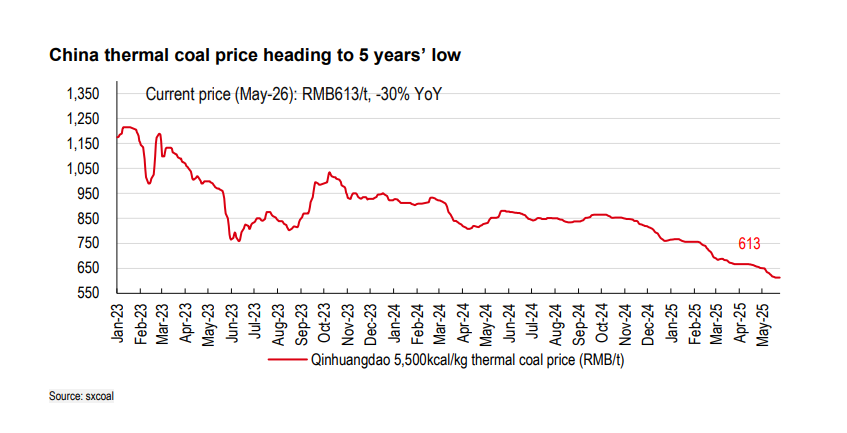
Core Viewpoint - The report from HSBC indicates that China's coal spot prices continue to decline, with the price of Qinhuangdao 5500 kcal thermal coal dropping to approximately 610 RMB/ton, marking a five-year low [1] Group 1: Price Trends - Despite expectations of price stabilization due to seasonal consumption recovery and pre-summer stockpiling, HSBC believes that seasonal stockpiling is unlikely to lead to a substantial rebound in coal prices [1] - The risk remains that coal prices could fall below 600 RMB/ton in the coming months due to historically high domestic production and elevated port inventories [1] - Currently, coal prices have decreased by 30% compared to the same period last year, a decline that exceeds market expectations [1] Group 2: Demand Analysis - Since March, the average daily coal consumption of major power plants has rebounded to levels comparable to last year and the past three-year average, with a reported daily coal consumption of 772.9 thousand tons as of May 26, reflecting a year-on-year increase of 2.2% [4] - HSBC does not consider demand to be the primary driver behind the decline in coal prices this year, anticipating that coal demand in China will remain similar to last year's levels due to the peak electricity demand period and the water power generation season [4] Group 3: Supply and Inventory Issues - The imbalance in supply is identified as the main factor dragging down coal prices, with domestic coal production reaching historical highs, showing a year-on-year increase of 6.6% from January to April, primarily driven by production recovery in Shanxi and capacity expansion in Xinjiang [6] - Although production decreased by 12% month-on-month last month, coal companies are expected to continue increasing production to maximize profits, leading to supply growth outpacing demand growth for the remainder of the year [6] - Port inventory remains a significant concern, with current levels still 21% higher than the same period last year, posing a major obstacle to any potential price rebound [9]
目标击垮美国页岩油?OPEC+本周预计大幅增产,意将油价压低至60美元以下
Hua Er Jie Jian Wen· 2025-05-26 07:14
Group 1 - OPEC+ is initiating an aggressive production increase strategy aimed at undermining the U.S. shale oil industry's survival threshold of $60 per barrel [1][4] - HSBC forecasts that OPEC+ will announce a production increase of 411,000 barrels per day for July, following similar increases in May and June [2][3] - The strategy is designed to push international oil prices below $60 per barrel, directly threatening the profitability of U.S. shale oil companies, which require at least $61 per barrel for new drilling to be profitable [1][4] Group 2 - The increase in U.S. shale oil market share from 14% to 20% over the past decade has prompted OPEC+ to reclaim lost market share, with OPEC's share declining from 50% to 25% [3] - OPEC+ leaders, particularly Saudi Arabia and Russia, are focused on regaining market share taken by U.S. shale oil producers [4][5] - The current environment is more challenging for U.S. producers due to rising inflation affecting drilling costs and the depletion of high-quality oil fields [6][7] Group 3 - U.S. shale oil companies are facing a potential crisis, with rising costs and declining production, leading to warnings of a possible wave of bankruptcies [7] - Major U.S. oil companies are reducing spending and idling drilling rigs, with some predicting a significant drop in production if oil prices fall to $50 per barrel [7] - HSBC's report indicates that Brent crude oil prices are facing downward risks, with predictions of a supply surplus in the fourth quarter of 2025 [8][9]
逆势!“降息潮”下有银行上调存款利率
第一财经· 2025-05-22 15:21
Core Viewpoint - The continuous decline in RMB deposit rates is forcing savers to adjust their investment strategies, seeking new avenues for income growth, while some private banks are raising deposit rates to attract customers [1][3][7]. Group 1: Changes in Deposit Rates - The RMB deposit rates have been consistently decreasing, impacting savers who traditionally relied on fixed deposits for income [3][4]. - Some private banks, like Yilian Bank, have raised their one-year fixed deposit rates to 2.00%, contrasting with the overall downward trend in deposit rates across major banks [4][8]. - As of May 22, 20 commercial banks have lowered their RMB deposit rates, indicating a widespread trend in the banking sector [8]. Group 2: Shift in Savings Behavior - There is a notable shift of household deposits from banks to non-bank financial institutions, with a decrease of 1.39 trillion yuan in household deposits in April, while non-bank deposits increased by 1.57 trillion yuan [1][7]. - Savers are increasingly exploring alternative investment products, with some finding higher returns in USD deposit products offered by various banks [5][9]. Group 3: USD Deposit Products - Several banks are promoting high-interest USD deposit products, with rates reaching up to 4.2% for six-month deposits, but these often come with conditions [5][9]. - The overall trend for USD deposit rates is also downward, with significant declines observed since the end of 2023 [8][10]. - There are concerns regarding the exchange rate risks associated with USD deposits, as the USD has shown volatility against the RMB [9][10].

降息潮下储户寻“存款替代”,利率高地有何风险
Di Yi Cai Jing· 2025-05-22 13:03
Core Viewpoint - The downward trend in interest rates is becoming increasingly evident, prompting depositors to seek alternative investment strategies due to shrinking returns on traditional RMB deposits [1][5][6]. Group 1: Interest Rate Trends - The RMB deposit rates have been continuously lowered, leading to a compression of returns for depositors [2][5]. - Some private banks, like Yilian Bank, have raised their one-year fixed deposit rates to 2%, contrasting with the general trend of rate cuts among major banks [3][5]. - As of May 22, 20 commercial banks have joined the trend of lowering RMB deposit rates, indicating a widespread acknowledgment of the ongoing "rate cut wave" [6]. Group 2: Shifts in Depositor Behavior - Depositors are increasingly moving their funds to non-bank financial institutions, with a reported decrease of 1.39 trillion yuan in household deposits in April, while non-bank deposits surged by 1.57 trillion yuan [1][5]. - Individuals like Li Xiang are actively searching for new investment avenues, while others, such as Chen Meng, are still exploring suitable financial products [2][3]. Group 3: Dollar Deposit Products - Several banks are offering attractive dollar deposit rates, with some reaching as high as 4.2% for six-month deposits, but these often come with conditions [4][7]. - The dollar deposit rates are also on a downward trend, with significant declines observed since the end of 2023 [6][8]. Group 4: Risks and Challenges - The high dollar deposit rates are often conditional, creating uncertainty for depositors who may not benefit from these rates in the long term [7]. - The dollar's value has been fluctuating, with the index dropping below 100, raising concerns about currency exchange risks for depositors [7][8].
2024财富管理市场:全国性银行领跑 城农商行波动中求生存
Jing Ji Guan Cha Wang· 2025-05-19 08:44
Group 1: Market Overview - In 2024, China's wealth management market is led by China Merchants Bank with a public fund product holding scale of 2.94 trillion yuan, maintaining its top position [1][3] - The report indicates that banks hold a dominant position in the wealth management industry, with 62 out of the top 100 institutions being banks [1][2] - The competitive landscape is characterized by a stable dominance of banks, a recovery for securities firms, pressure on public funds, and resilience from third-party institutions [2] Group 2: Bank Performance - China Merchants Bank, Industrial Bank, and Industrial and Commercial Bank of China rank first, second, and third in public fund product holdings, with 2.94 trillion yuan, 2.12 trillion yuan, and 1.71 trillion yuan respectively [3] - In the non-bank wealth management sector, China Merchants Bank also leads with 1.99 trillion yuan, followed by Industrial Bank and CITIC Bank [3] - The report highlights that while major banks show strong performance, local banks exhibit volatility, with some entering and exiting the top 100 rankings [4] Group 3: Technological Transformation - The wealth management industry is undergoing a paradigm shift from "product-driven" to "technology + service-driven," influenced by rapid advancements in technologies like big data, blockchain, and artificial intelligence [2][6] - Financial institutions are leveraging fintech to create intelligent investment research and precise marketing systems, enhancing their competitive edge [6] - Institutions that embrace technology and successfully transform will gain significant competitive advantages, while those that resist change may face market elimination [6] Group 4: Third-Party Institutions - By the end of 2024, the average index value for the top 100 third-party institutions in wealth management was 245.87, reflecting a 2.62% increase from the first half of the year [7] - The top third-party institutions are categorized into three tiers, with Ant Group and Shanghai TianTian Fund in the first tier, indicating stable industry positions [7] - Non-top third-party institutions face volatility in wealth management scale and market share, necessitating differentiation in services to attract and retain clients [7]


金融一线|9家银行网点实测:为特殊人群上门服务难不难
Nan Fang Du Shi Bao· 2025-05-19 06:57
Core Viewpoint - The recent news about an elderly person being required to withdraw money in person before passing away has sparked widespread social concern regarding whether banks should provide home service for special customer groups [2][5] Group 1: Home Service Availability - Most banks in Guangzhou have established mechanisms to provide home service for special groups, although some foreign banks have not yet opened this service [2][4] - Customers can directly call to make appointments for home service without needing to use an app, and banks generally follow a local proximity principle to match nearby branches for service [2][3] Group 2: Service Process and Limitations - The home service process primarily involves identity verification and authorization, requiring the elderly to have clear cognitive abilities and provide identification for themselves and the authorized person [3][4] - Some banks may only complete initial verification at home, requiring family members to visit the branch for subsequent processes, while a few banks equipped with mobile devices can complete the entire process at home [4][6] Group 3: Regulatory and Legal Context - Previous policy documents have emphasized the need for financial institutions to provide home services for elderly individuals, particularly those who are immobile or hospitalized [5][6] - Legal experts indicate that while banks are encouraged to offer home services, there is no mandatory requirement, and refusal of service must be justified [6][7] Group 4: Industry Recommendations - Industry insiders suggest that banks should enhance their services for the elderly by improving accessibility at physical branches and implementing flexible service options such as remote video verification and proxy services [7][8] - Recommendations include establishing "green channels" for elderly customers and improving the physical layout of branches to accommodate their needs [8][9]