
vivo

Search documents
【市场】网传2025年中国手机市场激活量排名 vivo第一 小米第二
Xin Lang Cai Jing· 2026-01-20 13:40
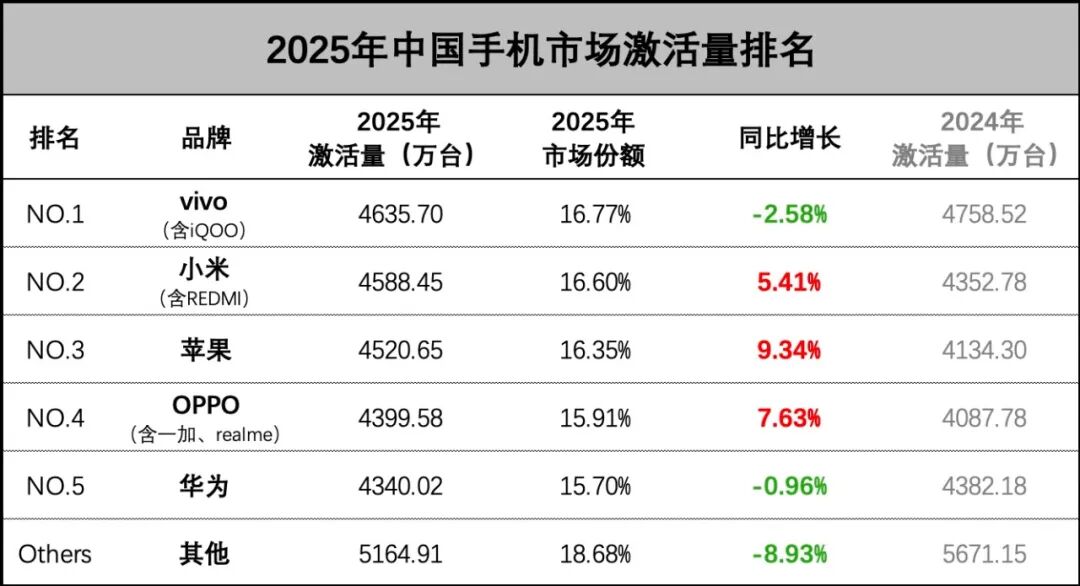
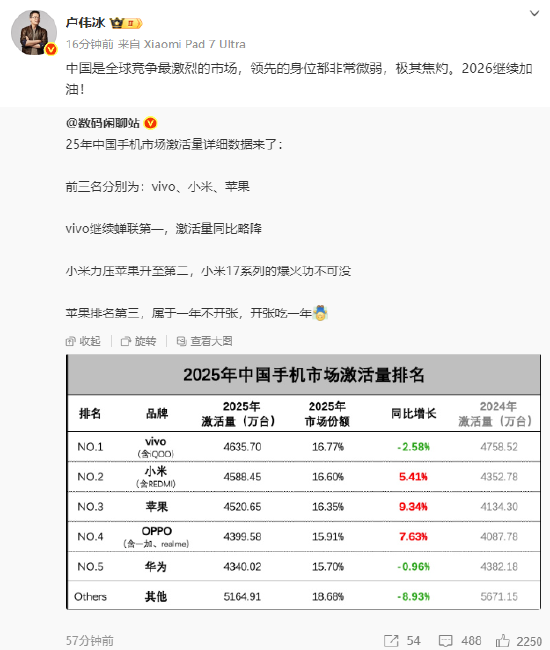
近日市场研究机构IDC、Counterpoint等纷纷更新了2025年第四季度(10-12月)和2025全年(1-12月)中国智能手机市场出货量数据,但都是出货量,今 日爆料达人数码闲聊站分享了一份激活量排名,来简单看下~ | | | | 2025年中国手机市场激活量排名 | | | | --- | --- | --- | --- | --- | --- | | 排名 | 品牌 | 2025年 | 2025年 | 同比增长 | 2024年 | | | | 激活量(万台) | 市场份额 | | 激活量(万台) | | NO.1 | VIVO (含iQOO) | 4635.70 | 16.77% | -2.58% | 4758.52 | | NO.2 | 小米 (含REDMI) | 4588.45 | 16.60% | 5.41% | 4352.78 | | NO.3 | 苹果 | 4520.65 | 16.35% | 9.34% | 4134.30 | | NO.4 | OPPO (含一加、realme) | 4399.58 | 15.91% | 7.63% | 4087.78 | | NO.5 | 华为 | ...



2025年中国手机激活量排名:vivo蝉联榜首 小米反超苹果登次席
Xin Lang Cai Jing· 2026-01-20 13:39
Core Insights - The 2025 Chinese smartphone market has seen a subtle shift in the competitive landscape, with vivo maintaining its lead, followed by Xiaomi and Apple, all surpassing 40 million units in activation volume [1][7]. Market Rankings - Vivo (including iQOO) ranked first with an activation volume of 46.357 million units, holding a market share of 16.77%, despite a slight decline of 2.58% from 2024 [2][8]. - Xiaomi (including REDMI) achieved an activation volume of 45.884 million units, capturing a market share of 16.60%, marking a growth of 5.41% year-on-year, thus surpassing Apple to claim the second position [3][9]. - Apple secured the third position with an activation volume of 45.206 million units and a market share of 16.35%, experiencing a significant growth of 9.34% [3][10]. - OPPO (including OnePlus and realme) ranked fourth with 43.996 million units and a market share of 15.91%, showing a year-on-year increase of 7.63% [4][10]. - Huawei placed fifth with an activation volume of 43.400 million units and a market share of 15.70%, reflecting a slight decline of 0.96% [4][10]. Market Trends - The overall smartphone market in China saw a slight decline in demand, with total shipments around 285 million units, down 0.6% year-on-year, indicating a softening consumer demand [2][8]. - The market is characterized by a "high-end consolidation and mid-range competition," with AI smartphones and foldable screens emerging as key growth areas [4][10]. - In 2025, the shipment volume of AI smartphones reached 118 million units, achieving a penetration rate of over 40% [4][10]. Future Outlook - Industry experts predict a continued slight decline in overall shipments by 2%-3% in 2026, with rising memory chip prices potentially increasing average smartphone prices by 10%-20% [11]. - The focus for leading brands will likely shift towards high-profit segments, intensifying market competition [11]. - Key questions for 2026 include whether vivo can maintain its lead, if Xiaomi can solidify its second position, and whether Apple can sustain its high-end growth trajectory [11].
小米超苹果成中国手机激活量第二,王腾:恭喜,非常不容易
Xin Lang Cai Jing· 2026-01-20 12:08
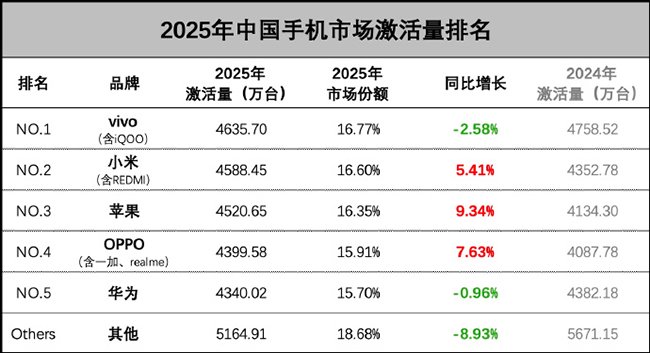
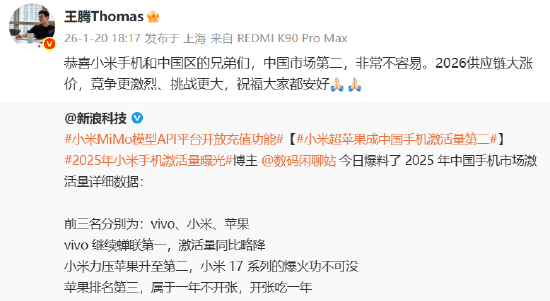
Core Insights - The 2025 Chinese smartphone market activation data shows that Vivo, Xiaomi, and Apple are the top three brands, with Vivo experiencing a year-on-year decline in activation volume, while Xiaomi's sales of the Xiaomi 17 series have propelled it to surpass Apple and rank second in the market [1][4]. Group 1: Market Rankings - Vivo (including iQOO) ranks first with an activation volume of 4,635.70 thousand units, holding a market share of 16.77%, but showing a year-on-year decline of 2.58% from 4,758.52 thousand units in 2024 [3][6]. - Xiaomi (including REDMI) ranks second with an activation volume of 4,588.45 thousand units, achieving a market share of 16.60% and a year-on-year growth of 5.41% from 4,352.78 thousand units in 2024 [3][6]. - Apple ranks third with an activation volume of 4,520.65 thousand units, capturing a market share of 16.35% and experiencing a year-on-year increase of 9.34% from 4,134.30 thousand units in 2024 [3][6]. Group 2: Other Competitors - OPPO (including OnePlus and realme) ranks fourth with an activation volume of 4,399.58 thousand units and a market share of 15.91%, reflecting a year-on-year growth of 7.63% from 4,087.78 thousand units in 2024 [3][6]. - Huawei ranks fifth with an activation volume of 4,340.02 thousand units, holding a market share of 15.70%, but showing a slight year-on-year decline of 0.96% from 4,382.18 thousand units in 2024 [3][6]. - The "Others" category accounts for 5,164.91 thousand units, representing 18.68% of the market, with a year-on-year decline of 8.93% from 5,671.15 thousand units in 2024 [3][6]. Group 3: Industry Commentary - Former REDMI General Manager Wang Teng congratulated Xiaomi and its team for achieving the second position in the Chinese market, emphasizing the challenges ahead due to anticipated supply chain price increases and intensified competition in 2026 [1][4].
粤产AI手机引领新消费,广东“手机天团”何以狂飙?
2 1 Shi Ji Jing Ji Bao Dao· 2026-01-20 10:49
Core Insights - Guangdong manufactures one out of every three smartphones sold globally, with five major brands dominating the market [1][3] - The smartphone industry in Guangdong has maintained its position as the largest in China for 35 consecutive years, with a projected combined global market share of 34.6% for major brands in 2024 [1][3] - The integration of AI technology into smartphones is expected to drive a new wave of consumer electronics innovation and a subsequent "upgrade wave" in the market [1][6] Industry Overview - Guangdong is the most significant hub for smartphone production in China, leading in scale, output, and export volume [2][3] - The city of Dongguan is a core area for smartphone manufacturing, accounting for 28.6% of Guangdong's smartphone output in 2024 [3] - The region has developed a complete supply chain for smartphone production, with over 90% of components sourced locally [3] Technological Advancements - Continuous R&D investment by major brands has led to significant technological innovations, including advancements in chip design, fast charging, and foldable screens [4][5] - Notable innovations include OPPO's 125W fast charging technology and Huawei's breakthrough in foldable phone hinge design [5][6] - The introduction of AI capabilities in smartphones is transforming them into intelligent assistants, enhancing user experience and functionality [6][7] Market Trends - The shift towards AI-integrated smartphones is expected to redefine market competition, moving beyond hardware performance to functional innovation [6][8] - Major brands are actively incorporating AI features into their flagship models, with Huawei's HarmonyOS enhancing user interaction through AI [6][7] - The emergence of AI Agent smartphones is anticipated to lead a new "upgrade wave" in the context of stagnant smartphone sales growth [6][8] Future Outlook - Guangdong plans to accelerate the development of high-quality action plans for AI terminal products, indicating a strategic focus on innovation and market leadership [7][8] - The ongoing evolution of smartphones in Guangdong reflects a broader trend of the manufacturing sector integrating advanced technologies and moving up the global value chain [8]


“广货群侠”多强大?广东这五大品牌征服了全球
2 1 Shi Ji Jing Ji Bao Dao· 2026-01-20 10:38
Group 1 - The core viewpoint of the articles emphasizes Guangdong's significant role in the global smartphone industry, highlighting its dominance in manufacturing and innovation [2] - Guangdong is home to five of the top ten smartphone manufacturers globally, showcasing its substantial market share [2] - The region accounts for one out of every three smartphones sold worldwide, indicating its critical position in the global supply chain [2] Group 2 - The smartphone industry in Guangdong has evolved over nearly 30 years, transitioning from feature phones to advanced technologies such as fast charging, imaging, full-screen displays, 5G, and AI ecosystems [2] - The "Guangdong Goods Going Global" spring campaign features a special event focused on smartphones, showcasing products from leading companies like Huawei, OPPO, vivo, and Honor [2] - The continuous innovation and manufacturing capabilities in Guangdong are setting new industry standards and pushing the boundaries of technology [2]

“广货群侠”多强大?广东这五大品牌征服了全球
21世纪经济报道· 2026-01-20 10:29
Core Viewpoint - The article emphasizes the competitive landscape of the smartphone industry, highlighting Guangdong's dominance as a major manufacturing hub and innovation center, with significant contributions from local brands like Huawei, OPPO, vivo, and Honor [1][13]. Industry Overview - Guangdong is recognized as the most important smartphone industry cluster in China, leading in scale, production, and export, with one in three smartphones sold globally originating from this region [13]. - The smartphone market is characterized by rapid technological advancements and intense competition, with major players continuously innovating to maintain their market positions [1]. Company Highlights - **Huawei**: Utilizes its advanced Kirin chips and Kunlun glass, with the HarmonyOS enabling seamless connectivity. In 2025, Huawei's smartphone shipments reached 4.67 million units, capturing 16% of the market share in China [3]. - **OPPO**: Focuses on imaging, AI, communication, and fast charging technologies. By November 2025, the global activation of the OPPO Reno series surpassed 10 million, and the Find X9 series sold over 1 million units within 10 days of its domestic launch [5]. - **vivo**: Specializes in professional imaging technology, launching the X300 series with a focus on high-quality mobile photography. Currently, vivo serves over 100 million users globally [7]. - **Honor**: Launched the Honor Power2 in January 2026, featuring a 10,080mAh battery to address battery life concerns. In 2025, Honor's smartphone shipments exceeded 71 million units, with over 30% of sales coming from international markets [9]. Technological Evolution - Over the past 30 years, Guangdong's smartphone technology has evolved from self-developed feature phones to the emergence of autonomous brands in the smartphone era, achieving breakthroughs in fast charging, imaging, full-screen displays, and 5G technology [16].

荣耀联名泡泡玛特推了款潮玩手机
第一财经· 2026-01-20 09:52
Group 1 - The core viewpoint of the article highlights the collaboration between Honor and Pop Mart, launching the "Honor 500 Pro MOLLY 20th Anniversary Limited Edition" smartphone, priced at 4,499 yuan, with a net price of 3,999 yuan after subsidies. The main differences from the regular version lie in design, system theme, boot animation, and packaging [2] - Pop Mart has previously collaborated with consumer electronics brands, but this partnership with Honor marks its most in-depth hardware collaboration to date, as it aims to accelerate cross-industry monetization around its core IP [2] - The collaboration occurs against a backdrop of a challenging Chinese smartphone market, where competition in the mainstream price segment is intensifying [2] Group 2 - According to IDC, China's smartphone market is projected to see an annual shipment of approximately 285 million units in 2025, reflecting a year-on-year decline of 0.6%, indicating a shift to a typical stock game phase [3] - As demand slows, upstream cost pressures are accumulating, with storage prices significantly rebounding since the second half of 2025, now accounting for 10% to 20% of smartphone hardware costs, a proportion that continues to rise [3] - Honor has made significant changes to its product lineup in recent months, including the reintroduction of the Honor WIN series targeting the gaming smartphone segment and the launch of a "Robot Phone" at CES, which integrates gimbal structures, imaging systems, and AI capabilities [3] Group 3 - The portable imaging device market is dominated by DJI, Insta360, and GoPro, prompting smartphone manufacturers to reintegrate gimbal, stabilization, tracking, and AI capabilities back into smartphones as a strategy to reclaim content entry points [4] - Compared to independent device manufacturers, smartphone companies still hold advantages in supply chain scale, channel coverage, and price bandwidth [4] Group 4 - In a market where expansion is challenging and cost curves are rising, manufacturers are finding it increasingly difficult to rely on conventional annual iterations to tell growth stories. Strategies such as collaborations with Pop Mart, reintroducing gaming product lines, and exploring imaging forms are being employed to seek market opportunities [5] - While these initiatives may not guarantee sales, the risk of remaining stagnant in the current industry environment is becoming increasingly pronounced [5]


广东将加快谋划出台AI终端高质量发展行动方案
第一财经· 2026-01-20 09:52
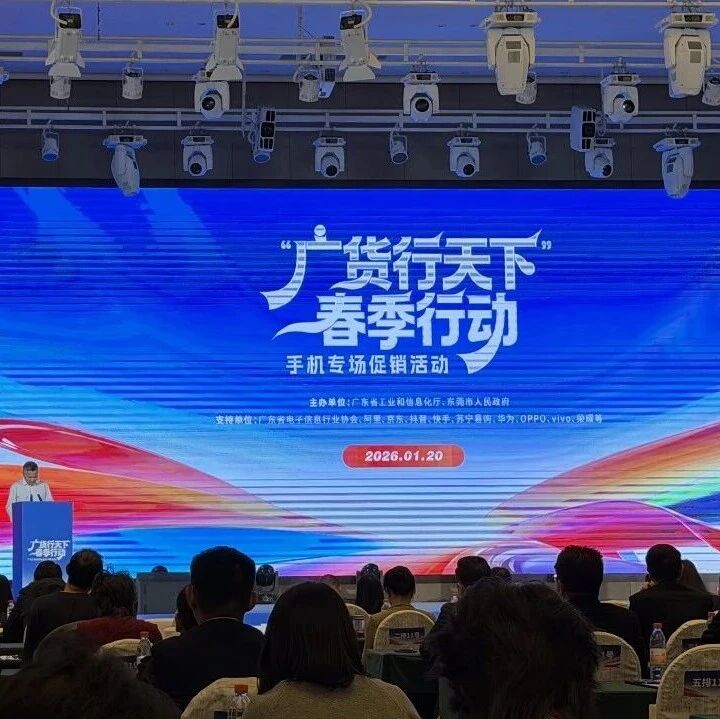
Core Viewpoint - Guangdong province is accelerating the development of high-quality action plans for mobile phones and AI terminals, maintaining its position as the largest mobile phone industry hub in China for 35 consecutive years [4]. Group 1: Industry Overview - Guangdong's mobile phone production reached 683 million units in 2024, accounting for 40.9% of the national total, with one in three mobile phones sold globally originating from Guangdong [4]. - The mobile phone industry cluster in Guangdong is supported by leading brands such as Huawei, OPPO, vivo, and Honor, which together form a complete industrial chain from chips to finished products [4]. - Dongguan is identified as the core area of the mobile phone industry in Guangdong, contributing 28.6% of the province's mobile phone production in 2024, with a high industry matching rate exceeding 90% [4]. Group 2: Market Dynamics - During a promotional event in Dongguan, major brands showcased 36 AI mobile phones and over 2000 products from more than 700 industry chain enterprises, indicating a strong market presence [3]. - Honor's government affairs director highlighted the importance of understanding consumer psychology and the trend of "self-satisfying consumption" in the current market [3]. - OPPO announced exclusive discounts for its new Find X9 Pro, offering a price reduction of 200 yuan compared to the discounted price during the Double Eleven shopping festival [3].
小米反超苹果成中国手机市场激活量第二,卢伟冰回应
Xin Lang Cai Jing· 2026-01-20 09:25
Core Insights - The Chinese smartphone market is highly competitive, with very narrow leading positions among brands, indicating a fierce battle for market share [1][3] - In 2025, Xiaomi surpassed Apple to become the second-largest smartphone brand in China, following Vivo, largely attributed to the success of the Xiaomi 17 series [1][2][3] Market Rankings - The top three brands in the 2025 Chinese smartphone market by activation volume are: 1. Vivo: 4,635.70 thousand units, 16.77% market share, a decrease of 2.58% from 2024 [2][3] 2. Xiaomi: 4,588.45 thousand units, 16.60% market share, an increase of 5.41% from 2024 [2][3] 3. Apple: 4,520.65 thousand units, 16.35% market share, an increase of 9.34% from 2024 [2][3] - Other notable brands include OPPO with 4,399.58 thousand units (15.91% market share) and Huawei with 4,340.02 thousand units (15.70% market share) [2][3]
闪德资讯存储市场洞察报告 2025年11月
闪德资讯· 2026-01-20 08:45
Investment Rating - The report indicates a bullish outlook for the storage industry, projecting a high prosperity cycle from 2025 to 2026, driven by strong demand from AI data centers and significant price increases in DRAM and NAND products [7][27][31]. Core Insights - The global manufacturing sector is under pressure, with PMI indices in major economies indicating contraction, while China's PMI shows slight improvement but remains below the threshold [7][8][9]. - The storage industry is entering a strong cycle characterized by technological upgrades and rising prices, with major players like Samsung and SK Hynix expanding production of advanced DRAM and NAND technologies [7][27][31]. - Supply chain dynamics are tightening, with rising costs for raw materials and significant demand for NAND and DRAM leading to extended delivery times and price increases across the board [7][27][31]. - The current market is experiencing a shortage of storage products, with prices for DRAM, NAND, and SSDs seeing substantial increases, driven by AI demand and supply constraints [7][27][31]. Summary by Sections Macroeconomic Overview - Global manufacturing is facing challenges, with most PMI indices in contraction territory, indicating weak demand and slowing orders [7][8][9]. - China's manufacturing PMI shows a slight increase but remains below the critical level, reflecting a weak economic environment [7][18][22]. Storage Supply Chain - Major manufacturers like Samsung and SK Hynix are ramping up production of advanced memory technologies, with significant price increases expected for HBM and DDR5 products [7][27][31]. - The supply chain is experiencing upward pressure on costs due to rising prices of copper and glass fiber, impacting the cost of electronic materials [7][42][43]. Market Dynamics - The report highlights a significant shortage in the storage market, with prices for various memory products experiencing dramatic increases, driven by AI-related demand [7][27][31]. - The current market conditions are leading to a shift in purchasing strategies, with long-term contracts becoming more common as companies seek to secure supply [7][37][39]. Company-Specific Developments - Samsung is actively expanding its production capabilities and has recently increased prices for DDR5 memory modules significantly [27][29][31]. - SK Hynix is also enhancing its product offerings and has confirmed price increases for HBM4, reflecting strong demand from AI applications [31][35][36]. - Western Digital reported strong performance driven by AI demand, with expectations for continued growth in revenue and market share [36][37].