万科A

Search documents
港股地产股走低
news flash· 2025-06-02 01:40
Group 1 - New World Development shares fell over 7% following the announcement of a delay in the payment of perpetual bond interest [1] - R&F Properties experienced a decline of more than 5% in its stock price [1] - Vanke Enterprises saw a drop of over 4% in its share value [1]


信用利差周度跟踪:中短久期中高等级信用利差上行,长久期信用债表现强势-20250601
Xinda Securities· 2025-06-01 07:50
Report Summary 1. Investment Rating of the Industry The provided content does not mention the industry investment rating. 2. Core View of the Report Interest rate adjustments have led to a divergence in the performance of credit bonds, with the spreads of medium - and short - term high - grade credit bonds widening, while long - term credit bonds have shown strong performance. The spreads of urban investment bonds have fluctuated narrowly, with weaker platforms performing well. Most industrial bond spreads have declined, but coal bonds and private real estate bonds have seen an increase in spreads. The yields of Tier 2 and perpetual bonds have mostly risen, and the spreads of 5 - year medium - and low - grade varieties have compressed. The excess spreads of 3 - year industrial and urban investment perpetual bonds have compressed, while the spreads of 5 - year urban investment bonds have rebounded [3]. 3. Summary by Directory 3.1 Interest Rate Adjustments Lead to Divergence in Credit Bond Performance, with Widening Spreads of Medium - and Short - Term High - Grade Bonds This week, the yields of interest - rate bonds have slightly rebounded. The yields of 1Y, 3Y, and 5Y China Development Bank bonds have increased by 2BP, and those of 7Y and 10Y bonds have increased by 1BP. The yields of medium - and short - term high - grade credit bonds have adjusted, while most other varieties have continued to decline. Credit spreads have mostly declined, with the largest decline in 7Y varieties, and the spreads of medium - and short - term high - grade bonds have widened. Rating spreads and term spreads have mostly declined [3][6]. 3.2 Narrow Fluctuations in Urban Investment Bond Spreads, with Good Performance of Weaker Platforms This week, the spreads of urban investment bonds have fluctuated narrowly, with some differentiation among different regions. The credit spreads of externally rated AAA - level platforms have increased by 1BP, those of AA + - level platforms have remained basically flat, and those of AA - level platforms have decreased by 1BP. When classified by administrative level, the spreads of provincial - level platforms have increased by 1BP, while those of municipal and district - level platforms have remained basically flat [3][10][17]. 3.3 Most Industrial Bond Spreads Decline, while Coal Bonds and Private Real Estate Bonds See an Increase in Spreads Most industrial bond spreads have declined, but coal bonds and private real estate bonds have seen an increase in spreads. This week, the spreads of central and local state - owned real estate bonds have increased by 0 - 1BP, the spreads of mixed - ownership real estate bonds have decreased by 2BP, and the spreads of private real estate bonds have increased by 40BP. The spreads of AAA - level coal bonds have increased by 9BP, those of AA + - level bonds have remained flat, and those of AA - level coal bonds have increased by 1BP. The spreads of steel and chemical bonds at all levels have declined by 0 - 3BP [3][15]. 3.4 Yields of Tier 2 and Perpetual Bonds Mostly Rise, with Compressed Spreads of 5 - Year Medium - and Low - Grade Varieties This week, the yields of Tier 2 and perpetual bonds have mostly risen, and the spreads of 5 - year medium - and low - grade varieties have compressed. Specifically, the yields of 1Y AAA - and AA + commercial bank Tier 2 capital bonds have increased by 4BP, and the yields of AA - level bonds have increased by 2BP, with spreads increasing by 0 - 2BP. The yields of 3Y Tier 2 capital bonds at all levels have increased by 4 - 6BP, and the spreads have increased by 2 - 4BP. The yields of 5Y AAA - and AA + Tier 2 capital bonds have increased by 1 - 2BP, and the spreads have decreased by 0 - 1BP, while the yields of AA - level bonds have decreased by 1BP, and the spreads have compressed by 3BP [27][28]. 3.5 The Excess Spreads of 3 - Year Industrial and Urban Investment Perpetual Bonds Compress, while the Spreads of 5 - Year Urban Investment Bonds Rebound This week, the excess spreads of 3 - year industrial AAA perpetual bonds have decreased by 2.18BP to 9.53BP, at the 11.52% percentile since 2015. The excess spreads of 5 - year industrial AAA perpetual bonds have remained flat at 9.22BP, at the 10.27% percentile since 2015. The excess spreads of 3 - year urban investment AAA perpetual bonds have decreased by 1.12BP to 4.31BP, at the 0.37% percentile. The excess spreads of 5 - year urban investment AAA perpetual bonds have increased by 1.37BP to 10.30BP, at the 9.54% percentile [31]. 3.6 Explanation of the Credit Spread Database Compilation The overall market credit spreads, commercial bank Tier 2 and perpetual spreads, and urban investment/industrial perpetual bond credit spreads are calculated based on ChinaBond medium - and short - term notes and ChinaBond perpetual bond data. The historical percentiles are calculated since the beginning of 2015. The credit spreads of urban investment and industrial bonds are compiled and statistically analyzed by Cinda Securities R & D Center, with historical percentiles also calculated since the beginning of 2015. Specific calculation methods and sample selection criteria are also provided [38].
租房大萧条,北上广深也扛不住了
Sou Hu Cai Jing· 2025-05-31 20:18
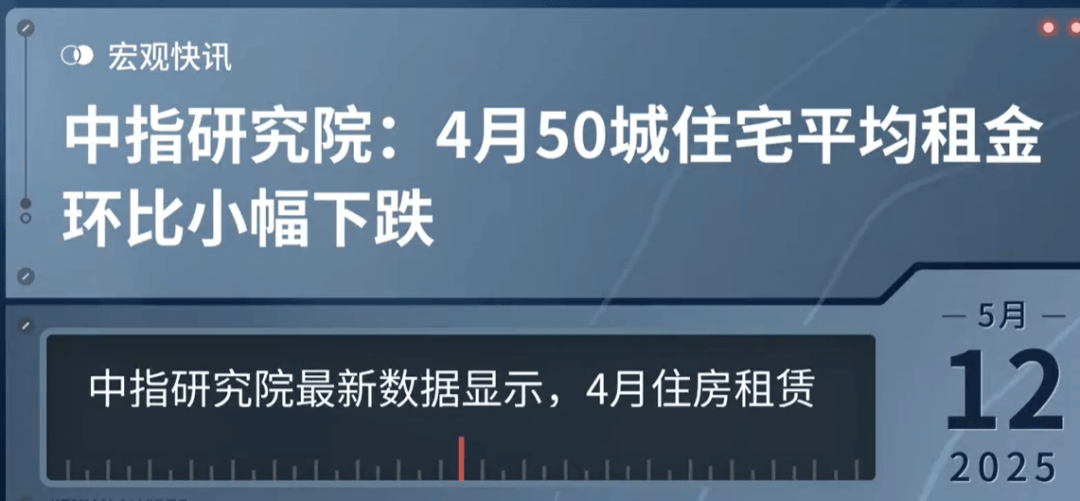
Core Viewpoint - The rental market in China is experiencing a significant decline, with average rents in 50 cities dropping for five consecutive months, indicating a shift from a seller's market to a more balanced one, particularly in first-tier cities [2][12][28]. Group 1: Rental Market Trends - Nationwide average rent in April was 35.2 yuan per square meter per month, down 3.4% year-on-year [2]. - Only two cities, Jiaxing and Shijiazhuang, saw a slight increase in rent, while Sanya experienced the largest decline at 1.1% [4]. - The rental market in first-tier cities like Beijing, Shanghai, Guangzhou, and Shenzhen, which traditionally attracted population inflows, is now facing downward pressure on rents [5][12]. Group 2: Factors Contributing to Rent Decline - Economic uncertainties, including the housing market downturn and external pressures, have increased employment and economic stress, leading to a decline in population in Beijing and Shanghai [14][16]. - A significant increase in housing supply, particularly affordable and public rental housing, is impacting the rental market, with 172,000 units of various types of affordable housing planned for 2024 [17][19]. - Many homeowners are opting to rent out their properties instead of selling, leading to increased competition in the rental market and further driving down rents [22][24]. Group 3: Implications for the Housing Market - The decline in rental income is changing perceptions about homeownership in China, as the financial viability of buying property diminishes with falling rents [28][30]. - The shift towards a rental market could alleviate social tensions and align China more closely with developed countries where renting is more common [33].

笛杨观察·上市并购|第五期·国资收购上市公司分析
Sou Hu Cai Jing· 2025-05-31 19:07
Overview of Acquisitions of Listed Companies - The acquisition of listed companies primarily refers to activities related to the acquisition and changes in shareholding rights of listed companies, as defined by the "Measures for the Administration of the Acquisition of Listed Companies" [1] Types of Equity Changes - Simplified equity change occurs when an investor and its concerted actors hold 5% or more but less than 20% of a listed company's shares [2] - Detailed equity change occurs when the shareholding reaches 20% or more but does not exceed 30% [2] - An acquisition occurs when the shareholding exceeds 30% through various legal means [2] Common Acquisition Methods - **Agreement Transfer**: This method involves acquiring shares through an agreement, with a minimum acquisition ratio of 5% [6][8] - **Secondary Market Acquisition**: This involves purchasing shares through competitive trading or block trading on the stock exchange [9] - **Tender Offer**: Investors must issue a tender offer when they continue to increase their shareholding beyond 30% [3][12] - **Subscription of New Shares**: This method allows investors to acquire shares through a directed issuance, with specific pricing rules [17][19] - **Indirect Acquisition**: This involves gaining control over a listed company through its controlling shareholder without directly acquiring shares [22][23] Regulatory Framework and Principles - The regulatory framework for acquisitions includes various rules and principles that govern the process, including information disclosure requirements and restrictions on trading during the acquisition period [30][35] - Information disclosure is crucial, especially when the shareholding exceeds certain thresholds, triggering specific reporting obligations [36][44] Case Studies - **Xiamen Jianfa's Acquisition**: Acquired 23.95% of Meikailong's shares through an agreement transfer, gaining control of the company [7] - **GQY Video's Indirect Acquisition**: The controlling shareholder's stake was transferred, leading to a change in actual control without direct share acquisition [27] - **MediTech's Acquisition by Mindray**: Mindray announced a cash acquisition of 21.12% of MediTech's shares at a significant premium, aiming for industry synergy [53][54] Recent Trends in State-Owned Enterprises Acquisitions - A review of 43 recent acquisitions by state-owned enterprises from 2019 to 2023 shows various structures, including agreement transfers combined with voting rights delegation [28] - The trend indicates a preference for complex transaction structures to achieve control while navigating regulatory requirements [28]

万科A: 万科企业股份有限公司2025年跟踪评级报告
Zheng Quan Zhi Xing· 2025-05-30 11:36
Core Viewpoint - Vanke Enterprise Co., Ltd. maintains a long-term credit rating of AAA, with a stable outlook, despite facing significant challenges in sales and liquidity management due to the ongoing adjustment in the real estate industry [1][3][4]. Company Overview - Vanke is one of the earliest real estate developers in China, with a balanced regional layout and diverse property types [3][5]. - The company has experienced a significant decline in signed sales amount in 2024, with a 34.6% year-on-year decrease, and continues to face liquidity pressure [3][12]. Financial Performance - As of the end of 2024, Vanke's total assets amounted to 12,862.60 billion yuan, with total equity of 3,388.55 billion yuan [9]. - The company reported a substantial loss of 471.87 billion yuan in profit for 2024, primarily due to a significant drop in gross profit margin and asset impairment [3][9]. - In the first quarter of 2025, Vanke's revenue was 379.95 billion yuan, reflecting a 38.31% year-on-year decline [11]. Debt and Liquidity - Vanke's short-term debt ratio is high, leading to refinancing pressure, with total debt reaching 3,612.77 billion yuan by the end of 2024 [3][4]. - The company has been actively managing cash flow and asset liquidation to alleviate liquidity issues, supported by its largest shareholder [4][5]. Market Environment - The real estate industry is undergoing adjustments, with continued pressure on sales and cash flow management [4][7]. - The company is expected to face ongoing challenges in sales performance due to a cooling market and reduced investment activity [4][12]. Shareholder Support - The largest shareholder has increased support for Vanke by enhancing management capabilities and providing loans for debt repayment [4][5]. - This support is crucial for mitigating the company's debt repayment risks amid a challenging market environment [4][5]. Industry Analysis - The real estate market is expected to continue facing downward pressure, with a focus on stabilizing sales and managing inventory [7][9]. - Despite the challenges, core city land resources remain in high demand, indicating potential opportunities for strategic acquisitions [7][9].
万科A(000002) - 万科企业股份有限公司2025年度跟踪评级报告
2025-05-30 11:17
万科企业股份有限公司 万科企业股份有限公司 2025 年度跟踪评级报告 编号:信评委函字[2025]跟踪 0343 号 2025 年度跟踪评级报告 编号:信评委函字[2025]跟踪【】号 万科企业股份有限公司 2025 年度跟踪评级报告 声 明 中诚信国际信用评级有限责任公司 2025 年 5 月 30 日 2 本次评级为委托评级,中诚信国际及其评估人员与评级委托方、评级对象不存在任何其他影响本次评级行为独立、 客观、公正的关联关系。 本次评级依据评级对象提供或已经正式对外公布的信息,以及其他根据监管规定收集的信息,中诚信国际按照相关 性、及时性、可靠性的原则对评级信息进行审慎分析,但中诚信国际对于相关信息的合法性、真实性、完整性、准 确性不作任何保证。 中诚信国际及项目人员履行了尽职调查和诚信义务,有充分理由保证本次评级遵循了真实、客观、公正的原则。 评级报告的评级结论是中诚信国际依据合理的内部信用评级标准和方法、评级程序做出的独立判断,未受评级委托 方、评级对象和其他第三方的干预和影响。 本评级报告对评级对象信用状况的任何表述和判断仅作为相关决策参考之用,并不意味着中诚信国际实质性建议任 何使用人据此报告 ...
万科A(000002) - 万科企业股份有限公司2025年跟踪评级报告
2025-05-30 10:34
万科企业股份有限公司 2025 年跟踪评级报告 | | | www.lhratings.com 1 联合〔2025〕3676 号 联合资信评估股份有限公司通过对万科企业股份有限公司主体 及其相关债券的信用状况进行跟踪分析和评估,确定维持万科企业 股份有限公司主体长期信用等级为 AAA,维持"21 万科 04""21 万科 06""22 万科 02""22 万科 03""22 万科 04""22 万科 05""22 万科 06""22 万科 07""23 万科 01""22 万 科 GN001""22 万 科 GN002""22 万 科 GN003""22 万 科 MTN004""22 万科 MTN005""23 万科 MTN001""23 万科 MTN002""23 万科 MTN003""23 万科 MTN004"信用等级为 AAA,评级展望为稳定。 特此公告 联合资信评估股份有限公司 评级总监: 二〇二五年五月三十日 声 明 一、本报告是联合资信基于评级方法和评级程序得出的截至发表之日的 独立意见陈述,未受任何机构或个人影响。评级结论及相关分析为联合资信 基于相关信息和资料对评级对象所发表的前瞻性观点,而非 ...
万科A: 关于控股子公司为银行贷款事项提供担保的公告
Zheng Quan Zhi Xing· 2025-05-28 11:21
Core Viewpoint - Vanke Enterprise Co., Ltd. has authorized its subsidiary to provide guarantees for financing, which is aimed at meeting operational needs and is deemed to be within controllable risk limits [1][5]. Summary by Sections Guarantee Matters - The subsidiary, Vanke Rainbow Investment Partner II Limited, is applying for a bank loan from overseas financial institutions, with a total loan principal amount not exceeding 6.872 billion HKD, for a term not exceeding 2 years [1]. - The company provides guarantees through credit guarantees and equity pledges, with the subsidiary also acting as a co-borrower [1]. Borrower Information - Vanke Rainbow Investment Partner II Limited was established on May 10, 2016, in the British Virgin Islands, with a registered capital of 2 USD [3]. - As of December 31, 2024, the total assets were approximately 75.22 billion RMB, with total liabilities of approximately 89.71 billion RMB, resulting in a net loss of approximately 8.97 billion RMB [3]. - As of April 30, 2025, total assets were approximately 75.21 billion RMB, with total liabilities of approximately 7.21 billion RMB, resulting in a net loss of approximately 721.33 million RMB [3]. Company Opinion - The guarantee is considered beneficial for the company's operational development needs, with no harm to the interests of the company and its shareholders [5]. Cumulative Guarantee Amounts - As of April 30, 2025, the total guarantee balance of the company and its subsidiaries was approximately 78.82 billion RMB, with no overdue guarantees [5]. - After this guarantee, the total external guarantee amount will be approximately 85.12 billion RMB [5].
万科A(000002) - 关于控股子公司为银行贷款事项提供担保的公告
2025-05-28 11:01
万科企业股份有限公司 关于控股子公司为银行贷款事项提供担保的公告 证券代码:000002、299903 证券简称:万科A、万科 H代 公告编号:<万>2025-073 本公司及董事会全体成员保证公告内容真实、准确和完整,没有虚假记 载、误导性陈述或者重大遗漏。 为满足经营需要,万科企业股份有限公司(以下简称"公司"或"万科")之控股子 公司Vanke Rainbow Investment Partner II Limited("借款方")向境外金融机构融 资,公司之控股子公司通过信用保证、股权质押方式为相应的融资提供担保。同 时,控股子公司作为共同借款人和借款方一起承担还款义务。 公司2023年度股东大会审议通过了《关于提请股东大会授权公司及控股子公司 对外提供担保的议案》,同意在授权有效期内提供的新增担保总额须不超过人民币 1,500亿元,有效期为自2023年度股东大会决议之日起至2024年度股东大会决议之 日止。董事会在取得股东大会授权之同时,已进一步转授权公司执行副总裁对于 单笔对外担保金额低于人民币125亿元进行决策。 本次担保事项在上述担保额度范围内,公司执行副总裁已在上述授权范围内 决策同意本次担 ...
74岁王石,突然表态
盐财经· 2025-05-28 08:55
Core Viewpoint - Wang Shi, the founder of Vanke, is attempting to establish smooth communication with the decision-making team of Vanke to ensure a stable transition and protect the interests of investors, partners, and employees [2] Group 1: Leadership Transition - Wang Shi has officially stepped down and passed the baton to Yu Liang, marking a significant leadership change after 33 years of contribution to the company [5] - Wang Shi is now the honorary chairman of the board and does not participate in company governance, focusing instead on social responsibilities such as education and climate initiatives [5] - Despite stepping back from management, Wang Shi has chosen to forgo his substantial retirement compensation in light of the company's liquidity challenges [5][6] Group 2: Financial Performance and Strategy - Vanke's management team has been adjusted due to significant projected losses for 2024, with a focus on enhancing operational management to mitigate risks and protect stakeholders [6] - In Q1, Vanke reported nearly 38 billion in revenue and over 35 billion in sales, achieving a repayment rate exceeding 100% and delivering over 10,000 high-quality homes [6] - The company has seen strong sales performance in various regions, with new residential products achieving high sales rates, and its long-term rental business leading the industry in scale and efficiency [6]