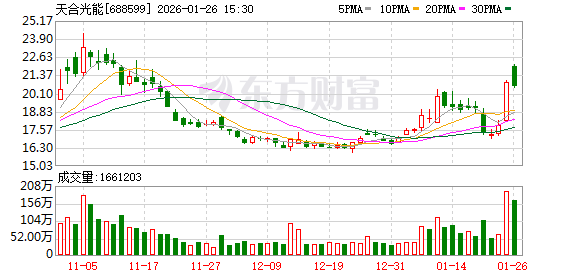
天合光能

Search documents
天合光能(688599):26年目标扭亏为盈,前瞻布局太空光伏
GUOTAI HAITONG SECURITIES· 2026-01-26 12:52
股票研究 /[Table_Date] 2026.01.26 26 年目标扭亏为盈,前瞻布局太空光伏 天合光能(688599) | [姓名table_Authors] | 电话 | 邮箱 | 登记编号 | | --- | --- | --- | --- | | 徐强(分析师) | 010-83939805 | xuqiang@gtht.com | S0880517040002 | | 吴志鹏(分析师) | 021-23215736 | wuzhipeng@gtht.com | S0880525070004 | 本报告导读: 公司股权激励草案计划的目标 26 年扭亏为盈,在太空光伏领域进行前瞻布局。 投资要点: | [Table_Finance] 财务摘要(百万元) | 2023A | 2024A | 2025E | 2026E | 2027E | | --- | --- | --- | --- | --- | --- | | 营业总收入 | 113,411 | 80,282 | 78,589 | 86,891 | 103,652 | | (+/-)% | 33.3% | -29.2% | -2.1% | 10. ...

【26日资金路线图】两市主力资金净流出超750亿元 石油石化等行业实现净流入
证券时报· 2026-01-26 11:36
截至收盘,上证指数收报4132.61点,下跌0.09%;深证成指收报14316.64点,下跌0.85%;创业板指收报3319.15点,下跌0.91%。两 市合计成交32482.03亿元,较上一交易日增加1629.79亿元。 沪深300今日主力资金净流出95.23亿元,创业板净流出281.49亿元。 | | | 各板块最近五个交易日主力资金净流入数据(亿元) | | | --- | --- | --- | --- | | 日期 | 沪深300 | 创业板 | 科创板 | | 2026-1-26 | -95. 23 | -281. 49 | 14. 49 | | 2026-1-23 | -10. 05 | 15. 15 | -31.71 | | 2026-1-22 | 17.99 | -4. 70 | -3. 20 | | 2026-1-21 | 154. 35 | -61. 61 | -17.06 | | 2026-1-20 | -199.71 | -388. 98 | 1.17 | | | | 尾盘资金净流入数据(亿元) | | | 2026-1-26 | 15. 52 | -6. 76 | 4. 12 | ...


果然财经|马斯克引爆太空光伏狂欢,技术革命前夜已至?
Sou Hu Cai Jing· 2026-01-26 11:20
Group 1 - Tesla CEO Elon Musk's statement at the Davos Forum has reignited interest in space solar power, proposing 8,000 launches per year and a goal of 200GW solar capacity in collaboration with SpaceX within three years [2] - The A-share photovoltaic sector saw significant gains following Musk's announcement, with over 20 stocks, including Dongfang Risheng and JinkoSolar, rising more than 5% [2] - Space solar power is not a new concept; it involves deploying photovoltaic components in space to generate electricity, with applications dating back nearly 70 years [2][3] Group 2 - Space solar power offers advantages over ground-based solar due to higher sunlight intensity (5-10 times greater) and the ability to generate power continuously without storage [3] - The market for space solar power is expected to grow significantly, with projections estimating a market size of approximately 29.5 billion yuan by 2030, ten times the current scale [4] - The combination of space data centers and space solar power is seen as a solution to energy bottlenecks, with potential market growth to over $500 billion if space data centers reach a deployment phase of 100GW [5] Group 3 - The global race for space solar power is intensifying, with major players like SpaceX and Tesla leading the charge in the U.S., aiming for 200GW solar capacity [6] - Europe is focusing on optimizing photovoltaic components for space environments, while Japan is advancing wireless energy transmission technology for space solar power [7] - China's approach involves collaboration between state-owned enterprises and private companies, with significant advancements in gallium arsenide solar cells for satellite applications [7] Group 4 - Companies like Qianzhao Optoelectronics and Mingyang Smart Energy are positioning themselves to benefit from the growing demand for space solar power, with Qianzhao being a leading supplier of gallium arsenide solar cells [8] - JinkoSolar and Jintai Technology are exploring perovskite tandem solar cells, achieving record efficiencies and prioritizing space solar power in their development strategies [9] - Some companies are cautioned against speculative investments in space solar power, as the technology is still in the early exploration phase and faces significant challenges [10]


商业航天发展提速,太空光伏迎布局良机
GUOTAI HAITONG SECURITIES· 2026-01-26 11:14
Investment Rating - The report assigns an "Accumulate" rating for the industry [1]. Core Insights - The market potential brought by space data centers is enormous, with crystalline silicon and perovskite battery technologies becoming key [2]. - The rapid development of commercial aerospace will benefit space photovoltaics significantly, as solar energy is the only reliable energy source in commercial aerospace, with solar irradiance in space being approximately 5-10 times that of ground photovoltaics [3][7]. Summary by Sections 1. Space Photovoltaics in Commercial Aerospace - Solar energy is a massive energy source, with the sun radiating energy equivalent to 130 trillion tons of coal annually, making it the largest exploitable energy source [7]. - Space photovoltaics are not affected by atmospheric interference, with solar irradiance around 1360 W/m², which is about 1.4 times that of ground photovoltaics [8]. 2. Successful Commercialization of Satellite Internet - Low Earth orbit (LEO) satellites have broad commercial application prospects, characterized by low transmission delays and costs, making them suitable for satellite internet applications [20]. - Companies like SpaceX's Starlink have successfully deployed LEO satellite constellations, enhancing global internet access [22]. 3. Development Opportunities - The mainstream energy solution in space is currently gallium arsenide (GaAs), but crystalline silicon and perovskite technologies are gaining traction due to their cost and efficiency improvements [48]. - The demand for space data centers is expected to grow significantly, with companies exploring the use of crystalline silicon and perovskite layered solutions [5]. 4. Market Outlook - If Elon Musk's goal of deploying 100 GW of AI computing power in space is achieved, it could lead to a demand for 680,000 satellites annually, compared to the current global stock of just over 10,000 satellites [5]. 5. Related Companies - Companies to watch in this sector include Junda Co., JinkoSolar, Trina Solar, Dongfang Risheng, and GCL-Poly Energy [5].

太空光伏火了!马斯克联手贝莱德冲刺100GW,低轨卫星+AI算力刚需爆发!
Xin Lang Cai Jing· 2026-01-26 11:09
Group 1: Industry Overview - The space photovoltaic industry is experiencing significant growth driven by the demand for gallium arsenide batteries and other advanced solar technologies, particularly in high-altitude satellites and deep space exploration [1][2][3] - Musk's 100GW solar power capacity plan is expected to boost the demand for space photovoltaic products, benefiting various companies in the supply chain [1][2][3] Group 2: Key Companies and Their Developments - Qianzhao Optoelectronics (300102) is a leading player in gallium arsenide space batteries with over 60% market share in China, achieving a production efficiency of 35% and an experimental efficiency exceeding 42% [1][12] - Dongfang Risen (300118) has successfully delivered small batches of HJT batteries to SpaceX, with its ultra-thin P-type HJT battery meeting the lightweight requirements for satellites [1][13] - Junda Co., Ltd. (002865) is a global leader in TOPCon batteries, with laboratory conversion efficiency surpassing 33.53%, and is rumored to be a potential supplier for SpaceX's perovskite batteries [1][14] - Yunnan Zhiyuan (002428) is a core supplier of germanium wafers for gallium arsenide space batteries, benefiting from the increasing demand for germanium substrates [1][15] - Sanan Optoelectronics (600703) holds the largest gallium arsenide production capacity globally and is expected to see significant revenue growth from its space photovoltaic applications [1][16] - Maiwei Co., Ltd. (300751) is a leading supplier of HJT production equipment and is well-positioned to benefit from the surge in demand for space photovoltaic manufacturing equipment [1][17] - Saiwu Technology (603212) specializes in photovoltaic packaging materials and is developing radiation-resistant encapsulation films for space applications [1][18][19] - China Satellite (600118) is a key player in satellite platform manufacturing and is expected to benefit from the growth in space photovoltaic systems [1][20] - Aerospace Electronics (600879) provides power systems and communication equipment for satellites, with increasing demand expected due to the growth in space photovoltaic applications [1][21] - Tuojin New Energy (002218) focuses on flexible photovoltaic components suitable for space applications, with expected growth in orders as the market expands [1][22] - Trina Solar (688599) covers multiple technology routes and is positioned to benefit from the expansion of space photovoltaic systems [1][23] - Shanghai Portwan (605598) supplies flexible solar wings and is accelerating the commercialization of perovskite batteries through in-orbit testing services [1][24] - Ruihua Tai (688323) is a leader in CPI film materials, essential for flexible space photovoltaic components, and is expected to see increased demand [1][25] - Jiejia Weichuang (300724) is a leading manufacturer of photovoltaic battery production equipment, poised to benefit from the demand surge in space photovoltaic manufacturing [1][26] - Lens Technology (300433) supplies protective covers for satellite batteries, with expected growth in orders due to the increasing demand for space photovoltaic applications [1][27]



两月股价增两倍,太空光伏点燃迈为股份千亿市值
Xin Lang Cai Jing· 2026-01-26 09:17
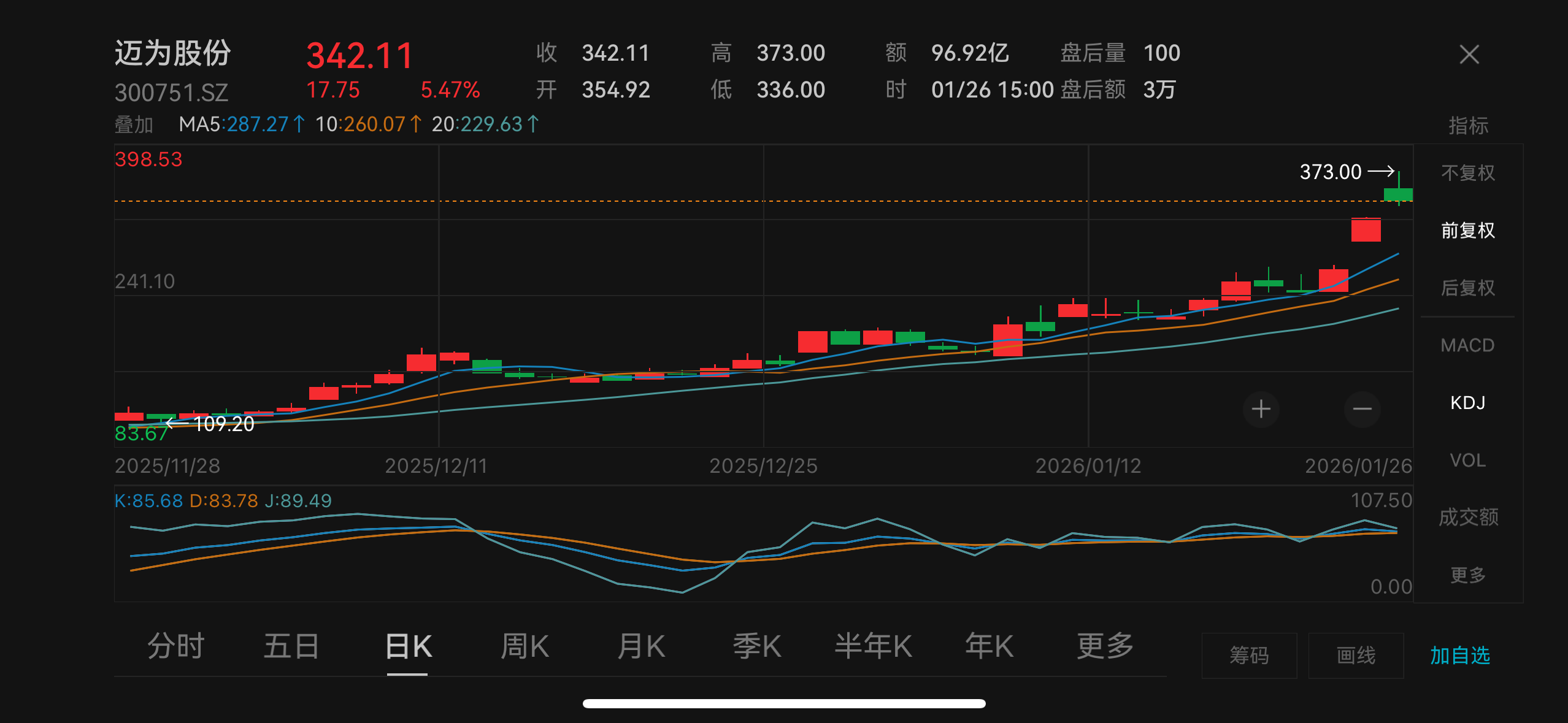
智通财经见习记者|蒋习 1月26日,迈为股份(300751.SZ)股价开盘大涨,市值一度破千亿元。 图片来源:Wind 在2026年1月22日的达沃斯世界经济论坛上,马斯克在与贝莱德CEO拉里·芬克对谈时再次力挺太空光伏,并透露特斯拉与Space X正分别推进在美国的太阳 能制造产能建设,目标为实现每年高达100吉瓦的产能。 马斯克在达沃斯的言论,迅速点燃资本市场对光伏板块的热情。 1月23日,迈为股份、晶科能源(688223.SH)、天合光能(688599.SH)等多家光伏上市公司股价涨停。 此前,有市场传言称,Space X与迈为的HJT设备订单基本敲定,金额约5亿美元,对应约7 GW异质结年产能。 截至1月26日收盘,迈为股份股价报收342.11元/股,涨幅为5.47%,公司市值为955.87亿。 自2025年12月初的114.25元/股起算,其股价在不足两个月内已实现近两倍的增长。 迈为股份是光伏设备商龙头,主营产品为太阳能电池生产设备,系自动化成套生产线。该公司在新一代技术选择上,更偏向于异质结(HJT)。 其股价走强,与特斯拉CEO埃隆·马斯克近期多次高调倡导"太空光伏",以及披露相关产能规划相关 ...

天合光能提示三年累计盈利96亿元目标不构成业绩承诺
Zhong Guo Jing Ying Bao· 2026-01-26 09:12
Core Viewpoint - Trina Solar has issued a risk warning regarding its performance targets outlined in the 2026 restricted stock incentive plan, stating that these targets do not constitute any commitment to future profitability or operational performance [1][2] Group 1: Incentive Plan Details - The incentive plan aims to assess performance over three accounting years from 2026 to 2028, with specific profit targets set: a minimum net profit of 200 million yuan in 2026, 3.2 billion yuan in 2027, or a cumulative total of 3.4 billion yuan for 2026-2027, and 6.2 billion yuan in 2028, or a cumulative total of 9.6 billion yuan for 2026-2028 [1] - The company emphasizes that the incentive plan is based on confidence in its long-term development potential and intrinsic value, aiming to attract and retain talent for sustainable growth [1] Group 2: Industry Context and Performance Outlook - Trina Solar's previous annual performance forecast for 2025 indicated an expected net loss of between 6.5 billion yuan and 7.5 billion yuan, reflecting the broader trend of losses in the photovoltaic industry [1] - The company believes that as the photovoltaic industry gradually recovers and its energy storage and system solutions businesses grow rapidly, it can achieve a performance rebound ahead of the industry [1][2] Group 3: Market Reaction and Stock Performance - As of January 26, Trina Solar's stock price was reported at 20.62 yuan per share, down 1.29%, with a total market capitalization of approximately 48.3 billion yuan [2]

400亿光伏龙头,急推千人股权激励
2 1 Shi Ji Jing Ji Bao Dao· 2026-01-26 08:55
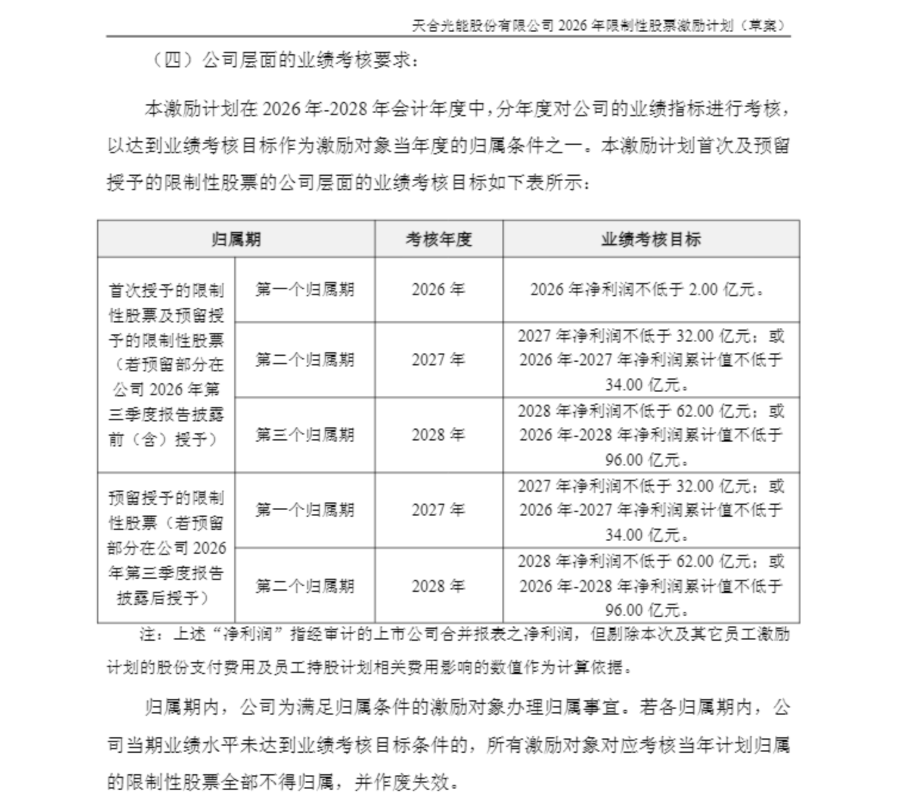
Core Viewpoint - Trina Solar has launched a restricted stock incentive plan for 2026, aiming to grant 28.00761 million shares, representing approximately 1.2% of the company's total equity, to 1,299 incentive recipients, including directors, senior management, and key technical personnel [2][3]. Group 1: Performance Targets - The performance assessment targets for the incentive plan include a cumulative net profit of no less than 9.6 billion yuan from 2026 to 2028, with specific annual targets of 200 million yuan for 2026, 3.2 billion yuan for 2027, and 6.2 billion yuan for 2028 [3][4]. - The company aims to reverse losses in 2026, as the previous incentive plan's performance targets were not met, resulting in no unlocking of stock incentives [4][5]. Group 2: Financial Outlook - Trina Solar has projected a significant loss for the fiscal year 2025, estimating losses between 6.5 billion yuan and 7.5 billion yuan, which is an increase compared to the previous year's losses [6][8]. - The company attributes its financial challenges to a supply-demand imbalance in the photovoltaic industry, increased competition, and rising costs of key raw materials, which have negatively impacted profitability [8]. Group 3: Strategic Initiatives - Trina Solar is focusing on diversifying its business, particularly in the energy storage sector, with a target of shipping 8 to 10 GWh in 2025 and aiming to double that in 2026 [8]. - The company is also exploring opportunities in space photovoltaic products, collaborating with leading aerospace companies in Europe and the U.S. [9].
400亿光伏龙头,急推千人股权激励
21世纪经济报道· 2026-01-26 08:50
记者丨 曹恩惠 编辑丨巫燕玲 时隔三年,光伏龙头天合光能(688599.SH)再次抛出涉及千人规模的股权激励。 | 归属期 | | 考核年度 | 业绩考核目标 | | --- | --- | --- | --- | | 首次授予的限制 | 第一个归属期 | 2026 年 | 2026年净利润不低于 2.00 亿元。 | | 性股票及预留授 | | | | | 予的限制性股票 (若预留部分在 | 第二个归属期 | 2027 年 | 2027年净利润不低于 32.00 亿元:或 2026年-2027年净利润累计值不低于 | | 公司 2026 年第 | | | 34.00 亿元。 | | 三季度报告披露 前(含)授予) | 第三个归属期 | 2028 年 | 2028 年净利润不低于 62.00 亿元:或 2026年-2028年净利润累计值不低于 | | | | | 96.00 亿元。 | | 预留授予的限制 | 第一个归属期 | 2027 年 | 2027年净利润不低于 32.00 亿元:或 2026年-2027年净利润累计值不低于 | | 性股票(若预留 | | | | | 部分在公司 2026 | | | ...

天合光能提示风险:“三年累计盈利不低于96亿元”不构成业绩承诺
Zhong Guo Jing Ying Bao· 2026-01-26 08:41
Core Viewpoint - Trina Solar (688599.SH) has announced a restrictive stock incentive plan and employee stock ownership plan for 2026, with performance assessment indicators set for the years 2026 to 2028, emphasizing confidence in the company's long-term development potential and intrinsic value [2][4]. Performance Assessment Targets - The performance assessment targets for the incentive plan are as follows: - For the first vesting period in 2026, the net profit must not be less than 200 million yuan [3]. - For the second vesting period in 2027, the net profit must not be less than 3.2 billion yuan, or the cumulative net profit for 2026-2027 must not be less than 3.4 billion yuan [3]. - For the third vesting period in 2028, the net profit must not be less than 6.2 billion yuan, or the cumulative net profit for 2026-2028 must not be less than 9.6 billion yuan [3]. Industry Context - Trina Solar's performance targets come amid a challenging backdrop for the photovoltaic industry, which has seen widespread losses. The company previously forecasted a net loss of 6.5 billion to 7.5 billion yuan for the year 2025, indicating a potential turnaround in the industry [4]. - The company believes that with the gradual recovery of the photovoltaic industry and rapid growth in its energy storage and system solutions businesses, it can achieve performance recovery ahead of the industry [4]. Market Reaction - As of January 26, Trina Solar's stock price was reported at 20.62 yuan per share, reflecting a decline of 1.29%, with a total market capitalization of approximately 48.3 billion yuan [5].