京东方

Search documents
从“房山制造”到“房山智造”:新质生产力引擎点燃发展新动能
Zhong Guo Jin Rong Xin Xi Wang· 2026-01-14 12:09
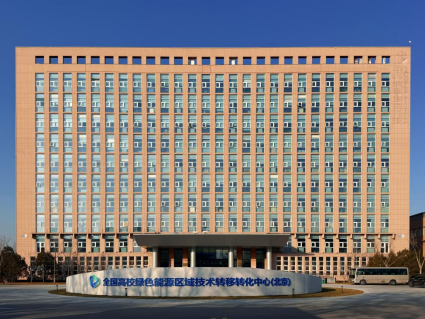
Core Viewpoint - The article highlights the ongoing industrial transformation in Fangshan District, driven by new productive forces, with a projected industrial output exceeding 80 billion yuan by 2025, primarily fueled by the green energy and new materials sectors. Group 1: Green Energy Sector - Fangshan District is positioned as a major hub for green energy, with 91 companies contributing to an output value of 22.5 billion yuan by the end of 2025, showcasing a growing industrial cluster effect [1][4]. - Leading companies in the energy storage sector, such as Haibo Shichuang and Xinyuan Zhichu, are expanding, with Haibo Shichuang recognized as a national enterprise technology center [1][2]. - The district has been approved for the establishment of a new energy storage power station application demonstration area and a green energy industry park, facilitating the large-scale application of storage technology [1][4]. Group 2: Hydrogen Energy Development - Fangshan is accelerating its hydrogen energy industry, with Yanshan Petrochemical's hydrogen purification facility now operational, providing a stable and high-purity hydrogen source for downstream applications [2]. - The district has initiated the use of hydrogen energy vehicles and established integrated energy stations, forming a comprehensive hydrogen energy industry chain [2]. Group 3: New Materials Sector - The new materials industry is positioned as a core driver of "new quality manufacturing," with the goal of establishing a competitive industrial cluster known as the Capital Materials Valley [5][6]. - The district has attracted 179 companies to the Zhongguancun Materials Industrial Park, achieving an output value of 18 billion yuan, further enhancing the Capital Materials Valley's industrial concentration [5][6]. Group 4: Innovation and Collaboration - Fangshan's development is rooted in a strategic design that emphasizes innovation-driven growth and the integration of education and industry, fostering a strong internal momentum for high-quality regional development [7][9]. - The district has established a unique technology transfer center for green energy at Liangxiang University Town, promoting collaboration between academia and industry, and has successfully transformed 25 technological achievements into practical applications [4][9]. Group 5: Future Outlook - As Fangshan enters the 14th Five-Year Plan, it aims to elevate its green energy and new materials sectors to higher levels, constructing a modern industrial system to support the high-quality development of the capital [9].

1月14日国企改革(399974)指数跌0.53%,成份股东方电气(600875)领跌
Sou Hu Cai Jing· 2026-01-14 10:18
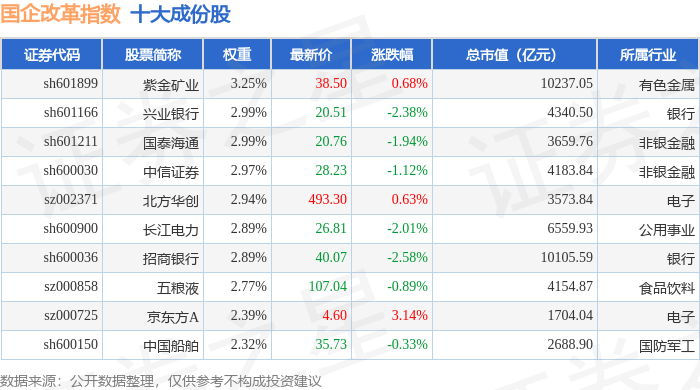
Core Viewpoint - The State-Owned Enterprise Reform Index (399974) closed at 1990.41 points, down 0.53%, with a trading volume of 297.446 billion yuan and a turnover rate of 1.42% [1] Group 1: Index Performance - On the day, 27 stocks in the index rose, with Guangdian Yuntong leading with a 5.19% increase, while 72 stocks fell, with Dongfang Electric leading the decline at 2.99% [1] - The top ten constituent stocks of the State-Owned Enterprise Reform Index are detailed, showing varying performance across sectors such as non-ferrous metals, banking, and electronics [1] Group 2: Stock Details - Key stocks include Zijin Mining with a weight of 3.25% and a price of 38.50 yuan, up 0.68%, and Industrial Bank with a weight of 2.99% and a price of 20.51 yuan, down 2.38% [1] - Other notable stocks include CITIC Securities, North Huachuang, and China Merchants Bank, with respective price changes of -1.12%, +0.63%, and -2.58% [1] Group 3: Capital Flow - The net outflow of main funds from the constituent stocks totaled 16.187 billion yuan, while retail investors saw a net inflow of 10.455 billion yuan [3] - Notable capital flows include a net inflow of 6.22 million yuan for BOE Technology Group, despite a net outflow from other stocks like China Great Wall and Hikvision [3]




天禄科技:TAC膜项目获产业链多方支持,一期规划年产能6000万平方米
2 1 Shi Ji Jing Ji Bao Dao· 2026-01-14 09:33
Core Viewpoint - Tianlu Technology's subsidiary, Anhui Jiguang, is engaged in the research and production of TAC optical films, receiving broad support from the industry chain [1] Group 1: Company Developments - The project has garnered support from stakeholders including polarizer manufacturer Sanlipu and panel manufacturer BOE, contributing to technology pathways, equipment selection, product validation, and sales channels [1] - The construction of the factory is progressing steadily, with major equipment expected to be installed and tested in the first half of 2026 [1] - The laboratory-produced films have been sent to downstream customers for testing, with results meeting expectations [1] Group 2: Production Capacity - The first phase of the project plans to establish one production line with an annual capacity of approximately 60 million square meters [1] - Future expansion plans for the second phase will be determined based on the progress of the initial phase [1]
天禄科技(301045) - 2026年1月14日投资者关系活动记录表
2026-01-14 09:10
Business Overview - Suzhou Tianlu Technology Co., Ltd. operates in three main business segments, focusing on optical films, including TAC film and reflective polarizing films, to address domestic supply chain challenges and enhance growth potential [1][2]. TAC Film Market Insights - The demand for TAC film is projected to reach 1.229 billion square meters by 2025, with over 70% of the panel production capacity located in mainland China [2]. - Currently, Japanese suppliers dominate the TAC film market, holding approximately 75% of the global market share [2]. - The cost of TAC film constitutes over 50% of the polarizer film material costs, making it a critical component for profitability in the polarizer industry [2]. Competitive Landscape - Key players in the domestic TFT-grade TAC film development include LeKai Film and Anhui Jiguang, with limited new entrants expected due to high technical barriers [3]. - The market competition for domestic alternatives is relatively mild, allowing ample growth opportunities for existing players [3]. Project Development and Financing - Anhui Jiguang has received support from major stakeholders across the supply chain, including Sanli Film and Beijing Electric Control Investment, enhancing project advancement through technical and operational assistance [4]. - The construction of Anhui Jiguang's factory is progressing, with a production line expected to yield approximately 60 million square meters of TAC optical film annually [5]. Reflective Polarizing Film Project - The global market for reflective polarizing films is anticipated to reach $1.438 billion by 2025, primarily dominated by suppliers from the US, Japan, and South Korea [6]. - Suzhou Yijia, a subsidiary established in 2025, aims to produce reflective polarizing films, with plans for two production lines capable of generating 2.4 million square meters annually [7]. Financial Strategy - The investment for the reflective polarizing film project is estimated at approximately 300 million yuan, with initial funding sourced from capital raising and company funds, alongside plans for external financing to optimize governance and equity structure [7]. Market Trends and Production Capacity - The LCD panel market is experiencing upward price trends due to increased demand from upcoming sports events and proactive inventory management by brand manufacturers [7]. - The production capacity utilization rate is expected to remain high, driven by preemptive demand and inventory replenishment strategies [7].
电子行业今日涨1.36%,主力资金净流出97.08亿元
Zheng Quan Shi Bao Wang· 2026-01-14 08:52
Market Overview - The Shanghai Composite Index fell by 0.31% on January 14, with 17 out of the 28 sectors rising, led by the computer and comprehensive sectors, which increased by 3.42% and 2.90% respectively [1] - The electronic sector rose by 1.36%, while the banking and real estate sectors experienced declines of 1.88% and 1.18% respectively [1] Capital Flow Analysis - The main capital outflow from the two markets totaled 71.378 billion yuan, with only three sectors seeing net inflows: computer (8.873 billion yuan), communication (2.824 billion yuan), and comprehensive (6.928 million yuan) [1] - The power equipment sector had the largest net outflow, totaling 14.433 billion yuan, followed by the electronic sector with a net outflow of 9.708 billion yuan [1] Electronic Sector Performance - In the electronic sector, 476 stocks were tracked, with 347 stocks rising and 118 stocks falling; three stocks hit the daily limit up [2] - The top three stocks with the highest net inflow were Huadian Co., Ltd. (1.377 billion yuan), BOE Technology Group (675 million yuan), and Haiguang Information (579 million yuan) [2] - The stocks with the largest net outflows included Zhaoyi Innovation (1.373 billion yuan), Changying Precision (1.290 billion yuan), and Luxshare Precision (1.220 billion yuan) [2] Electronic Sector Capital Inflow - The top stocks in the electronic sector by capital inflow included: - Huadian Co., Ltd. (6.02% increase, 137.718 million yuan inflow) - BOE Technology Group (3.14% increase, 67.494 million yuan inflow) - Haiguang Information (6.76% increase, 57.915 million yuan inflow) [2][3] Electronic Sector Capital Outflow - The top stocks in the electronic sector by capital outflow included: - Zhaoyi Innovation (-3.98% decrease, -1.372 billion yuan outflow) - Changying Precision (-4.13% decrease, -1.290 billion yuan outflow) - Luxshare Precision (-1.83% decrease, -1.220 billion yuan outflow) [4]





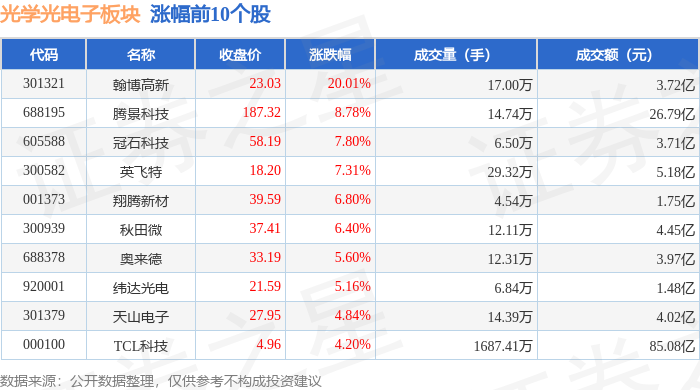
光学光电子板块1月14日涨1.39%,翰博高新领涨,主力资金净流出7.46亿元
Zheng Xing Xing Ye Ri Bao· 2026-01-14 08:50
Core Viewpoint - The optical and optoelectronic sector experienced a rise of 1.39% on January 14, with Hanbo High-tech leading the gains, while the Shanghai Composite Index fell by 0.31% [1] Group 1: Market Performance - The Shanghai Composite Index closed at 4126.09, down 0.31% [1] - The Shenzhen Component Index closed at 14248.6, up 0.56% [1] - The optical and optoelectronic sector saw significant individual stock movements, with notable gainers including: - Dongche High-tech (20.01% increase) [1] - Tengjing Technology (8.78% increase) [1] - Guanshi Technology (7.80% increase) [1] Group 2: Stock Performance - Key stocks in the optical and optoelectronic sector with their closing prices and percentage changes include: - Dongche High-tech: 23.03, +20.01% [1] - Tengjing Technology: 187.32, +8.78% [1] - Guanshi Technology: 58.19, +7.80% [1] - Infit: 18.20, +7.31% [1] - Xiangteng New Materials: 39.59, +6.80% [1] - Qiutian Micro: 37.41, +6.40% [1] - Aolaide: 33.19, +5.60% [1] - Weida Optoelectronics: 21.59, +5.16% [1] - Tianshan Electronics: 27.95, +4.84% [1] - TCL Technology: 4.96, +4.20% [1] Group 3: Fund Flow - The optical and optoelectronic sector experienced a net outflow of 746 million yuan from institutional funds, while retail investors saw a net inflow of 1.099 billion yuan [2] - Notable stock fund flows include: - 京东方 A: -4.12 million yuan from retail [3] - 腾景科技: -5899.32 million yuan from retail [3] - 翰博高新: +6880.73 million yuan from institutional [3]


青岛市新型显示产业园2025年营收预计超520亿元
WitsView睿智显示· 2026-01-14 07:45
Core Viewpoint - The Qingdao New Display Industry Park is projected to achieve a revenue of 52 billion yuan by 2025, accounting for approximately 32.6% of the city's new generation information technology industry revenue [1]. Group 1: Industry Overview - The Qingdao New Display Industry Park is one of the ten emerging industrial parks planned in Qingdao, covering three main areas: module panel area (5,754 acres), materials and equipment area (7,650 acres), and terminal application area (900 acres) [1]. - Since its establishment in 2022, the park has advanced the construction of over 14,000 acres and attracted several key industry players, including Hisense, BOE, and Wanda Optoelectronics [2]. Group 2: Industry Structure and Development - The park has formed a dual-chain structure led by Hisense (terminal application) and BOE (module panel), with material and equipment companies developing in coordination [2]. - The local supply rate for BOE's backlight sources has reached 100%, while the local supply rate for Hisense's metal back panels and diffusion plates is nearly 80% [2]. Group 3: Investment and Future Plans - A total of 17 projects have been put into operation with a total investment of 35.6 billion yuan, and there are 28 projects under discussion with a cumulative investment of 174.9 billion yuan [2]. - By 2025, the park is expected to have attracted 37 key projects with a total investment exceeding 70 billion yuan [2]. - According to the Qingdao Economic Development Zone's "2.0 version of the New Display Industry Park Construction Implementation Plan (2025-2030)," the park aims to strengthen its liquid crystal display sector, actively cultivate MLED micro-displays, and make breakthroughs in OLED displays, targeting a scale of 55 billion yuan by 2026 and 70 billion yuan by 2030 [2].


2026面板业危中有机:大盘或微降,液晶获利稳,中尺寸OLED飙升
Di Yi Cai Jing· 2026-01-14 06:06
Core Viewpoint - The memory price increase is impacting terminal demand, while the supply of LCD TV panels is concentrated, with a price rebound in January. The demand for automotive displays and high-end IT products will be the main growth points in the industry. Group 1: Company Performance - TCL Technology's subsidiary TCL Huaxing is expected to achieve revenue exceeding 100 billion yuan and net profit over 8 billion yuan by 2025, attracting attention to the panel industry [4] - TCL Huaxing's revenue is projected to grow by 23% to approximately 106.3 billion yuan in 2025, with 47% coming from TV panels, marking a decline in TV panel revenue share below 50% for the first time [5] - The company has strengthened its position by acquiring LGD's Guangzhou 8.5-generation LCD panel line and increasing its stake in Shenzhen Huaxing, contributing to profit growth [5] Group 2: Industry Outlook - The global display panel industry is expected to see a revenue of $114.4 billion in 2025, a slight decline of 1.3%, primarily due to a downturn in the mobile product panel market [6] - The LCD panel sales are projected to reach $69.5 billion, while OLED panel sales are expected to be $44.7 billion, both showing slight declines [6] - The overall sales of the global panel industry are anticipated to decrease by 1.8% to $112.4 billion this year, with a 2% decline in the shipment of mainstream consumer electronics expected [6] Group 3: Market Dynamics - The top three companies, BOE, TCL Huaxing, and Huike, account for 70% of the global LCD TV panel market shipment, with a projected 3% increase in global LCD TV panel shipments in 2025 [6][7] - The profitability of LCD panels is expected to stabilize due to production control and price stability, with a focus on large-size panels and a shift towards high-end products [7] - The demand for mid-size OLED panels is expected to grow significantly, with a projected sales increase of over 20% in 2026 [8] Group 4: Competitive Landscape - The competition in the mid-size OLED market is expected to intensify, particularly as new production lines from BOE and Samsung enter mass production [9] - The demand for automotive displays and high-end IT products is anticipated to be the main growth drivers in the future market [9]
消费电子ETF(561600)涨超1.3%,荣耀全球发货量首次突破7100万台
Xin Lang Cai Jing· 2026-01-14 05:40
Group 1 - The core viewpoint of the news highlights the strong performance of the consumer electronics sector, with the CSI Consumer Electronics Theme Index rising by 1.21% and notable gains in individual stocks such as Chipone Technology (up 5.89%) and Hengxuan Technology (up 5.72%) [1] - The IDC report indicates that Apple ranked first in China's smartphone market for Q4 2025, followed by Vivo, OPPO, Huawei, and a tie between Honor and Xiaomi in fifth place. Honor achieved a significant milestone with global shipments surpassing 71 million units, marking a year-on-year growth of approximately 55% in overseas shipments, the highest among the top ten global brands [1] - Open Source Securities notes that new AI terminals are rapidly evolving from general interaction to deep scene penetration, with Chinese brands leading innovation in AI glasses, including the launch of the world's first eSIM smart AR glasses by Thunderbird and the lightweight AI glasses "Rokid Style" [2] Group 2 - The CSI Consumer Electronics Theme Index consists of 50 listed companies involved in component production and brand design, reflecting the overall performance of the consumer electronics sector. As of December 31, 2025, the top ten weighted stocks in the index accounted for 54.35% of the total index weight [2] - The Consumer Electronics ETF closely tracks the CSI Consumer Electronics Theme Index, providing investors with exposure to the performance of the sector [3]
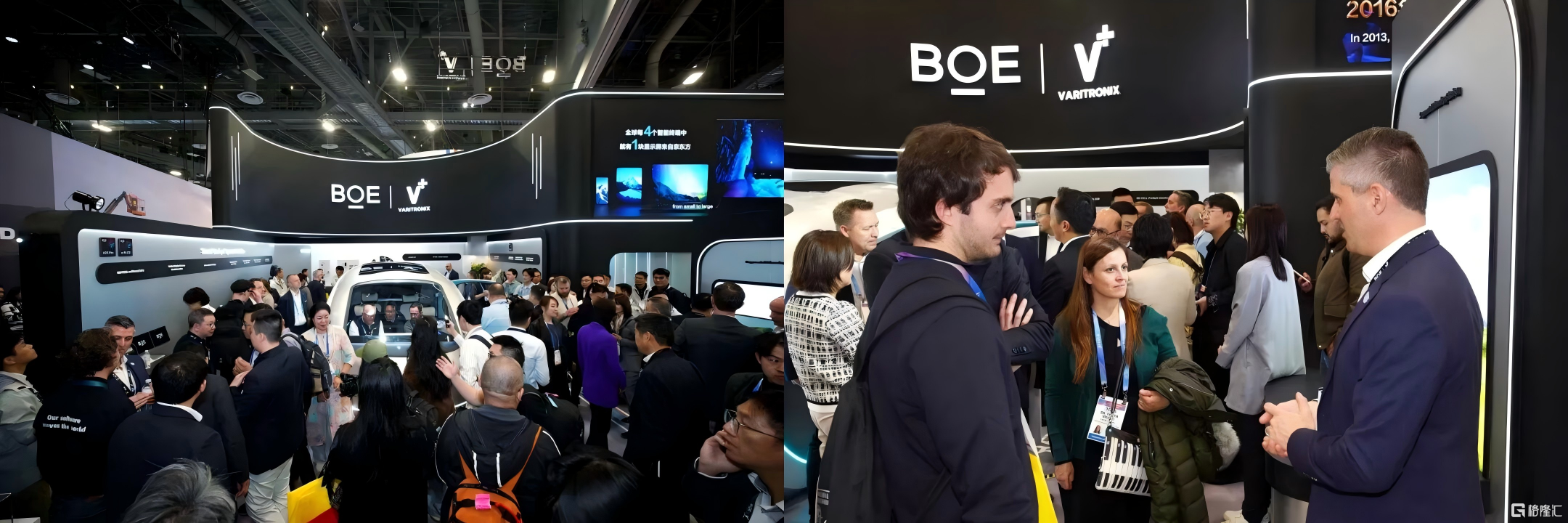
CES 2026 | 京东方精电发布多款全球首发产品,AI融合引领智能座舱新未来
Ge Long Hui· 2026-01-14 05:01
Core Insights - The article highlights the significant advancements made by BOE Technology Group at CES 2026, showcasing their innovative products and technologies in the automotive display sector, particularly focusing on smart cockpit solutions and AI integration [1][20]. Group 1: Product Innovations - BOE launched the HERO2.0 smart cockpit, featuring a comprehensive array of new products that integrate display technologies, AI, and innovative applications across various scenarios [1]. - The company introduced a full range of high-end automotive display products under three major technology brands: ADS Pro, f-OLED, and α-MLED, achieving breakthroughs in image quality, form factor innovation, and scene adaptability [2][20]. - The 15.6-inch automotive-grade UB Cell display utilizes Mini LED backlighting for precise light control, offering a million-level contrast ratio and deep blacks, comparable to OLED quality [5]. - The world's first 17-inch OLED rollable terminal was unveiled, capable of expanding from a 9.5-inch to a 17-inch display, enhancing portability and large-screen experience for mobile applications [7]. - A 30,000-nit MicroLED head-up display was introduced, providing clear visibility in outdoor conditions, while dual 12.3-inch MiniLED products deliver exceptional color performance [5]. Group 2: AI Integration and Interaction - AI technology was deeply integrated into product innovation, significantly increasing the proportion of soft and hard integration systems, enhancing the interactive experience of smart cockpits [9]. - The MicroLED PHUD panoramic head-up display features 50,000 nits brightness and supports multi-modal interactions, including touch, voice, and gesture controls [9]. - The AI-powered in-car digital amplifier utilizes AI noise reduction and sound quality restoration technologies, delivering high-quality audio experiences even in adverse conditions [11]. Group 3: Smart Interaction and Functionality - The introduction of a 3D ultrasonic fingerprint recognition car key allows for precise identification in challenging environments, enhancing user interaction and personalization [13]. - A dual-axis intelligent control screen enables dynamic adjustment of display angles based on driver posture, improving the overall driving experience [15]. - The innovative dual 24-inch "sky screen" integrates high color gamut and contrast technologies, enhancing the aesthetic appeal of the automotive cockpit [17]. Group 4: Ecosystem and Future Directions - BOE aims to integrate core technological capabilities with ecological resources, focusing on innovative scene-based solutions that extend from core cockpit scenarios to broader applications [18]. - The company is expanding into smart pet care, smart cycling, smart home, and smart retail sectors, showcasing a commitment to technological innovation across various industries [18][20]. - Future strategies will continue to emphasize technological innovation to enhance intelligent experiences in application scenarios, fostering collaboration with global partners [20].