成都银行

Search documents
债市波动拖累投资收益 银行非息收入增长现分化
Zhong Guo Zheng Quan Bao· 2025-11-06 22:34
Core Viewpoint - In a low interest rate environment, banks are increasingly relying on non-interest income as a key driver for revenue growth, with significant disparities emerging among different banks in terms of non-interest income performance [1] Non-Interest Income Overview - In the first three quarters of this year, 42 listed banks achieved a total non-interest income of 1.22 trillion yuan, an increase of over 300 billion yuan compared to the first half of the year and an increase of 583 billion yuan year-on-year [1] - Among these banks, only 18 reported positive year-on-year growth in non-interest income, while 8 banks experienced a decline in investment income due to bond market fluctuations, and 31 banks reported negative fair value changes [1] Fee and Commission Income - A breakdown of non-interest income shows that net fee and commission income, investment income, and fair value changes significantly impact overall non-interest income [2] - In the first three quarters, 27 banks reported positive year-on-year growth in net fee and commission income, with 12 banks achieving growth rates exceeding 10% [2] - Notable performers include Changshu Bank and Ruifeng Bank, with increases of 364.75% and 162.66% respectively, while major state-owned banks like Agricultural Bank, Postal Savings Bank, and Bank of China also reported steady growth [2] Impact of Bond Market Fluctuations - The bond market's volatility has negatively affected investment income and fair value changes for several banks, leading to declines in non-interest income and overall revenue growth [3] - For instance, China Merchants Bank reported a 4.23% year-on-year decline in non-interest net income, primarily due to reduced returns from bond and fund investments [3] - Other banks, such as Ping An Bank and Huaxia Bank, also reported significant declines in revenue attributed to market fluctuations affecting their non-interest income [3] Regional Bank Performance - Regional banks like Qingdao Bank faced similar challenges, with a year-on-year decrease in investment income and fair value changes due to weaker bond market performance [4] - Conversely, some banks, such as China Construction Bank and Changsha Bank, reported over 100% year-on-year growth in investment income [4] Future Market Outlook - Analysts suggest that the bond market is likely to remain volatile in the short term, with fluctuations in fair value changes being more pronounced for joint-stock and regional banks due to their higher proportion of FVTPL assets [5] - Experts recommend that banks focus on differentiated operations and niche markets to support non-interest income growth, while also balancing short-term gains with long-term risks [6] - The outlook for the bond market indicates a gradual return to fundamentals and liquidity, but uncertainties remain regarding the growth of other non-interest income sources [6]
债市波动拖累投资收益银行非息收入增长现分化
Zhong Guo Zheng Quan Bao· 2025-11-06 20:15
Core Viewpoint - In a low interest rate environment, banks are increasingly relying on non-interest income to drive revenue growth, with significant disparities in performance among different banks [1][2]. Non-Interest Income Overview - In the first three quarters of the year, 42 listed banks achieved a total non-interest income of 1.22 trillion yuan, an increase of over 300 billion yuan compared to the first half of the year and an increase of 583 billion yuan year-on-year [1]. - Only 18 banks reported a year-on-year increase in non-interest income, while 8 banks experienced a decline in investment income due to bond market volatility, and 31 banks reported negative fair value changes [1][2]. Fee and Commission Income - Among the non-interest income components, net fee and commission income, investment income, and fair value changes significantly impacted overall non-interest income [1]. - 27 banks reported a year-on-year increase in net fee and commission income, with 12 banks showing growth exceeding 10%. Notably, Changshu Bank and Ruifeng Bank saw increases of 364.75% and 162.66%, respectively [1][2]. Wealth Management and Consumer Finance - The recovery in domestic consumption and capital markets has created opportunities for wealth management and consumer finance, contributing to the growth of some banks' intermediary business income [2]. - China Bank attributed its growth in net fee and commission income to strong performance in agency, custody, and other entrusted businesses [2]. Impact of Bond Market Volatility - The bond market's fluctuations have negatively affected investment income and fair value changes for several banks. For instance, 8 banks reported a year-on-year decline in investment income, and 31 banks had negative fair value changes [2][3]. - For example, China Merchants Bank reported a 4.23% year-on-year decline in non-interest net income, with a 0.90% increase in net fee and commission income but an 11.42% decrease in other net income due to reduced bond and fund investment returns [2]. Regional Banks' Performance - Regional banks like Qingdao Bank also faced challenges, with a year-on-year decrease in investment income and fair value changes due to weaker bond market performance [3]. - Conversely, some banks, such as China Construction Bank and Changsha Bank, reported over 100% year-on-year growth in investment income [3]. Future Outlook - Analysts suggest that the bond market is likely to remain volatile in the short term, with various factors creating disturbances [4]. - The overall liquidity in the market is expected to remain favorable for the bond market, but the performance of risk assets may weaken the attractiveness of bonds [4][5].
城商行板块11月6日跌0.11%,厦门银行领跌,主力资金净流出6.08亿元
Zheng Xing Xing Ye Ri Bao· 2025-11-06 08:51
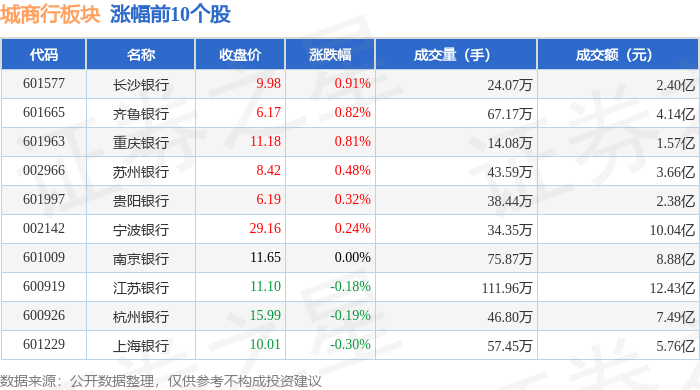
Core Viewpoint - The city commercial bank sector experienced a slight decline of 0.11% on November 6, with Xiamen Bank leading the drop, while the overall market indices showed positive movements with the Shanghai Composite Index up by 0.97% and the Shenzhen Component Index up by 1.73% [1][2]. Group 1: Market Performance - The closing price of Xiamen Bank was 7.16, reflecting a decrease of 2.59% with a trading volume of 539,700 shares and a transaction value of 387 million yuan [2]. - Other notable banks included Changsha Bank, which closed at 9.98 with a rise of 0.91%, and Qilu Bank, which closed at 6.17 with an increase of 0.82% [1]. - The city commercial bank sector saw a net outflow of 608 million yuan from major funds, while retail investors contributed a net inflow of 473 million yuan [2][3]. Group 2: Individual Bank Performance - Beijing Bank had a net inflow from major funds of 20.80 million yuan, while it experienced a net outflow from retail investors of 30.79 million yuan [3]. - Chongqing Bank recorded a net inflow of 11.91 million yuan from major funds but faced a net outflow of 12.20 million yuan from retail investors [3]. - Jiangsu Bank had a net inflow of 202.55 million yuan from major funds, while retail investors contributed a net inflow of 3.33 million yuan [3].



119家金融机构已披露助贷合作方名单 中互金:存在四大问题
Xin Jing Bao· 2025-11-06 04:50
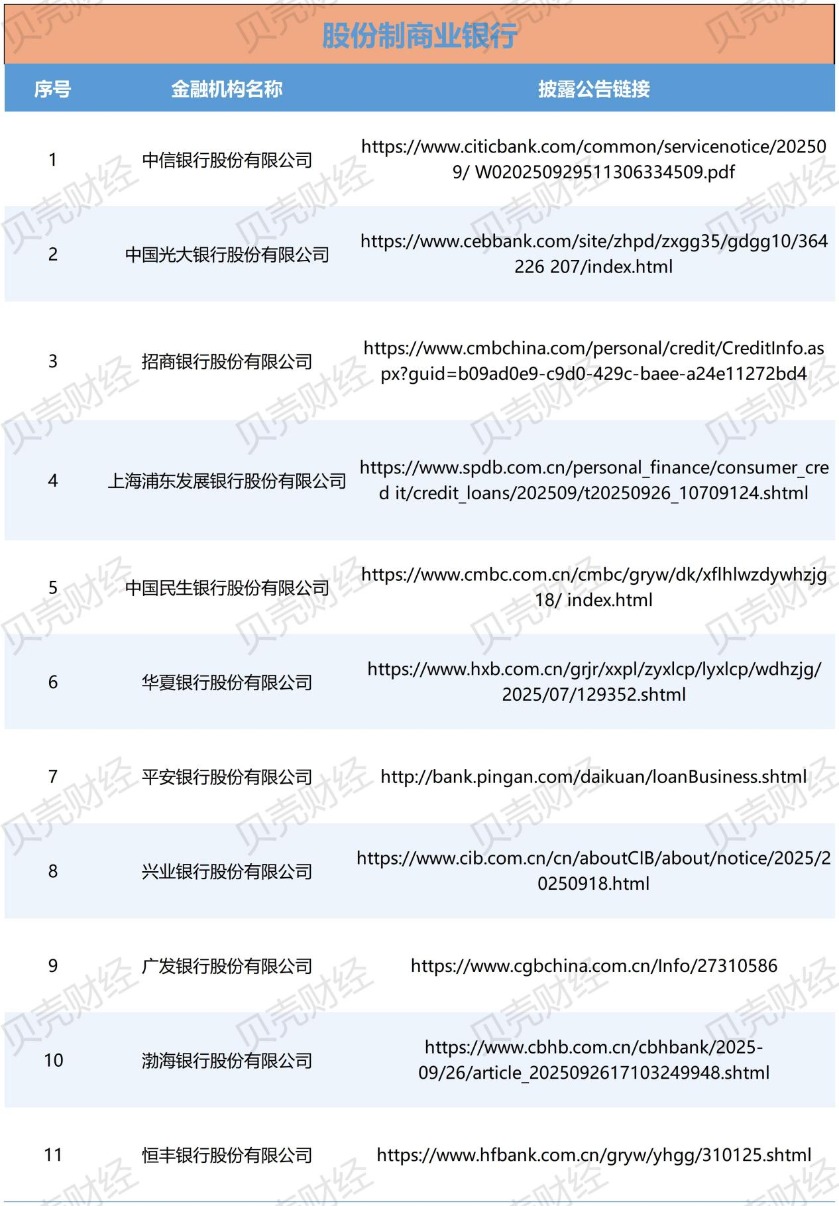
Core Points - The China Internet Finance Association (CIFA) released an announcement summarizing the disclosure status of 119 domestic financial institutions' internet lending business cooperation partners as of October 31 [1] - CIFA identified four major issues regarding the non-compliance and inaccuracies in the disclosure of lending partners by financial institutions [1] Group 1: Overview of Financial Institutions - The 119 financial institutions include 11 national joint-stock banks, 39 city commercial banks, 5 rural commercial banks, 16 private banks, 10 foreign banks, 30 consumer finance companies, 7 trust companies, and 1 direct bank [1] Group 2: Issues Identified by CIFA - The first issue is that the disclosure locations for lending partner lists are often obscure and lack search functionality, making them difficult to find [22] - The second issue is that the disclosure titles are merely "Announcement" and do not follow a chronological order or indicate the update time [22] - The third issue involves financial institutions updating the disclosure lists by directly overwriting the original announcement content [23] - The fourth issue is that the names of disclosed cooperation partners are not standardized, often only showing the group name or indicating that the partner has been renamed or deregistered [23] Group 3: Recommendations by CIFA - CIFA proposed three recommendations to improve the disclosure of lending business cooperation partners, emphasizing that financial institutions should disclose information in a manner that is easy for consumers to access [23]
成都银行发布三季度报:信贷扩张量提质优,营收净利双双增长
2 1 Shi Ji Jing Ji Bao Dao· 2025-11-06 00:05
Core Viewpoint - Chengdu Bank reported steady growth in revenue and net profit for the first three quarters of 2025, with a focus on expanding its asset scale and enhancing its financial services to support regional economic development [1][2][3] Financial Performance - For the first nine months of 2025, Chengdu Bank achieved operating income of 17.761 billion yuan, a year-on-year increase of 520 million yuan, representing a growth rate of 3.01% [1] - The net profit attributable to shareholders reached 9.493 billion yuan, up by 454 million yuan, with a growth rate of 5.03% [1] - The bank's net interest income for the first three quarters was 14.725 billion yuan, with a year-on-year growth of 8.2%, and a quarterly growth of 9.5% [1][3] Asset Growth - Chengdu Bank's total assets reached nearly 1.39 trillion yuan by the end of Q3 2025, reflecting a year-on-year increase of 135.139 billion yuan, or 10.81% [1][2] - Total deposits amounted to 986.432 billion yuan, up by 100.573 billion yuan, with an increase of 11.35% [1] - The total loan amount was 847.481 billion yuan, showing a growth of 104.913 billion yuan, or 14.13% [1] Loan Structure and Strategy - The bank's loan growth was primarily driven by corporate lending, with a year-to-date increase of 16.2% as of September 2025 [2] - Chengdu Bank has focused on supporting key industries in Sichuan and Chengdu, achieving 100% coverage of major industrial chains [2] - The bank has developed 20 specialized products for small and micro enterprises, addressing their needs throughout their lifecycle [2] Operational Efficiency - Chengdu Bank's net interest margin is stabilizing, with expectations of improved performance as long-term deposits are repriced [3] - Basic earnings per share for the first three quarters were 2.99 yuan, with an annualized return on assets (ROA) of 0.96% and a return on equity (ROE) of 15.20% [3] Asset Quality - The bank maintained a non-performing loan ratio of 0.68%, indicating strong asset quality compared to industry standards [3] - The provision coverage ratio stood at 433.08%, demonstrating robust risk resistance capabilities [3] Future Outlook - Chengdu Bank is planning a new round of strategic development, focusing on sustainable growth and diversifying its business model to include retail assets and wealth management [3]
五家银行跻身绿色信贷“万亿俱乐部” 绿色债券存量规模近2万亿
2 1 Shi Ji Jing Ji Bao Dao· 2025-11-05 23:42
Core Insights - Green finance has transitioned from an optional choice to a mandatory requirement for the banking industry, serving as a new engine for strategic transformation and a blue ocean market for future growth [1] - The balance of green financing at Industrial Bank has reached nearly 2.5 trillion yuan, with green loans exceeding 1 trillion yuan and a non-performing loan rate of only 0.57% [1] - The People's Bank of China and other departments have issued a unified policy framework for green finance, effective from October 1, 2025, to standardize various financial products [2] Group 1: Green Credit Growth - As of the end of 2024, the total balance of green credit among 42 A-share listed banks exceeded 27 trillion yuan, reflecting a year-on-year growth of approximately 20% [3] - State-owned banks dominate the green credit market, with the six major state-owned banks accounting for over 21 trillion yuan, representing 77.6% of the total [3] - Industrial Bank's green loan balance has risen to 1.08 trillion yuan, joining the "trillion club" [3] Group 2: Performance and Sector Focus - The average growth rate of green credit for A-share listed banks in 2024 was 20.6%, a slowdown from approximately 28% in 2023, yet leading institutions maintained strong growth [4] - The focus of green credit issuance is concentrated in four key areas: clean energy, green transportation, energy conservation and environmental protection, and green buildings [4] - The Yangtze River Delta, Guangdong-Hong Kong-Macau Greater Bay Area, and Chengdu-Chongqing Economic Circle are identified as core regions for green credit [4] Group 3: Product Innovation - A-share listed banks are deepening innovation in green financial products, creating a multi-dimensional product system that includes loans, bonds, asset securitization, insurance, and carbon finance [5] - Sustainable Development Linked Loans (SLL), carbon emission rights pledge financing, and environmental rights collateral loans are gaining traction [5] - Industrial Bank has launched the first green loan with biodiversity protection insurance, while Bohai Bank introduced a green loan linked to data center energy efficiency [6] Group 4: Broader Financial Tools - The issuance of green bonds has expanded, with the cumulative issuance of labeled green bonds in 2024 surpassing 4 trillion yuan [6] - Banks are actively participating in green wealth management and fund products, enhancing investor engagement through innovative offerings [6] - Carbon finance tools are transitioning from pilot programs to broader applications, with various banks introducing carbon emission rights pledge financing products [6] Group 5: Future Directions - The banking industry is expected to continue innovating green financial products to support sustainable economic development, moving beyond traditional green credit [7] - The development of ESG-linked loans and financing models using carbon emission rights as collateral will be explored [7] - These innovations will not only assist in achieving national carbon reduction goals but also cultivate new growth momentum for banks [7]





上市银行2025年三季报综述:盈利温和修复,利息与中收共振回暖
Ping An Securities· 2025-11-05 10:38
Investment Rating - The report maintains a "stronger than the market" rating for the banking sector [1][4]. Core Views - As of the end of October, 42 listed banks reported a 1.5% year-on-year increase in net profit for the first three quarters of 2025, an improvement of 0.7 percentage points compared to the first half of 2025 [4][9]. - The report highlights a continued recovery in profitability, driven by a rebound in interest income and non-interest income [4][10]. - The report anticipates that the positive signals from interest margin and non-interest income will persist into the fourth quarter of 2025, with a focus on the impact of policies aimed at reducing competition and the quality of retail assets [15][4]. Summary by Sections Profitability Analysis - The net interest income for the first three quarters of 2025 decreased by 0.6% year-on-year, while non-interest income from fees and commissions grew by 4.6% [10][6]. - The report notes that the profitability of individual banks varies, with some banks like Shanghai Pudong Development Bank and Agricultural Bank of China showing significant growth rates of 10.2% and 3.0% respectively [4][9]. Operational Breakdown - Total asset growth for the 42 listed banks was 9.3% year-on-year, with loan growth at 7.7% and deposit growth at 7.9% [22][4]. - The annualized net interest margin for the third quarter was stable at 1.36%, with a decrease in the cost of interest-bearing liabilities [4][6]. Investment Recommendations - The report suggests a shift towards reallocation rather than trading, emphasizing the importance of structural changes in funding flows that support valuation recovery in the banking sector [6][4]. - Specific banks such as Chengdu Bank, Jiangsu Bank, and Suzhou Bank are highlighted for their regional advantages and potential for continued profit growth [6][4].




存款还是理财?前三季度银行手续费上涨揭示财富配置新动向
Bei Ke Cai Jing· 2025-11-05 09:21
Core Insights - A discussion is emerging regarding whether to choose deposits or invest in wealth management products, as some banks see a rise in time deposit scales while others report a recovery in net fee income from non-interest sources, with some banks experiencing a doubling of this income [1][2]. Group 1: Wealth Management and Investment Trends - An increasing number of investors are moving funds from deposits to bank wealth management and fund products due to low deposit interest rates, with many seeking higher returns from these alternatives [2][5]. - The capital market's positive performance since the third quarter has led to significant increases in various wealth management products, contributing to the recovery of banks' net fee income [5][6]. - Among 42 listed banks, 26 reported a year-on-year increase in net fee income, with notable growth from Changshu Bank (364.75%) and Ruifeng Bank (162.66%) [5]. Group 2: Bank Performance and Fee Income - In the third quarter, net fee income for banks like China Merchants Bank reached 56.202 billion yuan, marking a 0.90% year-on-year increase, with wealth management fees growing by 18.76% [5]. - The growth in wealth management services is attributed to the favorable capital market conditions, with banks aiming to capitalize on the increasing wealth in society [6]. Group 3: Deposit Trends and Consumer Behavior - Despite a decline in deposit interest rates, personal time deposits have shown positive year-on-year growth across several banks, indicating a continued demand for savings [7][10]. - Some investors, particularly those with lower risk tolerance, continue to prefer time deposits as their primary investment method, even in a fluctuating market [7][8]. - A survey indicated that 62.3% of residents preferred saving over investing or spending, reflecting a cautious approach among consumers [8]. Group 4: Future Outlook - Industry experts predict that deposit interest rates will continue to decline, and the trend of moving funds from deposits to wealth management products is expected to persist [11][12]. - The outflow of funds from deposits to wealth management is driven by the faster decline in deposit rates compared to the yields on wealth management products, making the latter more attractive [13].
强势股追踪 主力资金连续5日净流入77股
Zheng Quan Shi Bao Wang· 2025-11-05 09:02
Core Insights - A total of 77 stocks in the Shanghai and Shenzhen markets have experienced net inflows of main funds for five consecutive days or more as of November 5, with Cambricon Technologies (寒武纪-U) leading with 50 days of continuous inflow [1] - The total net inflow of main funds for Cambricon Technologies reached 6.325 billion yuan, followed by Shanghai Pudong Development Bank with a net inflow of 777 million yuan over five days [1] - In terms of the proportion of net inflow to trading volume, *ST Baoying ranks first, with a 47.72% increase over the past eight days [1] Summary by Category Stocks with Continuous Net Inflows - Cambricon Technologies (688256) has seen net inflows for 50 days totaling 6.325 billion yuan, with a price increase of 44.33% [1] - Shanghai Pudong Development Bank (600000) recorded net inflows of 777 million yuan over five days, with a price increase of 0.42% [1] - CITIC Bank (601998) had net inflows of 439 million yuan over six days, with a price increase of 3.85% [1] Notable Performers - *ST Baoying had the highest net inflow ratio, with a significant price increase of 47.72% over the last eight days [1] - Other notable stocks include Jiangsu Bank (600919) with a net inflow of 342 million yuan and a price increase of 5.70%, and Yaxing Anchor Chain (601890) with a net inflow of 331 million yuan and a price increase of 10.16% [1] Additional Stocks with Inflows - Other stocks with notable net inflows include: - China Shenhua (601088) with 314 million yuan and a 3.42% increase [1] - Haotian Co., Ltd. (603759) with 166 million yuan and a 64.35% increase over 11 days [1] - Microelectronic Physiology (688351) with 140 million yuan and a 12.94% increase [1]




城商行板块11月5日涨0.12%,宁波银行领涨,主力资金净流入5236.36万元
Zheng Xing Xing Ye Ri Bao· 2025-11-05 08:55
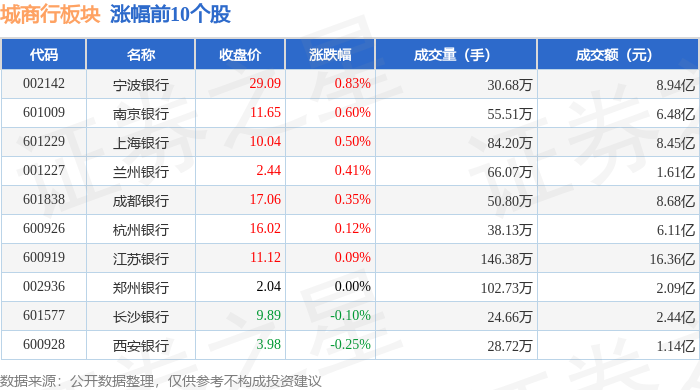
Market Performance - The city commercial bank sector increased by 0.12% on November 5, with Ningbo Bank leading the gains [1] - The Shanghai Composite Index closed at 3969.25, up 0.23%, while the Shenzhen Component Index closed at 13223.56, up 0.37% [1] Individual Stock Performance - Ningbo Bank (002142) closed at 29.09, up 0.83% with a trading volume of 306,800 shares and a transaction value of 894 million [1] - Nanjing Bank (6000000) closed at 11.65, up 0.60%, with a trading volume of 555,100 shares and a transaction value of 648 million [1] - Shanghai Bank (601229) closed at 10.04, up 0.50%, with a trading volume of 842,000 shares [1] - Other notable performances include Chengdu Bank (601838) at 17.06, up 0.35%, and Hangzhou Bank (600926) at 16.02, up 0.12% [1] Capital Flow Analysis - The city commercial bank sector saw a net inflow of 52.36 million from institutional investors, while retail investors contributed a net inflow of 89.18 million [2] - The sector experienced a net outflow of 142 million from speculative funds [2] Detailed Capital Flow for Selected Banks - Jiangsu Bank (600919) had a net inflow of 63.74 million from institutional investors, while it faced a net outflow of 46.26 million from speculative funds [3] - Chengdu Bank (601838) reported a net inflow of 63.42 million from institutional investors, with a net outflow of 57.05 million from speculative funds [3] - Ningbo Bank (002142) had a net inflow of 5.72 million from institutional investors but a significant net outflow of 43.57 million from retail investors [3]