Stellantis N.V.

Search documents
Auto industry expands open-source pact to boost development, cut costs
Yahoo Finance· 2026-01-07 12:10
Core Viewpoint - More than 30 companies in the automotive supply chain are collaborating on open-source software to develop next-generation vehicles and reduce costs, as announced by Germany's VDA at the CES trade show in Las Vegas [1][2]. Group 1: Collaboration and Participants - The initiative has expanded from 11 to 32 participating firms, including Stellantis, Traton, Schaeffler, Infineon, and Qualcomm, alongside major German carmakers like Volkswagen, BMW, and Mercedes-Benz [2]. - This collaboration signifies a global shift towards open innovation within the automotive industry, as stated by Mike Milinkovich, executive director of the Eclipse Foundation [3]. Group 2: Goals and Benefits - The initiative aims to reduce development and maintenance efforts by up to 40% and accelerate time to market by up to 30% [2].


GGII:2025年国内电池产业链投资扩产总结
高工锂电· 2026-01-07 10:11
Core Viewpoint - The article suggests that 2026 is expected to mark the beginning of a new healthy and orderly development cycle for China's lithium battery new energy industry [3][19]. Investment Overview - In 2025, over 282 public investment projects related to the lithium battery industry chain in China are anticipated, with a total investment exceeding 820 billion yuan, representing a year-on-year growth of over 74% [4]. - The investment projects are primarily concentrated in East and Central China, with regions like Fujian, Shandong, and Jiangsu leading in lithium battery and material manufacturing due to their rich chemical resources and strategic enterprise layouts [6]. Regional Distribution - The Southwest region, particularly Sichuan, is expected to dominate the investment in lithium battery positive materials, accounting for 59% of the projects, with a significant production capacity of over 350 GWh [11]. - Negative materials investment is more evenly distributed, with North and Northwest China favored due to lower electricity costs [11]. - The electrolyte projects are mainly concentrated in East China, benefiting from a robust industrial chain and proximity to downstream markets [11]. Overseas Expansion - Chinese lithium battery companies are increasingly focusing on overseas markets, with significant investments in Thailand, Spain, and Portugal, driven by favorable geopolitical conditions and local demand [7]. - Notable projects include the establishment of a zero-carbon AI super factory in Portugal and a joint venture factory in Spain by CATL and Stellantis [7]. Solid-State and Sodium Battery Development - In 2025, solid-state battery projects are expected to be concentrated in East China, with planned capacities of 74 GWh and total investments of 28 billion yuan [15]. - The sodium battery sector is projected to see significant growth, with planned capacities of 81 GWh and total investments of 32.2 billion yuan, primarily in the Southwest region [15]. Market Outlook - The lithium new energy industry is emerging from a challenging period characterized by supply-demand imbalances and declining prices, with positive signals indicating a recovery starting in 2025 [18]. - The demand for solid-state batteries and sodium batteries is expected to accelerate, with the latter projected to achieve a 100% increase in shipments by 2026 [19].








Ugly Charts of US Auto Sales, 2025: Stellantis, Nissan Flirt with Catastrophe. GM, Ford, Honda Sales Rise but far below Peaks. Toyota & Hyundai-Kia Set Records
Wolfstreet· 2026-01-07 04:34
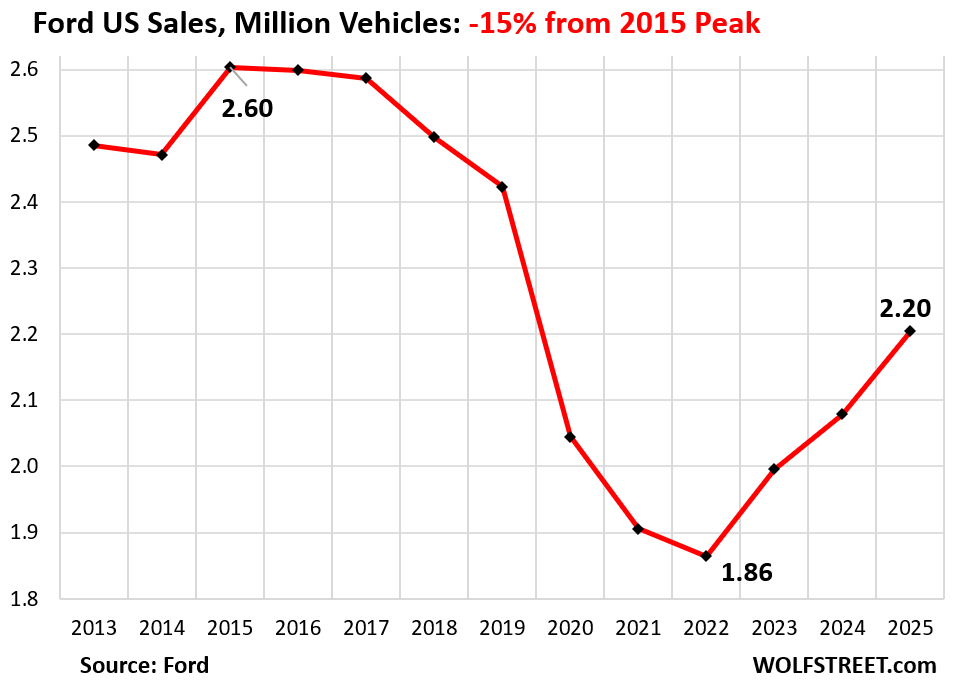
Core Insights - Total new-vehicle sales in 2025 rose by 2.4% to 16.2 million vehicles, marking the highest level since 2019 and just above 1986 levels, indicating four decades of stagnation and partial recoveries [1] - The automotive market has seen significant fluctuations, with some manufacturers experiencing steep declines while others have managed to increase sales [1][4] Sales Performance by Automakers - **General Motors (GM)**: Q4 sales fell by 6.9% year-over-year to 703,001 units, but full-year sales rose by 5.5% to 2.85 million vehicles, still down 7.5% from the 2015 peak [14] - **Toyota**: Combined sales for Toyota and Lexus jumped by 8.0% in 2025 to 2.52 million vehicles, slightly surpassing the 2015 peak [16] - **Ford**: Sales rose by 6.0% to 2.20 million vehicles for the year, but this was still down 15% from the 2015 peak [19] - **Hyundai-Kia**: Combined sales increased by 7.4% to a record 1.63 million vehicles, up 26% from the 2015 high [21] - **Honda**: Full-year sales inched up by 0.5% to 1.43 million vehicles, but still down 13% from the 2017 peak [25] - **Stellantis**: Sales dropped by 3% to 1.26 million vehicles, a 44% decline from the 2015 peak [28] - **Nissan**: Sales were roughly flat at 926,153 vehicles, down 42% from the 2017 peak [31] Pricing Trends - The average retail transaction price peaked at $47,329 at the end of 2022 and was $47,104 at the end of 2025, reflecting a 1.5% increase year-over-year but a 0.5% decrease from three years ago [8] - Automakers have raised prices across the board, with a 36% increase in average retail transaction prices from 2020 to 2022, leading to consumer pushback [6][7] Market Dynamics - The automotive industry has been characterized by a shift towards upscale models, with manufacturers focusing on larger and more expensive vehicles to boost revenues amid stagnating unit sales [7] - The market has seen a significant impact from federal incentives and tariffs, with Q3 sales surging due to frontrunning these changes, followed by a Q4 decline of 4.2% year-over-year [4]

海外Robotaxi产业链深度梳理
2026-01-07 03:05
Summary of Key Points from the Conference Call Industry Overview - The report focuses on the **Robotaxi industry**, highlighting the involvement of major players like **NVIDIA**, **Xpeng Motors**, and **Horizon Robotics** in the transition from L2 to L4 autonomous driving technology [1][2][4]. Market Segmentation - The **overseas Robotaxi market** is divided into four main regions: **North America**, **Europe**, **Middle East**, and **Southeast Asia**. Each region has distinct characteristics affecting the Robotaxi business model and growth potential [1][5]. North America - Dominated by **Uber** and **Lyft**, creating a duopoly with low tolerance for non-local companies. **Waymo** is the largest Robotaxi operator with commercial operations in place [5][10]. - The market has evolved through three phases: spontaneous development (2010-2013), price wars (2014-2017), and regulatory establishment (2018-present) [9]. Europe - Characterized by fragmented regulations and varying local market conditions. Local companies have advantages due to regulatory differences [5][13]. - The profitability of Robotaxis is higher in developed areas like the UK and UAE, with per kilometer prices reaching approximately **$66** [8]. Middle East - High customer spending, strong policy support, and significant infrastructure investment make it an ideal testing ground for Robotaxis. Chinese companies like **WeRide** and **Pony.ai** have made notable progress [5][17]. Southeast Asia - Infrastructure challenges and a low tolerance for four-wheeled vehicles hinder growth. Singapore is expected to lead in commercial deployment, but overall growth remains limited [5][18]. Market Projections - By **2030**, the projected Robotaxi penetration rates are as follows: - **China**: 5% - **North America**: 20% - **Europe**: 5% - **Middle East**: Rapid growth expected - **Southeast Asia**: Low penetration [7]. Key Players and Business Models - **NVIDIA** is positioned as a leading player in the autonomous driving ecosystem, enhancing the transition to L4 technology [2]. - **Xpeng Motors** is highlighted as a key player in the Hong Kong market, while **Horizon Robotics** is noted for its role in the hardware segment [4]. - Traditional automakers have struggled in the ride-hailing market due to conflicting interests and slow adaptation to market changes [14]. Financial Insights - In high-price areas of Europe, the gross profit per vehicle is estimated at **$55,000** in the UAE, **$16,000** in the UK, and **$17,000** in the US [3][8]. Regulatory Environment - North America has stringent regulations limiting non-local companies, while Europe has a more fragmented regulatory landscape that can benefit local players [6][13]. Future Outlook - The European shared mobility market is expected to reach **$55 billion** by **2025**, with the Robotaxi market projected to grow to **$6 billion** by **2030** [16]. Conclusion - The Robotaxi industry is poised for significant growth, particularly in North America and the Middle East, driven by technological advancements and evolving regulatory landscapes. However, challenges remain in Europe and Southeast Asia due to regulatory fragmentation and infrastructure limitations [1][5][17].



Trump’s Economic Encore: A Daily Dose of Market Mayhem
Stock Market News· 2026-01-06 18:00
Market Reactions to Geopolitical Events - The U.S. military's capture of Venezuelan President Nicolás Maduro caused significant market reactions, particularly in the energy sector, despite Venezuela's limited economic impact on global GDP [2][3] - On January 5, 2026, major U.S. indices surged, with the Dow Jones Industrial Average rising 1.23% to an all-time high of 48,977.18, the S&P 500 climbing 0.64% to 6,902.05, and the Nasdaq Composite gaining 0.69% to 23,395.82 [3] Energy Sector Performance - U.S. energy stocks benefited from the geopolitical developments, with Chevron's shares increasing by 4% and Exxon Mobil rising by 1.6% on the same day [4] - The S&P 500 energy index reached its highest level since March 2025, reflecting optimism about potential Venezuelan oil production [4] Oil Price Movements - Brent crude futures rose 1.2% to $61.48 per barrel, while West Texas Intermediate (WTI) gained 1.4% to $58.11 on January 5, 2026 [5] - However, Chevron's shares fell by 4% the following day, and WTI futures slipped 1% to $57.75, indicating market volatility [5] Canadian Oil Market Reaction - Canadian oil stocks experienced declines, with major producers like Canadian Natural Resources Ltd. and Cenovus Energy Inc. falling approximately 8% and 8.7% respectively, as analysts deemed the market's reaction an overreaction [6] Financial Sector Impact - Financial stocks also saw gains, with Goldman Sachs up 4.5% and JP Morgan gaining 2.9% on January 5, 2026, indicating a broader market response to the Venezuelan news [7] Tariff Policy Effects - The U.S.-U.K. trade deal, which reduced tariffs on cars from the U.K., led to a 14% increase in Aston Martin shares, while Detroit's automotive giants expressed disappointment over potential competitive disadvantages [9][10] - The Supreme Court's deliberation on Trump's tariffs, which generated $130 billion in revenue, could significantly impact market dynamics, with analysts predicting a 70-80% chance of unfavorable outcomes for Trump [11] Consumer Goods Sector Response - Delays in tariff hikes on furniture led to stock surges for retailers like Wayfair and RH, highlighting the immediate benefits of tariff postponements for certain sectors [12]



鸿特科技就配股事项回复深交所问询 控制权稳定性等问题逐一回应
Xin Lang Cai Jing· 2026-01-06 14:04
Core Viewpoint - Guangdong Hongte Technology Co., Ltd. has responded to the Shenzhen Stock Exchange's inquiry regarding its share placement to existing shareholders, addressing eight key concerns including control stability, project feasibility, customer and supplier reliance, and financial data authenticity [1][2]. Group 1: Control Stability - The company confirmed the stability of its control, with Guangdong Baibanghe Industrial Investment Co., Ltd. becoming the new controlling shareholder after acquiring 25.10% of the shares through judicial auction [2]. - Lu Yuxuan is identified as the actual controller, holding 70% of Guangdong Baibanghe's shares, while his father, Lu Chulun, does not hold shares in either the company or Guangdong Baibanghe, thus not affecting control recognition [2][3]. - Guangdong Baibanghe has pledged 50% of its shares for acquisition loan guarantees, but this is not expected to impact control stability due to strict conditions and the family's financial strength [3]. Group 2: Fundraising Projects - The company plans to raise up to 65 million yuan for several projects, including a Thai automotive parts production base, a technical transformation project in Zhaoqing, a headquarters R&D center, and working capital [4]. - The Thai production base is the core project, with a total investment of 40.83 million yuan, expected to generate annual sales of 55.79 million yuan and a gross profit margin of 17.52% upon reaching full capacity [4]. - The Zhaoqing project aims to replace outdated equipment with advanced technology, while the R&D center will address space and equipment issues, enhancing the company's capabilities in new energy vehicle components [5]. Group 3: Customer and Supplier Concentration - The company has a high customer concentration, with the top five customers accounting for over 55% of sales, primarily consisting of major international firms like Ford and Stellantis [6][7]. - Despite the high concentration, the company maintains stable long-term relationships with these clients, reducing the risk of significant customer loss [7]. - Supplier concentration is also notable, with a significant portion of purchases from related companies, but the company emphasizes fair pricing and the ability to switch suppliers easily, mitigating dependency risks [7]. Group 4: Financial Data Authenticity - The company reported that over 50% of its revenue comes from exports, with good alignment between foreign sales revenue and customs data [8]. - The gross margin for new energy die-casting parts has been declining, attributed to underutilization of new equipment and increased domestic sales, with a warning of potential further declines if competition intensifies [8]. - The company has established a comprehensive foreign exchange risk management mechanism, with exchange gains reported for the years 2022 to 2024 [8]. Group 5: Overall Impact - The completion of the share placement is expected to optimize the company's capital structure, enhance overseas production capacity, and strengthen its core competitiveness [9]. - The sponsoring institution, Huajin Securities, believes the company's responses to the inquiry are accurate and complete, indicating no significant uncertainties regarding the share placement [9].

Maduro pleads not guilty, Nvidia's robotaxi play, JPMorgan's 'secret sauce' and more in Morning Squawk
CNBC· 2026-01-06 13:10
Group 1 - Venezuelan President Nicolas Maduro and his wife are facing U.S. federal charges including narco-terrorism and money laundering [1] - Federal Reserve Bank of Minneapolis President Neel Kashkari indicated that interest rates may not need to decrease significantly, suggesting the current monetary policy has not been tight enough [2][3] - On the labor front, Kashkari noted that artificial intelligence is slowing hiring among large companies while enhancing productivity [4] Group 2 - General Motors reported a 5.5% annual increase in U.S. sales for 2025, outperforming the broader sector expected to rise by only 2% [5] - Stellantis, the parent company of Chrysler, experienced a 3.3% decline in sales, although its Jeep brand saw sales growth for the first time since 2018 [6] - Electric vehicle maker Lucid reported a 55% increase in deliveries for 2025, driven by a 70% annual increase in the fourth quarter [6] Group 3 - Nvidia is exploring the robotaxi market, collaborating with operators to utilize its AI chips and software in autonomous vehicle fleets as early as next year [9][10] - JPMorgan launched a new initiative called "Special Advisory Services" to provide clients with insights on various topics, initially free of charge [10][11]
China Automotive Systems Announces 2026-2030 Strategic Plan
Prnewswire· 2026-01-06 11:00
Core Viewpoint - China Automotive Systems, Inc. (CAAS) has finalized and implemented the "Hubei Henglong Enterprise Group 2026-2030 Strategic Plan," marking the beginning of a new phase of high-quality development aimed at achieving significant sales growth and global presence by 2030 [1][2][3]. Strategic Goals - The strategic plan outlines the Group's vision for 2030, focusing on "technology leadership" and "deepening global presence," with the goal of becoming a benchmark enterprise in global automotive intelligent steering systems [3]. - The overall strategic objectives for 2026-2030 are defined as "23144," aiming to exceed 20 billion yuan in total sales (including VAT) by 2030, demonstrating the Group's ambition in global markets [3]. Strategic Pillars - **Deepening Global Operations**: The plan emphasizes the construction of a "China + N" global manufacturing and supply chain network, enhancing local presence in key markets such as North America, South America, Europe, and Southeast Asia [4]. - **Strengthening Technological Leadership**: Increased R&D investment will focus on cutting-edge technologies like steer-by-wire and rear-wheel steering, while also expanding into other areas such as braking to achieve breakthroughs in intelligent chassis [5]. - **Building Exceptional Systems**: The plan aims to establish a "zero-defect" quality culture and implement lean, automated manufacturing systems to support the Group's strategic sales goals by 2030 [6]. Company Overview - China Automotive Systems, Inc. is a leading supplier of power steering components and systems in China, operating through sixteen Sino-foreign joint ventures and wholly owned subsidiaries, with an annual production capacity exceeding 8 million sets of steering gears, columns, and hoses [8].


201家世界500强扎根星城|2025长沙年终经济观察
Chang Sha Wan Bao· 2026-01-06 00:12
Group 1: Economic Development and Investment - Changsha aims to become a high ground for reform and opening up in inland areas, with significant projects and a robust foreign trade network [1] - The city has signed major investment projects, including a $50 million chip industry cluster and a 60GWh lithium battery project, enhancing its industrial capabilities [2] - In 2025, actual foreign investment is expected to reach $400 million, a 14.4% increase year-on-year, with 230 new major projects introduced [2] Group 2: Foreign Trade and Export Growth - Changsha's electric vehicle exports have surged by 50% in 2025, with over 79,000 units exported, marking a significant milestone [4][5] - The city has seen a remarkable 86.7% growth in exports of "new three samples" products, including electric vehicles, lithium batteries, and photovoltaic products [5] - Changsha's trade with Africa is thriving, with a projected 32.5% increase in imports and exports to Africa, reaching 31.2 billion yuan [7] Group 3: Logistics and Transportation - The China-Europe Railway Express from Changsha has become a key driver for expanding the city's openness, with over 1,000 trains operating in 2025 [8] - The international airport in Changsha has expanded its reach, operating 19 international routes and increasing international passenger traffic by 49.6% [9] - The city has improved its waterway logistics, achieving a 35.6% increase in vehicle transportation through the new port [9] Group 4: Business Environment and Services - Changsha is enhancing its business environment through reforms aimed at improving service efficiency and reducing costs for enterprises [10] - Customs facilitation measures have significantly reduced logistics costs, saving companies like BYD approximately 6 million yuan [11] - The establishment of a digital map for industrial investment aims to provide comprehensive support for businesses, facilitating connections between foreign trade companies and banks [11]

GM posts 5.5% U.S. sales gain in 2025, Stellantis' Jeep marks first increase in seven years
CNBC· 2026-01-05 17:31
Core Insights - General Motors reported a 5.5% increase in annual U.S. sales for 2025, despite a 6.9% decrease in the fourth quarter [1] - The sales growth was driven by incremental sales of electric vehicles (EVs), large SUVs, and entry-level vehicles like the Buick Envista [1] - GM's 2025 sales are expected to outperform the overall U.S. automotive industry, which is projected to rise about 2% compared to 2024 [1] Competitor Performance - Toyota Motor's sales increased by 8% in 2025 [2] - Hyundai achieved a record sales increase of 8.4% for the third consecutive year [2] - Honda Motor's sales rose by 0.5% [2] - Stellantis, the parent company of Chrysler, experienced a 3.3% decline as it implements a U.S. turnaround plan, although its Jeep brand saw its first annual sales gain since 2018, with an increase of less than 1% [2] Market Strategy - Stellantis' head of U.S. retail sales, Jeff Kommor, indicated that consecutive quarterly sales increases and market share growth reflect the company's effective steps to reset its U.S. business [3] - The company acknowledges that while progress has been made, further work is necessary, particularly with a diversified powertrain lineup [3]