青岛银行

Search documents
蛇年收官!银行股14万亿市值背后几家欢喜几家愁
Di Yi Cai Jing· 2026-02-13 11:04
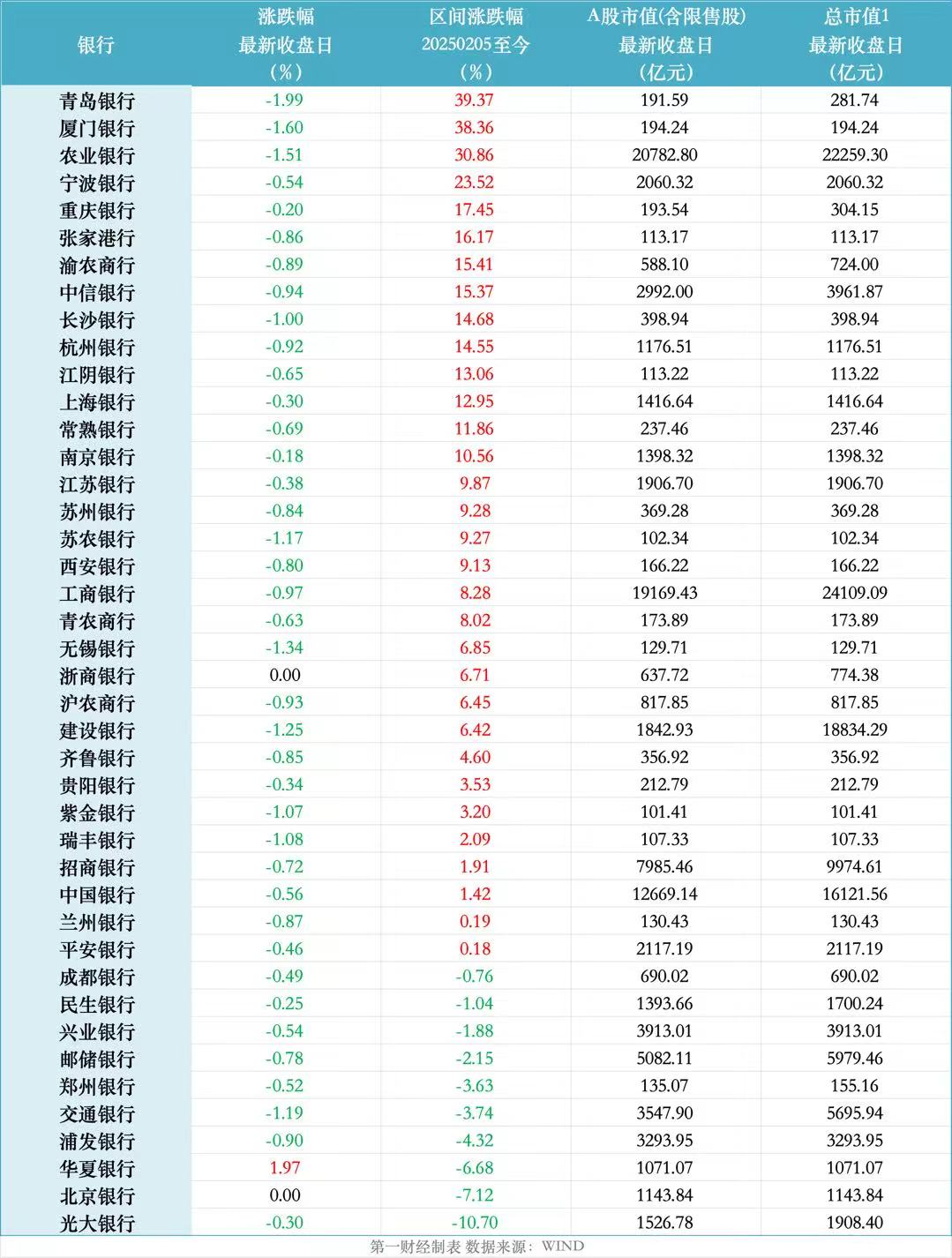
Core Insights - The A-share banking sector has seen a significant market capitalization increase, surpassing 10 trillion yuan for the first time, indicating a structural bull market despite a mixed performance among individual stocks [1][6][7] - The total market capitalization of the banking sector reached approximately 13.72 trillion yuan, growing by 1.45 trillion yuan from the previous year, while the overall A-share market capitalization increased by 0.93 trillion yuan to about 10.27 trillion yuan [1][6] - The year 2025 has shown a clear divergence in stock performance, with 32 out of 42 banking stocks gaining, while some, like Everbright Bank and Beijing Bank, experienced declines exceeding 10% [1][3] Market Performance - The banking sector's performance was characterized by a "structural bull market," with significant gains in high-dividend, low-valuation stocks acting as a safe haven [1][2] - The top three performing stocks were Qingdao Bank, Xiamen Bank, and Agricultural Bank, each with gains exceeding 30%, while the worst performers included Everbright Bank, Beijing Bank, and Huaxia Bank, with declines over 10% [1][3] - The overall banking index saw a slight decline of 0.3% for the year, contrasting with a 25.58% increase in the Shanghai Composite Index [2][3] Individual Stock Analysis - Notable individual stock performances included Qingdao Bank with a 39.37% increase, Xiamen Bank at 38.36%, and Agricultural Bank at 30.86% since February 5, 2025 [3][5] - The performance of state-owned banks showed mixed results, with four banks ending the year positively, while others like Postal Savings Bank and Bank of Communications saw declines [4][6] - The market capitalization of Agricultural Bank surpassed that of Industrial and Commercial Bank at one point, highlighting a competitive shift in the sector [7] Market Dynamics - The banking sector's market share within the A-share market decreased from 11.19% at the end of the previous year to around 9% [6][7] - The competition for the title of "market capitalization king" saw Agricultural Bank briefly take the lead before Industrial and Commercial Bank regained its position [7] - Future performance will be influenced by factors such as market rotation, earnings reports, and monetary policy adjustments, with expectations of continued divergence among individual bank stocks [7]



滨化股份:发行科技创新债券获准注册
Ge Long Hui· 2026-02-13 10:53
一、公司本次注册基础品种为中期票据,注册金额为10亿元,注册额度自通知书落款之日起2年内有 效,由青岛银行股份有限公司主承销。二、公司在注册有效期内可分期发行科技创新债券,接受注册后 如需备案发行,应事前先向交易商协会备案。公司应按照有权机构决议及相关管理要求,进行发行管 理。发行完成后,应通过交易商协会认可的途径披露发行结果。 格隆汇2月13日丨滨化股份(601678.SH)公布,近日,公司收到交易商协会出具的《接受注册通知书》 (中市协注〔2026〕MTN123号),同意接受公司科技创新债券注册。现就有关事项公告如下: ...

滨化股份(601678.SH):发行科技创新债券获准注册
Ge Long Hui A P P· 2026-02-13 10:51
一、公司本次注册基础品种为中期票据,注册金额为10亿元,注册额度自通知书落款之日起2年内有 效,由青岛银行股份有限公司主承销。二、公司在注册有效期内可分期发行科技创新债券,接受注册后 如需备案发行,应事前先向交易商协会备案。公司应按照有权机构决议及相关管理要求,进行发行管 理。发行完成后,应通过交易商协会认可的途径披露发行结果。 格隆汇2月13日丨滨化股份(601678.SH)公布,近日,公司收到交易商协会出具的《接受注册通知书》 (中市协注〔2026〕MTN123号),同意接受公司科技创新债券注册。现就有关事项公告如下: ...
联泓新科(003022.SZ):科技创新债券获准注册
智通财经网· 2026-02-13 08:29
智通财经APP讯,联泓新科(003022.SZ)发布公告,近日,公司收到交易商协会出具的《接受注册通知 书》(中市协注〔2026〕 MTN129 号),交易商协会决定接受公司科技创新债券注册。主要内容如下:本 次注册基础品种为中期票据,注册金额为10亿元,注册额度自《接受注册通知书》落款之日起2年内有 效,由青岛银行股份有限公司主承销。 ...

联泓新科:科技创新债券获准注册
Zhi Tong Cai Jing· 2026-02-13 08:28
Core Viewpoint - The company, Lianhong Xinke (003022.SZ), has received a registration notice from the trading association for its technology innovation bonds, indicating a positive step towards raising funds through bond issuance [1] Group 1: Company Announcement - The company announced that it has received the "Acceptance of Registration Notice" from the trading association, which is a significant regulatory approval for its bond issuance [1] - The registered amount for the medium-term notes is set at 1 billion yuan, which reflects the company's strategy to enhance its capital structure [1] - The registration validity period is two years from the date of the notice, allowing the company flexibility in timing its bond issuance [1] Group 2: Underwriting Details - Qingdao Bank (002948) has been appointed as the lead underwriter for the bond issuance, indicating a partnership that may enhance the credibility and market reach of the bond offering [1]
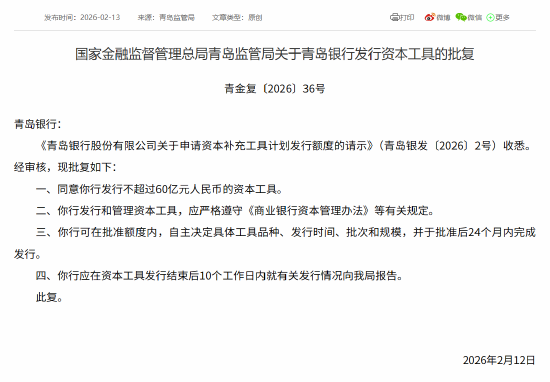
青岛银行获批发行不超过60亿元人民币的资本工具
Xin Lang Cai Jing· 2026-02-13 05:16
2月13日金融一线消息,国家金融监督管理总局青岛监管局发布关于青岛银行发行资本工具的批复,同 意青岛银行发行不超过60亿元人民币的资本工具。 责任编辑:王馨茹 2月13日金融一线消息,国家金融监督管理总局青岛监管局发布关于青岛银行发行资本工具的批复,同 意青岛银行发行不超过60亿元人民币的资本工具。 责任编辑:王馨茹 ...
8000亿之后的齐鲁银行:头部区域行打响“生存战”
阿尔法工场研究院· 2026-02-13 02:33
Core Viewpoint - The competition among regional banks has evolved into a battle of refined asset-liability management capabilities due to the backdrop of low interest rates and narrowing interest margins [4][20]. Group 1: Regional Bank Performance - Qilu Bank's 2025 operational data shows total assets reaching 804.38 billion, a year-on-year increase of 16.65%, with operating income of 13.135 billion, up 5.12%, and net profit of 5.713 billion, up 14.58% [5]. - The net interest margin (NIM) of Qilu Bank increased from 1.51% to 1.53%, reflecting effective asset-liability management [5][6]. - The bank's total loans amounted to 382.83 billion and total deposits were 489.53 billion, indicating a steady expansion pace [5]. Group 2: Interest Margin Dynamics - In the current interest rate environment, NIM is a core indicator of bank operational stability [6]. - The downward pressure on asset yields is exacerbated by loan repricing and interbank competition, necessitating a focus on reducing liability costs to mitigate NIM decline [7][8]. - Qilu Bank's ability to slightly increase NIM is attributed to effective control of liability costs and repricing of funding structures [8][9]. Group 3: Strategic Management Insights - Effective management of liability costs is crucial for banks to avoid homogeneous competition characterized by high-interest deposit acquisition [10][11]. - Qilu Bank leverages its geographical advantages to link with government projects and supply chain financing, resulting in a stable low-cost funding pool [12]. - The differentiation in NIM performance among banks reflects variations in customer quality, funding stability, and governance execution [13][14]. Group 4: Risk and Asset Quality - Qilu Bank's non-performing loan (NPL) ratio decreased to 1.05%, with a provision coverage ratio of 355.91%, indicating improved asset quality [17]. - The relationship between NIM, risk costs, and provisions creates a positive feedback loop for growth [17]. - The bank's strategic focus on asset-liability management is essential for maintaining profitability without sacrificing asset quality [18][19]. Group 5: Competitive Landscape - Compared to leading banks in Jiangsu and Zhejiang, Shandong's top banks still show significant gaps in asset quality metrics [19]. - The competition among regional banks has shifted from scale expansion to refined asset-liability management capabilities [20][21]. - The ability to manage interest margins and risk effectively will determine the future competitive positioning of regional banks [21].
丈量地方性银行(3):川渝132家区域性银行全梳理-20260212
GF SECURITIES· 2026-02-12 14:21
Investment Rating - The industry investment rating is "Buy" [2] Core Insights - The report analyzes 132 regional banks in the Sichuan-Chongqing area, highlighting the growth and structural changes in the banking sector [6][27] - The asset growth rates of major city commercial banks in the region are higher than those of listed city commercial banks, indicating a robust expansion [38] - Profitability metrics show that city commercial banks in the region have lower ROE compared to listed banks, while rural commercial banks outperform them [6][27] - Asset quality is slightly weaker in regional banks compared to listed banks, with higher non-performing loan ratios [6][27] Summary by Sections Economic Structure Analysis - Sichuan province is positioned as a key driver for western development, with a focus on enhancing the Chengdu-Chongqing economic circle [13][14] - In 2025, Chengdu's GDP is projected to account for 38.7% of the province's total, with significant growth in various sectors [15] Banking Sector Overview - The Sichuan-Chongqing region has 132 commercial banks, including 14 city commercial banks, 65 rural banks, and 51 rural commercial banks [27] - The asset growth rates for major city commercial banks in the region are 15.6% and 18.2%, surpassing the 14.2% growth of listed city commercial banks [38] Asset and Liability Structure - The proportion of loans to total assets has been increasing since 2016, with city commercial banks in Sichuan projected to have a loan ratio of 56.1% by 2024 [38][40] - The financial investment ratio for city commercial banks is on a downward trend, with a slight recovery noted in the first half of 2025 [40][46] Profitability and Asset Quality - The average ROE for city commercial banks in the region is 10.97%, lower than the 11.99% average for listed city commercial banks [6][27] - Non-performing loan ratios for city commercial banks in the region are higher than those of listed banks, indicating potential asset quality concerns [6][27] Capital Adequacy - Capital adequacy ratios for regional banks are comparable to those of listed banks, providing a safety margin for operations [6][27]




11家上市银行2025年业绩报告:变革中的机遇与2026年展望
Sou Hu Cai Jing· 2026-02-12 10:30
Core Viewpoint - The banking industry is undergoing an unprecedented transformation cycle in 2025, driven by macroeconomic stability, interest rate declines, regulatory upgrades, digital iteration, and a consensus on "anti-involution," pushing listed banks to accelerate their shift from "scale expansion" to "value prioritization" [2][10]. Performance Overview - As of February 10, 2026, 11 out of 42 listed banks in A-shares have reported their 2025 performance, all achieving year-on-year growth in net profit attributable to shareholders, reflecting "stable volume, quality improvement, and structural enhancement" [2][13]. - Among these banks, 10 achieved both revenue and net profit growth, with only CITIC Bank experiencing a slight revenue decline of 0.55%, breaking the market's pessimistic expectations regarding industry profitability [14]. Institutional Performance - City commercial banks showed remarkable performance, with Qingdao Bank's net profit increasing by 21.66%, leading the group; Qilu Bank and Hangzhou Bank also exceeded 10% growth, at 14.58% and 12.05% respectively [3][14]. - In the joint-stock bank category, Shanghai Pudong Development Bank achieved a net profit growth rate of 10.52%, the only institution in this category to reach double-digit growth; other banks like China Merchants Bank, CITIC Bank, and Industrial Bank had relatively modest growth rates of 1.21%, 2.98%, and 0.34% respectively [3][14]. Asset Quality and Risk Management - The 11 banks have increased their risk management efforts, with core asset quality indicators showing improvement; 6 banks reported a decrease in non-performing loan (NPL) ratios compared to the previous year [3][15]. - Qingdao Bank saw the most significant decline in NPL ratio, down 17 basis points to 0.97%; Qilu Bank and Shanghai Pudong Development Bank also saw declines of 14 and 10 basis points, respectively [4][15]. - Despite 8 banks experiencing a decline in provision coverage ratios, the overall level remains high, indicating solid risk resistance capabilities; Qingdao Bank and Qilu Bank saw increases in their coverage ratios [4][15]. Industry Transformation - The banking industry is accelerating its transformation, moving beyond scale expansion to seek balance among efficiency, safety, and value, driven by various policies and practices [6][17]. - Regulatory bodies have encouraged financial institutions to support key sectors of the real economy, with structural monetary policy tools effectively implemented [6][17]. - The introduction of consumer loan interest subsidies aims to stimulate domestic demand, with banks lowering consumer loan rates significantly [7][18]. Future Trends - The banking industry is expected to maintain a stable asset quality in 2026, with NPL ratios remaining steady and risk resistance capabilities strong [10][21]. - The differentiation among institutions will become more pronounced, with large state-owned banks and quality joint-stock banks maintaining low NPL ratios, while some smaller banks may face pressure [11][21]. - Investment logic will focus on "high dividend, defensive" and "high quality, growth" dual lines, with high-dividend banks likely to attract continued investment [12][22].
A股三大股指收涨:电力设备领涨,算力硬件产业链反弹
Xin Lang Cai Jing· 2026-02-12 07:37
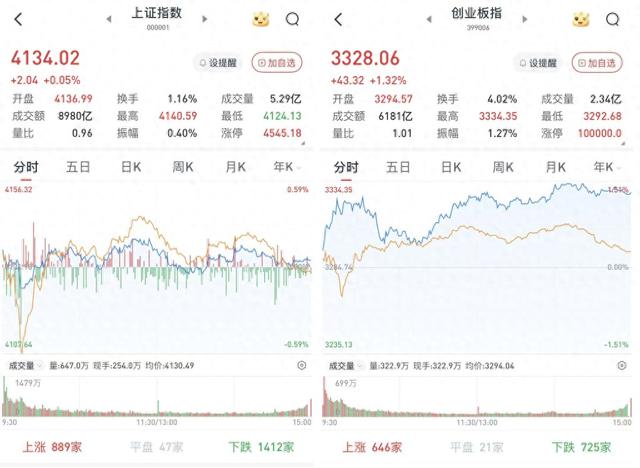
Market Performance - The three major A-share indices opened higher on February 12, with the ChiNext Index rising over 1% [2] - By the close, the Shanghai Composite Index increased by 0.05% to 4134.02 points, the ChiNext 50 Index rose by 1.78% to 1480.99 points, the Shenzhen Component Index gained 0.86% to 14283 points, and the ChiNext Index climbed 1.32% to 3328.06 points [2] Trading Volume - The total trading volume in the two markets and the Beijing Stock Exchange reached 21,418 billion yuan, an increase of 1,576 billion yuan compared to the previous trading day [3] - The Shanghai market's trading volume was 8,980 billion yuan, up 754 billion yuan from the previous day, while the Shenzhen market's volume was 12,438 billion yuan [3] Sector Performance - The power equipment sector led the market, with multiple stocks such as Tongguan Copper Foil and Hancable hitting the daily limit or rising over 10% [5] - The non-ferrous metals sector also saw gains, with stocks like Longmag Technology and Yunnan Tin Company reaching the daily limit or increasing over 10% [5] - Conversely, media stocks experienced significant declines, with companies like Rongxin Culture and Light Media hitting the daily limit or dropping over 10% [6] - Banking stocks also faced downward pressure, with several banks falling over 2% [6] Market Sentiment - Dongguan Securities indicated that the market may enter a phase of reduced trading volume as investor sentiment becomes more cautious ahead of the Spring Festival [7] - The market is expected to experience structural opportunities despite a potential short-term adjustment, with a shift towards a more balanced market style [7] - Huolong Securities noted that the market's trading volume has been shrinking, leading to a situation where funds are competing for existing stocks, making it difficult for popular sectors to maintain momentum [8]