软通动力

Search documents
软通动力(301236) - 关于股东部分股份解除质押的公告
2025-10-09 11:20
证券代码:301236 证券简称:软通动力 公告编号:2025-083 软通动力信息技术(集团)股份有限公司 关于股东部分股份解除质押的公告 刘天文先生保证向公司提供的信息内容真实、准确、完整,没有虚假记载、 误导性陈述或重大遗漏。 本公司及董事会全体成员保证信息披露的内容真实、准确、完整,没有虚假 记载、误导性陈述或重大遗漏。 软通动力信息技术(集团)股份有限公司(以下简称"公司")于近日接到股 东刘天文先生函告,获悉其持有的公司部分股份解除了质押,具体事项如下: 一、股东股份解除质押基本情况 (一)本次股份解除质押基本情况 注:表中所述限售股份不包括高管锁定股。 二、其他相关情况说明 根据刘天文先生函告:刘天文先生及其一致行动人质押股份数量占其所持公 司股份数量比例未达到或超过50%,上述质押股份不存在负担重大资产重组等业 绩补偿义务,其资信状况良好,具备良好的资金偿还能力,质押风险可控,不存 在平仓风险,不会对公司生产经营、公司治理等产生影响,也不会导致公司实际 控制权发生变更。刘天文先生将密切关注自身质押情况,保持与质权人的及时沟 通,做好股份质押的管理工作,并按规定及时告知公司股份质押后续进展,履行 ...
软件ETF(159852)涨近3%!成交额破4亿,软件国产替代将加速
Jin Rong Jie· 2025-10-09 07:25
Group 1 - The core viewpoint of the articles highlights the positive performance of the software industry in China, with significant growth in revenue and profits, as well as a favorable government policy promoting domestic products in procurement [1][2]. Group 2 - As of 13:21, the Shenzhen Component Index rose by 1.54%, the ChiNext Index increased by 1.34%, and the CSI Software Index saw a rise of 2.87%. Notable individual stock performances included Keda Xunfei up over 6% and several others like 360 and China Software rising over 3% [1]. - The software business revenue reached 96,409 billion yuan in the first eight months of 2025, marking a year-on-year increase of 12.6%. The total profit of the software industry was 13,186 billion yuan, reflecting a 13.0% year-on-year growth [2]. - Software business exports amounted to 404.4 million USD, showing a year-on-year growth of 6.4% [2]. - The Software ETF (159852) tracking the CSI Software Service Index had a management fee rate of 0.50% and a custody fee rate of 0.10% annually. The top ten weighted stocks in the ETF account for over 62.41% of the total weight [2].
华为鸿蒙+人形机器人:最正宗的8家公司(名单)
Sou Hu Cai Jing· 2025-10-09 01:39
Core Insights - The humanoid robot market in China is projected to reach 5.3 billion yuan by 2025 and exceed 38.7 billion yuan by 2028, with a compound annual growth rate (CAGR) of over 60% [1] - Huawei's HarmonyOS has become the third-largest mobile operating system globally, with over 1.19 billion devices and 7.2 million developers, facilitating the integration of robotics technology [1] Company Summaries - **Junsun Electronics**: Positioned as a "Tier 1" supplier in automotive and robotics, Junsun is transferring its sensor and AI technology to humanoid robots. It has secured over 1 billion yuan in smart driving orders for the first half of 2025 [4] - **Midea Group**: Entered the industrial robot sector through the acquisition of KUKA and focuses on home service robots integrated with HarmonyOS for multi-device collaboration [5][6] - **Zhiwei Intelligent**: Specializes in edge computing for robots, achieving a 35% revenue growth in edge computing devices, with 20% of orders related to robotics [8] - **Tuobang Co., Ltd.**: Holds over 30% market share in service robot motion control modules, with a 42% revenue increase in robot controllers in the first half of 2025 [9] - **Shengtong Co., Ltd.**: Launched a programming teaching robot compatible with HarmonyOS, expanding into 3,000 schools and achieving a gross margin of 35% in its tech education business [10][12] - **Zhongke Chuangda**: Developed the ROS2.0 system for multi-robot collaboration, with a 51% revenue increase in its robotics business in the first half of 2025 [11][12] - **Pingzhi Information**: Innovates with a "vehicle-road collaboration + robot" solution, with a 67% increase in 5G robot orders projected for 2025 [13][15] - **Softcom Power**: Acts as a core software supplier for the Harmony ecosystem, with a 45% revenue growth in software services and 15% of orders related to robotics [16][18]



中信证券:自主可控加速 持续看好国产算力
智通财经网· 2025-10-09 00:32
Group 1 - The core viewpoint is that the domestic AI computing power ecosystem is evolving rapidly, with significant server procurement results announced by major companies like Industrial and Commercial Bank of China and China Unicom, where domestic suppliers won over 90% of the bids [1][2][8] - The server procurement results include a total of approximately 10 billion yuan, with Industrial and Commercial Bank of China awarding 3 billion yuan for Haiguang chip servers and China Unicom awarding a total of 7.96 billion yuan across various server categories [2] - The release of Alibaba's large model Qwen3-VL-30B-A3B and Huawei's support for it indicates advancements in domestic AI models, with the model being competitive in various tasks with only 30 billion activation parameters [3][4] Group 2 - Tencent's latest visual model Hunyuan-Vision-1.5-Thinking achieved third place globally and first domestically in the LMArena rankings, showcasing the rapid iteration of domestic large models [4] - The trend towards self-controlled domestic solutions is becoming prominent, with significant investments expected in domestic computing power, especially as overseas AI chip supply is constrained due to geopolitical factors [5] - The overall sentiment is optimistic regarding the acceleration of domestic computing power and AI development, suggesting that investors should pay attention to leading companies in this sector [5][8]

《2025年中国金融科技行业发展洞察报告——卓越榜单与典型案例分享》
艾瑞咨询· 2025-10-05 00:06
Core Insights - The financial technology (FinTech) industry is experiencing significant growth, with projections indicating a compound annual growth rate (CAGR) of approximately 13.3%, expected to exceed 650 billion yuan by 2028 [1] - The report emphasizes the importance of a technology-driven financial value enhancement system, focusing on the "technology-industry-finance" cycle and the diversified application of data elements in financial business scenarios [1] Industry Overview - The domestic FinTech market is being propelled by the rapid development of the technology sector alongside the flourishing financial market [1] - The report highlights the ongoing digital transformation of financial institutions in China, particularly in the context of the "Financial Technology Development Plan (2022-2025)" [1] Evaluation Metrics - The evaluation model for FinTech service providers includes four core dimensions: industry depth, product and technology capabilities, service capabilities, and ecosystem capabilities [2] Top FinTech Service Providers - The "iResearch - Excellence" list includes the top 50 FinTech service providers in China, categorized into four types: comprehensive technology service providers, FinTech IT service providers, core technology application service providers, and financial business digital innovation service providers [5][7][8] Case Studies - SoftStone Technology focuses on integrating AI into financial services, offering a closed-loop service capability system that includes AI-driven applications in various areas such as intelligent marketing and risk control [10] - Chexiao Technology specializes in credit risk control, providing a comprehensive suite of platforms for automotive finance and risk management [14] - Zhongyi JinKe aims to create a full-scenario enterprise consumption management platform, addressing corporate spending needs through intelligent payment and expense management solutions [20] Technological Trends - The integration of cloud-native and AI-native technologies is becoming mainstream in the financial sector, with a focus on enhancing business value and operational efficiency [28][31] - The report discusses the importance of security in the context of new technologies, emphasizing the need for proactive security measures as the industry evolves [32] Future Directions - The financial technology market is expected to enter a dual development phase focusing on technological depth and value release, with an emphasis on compliance and security in data management [38] - The report suggests that the industry will increasingly rely on vertical industry models to achieve intelligent upgrades and enhance operational efficiency [43]

成本下降超50%!DeepSeek新模型API价格大幅下调,国产AI芯片第一时间适配
Xuan Gu Bao· 2025-09-29 23:28
Group 1 - DeepSeek has announced the update of its official App, web version, and mini-program to DeepSeek-V3.2-Exp, resulting in a significant reduction in API costs by over 50% for developers [1] - The cost of AI inference computing power has been decreasing due to advancements in AI large models and improvements in the performance and cost-effectiveness of inference chips, with hardware costs dropping approximately 30% annually and energy efficiency improving by about 40% [1] - The continuous decline in costs for large models, represented by DeepSeek, supports the commercialization of AI applications and enhances the efficiency of distilled models [1] Group 2 - The rapid iteration of large models and enhanced inference capabilities are creating opportunities for customized Agent applications, allowing users to tailor agents based on personal data and needs [2] - Companies like Cambricon and Huawei Ascend have announced their compatibility with DeepSeek-V3.2-Exp and have open-sourced the vLLM-MLU inference engine [2] - Companies such as Fanwei Network, Kingsoft Office, and Dingjie Smart are involved in the development of Agent and AI applications [3] Group 3 - Huawei Ascend has achieved software and hardware adaptation with companies like Softcom and Changshan Beiming [4] - Jiuqi Software plans to upgrade its Nüwa GPT in early 2025, integrating deeply with mainstream large models and launching various intelligent applications [4] - Jiuqi Software's AI distillation technology is similar to that of DeepSeek, indicating a trend in the industry towards efficient model optimization [4]

科技板块遭密集套现!A股高位减持再现 中际旭创、澜起科技等千亿股在列
2 1 Shi Ji Jing Ji Bao Dao· 2025-09-29 23:21
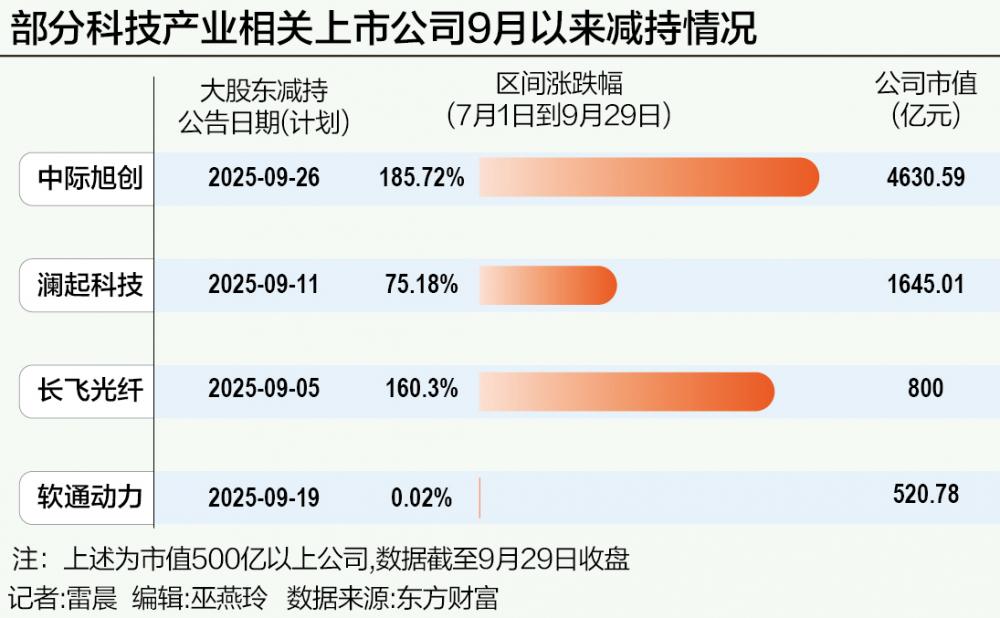
Core Viewpoint - The A-share technology sector is experiencing a wave of share reductions, with significant implications for market sentiment and stock valuations, particularly highlighted by the recent reduction plans from major shareholders of Zhongji Xuchuang [1][9]. Group 1: Shareholder Reductions - Zhongji Xuchuang's controlling shareholder, Shandong Zhongji Investment Holdings, plans to reduce its stake by up to 5.5 million shares within three months, potentially cashing out nearly 2.3 billion yuan based on the closing price on September 29 [1][3]. - Over 100 technology companies in the A-share market have announced share reduction plans since September, indicating a broader trend of shareholder cashing out amid high stock prices and valuation concerns [1][9]. - Major shareholders of Zhongji Xuchuang, including its chairman and vice president, have also engaged in share reductions, reflecting a pattern of selling among key insiders [3][4]. Group 2: Market Context and Performance - Zhongji Xuchuang's stock price has surged over 180% in the second half of the year, reaching a market capitalization of 463.1 billion yuan, which has prompted shareholders to realize gains [6][12]. - The company reported a revenue of 14.789 billion yuan in the first half of the year, a year-on-year increase of 36.95%, and a net profit of 3.995 billion yuan, up 69.4% [8]. - The technology sector has seen a concentration of share reductions, particularly in the electronics and computer industries, with notable companies like Lanke Technology and Softcom Power also announcing significant reductions [11][13]. Group 3: Valuation Concerns - The wave of reductions is occurring at a time when many technology stocks have reached high valuations, leading to increased scrutiny and differing opinions among institutional investors regarding future growth prospects [12][14]. - Analysts have expressed mixed views on the sustainability of high valuations in the light of recent performance, with some suggesting that the positive fundamentals may already be priced in [12][14]. - The ongoing reductions may serve as a "stress test" for the technology sector, as the market adjusts to the implications of insider selling and varying valuation perspectives [14].


科技股“高位减持”再现
2 1 Shi Ji Jing Ji Bao Dao· 2025-09-29 23:18
Core Viewpoint - The A-share technology sector is experiencing a wave of share reductions, with significant implications for market sentiment and stock valuations, particularly highlighted by the recent announcement from Zhongji Xuchuang's major shareholder [1][9][18]. Summary by Sections Shareholder Reductions - Zhongji Xuchuang's controlling shareholder, Shandong Zhongji Investment Holdings, plans to reduce its stake by up to 5.5 million shares within three months, potentially cashing out nearly 2.3 billion yuan based on the closing price on September 29 [1][2]. - Over 100 technology companies in the A-share market have announced share reduction plans since September, indicating a broader trend in the sector [1][9]. Stock Performance and Market Context - Zhongji Xuchuang's stock has seen a cumulative increase of over 180% in the second half of the year, with a market capitalization of approximately 463.1 billion yuan [6][12]. - The stock price surge is attributed to strong financial performance, with a 36.95% year-on-year increase in revenue and a 69.4% increase in net profit for the first half of the year [6][7]. Market Reactions and Analyst Opinions - Analysts suggest that the use of block trades for reductions minimizes immediate market impact compared to open market sales [3]. - The trend of shareholder reductions is seen as a response to high stock prices, with many shareholders opting to cash out at perceived peaks [11][13]. - There is a growing divergence in valuation opinions among institutional investors regarding technology stocks, particularly in the optical module sector [14][19]. Broader Industry Trends - The technology sector is witnessing concentrated reductions, especially in the electronics and computer industries, with notable companies like Lanke Technology and Softcom Power also announcing significant share reductions [10][12]. - The overall sentiment in the market suggests that while short-term volatility may increase due to these reductions, solid company fundamentals could present long-term investment opportunities [13][18].
4600亿大牛股,遭套现近23亿,A股高位减持再现
2 1 Shi Ji Jing Ji Bao Dao· 2025-09-29 15:16
Core Viewpoint - The A-share technology sector is experiencing a wave of share reductions, with significant implications for market sentiment and stock valuations, particularly highlighted by the recent reduction plans from major shareholders of Zhongji Xuchuang [2][10]. Group 1: Shareholder Reductions - Zhongji Xuchuang's controlling shareholder, Shandong Zhongji Investment Holdings, plans to reduce its stake by up to 5.5 million shares within three months, potentially cashing out nearly 2.3 billion yuan based on the closing price on September 29 [2][4]. - Over 100 technology companies in the A-share market have announced share reduction plans since September, indicating a broader trend of shareholder cashing out amid high stock prices and valuation concerns [2][10]. - Major shareholders of Zhongji Xuchuang, including its chairman and vice president, have also engaged in share reductions, with significant amounts cashed out during the high stock price period [5][6]. Group 2: Financial Performance and Market Context - Zhongji Xuchuang reported a revenue of 14.789 billion yuan for the first half of the year, a year-on-year increase of 36.95%, and a net profit of 3.995 billion yuan, up 69.4% [8]. - The stock price of Zhongji Xuchuang has surged over 180% in the second half of the year, reaching a market capitalization of 463.1 billion yuan, reflecting strong demand for optical modules driven by increased capital expenditures from overseas clients [6][8]. - The technology sector has seen a concentration of share reductions, particularly in the electronics and computer industries, with notable companies like Lanke Technology and Softcom Power also announcing significant shareholder reductions [10][11]. Group 3: Market Sentiment and Valuation Concerns - The wave of share reductions is perceived as a signal of increased willingness among institutional investors to cash out after substantial stock price increases, potentially leading to short-term market volatility [12]. - There is a growing divergence in valuation assessments among institutional investors regarding technology stocks, particularly in the optical module sector, as some analysts suggest that the positive fundamentals may already be reflected in current stock prices [12][13]. - The market is witnessing a reassessment of technology stock valuations, with some analysts expressing skepticism about overly optimistic profit forecasts for companies like Zhongji Xuchuang [13].

4600亿大牛股,遭套现近23亿,A股高位减持再现
21世纪经济报道· 2025-09-29 14:00
Core Viewpoint - The A-share technology sector is experiencing a wave of share reductions, with significant implications for market sentiment and stock valuations [1][9]. Group 1: Major Shareholder Reductions - Major shareholders of Zhongji Xuchuang (300308.SZ) are planning to reduce their holdings, with the controlling shareholder, Shandong Zhongji Investment Holdings, set to sell up to 5.5 million shares, potentially cashing out nearly 2.3 billion yuan [1][3]. - Since September, over 100 technology companies in the A-share market have announced share reduction plans, indicating a broader trend in the sector [1][11]. - Zhongji Xuchuang's stock price has surged over 180% in the past six months, leading to increased shareholder selling as they seek to realize gains [6][11]. Group 2: Financial Performance and Market Context - Zhongji Xuchuang reported a revenue of 14.789 billion yuan for the first half of the year, a year-on-year increase of 36.95%, with a net profit of 3.995 billion yuan, up 69.4% [8]. - The company is seeing increased demand for its 800G and 400G optical modules, driven by capital expenditure from overseas clients in AI infrastructure [8]. - The technology sector has seen a concentration of share reductions, particularly in the electronics and computer industries, with many companies experiencing significant stock price increases [11][12]. Group 3: Market Sentiment and Valuation Concerns - The wave of high-level share reductions may signal a cooling period for the market, with potential increased volatility for affected stocks [12]. - There is a growing divergence in valuation assessments among institutional investors regarding technology stocks, particularly in the optical module sector [12][13]. - Analysts have differing views on the sustainability of current stock prices, with some suggesting that the positive fundamentals have already been priced in [12].