OPPO

Search documents
存储涨价连锁反应:手机、PC降出货目标 面板、镜头被波及
Zhong Guo Jing Ying Bao· 2026-01-16 19:40
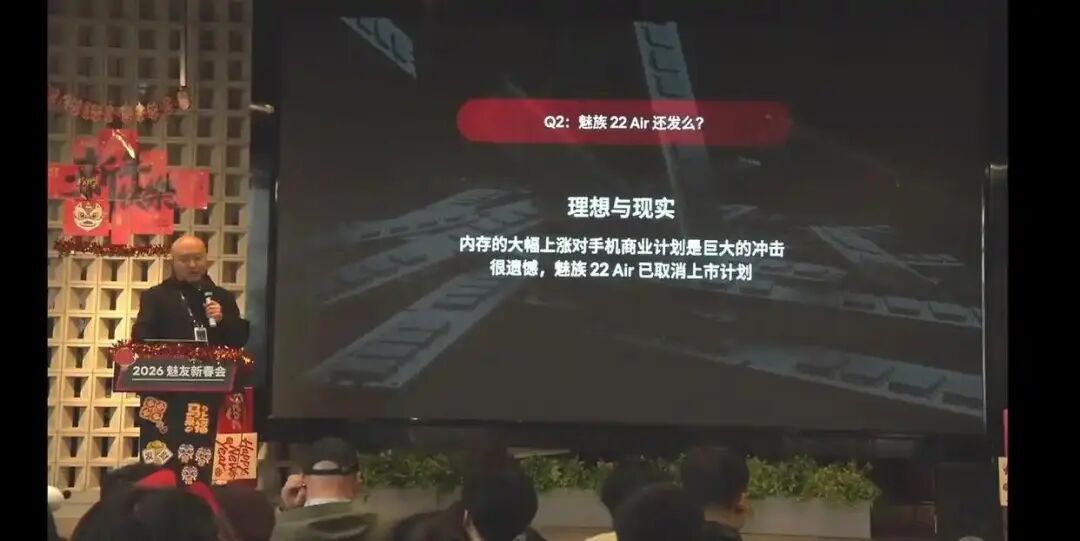
Core Viewpoint - The continuous rise in global storage chip prices is significantly impacting the consumer electronics industry, leading to price increases and strategic adjustments among various brands [1][2][3]. Group 1: Impact on Brands - Meizu has canceled the launch of its Meizu 22 Air due to the substantial increase in memory prices, reflecting the pressure on mid-tier brands [2]. - Other brands like realme have returned to OPPO for resource sharing to cope with cost pressures, while ASUS has also confirmed a halt on new product launches for 2026 [2]. - Major brands including Lenovo, Dell, HP, and Xiaomi have raised prices for their products, with increases ranging from hundreds to thousands of yuan [2][3]. Group 2: Storage Price Trends - The price of 256GB DDR5 server memory has exceeded 40,000 yuan, with a significant supply-demand imbalance expected to persist throughout the year [3]. - Since September 2025, the spot price of DDR5 memory chips has surged over 300%, while DDR4 prices have increased by 158% [2]. Group 3: Market Forecasts - The rise in storage costs has led to a 10% to 15% increase in material costs for smartphones, with a projected 2.1% decline in global smartphone shipments for 2026 [3]. - Major smartphone manufacturers have adjusted their shipment targets downward, particularly affecting brands with a higher market share in the low-end segment, such as Xiaomi and Transsion [3]. Group 4: Component Demand Weakness - The demand for mobile phone panels and optical lenses is weakening due to rising storage prices, leading to reduced production rates and downward price pressure in the panel market [5][6]. - The overall utilization rate of mainstream mobile panel manufacturers has dropped by 20% to 30% compared to the previous quarter [5]. Group 5: Strategic Adjustments - Companies are prioritizing core components that directly affect user experience, such as SoC performance and battery capacity, while reducing specifications for less critical components [1][5]. - The rising costs are forcing brands to make trade-offs in their BOM (Bill of Materials), impacting the upgrade paths for non-core components like optical lenses [6][7].
内存疯涨,买车要多掏腰包?
3 6 Ke· 2026-01-16 12:36
Group 1 - The price of memory chips has surged dramatically, with 16GB DDR4 memory increasing by 1800% and DDR5 by 500% compared to last year [1][3] - The automotive industry is facing significant cost pressures due to rising memory prices, with estimates suggesting that the memory cost for a car priced around 300,000 yuan has increased by 2,000 to 4,000 yuan [3][5] - Car manufacturers may respond to rising memory costs by either increasing prices or reducing features without lowering prices, leading to a potential decline in consumer experience [5][6] Group 2 - The primary driver behind the skyrocketing memory prices is the AI industry, which requires significantly more memory for training large models, diverting production away from standard memory used in consumer electronics and vehicles [6][7] - Major memory manufacturers like Samsung and SK Hynix have seen their stock prices soar, with Micron Technology's stock projected to increase by 240% by 2025 [7][9] - Domestic companies like Changxin Technology are emerging as potential players in the memory market, but they currently only meet a fraction of domestic demand, with China consuming nearly 40% of global memory but producing less than 10% [9][11] Group 3 - The current memory crisis resembles the previous chip shortage, where the focus was on basic components rather than advanced chips, indicating a supply chain issue that may persist [6][12] - Consumers looking to purchase vehicles may want to wait for potential price adjustments or take advantage of current pricing before manufacturers adjust for increased costs [13]




氪星晚报|西贝公关副总裁宋宣已离职;大麦娱乐宣布进军博物馆赛道;叮咚买菜江苏盐城开仓
3 6 Ke· 2026-01-16 11:23
Group 1 - Ford is in discussions with BYD for battery supply for hybrid vehicles produced at its overseas factories, with no agreements reached yet [1] - BYD is the world's leading electric vehicle manufacturer by sales [1] Group 2 - Song Xuan, Vice President of Public Relations at Xibei, has left the company for personal development reasons, following significant pressure from past events [2] Group 3 - Damai Entertainment has officially entered the museum sector by launching a collaboration plan with various museums to create innovative exhibitions [3] - The plan aims to enhance exhibition marketing, content production, and ticketing systems in partnership with museums [3] Group 4 - Major smartphone manufacturers including Xiaomi, OPPO, vivo, and Transsion have lowered their annual shipment forecasts due to rising upstream storage costs, with Xiaomi and OPPO reducing orders by over 20% [4] - Huawei is considering price reductions for certain product lines to capture market share despite the challenges posed by rising storage prices [4] Group 5 - Dingdong Maicai is expanding its operations by opening a new warehouse in Yancheng, Jiangsu, as part of its strategy to strengthen its presence in the Jiangsu market [5] - The company has opened over 200 new front warehouses in the past two years, with more than 60% located in lower-tier cities [5] Group 6 - MediaTek has launched the Dimensity 9500s and 8500 mobile chips, with the 9500s featuring a flagship 3nm process and a high-performance CPU [6] - The Dimensity 8500 offers a 25% increase in peak performance and a 20% reduction in power consumption compared to its predecessor [6] Group 7 - Meituan has released its first open-source "Reconsideration" model, which significantly reduces training costs for adapting new tools in complex tasks [7] - The new model supports simultaneous execution of tasks by eight "brains" and is available for free on the LongCat website [7] Group 8 - Mitsubishi Corporation announced the acquisition of U.S. shale gas assets for $7.53 billion, aiming to strengthen its position in the U.S. energy market [9] Group 9 - Huawei's CEO of the Intelligent Automotive Solutions BU expects over 80 models equipped with Huawei ADS to be launched this year, with significant user engagement metrics shared [10] Group 10 - TSMC's Chairman expressed concerns about power supply issues affecting AI development and the company's ability to expand production capacity [11] Group 11 - China's power and energy battery sales are projected to grow by 63.6% in 2025, with total sales reaching 1,700.5 GWh [11] - The report indicates that power batteries account for 70.6% of total sales, with a year-on-year growth of 51.8% [11] Group 12 - Spain is expected to receive a record 97 million international tourists in 2025, marking a 3.5% increase from the previous year [12] - The tourism sector's contribution to employment has also increased, with a 2.4% rise in jobs related to tourism, reaching 2.75 million [12]
内存条涨价风,席卷整个数码产业链
Qi Lu Wan Bao· 2026-01-16 11:05
Core Insights - The digital market is experiencing a significant price surge in memory and storage products, with prices for 16GB memory modules increasing from around 160-170 yuan to over 700 yuan, representing a rise of over 300% [2][4] - The price increases are affecting both assembled and branded computers, leading to higher costs for consumers and a decrease in customer inquiries at retail stores [2][3] - Major PC manufacturers, including HP, Acer, and Dell, have announced price hikes for their products due to rising memory costs, with increases ranging from 10% to 30% [4][5] Price Surge in Memory Products - The price of 8GB memory modules has risen from tens of yuan to 300-400 yuan, while 1TB solid-state drives have increased from over 300 yuan to around 800 yuan [2][4] - Retailers are adjusting their inventory purchasing strategies, opting for smaller, more frequent orders to mitigate risks associated with fluctuating prices [3][4] Impact on the PC and Smartphone Industries - The price increases in memory components have led to a ripple effect throughout the supply chain, forcing manufacturers to raise prices for their products [4][5] - Smartphone manufacturers, including Xiaomi and OPPO, have also raised prices for new models, with some models seeing increases of up to 20% due to higher memory costs [5][6] Market Dynamics and Future Outlook - The global storage chip market is currently in a "super bull market," with prices expected to rise by 40%-50% in the upcoming quarters due to supply-demand imbalances and trade uncertainties [7][8] - Industry experts predict that prices may not return to previous lows until after 2027, suggesting a prolonged period of high prices for consumers [8]
苹果用户退换十几次才抽到的三星屏,被国产拿来做低端机
3 6 Ke· 2026-01-16 10:51
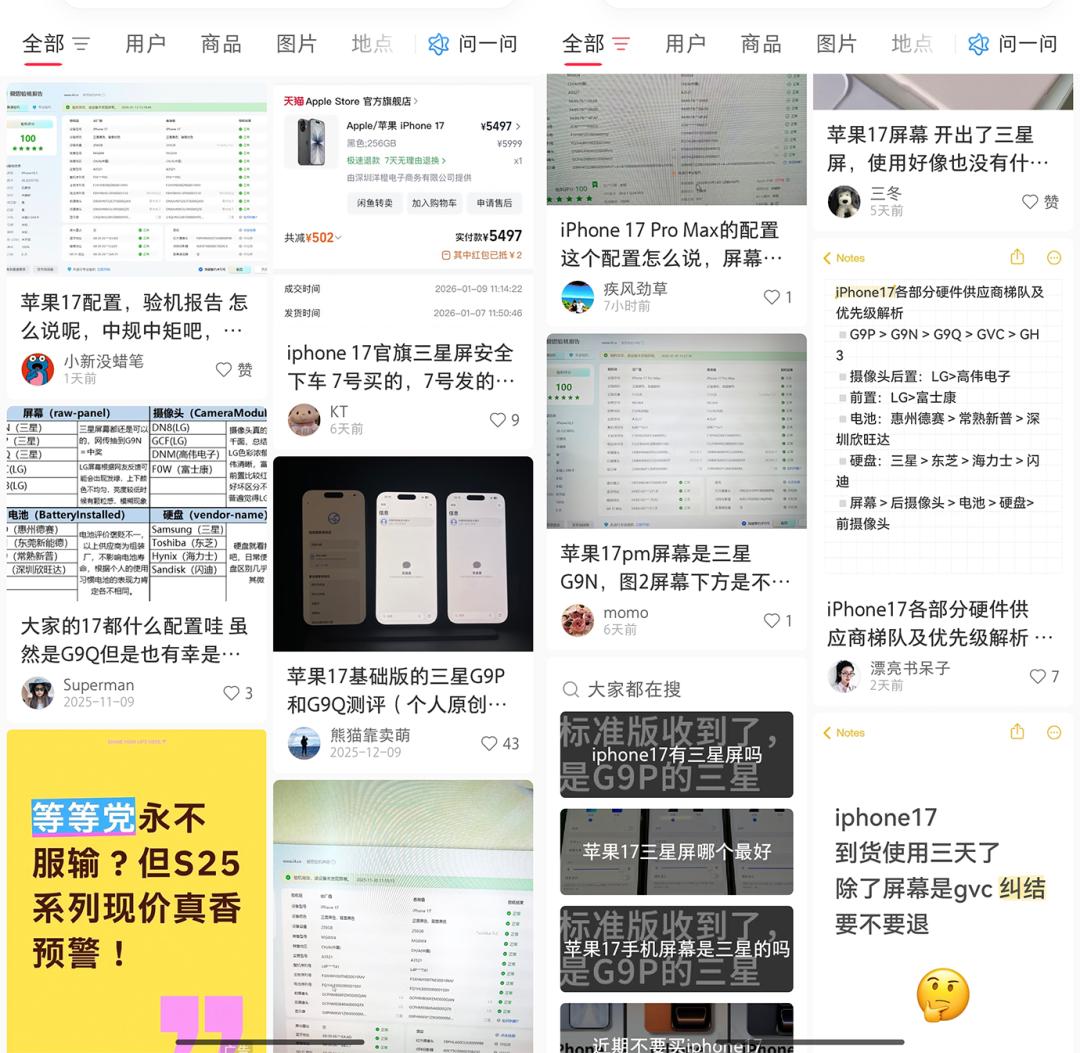
Core Viewpoint - The article discusses the ongoing obsession among Apple users for Samsung screens, particularly the desire for the "G9N" model, which is known for its superior display quality. This trend is contrasted with the recent announcement from OPPO's sub-brand, Realme, which will use Samsung's latest M14 emitting material in its Neo8 model, highlighting the competitive landscape in the smartphone display market [1][3][5]. Group 1: Samsung's Dominance in Display Technology - Samsung has historically dominated the OLED display market due to its control over core technologies and manufacturing processes, including the use of advanced vacuum deposition machines from Canon Tokki [7][11]. - The proprietary "diamond arrangement" technology developed by Samsung enhances color display and longevity of OLED screens, setting a high standard in the industry [13][16]. - Samsung's M14 emitting material is recognized for its high purity and efficiency, contributing to its leading position in the display market [25]. Group 2: Shift in Market Dynamics - Chinese manufacturers like Xiaomi, Vivo, and OPPO have increasingly moved away from Samsung displays, opting for domestic alternatives that offer comparable or superior quality at lower costs [20][22][27]. - The market share of Chinese OLED panels has surpassed 50% globally, with domestic screens accounting for 76% of the market in Chinese smartphones, indicating a significant shift away from Samsung's dominance [27]. - New technologies developed by Chinese firms, such as BOE's "blue diamond arrangement" and TCL's "pearl arrangement," are closing the gap with Samsung's offerings [23][25]. Group 3: Perception vs. Reality - Despite the advancements in domestic displays, Apple’s integration of Samsung screens in its devices still results in superior display performance due to Apple's rigorous calibration and optimization processes [28][29]. - The perception that Samsung screens are the best is challenged by the fact that Apple’s software and hardware optimizations can enhance the performance of various display types, including those from LG [29][33]. - The article raises questions about whether Realme's use of Samsung's M14 material will resonate with consumers, given the competitive landscape and the advancements made by domestic manufacturers [33].

1.16犀牛财经晚报:小米等四家手机厂商下调全年出货预期
Xi Niu Cai Jing· 2026-01-16 10:32
Group 1: Gold Jewelry Prices - Several gold jewelry brands in China have shown price discrepancies, with some maintaining prices while others have adjusted them down to around 1435 CNY per gram [1] - Specific prices include: Liufu Jewelry at 1434 CNY/gram, Chow Tai Fook and Xie Rui Lin at 1436 CNY/gram, and Chow Sang Sang at 1431 CNY/gram, which decreased by 5 CNY from the previous day [1] Group 2: Battery Industry Growth - In 2025, China's cumulative sales of power and energy storage batteries are projected to reach 1700.5 GWh, marking a year-on-year increase of 63.6% [1] - Power batteries account for 1200.9 GWh, representing 70.6% of total sales, with a year-on-year growth of 51.8%, while energy storage batteries are at 499.6 GWh, showing a 101.3% increase [1] Group 3: Passive Components Price Increase - Yageo Corporation announced a price increase of 15%-20% on certain resistor products due to significant cost rises in chip product lines, particularly for precious metals [2] Group 4: Smartphone Manufacturers Adjusting Forecasts - Major smartphone manufacturers including Xiaomi and OPPO have reduced their annual shipment forecasts by over 20% due to rising storage costs in the supply chain [2] - Vivo has lowered its forecast by nearly 15%, while Transsion has adjusted its target to below 70 million units [2] Group 5: Semiconductor Industry Performance - The semiconductor industry showed resilience with significant stock price increases, particularly in companies like Longji Technology, which reached a five-year high [20] - The storage chip sector also saw historical highs for companies like Baiwei Storage and Jiangbo Long [20] Group 6: New Product Developments - Samsung Display has commenced mass production of its 8.6-generation OLED panel line, indicating advancements in display technology [2] - Apple is expected to launch its AI glasses in the second quarter of this year, with design advantages over existing products [3] Group 7: Regulatory Actions - The China Securities Regulatory Commission has approved the IPO registration of Fuen Co., Ltd. on the Shenzhen Stock Exchange [7] - Several companies, including Haizheng Pharmaceutical and Mengguli, received warnings from regulatory bodies for financial discrepancies in their disclosures [8][9][10]
在2025年年末启动降价促销后,苹果又玩起了以旧换新,支持华为、小米等品牌,剑指安卓机型!
Jin Rong Jie· 2026-01-16 10:10
Group 1 - Apple has initiated a trade-in program that includes Android devices from brands like Huawei and Xiaomi, marking the first time such devices are accepted for trade-in [1][2] - The trade-in values for various devices are significant, with the iPhone 16 Pro Max offering up to 5800 RMB and the MacBook Pro up to 6050 RMB [1] - This move follows a recent price reduction for the iPhone 17 Pro and Pro Max, which saw price drops of 300 RMB on platforms like Tmall and JD [3][4] Group 2 - In Q1 2025, Apple's smartphone shipments in China fell by 9% year-on-year, placing it fifth in market share, while competitors like Xiaomi and Huawei maintained stronger positions [5] - Despite the decline, Apple's market share in China surged to 25% in October 2025, driven by the strong sales of the iPhone 17 series, marking a 37% year-on-year increase in sales [5] - In Q4 2025, Apple led the Chinese smartphone market with a shipment of 16 million units, achieving a market share of 21.1%, a significant increase from the previous year [6]
苹果突然宣布:华为、小米等也能以旧换新!
Shen Zhen Shang Bao· 2026-01-16 08:26
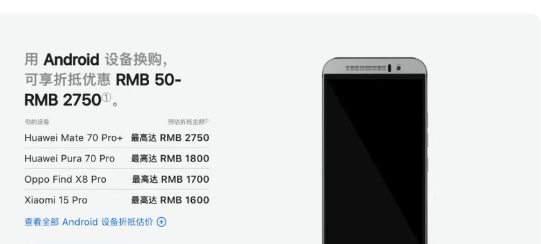
Core Insights - Apple has expanded its Apple Trade In program to include a wider range of brands, such as Huawei, OPPO, OnePlus, Samsung, vivo, and Xiaomi, allowing customers to trade in their old devices for new ones [1][3] Group 1: Trade-In Program Details - The Apple Trade In program allows customers to receive significant discounts on new devices when trading in old ones, with the iPhone 16 Pro Max offering up to 5800 yuan and the MacBook Pro up to 6050 yuan [3] - Specific trade-in values for other brands include Huawei Mate XT at 5400 yuan, Mate X6 at 3800 yuan, vivo X200 Pro at 1900 yuan, and OPPO Find X8 Pro at 1700 yuan [3] - The program enables consumers to trade in devices online or at Apple Store retail locations, and Apple will also recycle devices that do not meet trade-in conditions [3] Group 2: Historical Context - The Apple Trade In program was initially launched in mainland China on March 31, 2015, supporting trade-ins for iPod, iPad, and iPhone 4 and later models [3] - Users can assess the value of their old devices in-store to offset the cost of new purchases [3]
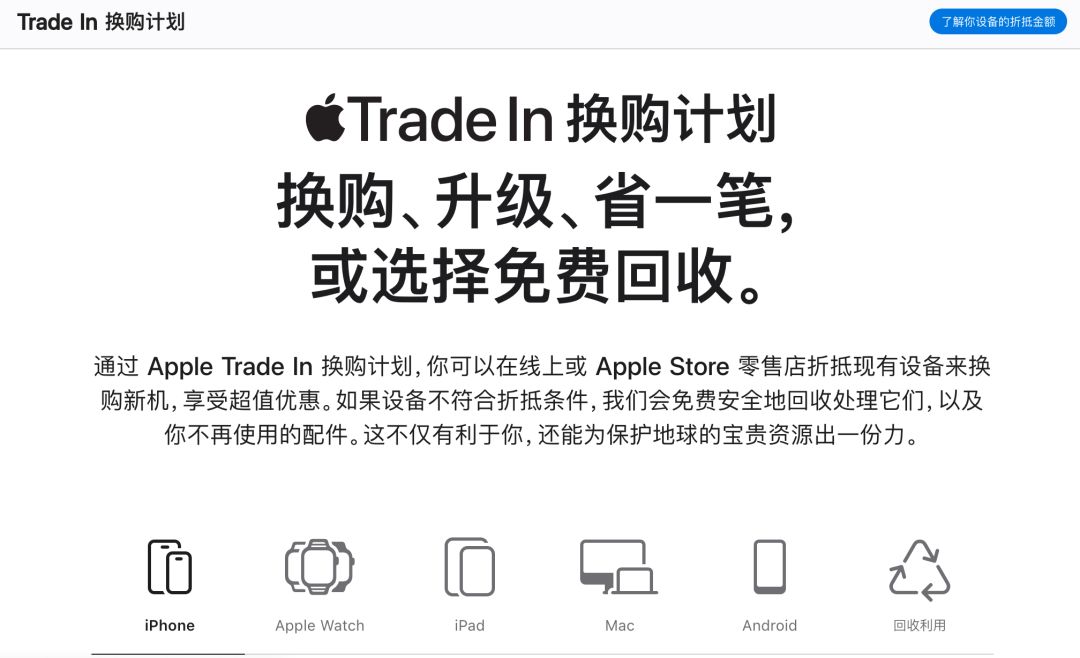
苹果官宣:华为、小米也能以旧换新了
新华网财经· 2026-01-16 08:26
Core Viewpoint - Apple has adjusted the trade-in values for its devices, including iPhone, iPad, and Mac, and has also included Android models from Huawei and Xiaomi in the trade-in program [1][2]. Group 1: Trade-In Values for Apple Devices - The iPhone 16 Pro Max can be traded in for up to RMB 5800 [4]. - The iPad Pro has a maximum trade-in value of RMB 5800, while the iPad Air can be traded in for up to RMB 3500 [4]. - The MacBook Pro has a maximum trade-in value of RMB 6050, and the Mac Pro can be traded in for up to RMB 14000 [4][6]. Group 2: Trade-In Values for Android Devices - The Huawei Mate X5 can be traded in for up to RMB 2850, and the Huawei Mate 70 Pro+ has a maximum value of RMB 2750 [7]. - The Oppo Find X8 Pro can be traded in for up to RMB 1700, while the Vivo iQOO 13 has a maximum trade-in value of RMB 1600 [7]. - The Xiaomi 15 Pro can also be traded in for up to RMB 1600 [7]. Group 3: Trade-In Program Details - The trade-in service is provided by Apple's trade-in service partners, and the quoted trade-in amounts are estimates that may vary based on the device's condition, configuration, release year, and the country or region of sale [8]. - Participants must be 18 years or older to take part in the program, and the trade-in value can be used to offset the purchase of new Apple devices [8].
华为、小米等品牌被纳入苹果以旧换新范围
21世纪经济报道· 2026-01-16 08:24
Core Insights - Apple has adjusted the trade-in values for devices including iPhone, iPad, and Mac, now including Android models from Huawei and Xiaomi in the trade-in program [1][3]. Trade-In Values - The maximum trade-in value for the iPhone 16 Pro Max in China is RMB 5800, with other models like iPhone 16 Pro at RMB 4900, iPhone 16 Plus at RMB 4175, and iPhone 16 at RMB 3400 [3][4]. - For Mac devices, the MacBook Pro has a maximum trade-in value of RMB 6050, while the Mac Pro can reach up to RMB 14000. Other models like MacBook Air and iMac have lower trade-in values [6]. - Android devices are also included, with Huawei Mate X5 valued at RMB 2850, Huawei Mate 70 Pro+ at RMB 2750, and Xiaomi 15 Pro at RMB 1600 [6]. Trade-In Program Details - The trade-in service is provided by Apple's trade-in service partners, and the quoted values are estimates that may vary based on the device's condition, configuration, and release year [8]. - Participants must be 18 years or older to engage in the trade-in program, and the trade-in value can be applied towards the purchase of new Apple devices [8].