华润三九

Search documents
步长制药:中期分红4.11亿元落地 与投资者共享公司发展成果
Guo Ji Jin Rong Bao· 2025-09-18 13:58
Core Viewpoint - The company, Buchang Pharma, has announced a cash dividend of 0.39 yuan per share, totaling 411 million yuan, reflecting its commitment to shareholder returns and robust cash flow [1][2]. Dividend Trends - There is a noticeable trend of increasing cash dividends among pharmaceutical companies, with Buchang Pharma being the first to implement a mid-term dividend since its listing, aligning with regulatory encouragement for higher shareholder returns [2]. - The dividend of 0.39 yuan per share positions Buchang Pharma at an above-average level within the industry, with a dividend yield of 2.52%, which is higher than that of peers like WuXi AppTec and Dong-E E-Jiao [2]. Financial Performance Supporting Dividends - The company has adopted a strategy of simultaneous cash dividends and share buybacks, with cumulative dividends reaching 7.948 billion yuan and share buybacks totaling 1.744 billion yuan [3]. - Strong cash flow from operating activities supports the company's ability to distribute dividends while maintaining business growth [3]. - The company has contributed over 32 billion yuan in taxes, indicating a positive impact on local economies and reflecting its strong financial performance [3]. Corporate Governance and Market Position - Cash dividends serve as a reflection of corporate governance quality and help attract long-term investors, enhancing the company's market image [4]. - Buchang Pharma's commitment to stable dividends signals confidence in future growth and shareholder returns, especially as the pharmaceutical industry shifts towards innovation and research-driven models [4]. - The company aims to leverage artificial intelligence in traditional Chinese medicine innovation and expand into the biopharmaceutical sector, contributing to the high-quality development of the healthcare industry [4].

华润三九拟百亿理财引争议,回购股份或更优
Bei Jing Shang Bao· 2025-09-18 12:35
Core Viewpoint - Companies with ample idle funds face a choice between investing in low-risk financial products or repurchasing shares, with share buybacks potentially offering greater benefits to shareholders [1][2]. Group 1: Investment Strategies - China Resources Sanjiu plans to invest up to 10 billion yuan in bank financial products, highlighting a trend among companies to utilize idle funds [1]. - Low-risk financial investments provide safety and liquidity, allowing companies to quickly access cash when needed, making them suitable for firms without immediate expansion plans [1]. - Share buybacks send a strong positive signal to the market, indicating management's confidence in the company's future and potentially increasing earnings per share, thus benefiting shareholders [1][2]. Group 2: Long-term Strategic Implications - Share repurchases can enhance a company's visibility and reputation in the capital market, creating favorable conditions for future financing activities [2]. - While low-risk financial investments yield some returns, they do not significantly impact a company's brand value or market position compared to share buybacks [2]. - Companies must assess their financial health and future strategies before deciding on share repurchases, as those with tight cash flows or major investment projects may find buybacks detrimental [2]. Group 3: Suitability of Share Buybacks - High price-to-earnings ratio companies may not benefit from share buybacks, as maintaining cash reserves can provide greater security for investors [3]. - For companies with stock prices below net asset value, share buybacks can reduce share capital and enhance net asset value per share, supporting stock price increases [3].



长城证券起诉“僵尸”三九胃泰
经济观察报· 2025-09-18 12:26
Core Viewpoint - The lawsuit involving Changcheng Securities is a historical issue from over 20 years ago, focusing on the confirmation of shareholder identity due to the company's operational suspension and revocation of its business license, making the valuation of its equity uncertain [1][5]. Group 1: Lawsuit Details - On September 16, Changcheng Securities announced a court hearing for a "shareholder qualification confirmation dispute" against Shenzhen Sanjiu Weitai Co., Ltd., with a hearing scheduled for November 7 [2]. - Changcheng Securities is seeking confirmation of its ownership of 900,000 shares in Sanjiu Weitai and requests the issuance of share certificates and registration in the shareholder registry [2]. Group 2: Background of Sanjiu Weitai - Sanjiu Weitai Co., established in 1993, was a chemical pharmaceutical raw material manufacturer that had its business license revoked in 2022 and is now considered a "zombie enterprise" [4]. - The company was once part of the well-known "999" brand, which has since been absorbed by China Resources Group during a restructuring process due to financial difficulties [10][11]. Group 3: Historical Context and Financial Implications - In 2008 and 2009, Changcheng Securities attempted to sell shares in 12 companies, including the 900,000 shares of Sanjiu Weitai, with the initial listing price dropping from 30,285,700 yuan to 24,228,600 yuan [7]. - The ongoing legal actions are part of a broader effort to resolve historical issues related to equity ownership, which arose during the transfer of shares by original shareholders between 2000 and 2008 [8]. Group 4: Legal and Financial Strategy - Legal experts suggest that the lawsuit serves multiple purposes: confirming shareholder identity, facilitating the appointment of a liquidation team, and ensuring rights to any remaining assets post-liquidation [8]. - For Changcheng Securities, which has total assets exceeding 100 billion yuan, resolving these historical equity issues is more about clarifying asset ownership than financial gain from the "zombie enterprise" [9].


侃股:相比理财回购或是更优选
Bei Jing Shang Bao· 2025-09-18 12:12
Core Viewpoint - Companies are increasingly faced with the decision of how to utilize idle funds, with options including low-risk financial products or share buybacks, each having distinct implications for shareholder value and company strategy [1][2]. Group 1: Investment Strategies - China Resources Sanjiu plans to invest up to 10 billion yuan in bank wealth management products, highlighting a trend among companies to use idle funds for low-risk investments [1]. - Low-risk financial investments provide companies with a safe way to earn returns on idle cash while maintaining liquidity for future needs [1]. - Share buybacks are viewed as a more attractive option for small shareholders, signaling management's confidence in the company's future and potentially increasing share value [1][2]. Group 2: Long-term Strategic Implications - Compared to financial investments, share buybacks have a more profound long-term strategic significance for companies, enhancing market visibility and stability [2]. - Frequent share buybacks can attract investor attention and improve a company's reputation in the capital market, which can facilitate future financing activities [2]. - Companies must consider their financial health and future strategies before deciding on share buybacks, as not all companies are suited for this approach [2][3]. Group 3: Market Conditions and Valuation - Companies with high price-to-earnings ratios may find share buybacks unsuitable, as it could lead to inflated valuations and decreased investor confidence [3]. - Conversely, companies with share prices below net asset value can benefit significantly from buybacks, reducing share capital and enhancing net asset value per share [3].
存款减少超千亿、理财产品增加,上市公司也在“存款搬家”?
2 1 Shi Ji Jing Ji Bao Dao· 2025-09-18 11:45
Core Insights - The significant decline in new resident deposits and the increase in non-bank deposits in August has sparked discussions about the phenomenon of "deposit migration" in the market [1] - The trend of asset allocation is shifting towards higher-yielding financial products due to declining deposit rates and a recovering equity market [1] - The overall scale of listed companies' financial management has shown a downward trend, with a 26.17% decrease from the peak in 2022 [1][3] Group 1: Financial Management Trends - Listed companies are increasingly investing in financial products, primarily using their own funds, with a focus on structured deposits and bank wealth management products [3] - The demand for corporate financial management is driven by the need for stable returns and liquidity, especially as companies stabilize and experience cash accumulation [3][4] - The proportion of cash holdings remains high at over 70%, but is declining, while the shares of bank wealth management, securities asset management, and trust products are on the rise [1][4] Group 2: Market Dynamics - The decline in deposit rates has heightened the demand for capital preservation and appreciation among companies, leading to a renewed interest in corporate wealth management [4][5] - The implementation of asset management regulations has facilitated the diversification and net value transformation of financial products, offering higher yields and flexibility compared to traditional deposits [4][5] - Companies are increasingly focused on optimizing their capital structure and improving asset return efficiency in response to uncertain operating environments [5] Group 3: Investment Performance - The average annualized yield of cash management products is currently at 1.32%, while fixed-income products have shown varying yields, generally outperforming traditional deposit products [7] - The investment scale in structured deposits remains significant, but has decreased by approximately 100 billion yuan year-on-year [7][8] - As corporate profits begin to recover, the total scale of funds used for financial management by listed companies is expected to improve [8] Group 4: Opportunities for Asset Management Institutions - Asset management institutions are recognizing the growing demand for corporate wealth management and are actively positioning themselves to meet this need [9][10] - Institutions are advised to enhance product customization, flexibility, and transparency to better serve corporate clients [10] - The market for corporate financial management is becoming more institutionalized and professionalized, necessitating asset management institutions to adapt and strengthen their competitive capabilities [10]

华润三九陷增长瓶颈:增收不增利CHC业务收入下滑18% 并购后遗症显现巨额商誉悬顶
Xin Lang Zheng Quan· 2025-09-18 10:42
Core Viewpoint - China Resources Sanjiu reported a revenue of 14.81 billion yuan for the first half of 2025, a year-on-year increase of 4.99%, but the net profit attributable to shareholders fell by 24.31% to 1.815 billion yuan, marking the first decline in interim profits in five years, indicating challenges in transitioning from a traditional OTC leader [1] Group 1: Financial Performance - The company's CHC (Consumer Health Care) business, which has historically contributed around 60% of revenue, saw a revenue decline of 17.89% to 7.994 billion yuan, with its revenue share dropping from 69.02% to 53.98% [2] - Sales expenses reached 3.939 billion yuan, an increase of 18.94%, with a sales expense ratio of 26.6%, indicating high costs without corresponding revenue growth [2] - The company's contract liabilities decreased by approximately 20% to 1.179 billion yuan, while inventory increased by 30% to 6.523 billion yuan, reflecting challenges in sales and inventory management [3] Group 2: Market Challenges - The rise of online pharmacies, growing at over 30%, has diverted significant traffic from physical stores, impacting China Resources Sanjiu, which heavily relies on its pharmacy network [3] - Increased competition in the OTC market, with at least 148 products transitioning from prescription to OTC since 2020, has led to product homogenization, diminishing the competitive edge of flagship products [3] - Policy uncertainties, particularly regarding the potential inclusion of core products in centralized procurement, pose risks to the company's pricing power and profitability [3] Group 3: M&A and Goodwill Issues - The company has pursued external growth through acquisitions, completing over ten transactions since 2012, including a significant acquisition of a 28% stake in Tianshili for 6.212 billion yuan [4] - The prescription drug business revenue surged by 100.18% to 4.838 billion yuan in the first half of 2025, driven by acquisitions, but goodwill risks are emerging with goodwill reaching 7.045 billion yuan, accounting for 33% of net assets [4] - High accounts receivable of 7.763 billion yuan, representing 36% of net assets, raises concerns about potential bad debt risks amid challenges in post-acquisition integration [5]
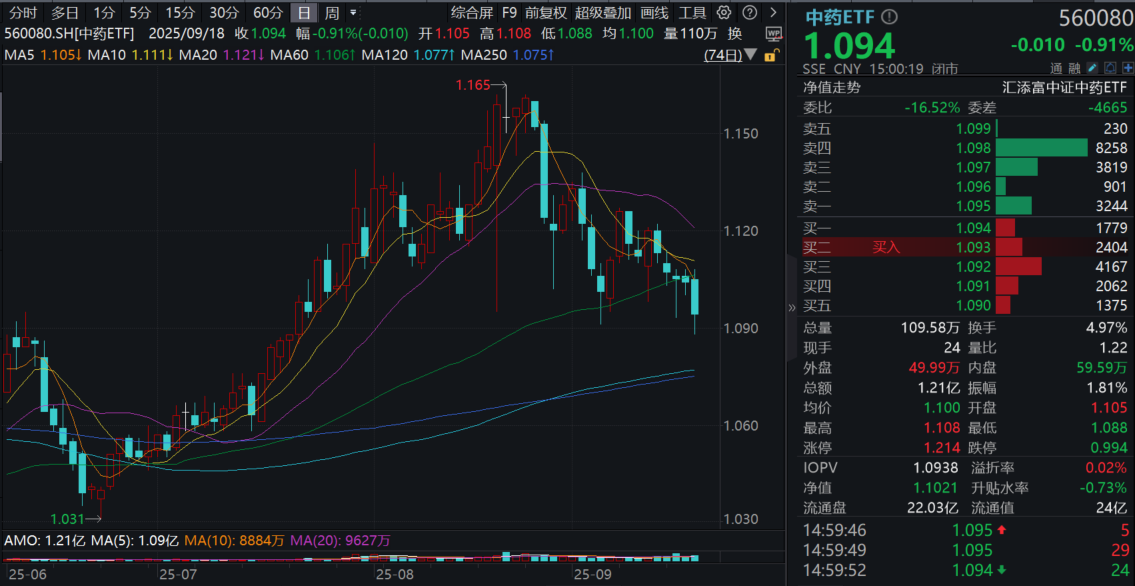
云南白药跌近1%!资金不改“高切低”,中药ETF(560080)回调再蓄势,近5日“吸金”超9200万元!中药企业盈利能力显现积极变化
Xin Lang Cai Jing· 2025-09-18 10:18
Core Viewpoint - The traditional Chinese medicine (TCM) sector is experiencing a phase of adjustment, with signs of resilience and potential recovery in profitability, supported by policy backing and market dynamics [3][4]. Group 1: Market Performance - The Shanghai Composite Index experienced a pullback, while the TCM sector continued to adjust, with the TCM ETF (560080) declining by 0.91% for five consecutive days [1]. - The trading volume for the TCM ETF exceeded 120 million yuan, marking a 68% increase compared to the previous day [1]. - The TCM ETF has seen net inflows in 9 out of the last 10 days, accumulating over 150 million yuan, with the latest fund size exceeding 2.4 billion yuan, leading its peers significantly [1]. Group 2: Financial Performance - In the first half of 2025, the TCM sector's total revenue was 172.9 billion yuan, a year-on-year decrease of 4.95%, while the net profit attributable to the parent company was 19.1 billion yuan, down 9.31% [4]. - The operating cash flow improved by 30.77% year-on-year, reaching 16.96 billion yuan [4]. - The gross margin for the TCM sector in H1 2025 was 42.05%, a decrease of 1.01 percentage points year-on-year, while the net profit margin was 11.04%, down 0.56 percentage points [4]. Group 3: Market Dynamics and Trends - Despite short-term demand pressures, the retail pharmacy sector's consolidation is expected to enhance the market concentration of OTC products [7]. - Market shares for leading OTC products have increased, with notable gains for brands like Huazhu Sanjiu and Jiangzhong Pharmaceutical [7]. - The TCM sector is characterized by both new consumer demand and pharmaceutical attributes, suggesting a favorable investment outlook for the TCM ETF (560080) and related funds [7].

长城证券起诉“僵尸”三九胃泰:20年前遗留股权清算倒计时
Jing Ji Guan Cha Wang· 2025-09-18 09:09
Core Viewpoint - Changcheng Securities has initiated a lawsuit against Sanjiu Weitai Co., Ltd. to confirm its shareholder status and seek the issuance of share certificates for its 900,000 shares, as the company has been dissolved and is no longer operational [1][2]. Group 1: Company Background - Sanjiu Weitai Co., Ltd. was established in 1993 and was a manufacturer of chemical pharmaceutical raw materials, but its business license was revoked in 2022 [2]. - The company was once associated with the well-known "999" brand, which was part of the Shenzhen Southern Pharmaceutical Factory, now a residential area [2][6]. - The original Sanjiu Group, founded in 1991, expanded significantly but faced liquidity crises leading to restructuring by China Resources Group in 2007 [6][7]. Group 2: Legal Proceedings - The lawsuit is part of a historical issue dating back over 20 years, aimed at clarifying the ownership of assets and ensuring compliance as a listed company [5]. - Changcheng Securities has previously attempted to divest its shares in Sanjiu Weitai, with the shares listed for sale at a significantly reduced price in 2008 [3][4]. - The legal action may also facilitate the appointment of a liquidation team for Sanjiu Weitai, as it has not undergone liquidation since its license was revoked [4]. Group 3: Industry Context - The broader context involves the ongoing cleanup of "zombie enterprises" by state-owned enterprises, with efforts to clear out non-core and inefficient assets [7]. - China Resources Group has been actively pursuing the liquidation of former subsidiaries of the Sanjiu Group, with over 20 forced liquidation cases filed recently [7][8].
9月18日早间重要公告一览
Xi Niu Cai Jing· 2025-09-18 05:10
Group 1 - Dagan Holdings' shareholder plans to reduce holdings by up to 3% of the company's shares, totaling approximately 9.52 million shares [1] - China Resources Sanjiu intends to invest up to 10 billion yuan of its own funds in bank wealth management products, with a rolling investment strategy [1] - Xinyu Guoke's shareholder plans to reduce holdings by up to 1% of the company's shares, totaling approximately 276.76 thousand shares [3] Group 2 - Tianpu Co. has completed the stock trading suspension review and will resume trading after a period of abnormal price fluctuations [5] - Xinhang New Materials' controlling shareholder plans to reduce holdings by up to 2% of the company's shares, totaling approximately 174.88 thousand shares [6] - Yinbang Co.'s shareholder plans to reduce holdings by up to 3% of the company's shares, totaling approximately 24.66 million shares [7] Group 3 - Yuanfei Pet's shareholders plan to collectively reduce holdings by up to 3.48% of the company's shares, totaling approximately 565.14 thousand shares [7] - Changchun High-tech's subsidiary will gain exclusive agency rights for three products in mainland China [9] - Hanyi Co.'s controlling shareholder plans to reduce holdings by up to 3% of the company's shares, totaling approximately 294 thousand shares [10] Group 4 - Zhongcai Energy's subsidiary signed a total contract worth 347 million yuan for a project in Hubei Province [11] - Ruifeng Bank's shareholder reduced holdings by 408.83 thousand shares, decreasing their ownership from 6.10% to 5.89% [12] - Shanghai Construction's gold business revenue is low, accounting for less than 0.5% of total revenue [13] Group 5 - Guanggang Gas's shareholder plans to reduce holdings by up to 2.63 million shares, approximately 1.9994% of the company's total shares [14] - Kairun Co.'s controlling shareholder has decided to terminate the share reduction plan early [15] - Boyun New Materials' shareholder plans to reduce holdings by up to 1% of the company's shares, totaling approximately 573 thousand shares [16] Group 6 - Yuanda Environmental's acquisition of assets and fundraising has been approved by the Shanghai Stock Exchange [17] - ST Ningke's stock will be subject to delisting risk warning due to the company's restructuring [18] - Anke Biotech's investee company has received approval for a key II phase clinical trial for a new injection [19] Group 7 - Shuanglu Pharmaceutical's director plans to reduce holdings by up to 37.52 thousand shares, approximately 0.0365% of the company's total shares [20] - Zhongji Xuchuang's specific shareholder's holding ratio changed by more than 1% [21] - ST Nanzhi plans to sell real estate development and leasing business assets for 1 yuan to focus on urban operation [22]



市值约480亿元“OTC龙头”拟豪掷100亿购买理财产品,年中分红仅7.5亿元
Xin Lang Cai Jing· 2025-09-18 01:25
Group 1 - Company Huazhu Sanjiu announced an investment of up to RMB 10 billion in bank wealth management products to utilize idle funds effectively, with a rolling investment period until October 9, 2026 [1] - As of June 30, 2025, Huazhu Sanjiu reported cash and trading financial assets totaling RMB 9.672 billion, alongside long-term equity investments of RMB 1.699 billion and other non-current financial assets of RMB 495 million [1][2] - The company has distributed a total cash dividend of RMB 4.166 billion over the past three years, with a proposed cash dividend of approximately RMB 751 million for the mid-2025 period [2] Group 2 - The growth in revenue is primarily driven by the prescription drug business, which saw a 100.18% increase in revenue to RMB 4.838 billion following the acquisition of Tianshili [3] - The CHC health consumer products segment, which contributes about 60% of the company's revenue, reported a revenue of RMB 8 billion in the first half of 2025, a decline of 18% year-on-year [3] - Huazhu Sanjiu's stock price closed at RMB 28.92 on September 17, 2023, with a total market capitalization of RMB 48.13 billion [5]