
特宝生物

Search documents
东海证券晨会纪要-20250819
Donghai Securities· 2025-08-19 05:12
Group 1: Core Insights - The report highlights a strong performance in the pharmaceutical and biotechnology sector, with an overall increase of 3.08% from August 11 to August 15, 2025, outperforming the CSI 300 index by 0.71 percentage points [5][6] - Year-to-date, the pharmaceutical and biotechnology sector has risen by 25.02%, ranking fourth among 31 industries, and surpassing the CSI 300 index by 18.22 percentage points [5][6] - The current PE valuation for the pharmaceutical and biotechnology sector stands at 31.31 times, which is at the historical median level, with a premium of 145% compared to the CSI 300 index [5][6] Group 2: Industry Developments - The National Healthcare Security Administration (NHSA) announced the preliminary review list for the 2025 National Basic Medical Insurance and commercial insurance drug directories, with 534 drugs passing the basic medical insurance review and 121 passing the commercial insurance review [6][7] - The NHSA issued a temporary management method for disease-based payment, aimed at addressing issues such as dynamic adjustment expectations and regional management disparities [6][7] - Novo Nordisk received FDA approval for a supplemental new drug application for semaglutide (Wegovy) to treat patients with metabolic dysfunction-associated fatty liver disease [7] Group 3: Investment Recommendations - The report suggests that the pharmaceutical and biotechnology sector is expected to continue its upward trend, driven by the recent announcements from the NHSA regarding drug directory updates and payment management reforms [7] - It is recommended to focus on investment opportunities in innovative drugs, CXO, medical devices, traditional Chinese medicine, chain pharmacies, and medical services as the market enters a period of intensive mid-year report disclosures [7][9] - A specific stock recommendation list includes companies such as Betta Pharmaceuticals, Teva Biologics, and Kaili Medical, with a watchlist including Kelun Pharmaceutical and Qianhong Pharmaceutical [9]
136只个股连续5日或5日以上获主力资金净买入
Zheng Quan Shi Bao Wang· 2025-08-19 03:09
Core Insights - As of August 18, a total of 136 stocks in the Shanghai and Shenzhen markets have experienced net buying from major funds for five consecutive days or more [1] - The stock with the longest streak of net buying is Jichuan Pharmaceutical, which has seen net buying for 13 consecutive trading days [1] - Other notable stocks with significant net buying days include Dingyang Technology, Suzhou Bank, Zhongchi Co., Everbright Jiabao, Jinko Technology, ST Guangwu, Tebao Biological, and Zheshang Bank, with 12, 11, 11, 10, 10, 10, 9, and 9 days of net buying respectively [1]
强势股追踪 主力资金连续5日净流入38股
Zheng Quan Shi Bao Wang· 2025-08-14 09:09
Core Insights - A total of 38 stocks on the Shanghai and Shenzhen exchanges have experienced net inflows of main funds for five consecutive days or more as of August 14, with Dingyang Technology leading at 10 days of inflow [1][2] - The stock with the highest total net inflow amount is Taicheng Light, which has seen a cumulative net inflow of 843 million yuan over six days [1] - The stock with the highest net inflow ratio relative to trading volume is Dayuan Pump Industry, which has increased by 48.78% over the past five days [1] Summary by Category Stocks with Continuous Net Inflows - Dingyang Technology: 10 days of net inflow, 73 million yuan, 6.82% increase [2] - Chinese Media: 9 days of net inflow, 83 million yuan, 1.20% increase [1][2] - Taicheng Light: 6 days of net inflow, 843 million yuan, 15.94% increase [1] Highest Net Inflow Amounts - Taicheng Light: 843 million yuan over 6 days [1] - Huicheng Environmental Protection: 746 million yuan over 9 days [1] - Huatai Securities: 666 million yuan over 5 days [1] Highest Net Inflow Ratios - Dayuan Pump Industry: 14.72% net inflow ratio, 48.78% increase over 5 days [1] - Huicheng Environmental Protection: 10.16% net inflow ratio, 26.41% increase over 9 days [1] - Huatai Securities: 5.24% net inflow ratio, 7.80% increase over 5 days [1]


特宝生物(688278)8月13日主力资金净流入2310.92万元
Sou Hu Cai Jing· 2025-08-13 09:30
来源:金融界 天眼查商业履历信息显示,厦门特宝生物工程股份有限公司,成立于1996年,位于厦门市,是一家以从 事医药制造业为主的企业。企业注册资本40680万人民币,实缴资本40680万人民币。公司法定代表人为 孙黎。 通过天眼查大数据分析,厦门特宝生物工程股份有限公司共对外投资了3家企业,参与招投标项目762 次,知识产权方面有商标信息146条,专利信息27条,此外企业还拥有行政许可52个。 金融界消息 截至2025年8月13日收盘,特宝生物(688278)报收于87.1元,上涨1.52%,换手率0.54%, 成交量2.21万手,成交金额1.92亿元。 资金流向方面,今日主力资金净流入2310.92万元,占比成交额12.06%。其中,超大单净流入595.95万 元、占成交额3.11%,大单净流入1714.98万元、占成交额8.95%,中单净流出流出1986.17万元、占成交 额10.36%,小单净流出324.76万元、占成交额1.69%。 特宝生物最新一期业绩显示,截至2025一季报,公司营业总收入6.73亿元、同比增长23.48%,归属净利 润1.82亿元,同比增长41.40%,扣非净利润1.89亿元,同 ...

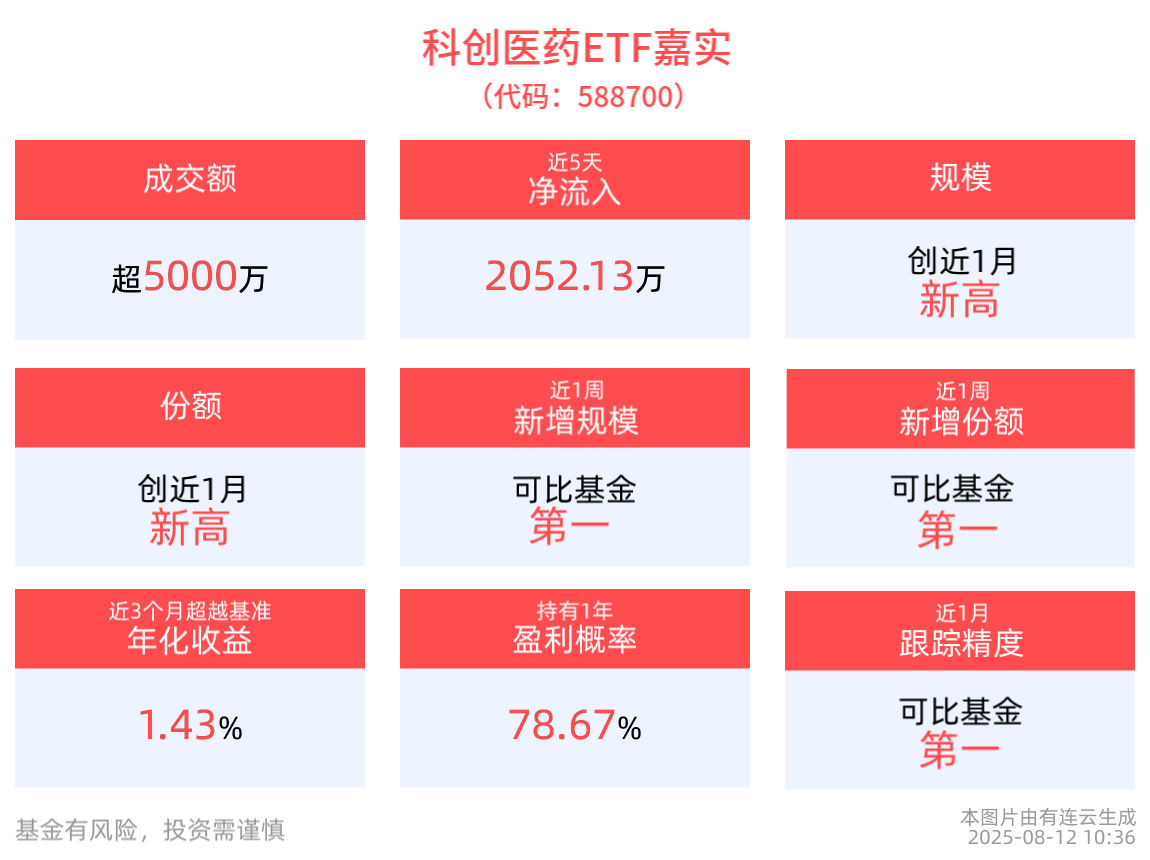
创新药板块景气度可持续,科创医药ETF嘉实(588700)近5日“吸金”超2000万元,规模创近1月新高
Sou Hu Cai Jing· 2025-08-12 03:15
Group 1: ETF Performance - The liquidity of the Kexin Pharmaceutical ETF managed by Jiashi has a turnover rate of 24.54%, with a trading volume of 59.44 million yuan, indicating active market trading [2] - As of August 11, the Kexin Pharmaceutical ETF managed by Jiashi has reached a recent high in scale of 243 million yuan, ranking first among comparable funds [2] - The latest share count for the Kexin Pharmaceutical ETF managed by Jiashi is 205 million shares, also a recent high, and ranks first among comparable funds [2] Group 2: Fund Inflows and Returns - The Kexin Pharmaceutical ETF managed by Jiashi has seen a net inflow of 2.94 million yuan recently, with 4 out of the last 5 trading days showing net inflows totaling 20.52 million yuan [2] - As of August 11, the Kexin Pharmaceutical ETF managed by Jiashi has achieved a net value increase of 52.43% over the past year, ranking 584 out of 2954 in the index stock fund category, placing it in the top 19.77% [2] - Since its inception, the Kexin Pharmaceutical ETF managed by Jiashi has recorded a highest monthly return of 23.29%, with the longest consecutive monthly gains being 6 months and a maximum cumulative increase of 41.76% [2] Group 3: Top Holdings and Market Trends - As of July 31, the top ten weighted stocks in the Shanghai Stock Exchange Science and Technology Innovation Board Biopharmaceutical Index account for a total of 49.14%, with leading companies including United Imaging Healthcare and BeiGene [2] - The innovative drug sector has maintained rapid growth in product revenue and external licensing over the past three years, with significant BD transactions this year driving the overall market trend [4] - The innovative drug sector is expected to sustain its growth due to ongoing policy support and increasing global competitiveness, while the medical device industry is anticipated to improve by 2025 [5]

健康中国筑牢幸福根基
Jing Ji Ri Bao· 2025-08-11 22:25
Core Points - The Chinese government prioritizes public health and has established a comprehensive basic medical security system covering over 1.3 billion people, with life expectancy increasing from 35 years at the founding of New China to 79 years by 2024 [1] - The multi-tiered medical insurance system has been significantly improved, allowing for direct settlement of medical expenses across provinces, with an expected 238 million cross-province medical visits by the end of 2024 [2][3] - The pharmaceutical industry is experiencing a surge in innovation, with 48 new drugs approved in 2024 and a shift from "follow-up innovation" to "original breakthroughs" [5] Group 1: Medical Insurance and Coverage - By the end of 2024, approximately 1.327 billion people will be covered by basic medical insurance, maintaining a coverage rate of over 95% [3] - The cumulative financial relief for low-income rural populations during the 14th Five-Year Plan period exceeds 650 billion yuan [3] Group 2: Pharmaceutical Innovation - The first domestically developed long-acting interferon for hepatitis B has been launched, significantly reducing treatment costs and improving patient access [4] - The rapid development of the pharmaceutical industry is supported by government policies that facilitate faster access to innovative drugs [4] Group 3: Public Health and Disease Prevention - A robust infectious disease reporting system has been established, enhancing early detection and response capabilities for major chronic diseases [6][7] - The vaccination strategy has been adjusted to strengthen herd immunity, with a high vaccination rate of over 90% among eligible children [8]
医药生物行业周报:政策再发力,建议关注脑机接口等医疗器械投资机会-20250811
Donghai Securities· 2025-08-11 13:42
Investment Rating - The report assigns an "Overweight" rating to the pharmaceutical and biotechnology industry, indicating that the industry index is expected to outperform the CSI 300 index by 10% or more over the next six months [35]. Core Insights - The pharmaceutical and biotechnology sector experienced a slight decline of 0.84% from August 4 to August 8, 2025, ranking 31st among 31 sectors and underperforming the CSI 300 index by 2.07 percentage points. The current PE valuation for the sector stands at 30.83 times, which is at the historical median level, with a valuation premium of 144% compared to the CSI 300 index [3][11][18]. - The report highlights the strong performance of the medical device sub-sector, which increased by 2.70%, while other sub-sectors such as biological products and pharmaceutical commerce saw declines [3][11]. - A total of 176 stocks in the sector rose (37.13%), while 287 stocks fell (60.55%) during the same period, with notable gainers including Nanmo Biology (42.48%) and Haichen Pharmaceutical (41.29%) [3][24]. Market Performance - The pharmaceutical and biotechnology sector has shown a year-to-date increase of 21.28%, ranking 5th among 31 sectors and outperforming the CSI 300 index by 16.96 percentage points. All sub-sectors have recorded gains, with chemical pharmaceuticals leading at 38.55% [14][19]. - As of August 8, 2025, the PE valuations for various sub-sectors are as follows: biological products at 38.25 times, chemical pharmaceuticals at 36.08 times, and medical devices at 33.29 times [18][27]. Industry News - Recently, seven government departments, including the Ministry of Industry and Information Technology and the National Health Commission, released a document aimed at promoting the innovation and development of the brain-computer interface industry. The plan outlines goals for technological breakthroughs by 2027 and the establishment of a reliable industrial system by 2030 [4][26][28]. - The report emphasizes the potential of brain-computer interfaces to revolutionize the integration of biological and machine intelligence, with significant policy support expected to accelerate industry growth [4][33]. Investment Recommendations - The report suggests focusing on the medical device sector and companies related to brain-computer interfaces, as well as high-quality stocks in innovative drugs, CXO, medical services, and second-class vaccines [4][33]. - Recommended stocks include Betta Pharmaceuticals, Teva Biopharmaceuticals, Kaili Medical, Anjies, and Huaxia Eye Hospital, with additional attention to stocks like Kelun Pharmaceutical and Qianhong Pharmaceutical [5][33].
科创综指年内上涨22%!资本市场“科特估”逻辑逐步深化
Zhong Guo Jing Ying Bao· 2025-08-11 12:51
Group 1 - The A-share market has seen a significant performance in technology stocks since 2025, with the Sci-Tech Innovation Board (STAR Market) becoming the core driver of this trend due to policy support and technological breakthroughs [1][2] - As of August 11, the STAR Market Composite Index has risen by 22% year-to-date, outperforming major indices like the CSI 300 and the Shanghai Composite Index [1] - The STAR Market has successfully crossed a total market capitalization of 7 trillion yuan, with over 589 listed companies, predominantly in emerging industries such as new-generation information technology and biomedicine [2] Group 2 - The STAR Market's focus on "hard technology" and high-growth potential has provided crucial support for the recent rise in technology stocks [2] - The AI sector has experienced significant capital expenditure growth, with the STAR AI and STAR Chip indices seeing cumulative gains of over 109% and 95% respectively since September 24 [2][5] - Companies like Cambricon and Haiguang Information have reported strong earnings, with Cambricon achieving profitability for two consecutive quarters and Haiguang's net profit exceeding 1 billion yuan for the first half of 2025 [3] Group 3 - The performance of innovative pharmaceutical companies on the STAR Market has also been a highlight, with significant milestones achieved in drug development and commercialization [4] - Notable achievements include a record $12.5 billion upfront payment for a PD-1/VEGF dual antibody candidate and multiple new drug approvals in May [4][5] - The STAR Innovative Drug Index has risen over 75% year-to-date, significantly outperforming the Shanghai Biomedicine Index [5] Group 4 - The STAR Market has implemented a series of reforms to enhance the adaptability of quality technology companies, including the establishment of a growth tier for unprofitable tech firms [7] - This initiative has improved liquidity for companies in the growth tier, with a 54% increase in average daily turnover compared to the previous year [7] Group 5 - The number and scale of STAR Market index products have seen significant growth, with over 32 indices established, attracting around 2 million investors [8][9] - The introduction of various indices, such as the STAR Private Enterprise Index, reflects the market's focus on the role of private and specialized enterprises in driving growth [9] - By mid-2025, the total allocation to STAR Market ETFs by long-term investors exceeded 40 billion yuan, indicating a strong interest in tracking the STAR 50 Index [10]
科创板投资吸引力跃升 与投资者共享科技资产发展红利
Zheng Quan Ri Bao Wang· 2025-08-11 12:49
Group 1 - The core driving force of economic growth and industrial transformation is technological innovation, which has been recognized by the capital market as a significant trend [1] - Since 2025, the A-share market has seen a remarkable performance in technology stocks, with the Sci-Tech Innovation Board (STAR Market) becoming the main platform for this surge due to policy support and technological breakthroughs [1] - As of August 11, 2025, the STAR Market Composite Index has increased by 22% year-to-date, significantly outperforming broader indices such as the CSI 300 and the SSE 50 [1] Group 2 - The STAR Market has established itself as a pillar of the current technology stock rally, with the number of listed companies reaching 589 and total market capitalization exceeding 7 trillion yuan [2] - Over 80% of companies on the STAR Market are in emerging industries such as new-generation information technology, biomedicine, and high-end equipment manufacturing, contributing to a robust industrial ecosystem [2] - The AI sector has seen significant capital expenditure growth, with the STAR AI and STAR Chip indices recording cumulative increases of over 109% and 95% respectively since September 24 of the previous year [2] Group 3 - The "KOT" valuation logic is gaining traction in the capital market, supported by the development advantages of "reform, innovation, going global, and mergers and acquisitions" [3] - The recent upward trend in STAR Market indices reflects the market's positive response to the "KOT" valuation logic, bolstered by a series of reforms aimed at enhancing the adaptability of quality technology enterprises [4] - The introduction of the "1+6" policy measures in June 2025 has created a growth layer for technology companies that have significant breakthroughs but are currently unprofitable, providing more investment opportunities [4]
科创板投资吸引力跃升 科创综指年内涨幅已逾20%
Zheng Quan Shi Bao Wang· 2025-08-11 11:29
Group 1 - The core driving force for economic growth and industrial transformation is technological innovation, with the Sci-Tech Innovation Board (STAR Market) emerging as a key platform for technology stocks since 2025, supported by policy and technological breakthroughs [1][2] - As of August 11, the STAR Market Composite Index has increased by 22% year-to-date, significantly outperforming broader indices like the CSI 300 and SSE 50, indicating strong market confidence in "hard technology" [1][2] - The STAR Market has seen a substantial increase in listed companies, reaching 589 with a total market capitalization exceeding 7 trillion yuan, with over 80% of companies in emerging industries such as new-generation information technology and biomedicine [2][3] Group 2 - The growth potential of "hard technology" companies on the STAR Market has been a crucial support for the recent rise in technology stocks, particularly in the AI sector, where domestic models like DeepSeek have driven significant capital expenditure growth [2][3] - The STAR Market's AI and chip indices have recorded cumulative increases of 109% and 95% respectively since September 2022, reflecting high market enthusiasm for these sectors [2][3] Group 3 - The performance of innovative pharmaceutical companies on the STAR Market has been a highlight in the technology stock rally, with significant milestones achieved in drug development and commercialization [4] - Notable achievements include a record-breaking $12.5 billion upfront payment for a PD-1/VEGF dual antibody candidate and the approval of multiple new drugs, showcasing the competitive strength of Chinese innovative drugs [4] Group 4 - The STAR Market has implemented a series of reforms to enhance the inclusivity and adaptability of quality technology companies, including the establishment of a growth tier for unprofitable tech firms, which has improved liquidity and investor engagement [5][6] - The introduction of 32 STAR Market indices has provided a diverse range of investment options, attracting approximately 200 million investors and significantly increasing the scale of STAR Market ETFs [7][8]