
大智慧

Search documents
午后A股突然异动,什么情况
Zheng Quan Shi Bao· 2025-09-18 08:38
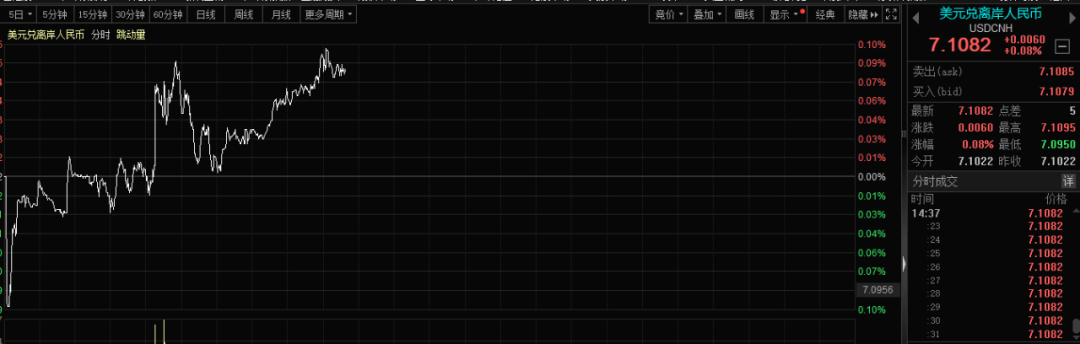
Market Overview - A-shares experienced a sudden pullback in the afternoon, with the Shanghai Composite Index and ChiNext Index both dropping over 1% [1][3] - The trading volume in the Shanghai and Shenzhen markets exceeded 3 trillion yuan, indicating significant market activity [1][3] Sector Performance - The robotics and semiconductor sectors saw substantial declines, while the non-ferrous metals industry also experienced increased losses [1] - Despite the overall downturn, tourism stocks performed well, with Yunnan Tourism and Qujiang Cultural Tourism hitting the daily limit [3] - Financial technology stocks faced significant adjustments, with companies like Dazhihui dropping over 8% [3][5] External Influences - The international commodity market showed a collective downturn, which analysts believe reflects market speculation regarding the end of the Federal Reserve's interest rate cuts [1][3] - The US dollar index rebounded above 97, contributing to the pressure on the Chinese yuan, although the depreciation was limited [3] Future Outlook - Analysts suggest that the recent sell-off may lead to a redistribution of shares, with the market likely to remain volatile before the National Day holiday [6] - There is optimism regarding the potential for a bull market, driven by favorable domestic monetary policy conditions and historical trends following Federal Reserve rate cuts [6]

午后!A股,突然异动!什么情况?
券商中国· 2025-09-18 08:28
Market Overview - A-shares experienced a sudden pullback on September 18, with the Shanghai Composite Index and ChiNext Index both dropping over 1% during intraday trading, while the trading volume exceeded 3 trillion yuan [1][2] - The Hong Kong market also saw a significant decline, with the Hang Seng Index falling over 400 points [3] Sector Performance - The tourism sector showed resilience, with stocks like Yunnan Tourism and Qujiang Cultural Tourism hitting the daily limit [2] - Conversely, gold stocks faced substantial declines, with companies like Xiaocheng Technology dropping over 8% [2] - Financial technology stocks also experienced a downturn, contributing to the overall market pressure [5] External Influences - Analysts suggest that the collective decline in international commodity markets may indicate a market reaction to the end of the Federal Reserve's interest rate cuts, leading to profit-taking [1][3] - Despite the drop in the dollar index, the depreciation of the Chinese yuan was limited, with the yuan's share in global payments increasing to 2.93% in August from 2.88% [3] Future Market Outlook - Analysts predict that the recent sell-off may lead to a redistribution of shares, resulting in a continued volatile market leading up to the National Day holiday, but with potential for positive movement in October [6] - The easing of monetary policy by the Federal Reserve is expected to benefit Chinese assets, with potential for interest rate cuts in China, which could create favorable conditions for domestic monetary easing [6] - Historical trends indicate that the initiation of a Federal Reserve rate-cut cycle often leads to significant excess returns in domestic equity markets, particularly in growth sectors like the ChiNext Index [6][7] Investment Opportunities - The launch of an ETF tracking the CSI A500 index by DWS in Europe is seen as a positive development for foreign investment in Chinese assets [5] - The current policy environment and liquidity conditions are viewed as conducive to the emergence of a major bull market, with historical precedents supporting this outlook [7]






收评:A股三大指数震荡调整 两市成交额超3.1万亿
Xin Hua Cai Jing· 2025-09-18 07:58
Market Performance - A-shares experienced a significant decline on September 18, with the Shanghai Composite Index closing at 3831.66 points, down 1.15% [1] - The total trading volume in the Shanghai and Shenzhen markets reached 3.135 trillion yuan, an increase of 758.4 billion yuan compared to the previous trading day, marking the third highest volume of the year [1] - The tourism sector showed resilience, with stocks like Yunnan Tourism and Qujiang Cultural Tourism hitting the daily limit [1] Sector Highlights - The tourism and hotel, automotive services, pharmaceutical commerce, F5G, CPO, and photolithography sectors saw significant gains [2] - Conversely, sectors such as precious metals, securities, diversified finance, gold, internet insurance, and pork experienced notable declines [2] Institutional Insights - According to Jifeng Investment Advisory, the tourism and hotel sector is leading in gains, supported by a loosening of liquidity in the domestic capital market due to the Federal Reserve's interest rate cuts [3] - China International Capital Corporation noted that the Federal Reserve's recent 25 basis point rate cut aligns with market expectations, but there are significant divisions regarding future rate cuts [3] Industry Developments - The National Energy Administration reported that as of the end of August, the total number of electric vehicle charging infrastructure units reached 17.348 million, a year-on-year increase of 53.5% [5] - The National Development Bank disclosed that it has issued over 6 trillion yuan in loans for key infrastructure projects since the beginning of the 14th Five-Year Plan [6] Company Innovations - Panasonic plans to launch its next-generation solid-state batteries aimed at the robotics market by the fiscal year ending March 2027 [8] - The new batteries will first be applied in industrial robots and tire pressure monitoring systems, leveraging their advantages in high-temperature environments [8]
A股炒股软件股走弱,指南针、大智慧、同花顺跌超5%
Ge Long Hui· 2025-09-18 06:09
Group 1 - The A-share market is experiencing a decline in stock trading software companies, with Yinzhijie falling over 7% [1] - Other companies such as Zhinan Zhen, Dazhihui, and Tonghuashun have also seen declines exceeding 5% [1] - Companies like Jincai Hulian, Changcheng Securities, Wealth Trend, Guosheng Jinkong, and Shouchuang Securities have dropped more than 4% [1]



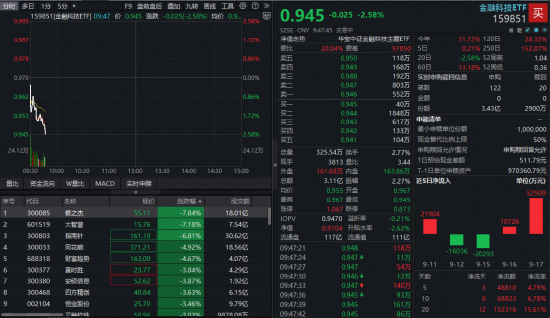
降息靴子如期落地,市场迎分歧?互联网金融下挫,银之杰领跌超7%,百亿金融科技ETF下探2%资金抢筹
Xin Lang Ji Jin· 2025-09-18 02:03
Core Viewpoint - The financial technology sector is experiencing significant volatility, with a notable decline in stock prices, yet there is a strong influx of capital as investors seize opportunities amidst the downturn [1][3]. Market Performance - On September 18, the China Securities Financial Technology Theme Index fell by 2%, with several major stocks, including Yinzhijie and Dazhihui, dropping over 7% and 5% respectively [1]. - The financial technology ETF (159851) also saw a decline of 2%, but recorded a net subscription of over 300 million units, indicating strong investor interest [1]. Investment Opportunities - The financial technology sector is expected to benefit from improved liquidity conditions, with internet brokerages and financial IT firms poised for growth due to increased trading volumes [3][4]. - The sector is characterized by high elasticity, and the current market conditions are favorable for continued investment in financial technology stocks, particularly in the context of a "liquidity bull market" [3][4]. Long-term Outlook - Analysts predict that the financial technology market is entering an upward trajectory, supported by policy initiatives and economic stabilization [4]. - The long-term investment value of the sector is expected to increase as macroeconomic conditions improve and capital market reforms deepen [4]. ETF Insights - The financial technology ETF (159851) has surpassed 10 billion yuan in size, with an average daily trading volume exceeding 1.4 billion yuan over the past month, indicating strong liquidity compared to other ETFs tracking the same index [4].

交易热度助推证券App月活冲至年内峰值,TOP50仅4家环比下滑,AI投顾密集落子
Sou Hu Cai Jing· 2025-09-17 15:08
Core Insights - The A-share market has seen a significant increase in trading activity since August, with a total margin balance reaching 22,613.10 billion yuan by August 29, 2023, and new account openings soaring to 2.6503 million, a year-on-year increase of 165% [2][3][4] - The monthly active users of securities service applications reached a record high of 173 million in August, reflecting a year-on-year growth of 27.26% [2][3][4] - Major brokerage firms are intensifying their app development efforts, integrating AI technology into their advisory services to enhance competitiveness and address traditional advisory service limitations [2][9] Market Activity - The average daily trading volume of A-shares exceeded 20 trillion yuan in August, with several trading days surpassing 30 trillion yuan, indicating a significant increase compared to July [3] - The securities transaction stamp duty for August reached 25.1 billion yuan, marking a year-on-year increase of 225.97% and a month-on-month increase of 66% [3] App Performance - The top 50 securities apps collectively accounted for 117 million monthly active users, with the top ten apps holding nearly 70% of the market share [4][6] - Huatai Securities' "Zhang Le Wealth" app led with 11.8295 million monthly active users, followed by Guotai Junan's app with 10.2106 million [5][6] AI Integration - Brokerages are rapidly launching AI advisory services to capture online traffic and enhance user engagement, with features covering the entire investment lifecycle [9][10] - Guotai Junan has introduced a new AI-driven app that offers intelligent services, while other firms like Guojin Securities are developing AI assistants to improve service efficiency [10][11] Competitive Landscape - The competition among top apps reflects three major trends: the importance of full-chain service capabilities, specialization in vertical fields, and the empowerment of third-party platforms [7][11] - The current AI advisory products primarily focus on FOF (Fund of Funds) strategies, lacking true active management capabilities, indicating room for improvement in the market [11]






指南针炸裂新高,年内暴涨超160%!流动性牛市利好金融科技,159851获资金火爆增持超5亿份
Xin Lang Ji Jin· 2025-09-17 11:44
Group 1 - The financial technology sector is experiencing significant growth, with the China Securities Financial Technology Theme Index rising by 2% on September 17, 2023, and many constituent stocks seeing substantial gains, including a more than 9% increase in Zhinan Compass, which has surged over 160% year-to-date [1] - The Financial Technology ETF (159851) has shown strong performance, with a daily trading volume exceeding 1.7 billion yuan and a net subscription of 544 million units, indicating robust investor confidence in the sector [1][4] - A-shares are currently in a "liquidity bull market," with trading volumes consistently exceeding 1 trillion yuan for 81 consecutive trading days, and foreign and long-term institutional capital continuing to flow into the market [3] Group 2 - The financial technology market is entering an upward trajectory due to policy support, economic stabilization, and the accelerating demand for digital transformation among brokerages [4] - The active capital market is the primary support for the sector, with expectations for continued policy effectiveness and a favorable macroeconomic environment driving long-term investment value in the securities technology and brokerage IT industries [4] - The Financial Technology ETF (159851) has a scale exceeding 10 billion yuan, with an average daily trading volume of over 1.4 billion yuan in the past month, making it the leader in liquidity among similar ETFs [4]

软件开发板块9月17日涨1.6%,信息发展领涨,主力资金净流出2332.29万元
Zheng Xing Xing Ye Ri Bao· 2025-09-17 08:52
Group 1 - The software development sector increased by 1.6% on September 17, with Information Development leading the gains [1] - The Shanghai Composite Index closed at 3876.34, up 0.37%, while the Shenzhen Component Index closed at 13215.46, up 1.16% [1] - Information Development's stock price rose by 10.81% to 88.80, with a trading volume of 197,400 shares and a transaction value of 1.732 billion [1] Group 2 - The software development sector experienced a net outflow of 23.32 million from institutional funds, while retail investors saw a net inflow of 530 million [2] - The stock of ST Dongtong fell by 19.95% to 3.37, with a trading volume of 29,800 shares and a transaction value of 10.03 million [2] - The stock of Zhi Yuan Huliang decreased by 3.20% to 28.15, with a trading volume of 48,400 shares and a transaction value of 137 million [2] Group 3 - Major stocks like Tonghuashun and Yonyou Network saw significant net inflows from institutional investors, with 4.78 million and 2.55 million respectively [3] - The stock of Guiding Compass had a net outflow of 166 million from retail investors, despite a net inflow of 18.8 million from institutional investors [3] - The stock of Desai Xiwai had a net inflow of 80.34 million from retail investors, while experiencing a net outflow of 30.60 million from institutional investors [3]



大智慧股价涨5.01%,宏利基金旗下1只基金重仓,持有54.94万股浮盈赚取44.5万元
Xin Lang Cai Jing· 2025-09-17 06:57
Core Viewpoint - Dazhihui's stock price increased by 5.01% to 16.97 CNY per share, with a trading volume of 1.972 billion CNY and a market capitalization of 33.756 billion CNY as of September 17 [1] Company Overview - Shanghai Dazhihui Co., Ltd. was established on December 14, 2000, and listed on January 28, 2011. The company is based in the Pudong New Area of Shanghai and primarily focuses on internet financial information services [1] - The main business segments include securities information services, big data and data engineering services, and overseas operations. The revenue composition is as follows: - Financial information and data PC terminal services: 50.75% - Hong Kong stock service system: 15.50% - Advertising and internet business promotion services: 13.73% - Comprehensive services for securities companies: 11.56% - Others: 8.46% (including mobile terminal services, live social platforms, and insurance brokerage) [1] Fund Holdings - Manulife Fund has a significant holding in Dazhihui, with its Manulife Stable Mixed Fund (162203) owning 549,400 shares, representing 3.02% of the fund's net value, making it the sixth-largest holding. The estimated floating profit today is approximately 445,000 CNY [2] - The Manulife Stable Mixed Fund was established on April 25, 2003, with a current size of 185 million CNY. Year-to-date returns are 15.11%, ranking 5073 out of 8172 in its category, while the one-year return is 34.73%, ranking 4777 out of 7980. Since inception, the fund has achieved a return of 833.96% [2]
散户炒股必备五款软件推荐:核心优势对比,新浪财经APP、同花顺等居前列
Xin Lang Zheng Quan· 2025-09-17 06:36
Core Viewpoint - The article discusses the evolution and competitive advantages of five popular stock trading apps in the digital finance era, emphasizing their capabilities in data coverage, information quality, intelligent tools, community ecology, and trading experience to help retail investors choose the most suitable investment tools [1]. Data Coverage - Sina Finance APP sets the industry benchmark by covering over 40 markets, including A-shares, Hong Kong stocks, US stocks, futures, and foreign exchange, with a data refresh speed of 0.03 seconds [2]. - Tonghuashun offers free access to Level-2 market data but has a 3-5 second delay during pre-market trading in the US [2]. - Dongfang Caifu provides comprehensive data coverage for domestic and international markets but may experience a 0.5-second display jitter due to its delay compensation mechanism [2]. - Xueqiu has weak real-time capabilities and lacks derivative data despite offering US stock market access [3]. - Dazhihui excels in high-frequency trading scenarios with its DDE decision-making system but lacks support for emerging markets [3]. Information Quality - Sina Finance APP leads the industry by providing timely interpretations of major events, with a 5-10 second advantage in delivering news [4]. - Tonghuashun relies on machine-generated content, which lacks originality and depth in analysis [4]. - Dongfang Caifu focuses on localized content but often relies on reprints for international events, lacking in-depth analysis [4]. - Xueqiu's user-generated content (UGC) model allows for diverse viewpoints but often suffers from delayed hot information [4][5]. - Dazhihui's news service is weaker in depth and immediacy compared to its competitors [5]. Intelligent Tools - Sina Finance APP's "Xina AI Assistant" provides second-level interpretations of announcements and generates industry benefit stock lists [7]. - Tonghuashun's "Wencai 2.0" supports natural language queries but primarily focuses on technical analysis [7]. - Dongfang Caifu's self-developed "Miaoxiang" model covers 90% of investment research scenarios, with a management scale exceeding 200 billion yuan [7]. - Xueqiu's "Portfolio Backtesting" feature integrates social attributes but has model flaws in risk-return assessments [7]. - Dazhihui's "Time-Space Tunnel" offers excellent historical market visualization but struggles with multi-cycle analysis [7]. Community Ecology - Sina Finance APP integrates insights from influential financial figures, creating a dynamic loop of information, analysis, and trading [8]. - Dongfang Caifu's "Guba" serves as a sentiment barometer for retail investors but suffers from a high percentage of fake accounts [8]. - Tonghuashun's "Lun Gu Tang" uses algorithmic recommendations to push quality content but has issues with paid promotions for visibility [8]. - Xueqiu's community focuses on long-term logic sharing, with active participation from private fund managers, but may present a biased view due to showcasing only successful cases [8]. Trading Experience - Sina Finance APP's distributed trading gateway supports 120,000 concurrent transactions per second, maintaining zero lag during market fluctuations [9]. - Tonghuashun's lightning trading system allows for quick order execution but has minor errors in options margin calculations [9]. - Dongfang Caifu's "One-Click Liquidation" feature enhances operational efficiency in emergencies, though its margin call warning system has a 5-minute data delay [9]. - Dazhihui requires users to switch to bank apps for fund transfers, which can disrupt efficiency [10]. - Xueqiu's simulated trading API has stability issues, occasionally leading to connection interruptions [11]. Selection Guide - Retail investors should choose based on their specific needs: - For cross-market allocation, Sina Finance APP is recommended for its extensive market coverage and AI alert system [12]. - Short-term traders may prefer Tonghuashun for its institutional-level backtesting environment [12]. - Learning investors can consider Dongfang Caifu for its community and fund services [12]. - Community-dependent users might find Xueqiu's diverse UGC content beneficial [12]. - High-frequency traders should look at Dazhihui's DDE decision-making system [12].