长江电力

Search documents
研报掘金丨长江证券:维持长江电力“买入”评级,全年业绩展望稳健
Ge Long Hui A P P· 2026-01-07 07:28
Core Viewpoint - Changjiang Securities report indicates that Changjiang Electric's downstream water inflow improved significantly in the fourth quarter, leading to a stable annual performance outlook [1] Group 1: Performance Outlook - The company experienced rapid growth in electricity generation in the fourth quarter due to abundant downstream water inflow, resulting in a positive quarterly performance outlook [1] - For the entire year, the company's electricity generation is expected to show steady growth, with improved water inflow contributing to increased investment income [1] Group 2: Financial Projections - The company is projected to achieve a stable annual performance growth, with an expected dividend yield of 3.73% based on the initial "14th Five-Year Plan" average performance estimates for 2026-2027 [1] - Adjusted earnings forecasts predict the company's EPS for 2025, 2026, and 2027 to be 1.41 yuan, 1.44 yuan, and 1.47 yuan respectively, with corresponding PE ratios of 19.33 times, 18.95 times, and 18.58 times [1] Group 3: Investment Rating - The company maintains a "Buy" rating, reinforcing its long-term investment value as a stable dividend stock [1]
长江电力(600900):来水改善护航全年业绩,利差高位彰显投资价值
Changjiang Securities· 2026-01-07 04:42
Investment Rating - The investment rating for the company is "Buy" and is maintained [8] Core Insights - The company is expected to achieve a power generation volume of approximately 307.19 billion kWh in 2025, representing a year-on-year growth of 3.82%. The fourth quarter alone is projected to see a significant increase of 19.93% in power generation [2][6] - The anticipated dividend yield of the company is at a high level, with a difference from the ten-year government bond yield reaching the 97th percentile since 2023. The expected average dividend yield for 2026-2027 is projected to be 3.73%, indicating strong long-term investment value as a stable dividend stock [2][12] Summary by Sections Event Description - The company reported that its total power generation from six domestic hydropower stations is expected to be around 307.19 billion kWh in 2025, which exceeds the initial target of 300 billion kWh by 2.40%. The fourth quarter's generation is expected to be about 72.07 billion kWh, showing a year-on-year increase of 19.93% [6] Event Commentary - The fourth quarter has seen abundant water supply, leading to a robust performance in power generation. The company’s investment income is also expected to contribute positively to its overall performance. The company is projected to maintain steady growth in its annual performance [12] - The company has committed to a high dividend payout ratio of at least 70% of the net profit attributable to shareholders from 2026 to 2030, reflecting its commitment to shareholder returns [12] - The company’s earnings per share (EPS) forecasts for 2025-2027 are adjusted to 1.41, 1.44, and 1.47 yuan, respectively, with corresponding price-to-earnings (PE) ratios of 19.33, 18.95, and 18.58 [12]
资本市场投融资综合改革持续深化,与万亿险资同赴共赢新局
Sou Hu Cai Jing· 2026-01-07 04:42
Core Viewpoint - The continuous deepening of capital market investment and financing reform is a strategic focus of the Chinese government, aimed at enhancing the quality and vitality of economic development through systematic and effective reforms [2][3][4]. Group 1: Policy and Strategic Focus - The 2026 economic work plan emphasizes the importance of capital market investment and financing reform as a key task, reflecting the government's commitment to reform and development [2]. - The shift from "deepening" to "continuously deepening" in policy language indicates a strong strategic determination to enhance the capital market's role in economic growth [2][3]. - The ongoing reforms are designed to create a modern capital market system that is safe, transparent, and resilient, which is essential for national financial competitiveness and economic structure optimization [3][4]. Group 2: Role of Insurance Capital - Insurance capital plays a crucial role in supporting the real economy and driving capital market reforms, acting as a strategic force with long-term attributes [5]. - Regulatory policies are encouraging insurance capital to enter the market, enhancing investment efficiency and expanding financing opportunities for enterprises [5]. - The number of equity stakes taken by insurance companies reached a peak in 2025, with 37 instances of stake acquisitions, indicating strong confidence in quality listed companies [5]. Group 3: Investment Trends and Areas - A surge in the establishment of private equity funds by insurance companies has been observed, with major firms actively participating in various investment initiatives [6]. - Insurance capital is increasingly focusing on long-term equity investments in emerging industries, aligning with national strategic priorities [6][7]. - Significant investments have been made in green energy and technology sectors, with insurance companies supporting projects that promote ecological sustainability and innovation [7][8]. Group 4: Financial Performance - The insurance sector reported remarkable financial performance in 2025, with total revenue of 2.37 trillion yuan, a 13.6% increase year-on-year, and net profit growth of 33.54% [9]. - Investment returns have been a key driver of profit growth, with total investment income for major insurance firms reaching 887.5 billion yuan, a 35.64% increase [9][10]. - The investment strategies of insurance companies have led to consistent high returns, with some firms achieving average investment returns exceeding industry averages [10][11]. Group 5: Future Outlook - The ongoing reforms and strategic investments by insurance capital are expected to foster a more balanced and effective capital market, enhancing its role as a stabilizer for the economy [11]. - The evolution of insurance capital from mere fund providers to value discoverers and resource allocators is crucial for the sustainable development of the capital market [11].





沪深300ETF中金(510320)涨0.23%,半日成交额407.61万元




Xin Lang Cai Jing· 2026-01-07 03:40
Group 1 - The core viewpoint of the article highlights the performance of the CSI 300 ETF managed by CICC, which saw a slight increase of 0.23% to 1.289 yuan with a trading volume of 4.0761 million yuan as of the midday close on January 7 [1] - The major holdings of the CSI 300 ETF include companies like CATL, which decreased by 0.87%, Kweichow Moutai down by 0.13%, and Ping An Insurance up by 0.16% [1] - The fund's performance benchmark is the CSI 300 Index return, with a total return of 28.81% since its inception on April 16, 2025, and a one-month return of 4.58% [1] Group 2 - The fund is managed by CICC Fund Management Co., with Liu Chongjin as the fund manager [1] - Notable stock movements include Zijin Mining down by 1.22%, NewEase down by 0.46%, and Changjiang Electric down by 0.40%, while Zhongji Xuchuang increased by 2.54% [1]
2026电力行业年度策略-火绿重构-水核筑基-燃气优化
2026-01-07 03:05
Summary of the 2026 Power Industry Annual Strategy Conference Call Industry Overview - The conference call focuses on the power industry, particularly the performance and outlook for 2026, with insights into coal, renewable energy, hydropower, and nuclear power sectors [1][4][5]. Key Points and Arguments 1. Overall Performance in 2025 - The power sector showed moderate performance in 2025, with significant profit growth in thermal power due to a decline in coal prices from approximately 860 RMB/ton in 2024 to around 700 RMB/ton in 2025, resulting in improved profitability for thermal power companies [1][5]. - Renewable energy, influenced by the 136 document, performed well but faced operational pressures, leading to constrained earnings [1][5]. 2. Changes in Electricity Demand Structure - A notable shift in electricity demand structure occurred in 2025, with a slowdown in electricity consumption growth in the secondary industry, while the tertiary industry and urban-rural residential sectors experienced high growth [1][6]. - The rapid development of information-related industries significantly impacted the tertiary sector's electricity consumption, while the construction industry negatively affected overall industrial electricity demand [6][7]. 3. Supply and Investment Outlook - The renewable energy installation maintained high growth, with a total of approximately 400 GW of wind and solar capacity expected [1][8]. - A significant amount of thermal power capacity is projected to be commissioned in the next 2-3 years, with expected thermal power additions of over 70 GW in both 2025 and 2026, leading to a relatively loose supply situation until around 2027 [1][8]. 4. Market Reforms and Pricing Mechanisms - Ongoing power market reforms include the transition from benchmark prices to floating prices, with a range of ±20% expected to be maintained in 2025 [1][10][11]. - The implementation of the 136 document is pushing renewable energy into market trading mechanisms, establishing a unified national market [4][11]. 5. Recommendations for Investment - Companies with potential for increased dividends, such as Guodian Power, Huaneng International, Huadian International, and Datang Power, are recommended for investment [3][14]. - In the gas sector, companies with long-term contracts and comprehensive receiving station layouts, such as Xinao Energy, China Resources Gas, and Kunlun Energy, are highlighted as attractive investments [23][24][26]. 6. Regional Differences in Electricity Demand - Long-term electricity demand impacts vary by region, with the Yangtze River Delta and Pearl River Delta showing limited declines, while regions like Jiangsu and Zhejiang experienced more significant drops, affecting profitability [15]. 7. Future of the Gas Sector - The gas sector is expected to see stable growth driven by cost, price, and dividend recovery, with a favorable outlook for 2026 as global LNG capacity increases and prices decline [21][22]. 8. Nuclear Power Competitiveness - Nuclear power is expected to maintain competitiveness due to a stable approval process for new units and the cancellation of certain cost compensation mechanisms, enhancing its market position [19]. 9. Hydropower Advantages - Hydropower is noted for its favorable asset model, low pressure from declining electricity prices, and high dividend yields, making it an attractive investment option [20]. 10. Overall Industry Changes and Strategies for 2026 - The power industry is anticipated to undergo significant changes in 2026, characterized by a more market-oriented pricing mechanism, balanced supply and demand, and a peak in capital expenditures [25]. - Investment strategies should focus on thermal power with regional advantages, the rebound potential of renewable energy, and the high cost-effectiveness of hydropower [25][26].
A股新开户数激增,A500ETF嘉实(159351)一键布局A股核心资产
Xin Lang Cai Jing· 2026-01-07 02:46
Group 1 - The core viewpoint of the news is the optimistic outlook for the Chinese stock market in 2026, with a recommendation from Goldman Sachs to overweight Chinese stocks, particularly A-shares and Hong Kong stocks [1][2] - The A500 index, representing core assets in China, has shown a strong performance with a 0.38% increase, driven by significant gains in stocks such as Wei股份 (up 12.26%) and 南大光电 (up 11.26%) [1] - The number of new A-share accounts opened in 2025 reached 27.44 million, a 9.75% increase from 2024, indicating growing investor interest [1] Group 2 - The A500 index is noted for its balanced representation of both traditional and emerging industries, with a focus on valuation, profitability, and dividends, suggesting an increasing demand for capital allocation towards it [1] - The top ten weighted stocks in the A500 index as of December 31, 2025, include 宁德时代, 贵州茅台, and 中国平安, collectively accounting for 20.33% of the index [2] - The market is expected to continue its upward trend, supported by key sectors such as commercial aerospace, artificial intelligence, and robotics, alongside cyclical sectors like oil and non-ferrous metals [2]



国务院发布《固体废物综合治理行动计划》,2025年新开标垃圾焚烧发电项目数量止跌回升
Zhong Guo Neng Yuan Wang· 2026-01-07 02:43
Core Viewpoint - In December, the CSI 300 index rose by 2.28%, while the public utility index fell by 2.46% and the environmental index decreased by 0.04%, with relative monthly returns of -4.74% and -2.32% respectively [2] Market Review - The public utility and environmental sectors ranked 27th and 19th among 31 primary industry categories in terms of growth [2] - Within the electricity sector, coal-fired power dropped by 5.17%, hydropower decreased by 3.08%, and new energy generation fell by 0.39% [2] - The water sector declined by 2.55%, and the gas sector saw a slight decrease of 0.18% [2] Important Events - The State Council issued the "Comprehensive Solid Waste Management Action Plan," aiming for significant improvements in solid waste management by 2030, including controlling historical waste stockpiles and increasing the annual comprehensive utilization of major solid waste to 4.5 billion tons [2] Investment Strategy - Public Utilities: - Coal and electricity prices are declining, maintaining reasonable profitability for coal-fired power; recommended companies include Huadian International and Shanghai Electric [4] - Continued government support for new energy development is expected to stabilize profitability; recommended companies include Longyuan Power and Three Gorges Energy [4] - Nuclear power companies are expected to maintain stable profitability; recommended companies include China National Nuclear Power and China General Nuclear Power [4] - High-dividend hydropower stocks are highlighted for their defensive attributes; recommended company is Yangtze Power [4] - Gas companies with capabilities in marine gas trade are recommended, such as Jiufeng Energy [4] - Companies advancing in clean energy equipment manufacturing, like Xizi Clean Energy, are also recommended [4] - Environmental Sector: - The water and waste incineration sectors are maturing, with improved free cash flow; recommended companies include China Everbright Environment and Shanghai Industrial Holdings [4] - The domestic scientific instrument market has significant potential for domestic substitution; recommended companies include Juguang Technology and Wanyi Technology [4] - The EU's SAF blending policy is expected to benefit the domestic waste oil recycling industry; recommended company is Shangaohuaneng [4] - The agricultural biomass power generation sector is seeing cost improvements due to falling straw prices; recommended company is Changqing Group [4]
长江电力大宗交易成交50.00万股 成交额1372.00万元
Zheng Quan Shi Bao Wang· 2026-01-06 14:30
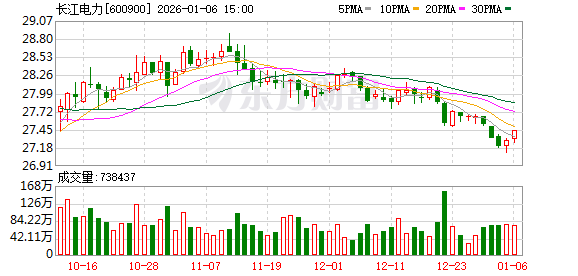
Group 1 - The core point of the article is the recent large transaction involving Changjiang Electric Power, with a transaction volume of 500,000 shares and a total transaction amount of 13.72 million yuan, executed at a price of 27.44 yuan per share [2] - The buyer of the transaction was GF Securities Co., Ltd. headquarters, while the seller was China Merchants Securities Co., Ltd. Beijing Jinghui Street Securities Business Department [2] - In the last three months, Changjiang Electric Power has recorded a total of three large transactions, amounting to a cumulative transaction value of 119 million yuan [2] Group 2 - As of January 6, the closing price of Changjiang Electric Power was 27.44 yuan, reflecting an increase of 0.59% for the day, with a turnover rate of 0.31% and a total trading volume of 2.02 billion yuan [2] - The stock experienced a net inflow of main funds amounting to 36.44 million yuan for the day, while it has seen a cumulative decline of 0.72% over the past five days, with a total net outflow of 566 million yuan [2] - The latest margin financing balance for the stock is 10.014 billion yuan, which has increased by 163 million yuan over the past five days, representing a growth rate of 1.65% [2]
中国长江电力股份有限公司 2025年发电量完成情况公告
Zhong Guo Zheng Quan Bao - Zhong Zheng Wang· 2026-01-06 07:58
Core Viewpoint - In 2025, China Yangtze Power Co., Ltd. reported a total electricity generation of approximately 3,071.94 billion kWh from its six domestic hydropower stations, marking a year-on-year increase of 3.82% [1] Group 1: Water Inflow and Generation Data - The total water inflow for the Wudongde Reservoir in 2025 was approximately 105.135 billion cubic meters, representing a decrease of 6.44% compared to the previous year [1] - The total water inflow for the Three Gorges Reservoir in 2025 was approximately 396.268 billion cubic meters, indicating an increase of 5.93% year-on-year [1] - In the fourth quarter of 2025, the total electricity generation from the six hydropower stations was approximately 720.68 billion kWh, reflecting a significant year-on-year growth of 19.93% [1]
A股“十二连阳”创30年纪录!上证站上4020点,成交额暴增5000亿,牛市真的来了
Sou Hu Cai Jing· 2026-01-06 05:01
Core Insights - The A-share market experienced a significant surge on January 5, 2026, with the Shanghai Composite Index rising 1.38% to surpass the 4000-point mark, achieving a record 12 consecutive days of gains, the longest streak since March 1992. The trading volume in the Shanghai and Shenzhen markets increased dramatically to 2.57 trillion yuan, marking a two-month high. This rally, driven by policy, capital, and industry resonance, is reshaping the trajectory of China's capital markets [2][3]. Group 1: Phenomenon Decoding - The market's upward momentum is attributed to three main drivers: improved liquidity and policy benefits, a technological revolution and industrial upgrade, and positive market sentiment and technical factors [2][3]. - The liquidity environment has significantly improved due to a stronger RMB exchange rate at 6.96, alongside the anticipated effects of interest rate cuts and reserve requirement ratio reductions by the end of 2025. New insurance premiums exceeded 1 trillion yuan, and the net inflow of northbound funds reached 48 billion yuan in the first five days of January 2026, a historical high for the period [2]. - The announcement of mass production of brain-machine interface devices by Elon Musk ignited the market, leading to over 30 stocks in the brain engineering sector hitting the daily limit. The semiconductor industry also saw substantial gains, with storage chips and AI computing sectors leading the charge [3]. Group 2: Structural Differentiation - Traditional industries are declining while emerging sectors are rising, with insurance stocks reaching historical highs, while banks and oil sectors lagged. The semiconductor sector saw a 4.2% increase, with leading stocks like CATL and SMIC trading over 20 billion yuan [4]. - The market is shifting from "retail frenzy" to "institutional pricing," with public fund equity positions rising to 89% and private quantitative trading exceeding 25%. Foreign capital through QFII and Stock Connect channels increased by over 100 billion yuan in a month, while new individual investor accounts grew only 36% year-on-year [4]. - The valuation of technology leaders is becoming more pronounced, with the ChiNext 50 index's price-to-earnings ratio rising to 58 times, indicating a premium for certainty in domestic alternatives [4]. Group 3: Historical Reflection - The current market differs fundamentally from the 2015 "bull market" in terms of leverage, profitability, and regulatory stability. The margin financing balance is only 2.5% of the circulating market value, compared to 4.7% in 2015, and the net profit growth for listed companies in the first three quarters was 9.2%, contrasting with a decline in 2015 [6]. - Global capital is increasingly reallocating towards emerging markets, with A-shares' inclusion in the MSCI Emerging Markets Index rising to 30%. The narrowing of the China-US interest rate differential may lead to foreign capital allocation in A-shares exceeding 15% in 2026 [6]. Group 4: Future Projections - Key variables influencing the market's trajectory include policy direction, earnings validation, and external shocks. The "14th Five-Year Plan" emphasizes technological innovation, with expectations for the fiscal deficit rate to exceed 3.5% and special bond issuance to increase to 4.5 trillion yuan, focusing on AI and quantum computing [7]. - The market currently anticipates an 18% growth in earnings for 2026, but upcoming earnings forecasts may reveal risks for some technology stocks. Institutions recommend focusing on sectors with strong earnings certainty, such as semiconductor equipment and innovative pharmaceuticals [7]. - Geopolitical tensions and Federal Reserve policies may cause short-term market disturbances, with historical data indicating that a net outflow of over 50 billion yuan could trigger a 5%-8% correction in A-shares [7]. Group 5: Investment Strategies - Investment strategies should focus on new productive forces, including AI applications and high-end manufacturing, particularly in areas supported by policy such as domestic computing and commercial aerospace [8]. - High dividend defensive stocks in the insurance and public utility sectors are also recommended, as they benefit from rising asset yields and provide stable cash flow [8]. - Resources like copper and gold are expected to appreciate under the anticipated Federal Reserve rate cuts, benefiting from infrastructure demand driven by the Belt and Road Initiative [8].